
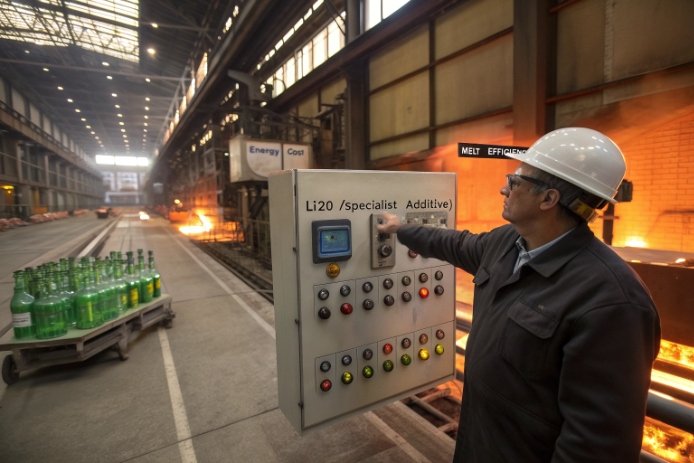
Energy cost keeps rising, but bottle quality cannot drop. One wrong flux choice can lower fuel use and still create seeds, haze, and unstable forming.
Lithium oxide (Li₂O) can lower melting temperature and viscosity at small doses, but it adds cost, supply risk, and devitrification and recycling complexity. The best use is usually a controlled micro-substitution, not a big recipe shift.
Li₂O is a powerful lever, so it needs a narrow operating plan
Li₂O sits in the same “alkali modifier” family as Na₂O and K₂O, but it does not behave like a simple swap. Lithium ions are small and have high field strength. That mix can reduce melt viscosity 1 and speed up early batch reactions, which can cut melting energy and help fining. Papers on soda-lime-silicate systems show that even ~1 wt% Li₂O can reduce melting temperature and lower viscosity, while also shifting characteristic temperatures like Tg and softening. The same studies also show that these shifts are not always linear, and the thermal expansion response can move in either direction depending on the exact substitution path.
This is why Li₂O is rarely “essential” in standard container glass. A standard furnace already has several cheaper levers: cullet %, sulfate fining stability, temperature profile, and batch quality. Li₂O becomes interesting only when the plant has a clear bottleneck that is hard to solve with normal tools, such as persistent seeds at a given pull rate, or a need to reduce melting energy while keeping the same forming speed.
The main advantage is simple: Li₂O can lower viscosity without pushing total alkali too high. The main drawback is also simple: Li₂O raises cost and introduces new failure modes, especially lithium-silicate devitrification and cullet contamination 2 in open recycling streams.
A simple benefit–risk map before any trial
| Topic | What Li₂O can improve | What Li₂O can damage | What must be tracked weekly |
|---|---|---|---|
| Melting and energy | lower melt temperature, faster reactions | volatility and batch drift if unstable | fuel per ton, batch blanket, alkali loss |
| Fining / seeds | fewer seeds if viscosity and redox timing improve | foam or cords if fining balance shifts | seed count, foam height, cords/striae |
| Forming window | easier flow at the same heat input | finish dimensions if viscosity curve shifts | gob temp/weight, IS stability, checks |
| Durability / leachables | mixed-alkali effects can reduce Na mobility | Li can appear in extractables | ISO 4802/USP <660> trend, ICP profile |
| Recyclability | closed-loop cullet can be stable | open cullet stream gets “poisoned” | cullet Li₂O trend, color and ΔE trend |
The best approach is to treat Li₂O like a “micro-tool” that must stay stable across months, not like a daily adjustment knob.
So the first question is dosage and substitution strategy.
How much Li₂O can substitute for Na₂O/K₂O to lower melt temperature and energy use while keeping forming viscosity stable?
Fuel savings feel great until the bottle finish starts drifting and rejects rise. That happens when viscosity moves more than the forming line can tolerate.
In most bottle plants, Li₂O is best used as a small partial substitution—often around 0.2–1.0 wt% Li₂O—replacing Na₂O/K₂O on a molar basis, so melting gets easier while the forming viscosity curve stays predictable.
Start with molar substitution, not weight substitution
Li₂O has a much lower molecular weight than Na₂O. So equal weight is not equal chemistry. A practical rule for planning is:
- 1.0 wt% Li₂O ≈ 2.1 wt% Na₂O (same moles of alkali oxide)
That means even a “small” Li₂O weight addition can be a meaningful alkali change in molar terms. If total alkali drifts too much, the forming window can move, and chemical durability 3 can become harder to control.
Typical trial bands that do not shock a container furnace
A common safe trial structure is:
- 0.2 wt% Li₂O steps, with pauses long enough to see stable trends
- cap the trial near 0.8–1.0 wt% Li₂O unless the furnace has a strong reason to go higher
- replace Na₂O/K₂O rather than adding on top, to keep total alkali stable
Published container-glass work has studied substitution up to about 1 mol% of total alkali oxide in steps, and it reports “considerable” viscosity reduction even at small replacement levels. Other soda-lime-silicate results show melting temperature reductions when Li₂O rises toward ~1 wt%, which explains why energy savings are real in some plants.
What “stable forming viscosity” means on the line
A bottle line does not only need a target viscosity. It needs a stable viscosity curve across the forehearth range. Li₂O can lower viscosity, which can help melting, but it can also make the process more sensitive if the forehearth control is already weak. So the correct approach is to define a forming window and keep it.
| Planning item | Practical target | Why it keeps forming stable |
|---|---|---|
| Li₂O dose | 0.2–1.0 wt% (start low) | prevents large viscosity jumps |
| Replacement method | replace Na₂O/K₂O on mol basis | keeps total alkali effect consistent |
| Total alkali | hold flat or slightly lower | avoids durability and volatility surprises |
| Forehearth control | tighten temperature stability | prevents dimension drift after viscosity shift |
Li₂O can save energy, but only when the plant protects the forming window with tight control. If the plant cannot hold gob temperature and weight steady, Li₂O will not feel like a benefit.
Next comes the common belief that Li₂O always improves strength and thermal shock. The reality is more mixed.
Does Li₂O raise strength and thermal-shock resistance by shifting Tg/strain point and thermal expansion in soda-lime glass?
Hot-and-cold handling cracks cost money fast. Many teams hope Li₂O is an easy thermal-shock upgrade.
Li₂O does not reliably raise Tg or strain point in soda-lime glass. Many data sets show Tg and softening can decrease with Li₂O, while thermal expansion can move up or down depending on composition. Thermal-shock gains usually come more from a lower CTE and fewer defects than from a higher strain point.
Tg and strain point: Li₂O often lowers characteristic temperatures
In soda-lime-silicate compositions that add Li₂O up to ~1 wt%, published results show Tg and softening temperatures 4 can drop by tens of degrees while viscosity drops and melting temperature drops. In binary lithium-silicate systems, deformation point temperatures can also decrease slightly as Li₂O increases. This trend is important for bottles because a lower strain point does not help thermal shock on its own.
So if a project needs higher hot-fill margin, Li₂O is not the first tool. Higher SiO₂/Al₂O₃ and lower total alkali usually do more for raising characteristic temperatures.
Thermal expansion: the effect depends on the substitution path
Thermal expansion behavior is not one-directional:
- In some lithium-silicate systems, expansion increases with Li₂O concentration.
- In some soda-lime-silicate trials, a small Li₂O addition shows a lower CTE at a specific dose (a non-linear response), and authors also describe Li₂O as able to reduce thermal expansion 5 due to strong Li–O bonding.
This means the plant must measure the CTE response in its own base glass, not assume it.
Strength: most gains are indirect
Li₂O can improve real bottle strength indirectly when it:
- reduces viscosity enough to improve melt homogeneity and reduce seeds
- lowers defect density at the surface (fewer cords, fewer stones)
- reduces thermal expansion in the working range (if the composition response goes that way)
But Li₂O can also reduce strength if it raises devitrification risk or increases alkali volatility and creates cords.
| Property | What teams expect | What often happens in soda-lime | What to do instead of guessing |
|---|---|---|---|
| Tg / strain point | goes up | can go down with Li₂O addition | measure strain/annealing points after steady-state |
| Thermal expansion | goes down | can go down or up | measure CTE on real production samples |
| Thermal-shock resistance | improves | improves only if CTE drops and defects drop | link trials to defect counts and CTE |
| Mechanical strength | improves | improves mainly via defect reduction | track seeds, cords, surface flaws |
Li₂O can support thermal shock only if it reduces CTE and defects in the final bottle. It is not a guaranteed “stronger glass” additive.
Now the harder part is compliance and leachables. Lithium is an alkali, so it will show up in elemental profiles.
How does Li₂O affect chemical durability and leachables—can bottles still pass FDA/EU and USP <660>/ISO 4802 tests?
One customer asks for recycled content. Another asks for low leachables. A third asks for pharma-ready proof. The recipe must survive all three.
Bottles can still pass FDA/EU food-contact expectations and hydrolytic resistance tests with small Li₂O additions, but only if total alkali mobility stays controlled and the process keeps a smooth inner surface. Li may appear in extractables, so pharma projects need an explicit elemental profile plan.
FDA/EU food-contact: performance, not a named-oxide ban
For normal beverages, regulatory risk is rarely “lithium as a banned element.” The risk is migration and taste/odor impact. Li₂O at small levels does not automatically increase risk, but it changes the alkali mix. That can change ion exchange behavior.
Hydrolytic resistance: Li changes the alkali release profile
ISO 4802 and USP <660> 6 focus on hydrolytic resistance by measuring alkali released from glass surfaces under defined conditions. Li₂O adds another alkali ion that can be released. Still, mixed-alkali behavior can reduce the mobility of each alkali compared with a single-alkali glass in some cases. This can help stability, but it must be proven.
A practical way to manage this is:
- keep total alkali steady or slightly lower when Li₂O is added
- increase Al₂O₃ modestly if meltability allows, because it often improves durability
- control the surface quality (cords and devit skins matter more than small oxide moves)
What to specify in a compliance plan
For beverage bottles, a simple plan is enough:
- run hydrolytic resistance trend testing as a process control
- run periodic ICP screening to confirm no unexpected element spikes
- confirm taste/odor neutrality in the real beverage
For pharma or cosmetic bottles with stricter extractables expectations, an additional plan is needed:
- define an elemental composition fingerprint (WDXRF or equivalent)
- define an extractables profile that includes lithium, sodium, and other alkalis
- set internal control limits even if the regulation does not name lithium specifically
| Use case | Li₂O risk level | What must be verified | What usually causes failure (not Li itself) |
|---|---|---|---|
| Beverage (food-contact) | low to moderate | hydrolytic trend + taste neutrality | dirty cullet, cords, surface roughness |
| Cosmetics | moderate | extractables profile and clarity | coating interactions, surface salts |
| Pharma (primary) | higher expectation | USP <660>/ISO 4802 class + elemental fingerprint | surface treatment drift, high alkali release, delamination risk from other causes |
Li₂O can fit compliance, but it cannot replace a proof package. The proof package must include lithium in the elemental story so customers do not get surprised later.
Now the last part is where many Li₂O projects stop: cost and operational risk at scale.
What are the cost, supply, and process risks—refractory corrosion, devitrification (lithium silicates), and cullet contamination—when using Li₂O at scale?
A pilot trial can look great. Then purchasing asks about lithium prices, operations asks about refractory life, and recycling asks what happens to mixed cullet.
At scale, Li₂O adds four major risks: cost volatility and supply concentration, higher alkali vapor and refractory stress, higher devitrification sensitivity toward lithium silicate phases if the cold spots exist, and cullet contamination that can spread Li into standard recycling streams.
Cost and supply: lithium competes with batteries
Lithium salts pricing has been very volatile in recent years because battery demand and supply cycles move fast. News and market trackers show large swings, including rebounds after deep declines 7. For a bottle plant, this means Li₂O is a cost risk even when the technical case is positive.
Also, lithium production and refining are concentrated by region and by company, so supply disruption risk is real. This matters more for a continuous furnace than for batch production, because a furnace cannot pause easily.
Refractory and furnace atmosphere risk: more alkali, more vapor stress
Any alkali oxide can increase alkali vapor in the furnace atmosphere. Alkali vapors react with silica crown refractories over time and contribute to corrosion 8. Li₂O can add to total alkali vapor load and can also contribute to compositional drift if volatilization is not balanced.
This does not mean Li₂O will destroy refractories by itself. It means refractory life must be monitored with the same seriousness used for high-alkali or high-sulfate operations.
Devitrification: lithium silicate phases are real
Lithium silicate crystals such as lithium metasilicate and lithium disilicate are well-known in glass-ceramic systems and can nucleate under certain gradients and heat histories. In bottle furnaces, the practical risk is:
- cold spots in forehearth and feeders
- steep composition gradients from poor mixing or dirty batch carryover
- long residence in the “liquidus danger zone”
If lithium silicate devit forms, it can show up as haze, stones, or weak surfaces. That destroys both clarity and strength.
If Li₂O glass enters a mixed cullet stream, it can spread into standard soda-lime cullet. For a closed-loop bottle program with dedicated cullet, that can be controlled. For open recycling, it is harder.
The safest strategy is to use Li₂O only when:
- cullet is mostly internal or tightly controlled
- color stream is dedicated (flint, amber, green separation)
- the plant has a way to track Li₂O drift in cullet chemistry
| Risk | What it looks like on the line | Root cause | Practical mitigation |
|---|---|---|---|
| Lithium cost volatility | sudden batch cost jump | market swings | limit Li₂O to micro-dose, long-term contracts if needed |
| Refractory stress | faster crown corrosion, deposits | higher alkali vapor load | atmosphere management, refractory selection, monitoring |
| Devitrification | haze, stones, weak spots | cold zones + gradients | fix forehearth profile, tighten mixing, cap Li₂O level |
| Cullet contamination | long-term recipe drift | open cullet mixing | dedicated cullet loop, incoming chemistry checks |
| Volatilization drift | changing viscosity over campaign | alkali loss at high T | tighter mass balance, furnace control, batch adjustment |
For most bottle plants, these risks push Li₂O toward “small, controlled substitution” rather than “standard ingredient.” When the benefits are real, the project still needs a scale plan that protects the furnace and the recycling loop.
Conclusion
Li₂O can lower energy and help melt stability at small doses, but it adds cost volatility and new devit and recycling risks, so it works best as a tightly controlled micro-substitution with strong verification.
Footnotes
-
A measure of how thick or thin the molten glass is, critical for forming bottles. ↩
-
Using recycled glass (cullet) with unknown chemistry can ruin the melt. ↩
-
The glass surface’s ability to resist attack from water and chemicals. ↩
-
The temperature range where glass transitions from hard to soft. ↩
-
How much the glass expands when heated; lower is usually better for thermal shock. ↩
-
Standard tests for pharmaceutical glass to ensure it doesn’t leach alkali. ↩
-
Lithium prices are unstable due to high demand from the EV battery market. ↩
-
The gradual wearing away of furnace lining materials by aggressive chemical vapors. ↩






