
UV damage often shows up after launch. A product fades, an active weakens, and customers blame the brand, not the bottle.
Bottle glass blocks UV because certain oxides and colorants absorb specific wavelengths, and the final protection depends on composition, redox, cullet, refining, and wall thickness working together.
The physics behind UV absorption in bottle glass
Glass does not “filter UV” in a simple on/off way. It absorbs light by electronic transitions 1 in the glass network and in dissolved ions. That absorption has a shape. The shape decides where the UV cutoff sits and how steep it is. For bottles, the cutoff and the slope are mainly controlled by trace transition metals (iron, chromium, cobalt, nickel), chalcogen systems (selenium–sulfur), and “UV-screening” oxides like cerium.
Two practical ideas help keep this simple on a production line.
First, absorption follows a thickness rule. Transmittance drops fast as thickness increases. The common model is Beer–Lambert behavior: absorbance 2 (A) is proportional to concentration (c) times path length (l), and transmittance (T) falls as T = 10^(-A). This is why a formula that looks fine in a 2 mm bottle can fail in a 3.5 mm bottle, and also why “color density” and thickness must be discussed together.
Second, iron redox changes the shape. Fe²⁺ and Fe³⁺ are not the same “color.” Fe²⁺ tends to push a stronger green and stronger near-UV/visible absorption. Fe³⁺ pushes more yellow and more absorption in the shorter wavelengths. So two melts with the same total iron can show a different UV–Vis curve if the furnace oxygen potential shifts.
This is also why a bottle can meet a UV number at 254 nm (deep UV) but still leak too much at 365 nm (near UVA). Different ions dominate different wavelength zones.
UV wavelength zones that matter for packaging
-
254 nm: deep UV (common germicidal line). Many soda-lime glasses already attenuate strongly here, but “strongly” is not the same as “zero,” and thin flint can still pass measurable light.
-
313 nm: UVB boundary zone (photochemical risk for some actives and fragrances).
-
365 nm: UVA (common curing/lighting wavelength, and a real risk for many cosmetics and botanicals).
Why composition shifts the cutoff
The “cutoff” is where transmittance drops below a target. It shifts upward (toward longer wavelengths) when the glass contains ions or defects that absorb further into UVA and the visible. Amber systems do this by design. Cerium can do this without making the bottle dark, but it has trade-offs in color tone and cost.
| Lever | What it changes in the UV–Vis curve | What operators notice first |
|---|---|---|
| Total iron (as Fe₂O₃) | Raises overall absorption and can add green/yellow tint | Flint looks less “water-white” |
| Iron redox (Fe²⁺/Fe_total) | Shifts green strength and changes UVA edge | Same iron, different shade day to day |
| Selenium–sulfur amber system | Adds broad absorption into UVA and blue | Amber gets darker fast if over-reduced |
| Cerium (CeO₂) | Adds strong UV absorption with low visible color | UV improves but tone can warm or haze rises |
| Thickness | Multiplies absorbance at all wavelengths | UV improves but bottle looks heavier/darker |
This base picture sets up the four control questions below.
The next step is to connect specific oxides to specific wavelength behavior, then turn that into targets that buyers can sign and factories can hold.
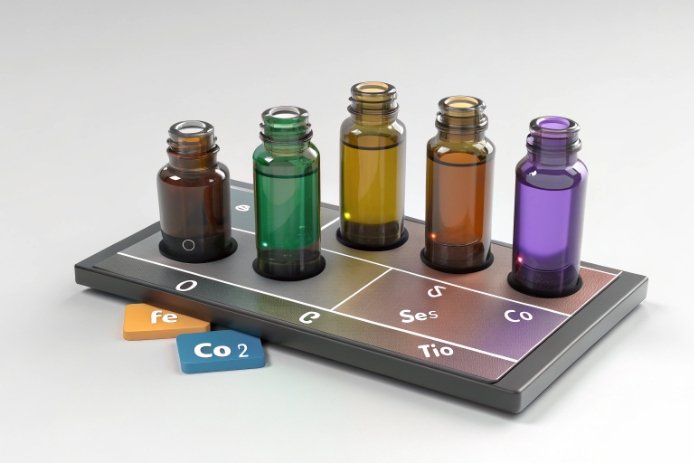
Which oxides and colorants (Fe₂O₃/FeO, Cr₂O₃, Se–S, CoO, CeO₂, TiO₂) most strongly shift the UV cutoff?
If the UV cutoff is missing, the first reaction is often “make it darker.” That can solve UV, but it can break branding, inspection, and cost.
The strongest UV-cutoff shifters are CeO₂ and the iron–sulfur amber system; iron redox and trace Cr/Ni decide the green cast, while Co and Se tune tone more than UV, and TiO₂ can help UV but risks haze and opacity.
Iron: the baseline driver for both UV and visible tint
Iron exists mainly as Fe²⁺ and Fe³⁺ in bottle melts. Both absorb in the UV, but Fe²⁺ usually creates a stronger green cast and can pull absorption further into the near-UV/visible edge. This matters because 365 nm is close to visible. If Fe²⁺ climbs, the glass often looks greener and blocks more UVA, but the bottle no longer looks “extra flint.” If Fe³⁺ dominates, the glass can look warmer or slightly yellow, and UVA blocking can still improve, but the tone shifts.
Chromium: small additions can create noticeable green
Cr₂O₃ is powerful for green color even at low levels. In flint programs, chromium is normally treated as a contaminant from cullet, raw materials, or refractories. It can reduce UV transmittance in parts of the spectrum, but the first thing it does is add an unwanted green cast. So it is not a preferred UV strategy for “high-transmittance” bottles.
Selenium–sulfur: the amber workhorse for UV and blue light
The Se–S family (often tied to sulfur species and redox conditions) is the main reason amber glass protects products. It broadens absorption into UVA and also cuts blue light. This is ideal for beer and many syrups, but it is easy to overdo. Over-ambering can happen when redox becomes too reducing or sulfate behavior changes, and it can show as dark tone drift and cords.
Cobalt: strong blue, but not a pure UV blocker
CoO gives a blue color that can neutralize yellow tones in flint. It can slightly affect the near-UV edge because it shapes the visible spectrum, but it is mainly a tone tool. In high-white flint, cobalt is used in tiny amounts as a balancing decolorizer, not as a UV cutoff lever.
Cerium oxide: the “clear UV shield” tool with trade-offs
CeO₂ is one of the most direct ways to reduce UV transmission while keeping the bottle looking clear. It absorbs strongly in UV regions and can shift the cutoff into longer wavelengths without heavy visible darkness. The trade-offs are cost, supply, and the need for tight control. If dosing is unstable, the UV curve drifts. If used with the wrong redox and fining balance, haze or tone changes can appear.
Titanium dioxide: UV absorption with a risk of haze
TiO₂ can contribute to UV absorption, but it also tends to increase light scattering 3 and can raise haze if it is not fully dissolved or if micro-crystals form. For “ultra-clear” bottles, TiO₂ is usually controlled as an impurity, not added as a UV strategy, unless the bottle is intended to be semi-opaque or “frosted” by design.
| Additive / impurity | Primary job in practice | UV cutoff impact | Biggest risk in bottles |
|---|---|---|---|
| Fe₂O₃ (total iron) | Baseline tint driver | Moderate | Green/yellow cast, brand mismatch |
| FeO share (Fe²⁺) | Redox indicator | Moderate to strong near 365 nm | Day-to-day drift with furnace redox |
| Cr₂O₃ | Green contaminant | Secondary | Strong green even at low levels |
| Se–S system | Amber protection | Strong | Over-ambering, cords if redox bands form |
| CoO | Tone tuning (blue) | Weak to moderate | Overdose looks cold and reduces brilliance |
| CeO₂ 4 | UV shielding in “clear” | Strong | Cost, haze risk, tone warming if unstable |
| TiO₂ 5 | UV + scattering | Moderate but indirect | Haze, opacification, devit risk |
For most brands, the cleanest strategy is to pick one “main UV lever” and control it tightly, rather than mixing many small levers that drift for different reasons.
What formulation targets help meet UV-blocking specs for beer, pharma syrups, and cosmetics?
Many specs fail because the buyer asks for “UV protection,” but the lab measures only one wavelength, and the product is sensitive in another range.
Beer usually needs amber that blocks UVA and blue light, pharma syrups need a defined low transmission window with stable tone, and cosmetics need either amber or clear-with-CeO₂ depending on the active ingredients and the desired shelf look.

Beer: amber is the safest path because it blocks both UV and blue
Beer protection is not only about 254 nm. The practical risk is near-UV and blue light, because those wavelengths can trigger flavor damage 6 fast. For beer, the formulation target is usually a classic amber system:
-
Controlled total iron level suitable for amber shade
-
Retained sulfur under controlled redox
-
Low cord risk through stable melting and homogenization
For beer, “extra flint with UV blockers” is rarely the best value. Amber is cheaper to hold stable, and it has a stronger safety margin.
Pharma syrups: functional amber with inspection and compliance needs
Pharma syrups often ask for amber because it is proven, but the bottle still needs:
-
A stable UV–Vis curve at a defined thickness
-
A tone that does not drift across campaigns
-
Clean glass with low defects for visual inspection
Formulation targets here are less about “darkest amber” and more about “repeatable compliance.” That usually means stable redox, stable sulfate behavior, and strict cullet governance.
Cosmetics splits into two worlds:
-
Brand-first products: want clear, water-white glass. UV protection may be mild, and the formula relies on label claims and internal stability tests.
-
Active-first products: retinoids, botanical extracts, some vitamins, and fragrances can be UVA sensitive. These often need amber, or a clear bottle with a UV absorber like CeO₂ plus secondary packaging 7.
For cosmetics, the practical formulation decision is: keep the bottle clear and add CeO₂ (and accept cost and control needs), or go amber and accept darker appearance.
A target-setting table that buyers can use
Targets must be written as “at thickness X, transmission at wavelengths Y.” The numbers below are typical working goals used for building internal specs. Actual acceptance limits should be set by shelf-life risk and by the test method used.
| Segment | Typical bottle color strategy | Practical UV–Vis target style | Common formulation direction |
|---|---|---|---|
| Beer | Amber | Low transmission across near-UV and blue range | Fe + sulfur system under controlled redox |
| Pharma syrups | Amber (light-resistant) | Low transmission in UV window at defined thickness | Stable amber with tight SO₃ and redox control |
| Cosmetics (premium look) | Extra flint + optional CeO₂ | Set limits at 313/365 and keep visible high | Low iron + controlled CeO₂, low haze |
| Cosmetics (light-sensitive actives) | Amber or clear + secondary pack | Stricter UVA control | Amber, or clear with higher UV shielding plan |
A stable target is better than an aggressive target that forces daily dosing changes. A buyer can accept “slightly darker” once, but they will not accept “shade changes every lot.”
How do cullet quality, furnace redox, and refining agents change UV–Vis transmittance at 254/313/365 nm?
A UV–Vis curve is a fingerprint of the whole process. When it drifts, it is often not “one ingredient.” It is the furnace and cullet telling the truth.
Cullet contamination changes the baseline metal ions, furnace redox changes Fe²⁺ share and amber chemistry, and refining agents change sulfate and bubble behavior, so all three can move transmittance at 254/313/365 nm even when the recipe looks unchanged.
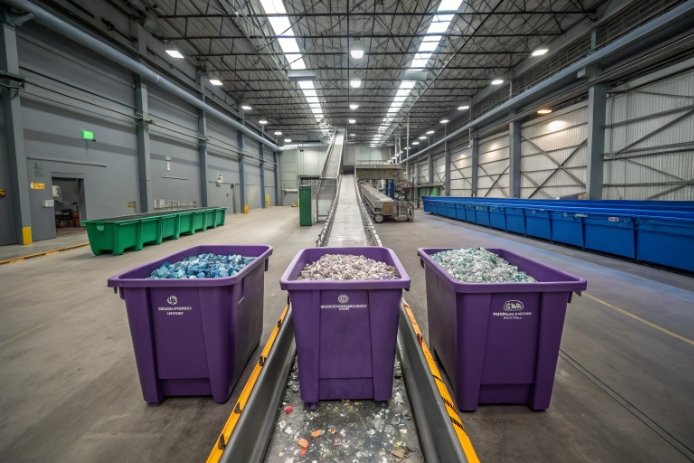
Cullet: the fastest way to change the spectrum without noticing
Cullet can carry:
-
Iron and chromium from mixed colors
-
Organics that push reduction in the doghouse
-
Ceramics and stones that raise defects and haze
Even if total iron looks stable, the type of iron contamination can change, and so can the redox behavior. At 365 nm, small changes can show up faster than at 254 nm because 254 nm is often already strongly absorbed by many glasses, while 365 nm is closer to the visible edge where tint differences matter.
Furnace redox: the daily driver of Fe²⁺ and amber formation
When oxygen potential shifts, iron redox shifts. That changes how much Fe²⁺ exists. It also changes sulfur species in amber systems. The outcome is:
-
365 nm transmission can swing with Fe²⁺ shifts
-
Amber shade can jump darker when the melt becomes more reducing
-
Cords become visible if redox is not uniform across the melt
A stable combustion and pull strategy often improves UV stability more than changing the batch.
Refining agents: they change sulfate balance and melt homogeneity
Refining agents and fining chemistry change:
-
Bubble removal (seeds)
-
Foam behavior
-
Sulfur retention and sulfate decomposition
For amber and sulfur-sensitive systems, sulfate stability matters directly for color density and UV. For flint with CeO₂ or Se/Co trims, refining stability matters because haze and seeds reduce “usable transmittance” even if the UV absorption is correct.
A practical “cause → wavelength” map
| Change | 254 nm impact | 313 nm impact | 365 nm impact | What it looks like on bottles |
|---|---|---|---|---|
| More colored cullet 8 (Fe/Cr) | Small to moderate | Moderate | Strong | More tint, less brilliance |
| More organics in cullet (more reducing) | Small | Moderate | Strong | Greener flint or darker amber |
| Higher Fe²⁺ share | Small | Moderate | Strong | Greener tone, UVA improves but look worsens |
| Unstable sulfate fining | Indirect | Indirect | Indirect | More cords/seeds, spectrum noise and haze |
| Poor homogenization | Indirect | Indirect | Indirect | Stripe-like tint changes and variable readings |
For tight UV specs, incoming cullet QC and furnace stability are often the cheapest improvements. Recipe changes alone usually create a new set of problems.
Does wall thickness and color density interact with composition to reduce UV exposure without over-darkening?
Many brands want “more protection” but also want the bottle to stay bright and premium. This is where thickness and composition must be designed together.
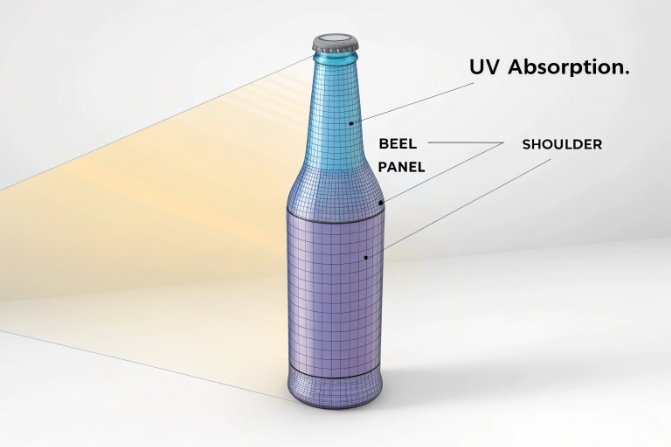
Yes, thickness multiplies absorption, so a small composition change can become a big UV gain at thicker walls; the best approach is to tune absorption where the product is sensitive (often 313/365) while keeping visible darkness low by controlling which ions absorb and how uniformly they are distributed.
Thickness is the easiest UV lever, but it has cost and look penalties
Increasing wall thickness reduces transmittance at all wavelengths. This can improve UV quickly, but it also:
-
increases glass weight and cost
-
increases cooling time and energy use
-
can make the bottle look darker or heavier
-
can reduce line speed in some cases
So thickness is a lever, but it is not free.
Color density is a better design knob than “more pigment”
Color density is the absorption strength per thickness. Two bottles can have the same visible shade at first glance, but different UV performance if one has a UV absorber that does not add much visible color. This is why CeO₂ can be valuable for cosmetics: it can raise UV absorption without turning the bottle into amber.
For amber, color density must be controlled to avoid over-darkening. This is where redox uniformity matters. A slightly darker target that is stable is safer than a lighter target that swings.
Use “targeted absorption” instead of “global darkness”
A smart design aims to reduce transmittance at the risk wavelengths (often 313 and 365) while keeping visible transmittance high enough for the shelf look and for inspection. This is easiest in two cases:
-
Amber where the brand accepts darker glass
-
Clear glass where CeO₂ is allowed and haze is controlled
A simple design approach that avoids over-darkening
1) Fix the visual target first (how light or dark the bottle must look).
2) Pick thickness that fits strength and cost.
3) Choose composition to push UV down at 313/365 without adding too much visible absorption.
4) Validate with UV–Vis transmission 9 at the real thickness, not a brochure curve.
| Goal | Best main lever | Secondary lever | What to avoid |
|---|---|---|---|
| Strong UV block, beer | Amber color density | Thickness tuning | Fighting shade with big daily redox swings |
| UV block with clear look | CeO₂ (controlled) | Slight thickness increase | TiO₂ haze or heavy Se/Co that greys the glass |
| Keep bottle bright and neutral | Low total iron + stable redox | Small decolorizer trim | Using thickness alone to “solve UV” |
| High consistency in production | Cullet governance + stable furnace | Tight fining control | Frequent recipe changes to chase daily readings |
When thickness and composition are designed as one system, UV exposure drops and the bottle still looks right. When they are treated separately, the plant ends up choosing between protection and appearance.
Conclusion
UV protection comes from the right absorber chemistry, stable redox and cullet control, and thickness tuned to the real bottle path length, not from “darker glass” alone.
Footnotes
-
Electron transitions within the atomic structure of glass absorb light energy, effectively filtering out UV radiation. ↩
-
Absorbance is a quantitative measure of the light energy absorbed by a material, inversely related to transmittance. ↩
-
Light scattering occurs when light waves are deviated from their straight path by irregularities in the glass medium. ↩
-
Cerium oxide is a specialized glass additive that absorbs ultraviolet light without significantly altering visible transparency. ↩
-
Titanium dioxide is a white pigment that can block UV but may cause haziness due to its light-scattering properties. ↩
-
Flavor damage in beer, often called skunking, is a chemical reaction triggered by exposure to UV and blue light. ↩
-
Secondary packaging refers to the outer carton or wrap that provides an additional barrier against light and damage. ↩
-
Cullet, or recycled glass, must be carefully sorted to prevent color contamination that affects UV absorption. ↩
-
UV-Vis transmission spectroscopy measures the percentage of light that passes through the glass at specific wavelengths. ↩






