
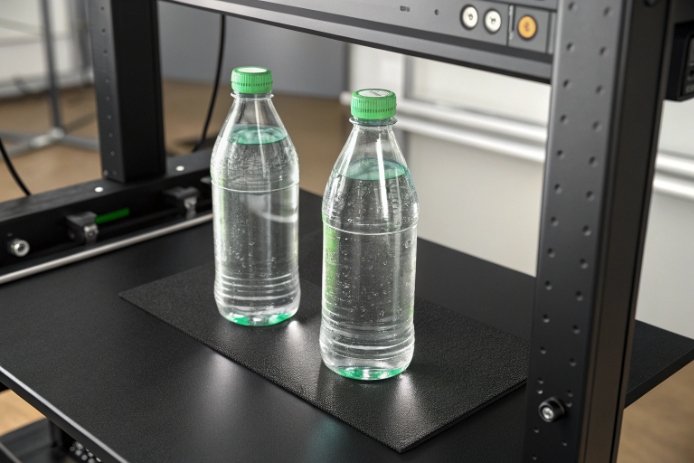
A bottle can be “clear” and still look cheap. A small green or yellow cast shows up fast under store lights and makes the product color look wrong.
Extra-flint clarity comes from keeping total iron low, keeping the Fe²⁺ share even lower, and using cullet + decolorizers in a way that stays stable for months of continuous production.
How to think about iron control in a way that buyers and production both accept
High-transmittance bottles are not only a “ppm target.” They are a contract between the batch house 1, the furnace, and the buyer’s eyes. Iron drives tint, but redox 2 drives which tint appears. Total iron sets the ceiling. The Fe²⁺ share sets the green tone. The Fe³⁺ share pushes yellow. A plant can hit the same total iron and still miss the look if redox drifts.
A practical spec always starts with one measurement method and one thickness reference. Color numbers without thickness are not comparable. Many labs use polished glass coupons at a fixed path length. Some plants use a “standard bottle” as the master. Either way, the rule stays the same: measure the same way every time, then control the recipe to keep the result inside a tight window.
For procurement, “iron” must be written as total iron expressed as Fe₂O₃ in ppm (or wt%). This avoids fights across labs. The redox spec must be written as a ratio such as Fe²⁺/Fe_total (often called iron redox ratio), because it links directly to green tint risk.
Below is the way high-transmittance programs are usually framed when the goal is extra-flint or water-white appearance.
| Flint grade (buyer language) | Total iron target (as Fe₂O₃) | Redox target (Fe²⁺/Fe_total) | What it looks like on shelf |
|---|---|---|---|
| Standard flint | 250–500 ppm | 0.15–0.25 | Clear, but can show slight green/yellow |
| High-white flint | 150–250 ppm | 0.10–0.20 | Cleaner “white,” less tint in thick glass |
| Extra-flint | 80–150 ppm | 0.08–0.15 | Very neutral, premium spirits look |
| Water-white (ultra) | 50–120 ppm | 0.05–0.12 | “Crystal” look, strongest shelf impact |
These ranges are not a universal law. They are workable targets that allow production yield to stay safe. A plant can push lower, but the cullet stream and raw material purity must be strong, or the plant ends up chasing color every day.
The most important point is simple: extra-flint is usually won by stability, not heroically low ppm for one week.
A stable iron and redox program makes every next question easier.
What Fe₂O₃ ppm and FeO/Fe³⁺ redox targets deliver extra-flint clarity?
When a buyer says “extra-flint,” they are asking for a bottle that stays neutral even when the wall is thick and the light is harsh. That pushes both total iron and redox control.
Extra-flint clarity is usually achieved by holding total iron around 80–150 ppm (as Fe₂O₃) and keeping the iron redox ratio low and steady, commonly around 0.08–0.15 Fe²⁺/Fe_total, so green tone stays suppressed.
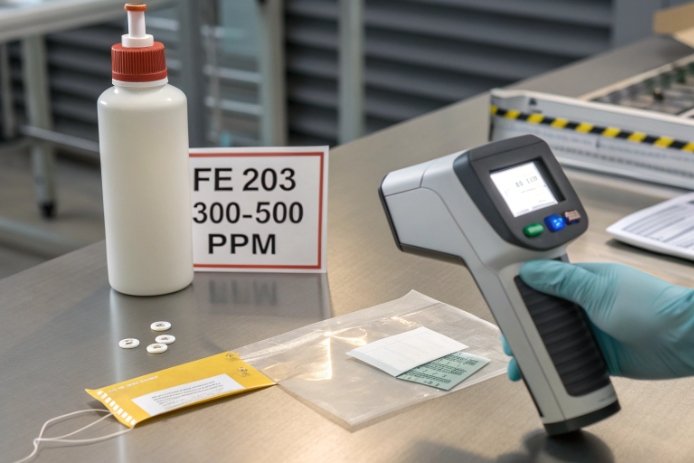
Set total iron as a “hard ceiling,” not a daily knob
Total iron is the slow knob. It comes from sand, carbonates, batch dust, refractory pickup, and most of all, cullet 3. If total iron jumps, the plant needs a long time to recover because the furnace is a big mixing tank.
A good buyer spec uses three lines:
-
Target: 100–120 ppm Fe₂O₃ (common extra-flint target)
-
Upper limit: 150 ppm Fe₂O₃ (keeps drift from showing on shelf)
-
Alarm level: 130 ppm Fe₂O₃ (triggers a cullet and raw material check)
Even small Fe²⁺ 4 changes can make the bottle look greener. That is why extra-flint programs track Fe²⁺/Fe_total (or FeO fraction) as a daily control item.
My common control logic:
-
Keep Fe²⁺/Fe_total in a tight band, not only “below a limit.”
-
Tie the band to furnace operating style. If the plant runs slightly reducing for fining stability, the band must be tighter.
-
Do not fight redox only with decolorizers. Fix furnace oxygen potential swings first.
Use a simple production dashboard
Extra-flint needs a simple dashboard that operators trust:
| Item | Frequency | Typical control goal | Action if out of range |
|---|---|---|---|
| Total Fe (as Fe₂O₃) | Daily or per shift | ≤150 ppm (extra-flint cap) | Check cullet lot + sand COA + batch dust |
| Iron redox ratio (Fe²⁺/Fe_total) | Daily | 0.08–0.15 | Adjust combustion stability + sulfate balance |
| CIE b* (thickness fixed) | Per shift | near 0, slightly positive allowed | Small decolorizer trim, then root cause |
| Visible transmittance (thickness fixed) | Daily / weekly | ≥90% for premium flint | Review decolorizer overdosing and haze |
Extra-flint is not fragile when this dashboard is steady. It becomes fragile only when cullet and furnace conditions are allowed to drift without quick feedback.
Do water-white bottles need ≤100–120 ppm total iron with FeO kept below ~20% of total iron?
This question comes up because buyers see “crystal” bottles in premium spirits and cosmetics, then ask for the same look in mass production.
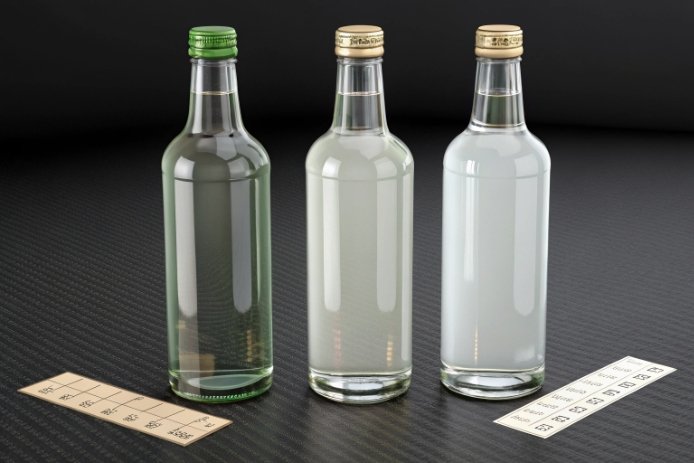
Yes, ≤100–120 ppm total iron (as Fe₂O₃) with Fe²⁺ held below about 20% of total iron is a common and realistic water-white target, but only if cullet and decolorizer strategy are designed to keep that ratio stable.
Why the “100–120 ppm” range is practical
In continuous container furnaces, going below 100 ppm is possible, but it raises the cost and raises sensitivity to cullet contamination. Many plants choose a water-white target band that still tolerates small real-world noise:
-
Sand lots vary.
-
Limestone lots vary.
-
Cullet always brings unknowns.
-
Refractories age and can add trace color.
So 100–120 ppm becomes a strong business target because it can be held over time, not only in a pilot run.
Why “FeO below ~20%” makes sense
Operators often translate redox into a simple statement: “keep FeO low.” The cleaner way is the ratio Fe²⁺/Fe_total, but the meaning is similar. Keeping Fe²⁺ below ~20% usually prevents the green cast from becoming visible in thick sections.
Still, there is a trap: if the furnace becomes too oxidizing, Fe³⁺ increases and yellow can show up. That is why water-white is a balance:
-
Too reducing: greener
-
Too oxidizing: yellower
-
Stable middle: neutral
How to write this into a buyer spec
A buyer spec that works in procurement and on the floor looks like this:
| Spec line | Suggested water-white value | Notes |
|---|---|---|
| Total Fe as Fe₂O₃ | Target 100 ppm, Max 120 ppm | State test method + sampling |
| Iron redox ratio | Max 0.20, Target 0.10–0.15 | Target band prevents daily color drift |
| CIE b* (fixed thickness) | Target 0.0 to +0.5 | Slight positive is often acceptable |
| Visible transmittance (fixed thickness) | ≥90–92% | Depends on thickness and haze |
If water-white is the brand promise, the redox target must be treated like a production KPI, not a lab curiosity.
How do cullet quality and decolorizers (Se, Co, CeO₂) influence allowable iron limits?
Iron limits are not set only by chemistry. They are set by what the plant can control. Cullet and decolorizers 5 decide how much “iron noise” the system can absorb.
Clean flint cullet can let a plant run higher cullet ratios without tint drift, while Se/Co can cancel residual green-yellow at low doses; CeO₂ can reduce green by pushing Fe²⁺ to Fe³⁺, but too much can create yellow and reduce long-term color stability.
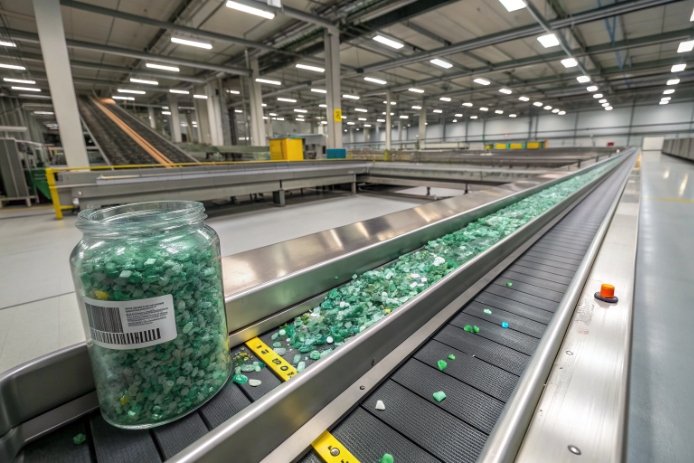
Cullet quality sets the real-world floor for iron
For extra-flint, cullet is the biggest risk. A small amount of green or amber contamination can move b* and visible transmission quickly, and it can force higher decolorizer dosing that makes the bottle look grey.
Practical cullet rules that protect extra-flint:
-
Use a dedicated flint cullet stream.
-
Set a strict max for colored cullet contamination.
-
Track each incoming cullet lot with quick color screening and impurity checks.
The more stable the cullet, the more stable the iron. This is why two plants with the same recipe can show different “best possible” water-white results.
Se + Co: strong physical decolorizing, but overdosing reduces brilliance
Selenium 6 and cobalt 7 are used as a classic package to neutralize tint. This is powerful because it works even when iron is not extremely low. But it has a trade-off: if dosing is too high, it reduces visible transmittance and can create a cold grey look.
My common rule is to treat Se/Co as a fine trim:
-
Use it to keep b* near the target.
-
Do not use it to hide poor cullet control.
-
Do not allow frequent large adjustments, because that usually means cullet or redox is unstable.
CeO₂: chemical decolorizing, good for green control, but watch yellow and UV absorption
Cerium oxide 8 can act as an oxidizer in the melt. It can push Fe²⁺ toward Fe³⁺ and reduce the strong green absorption linked to Fe²⁺. This helps transmittance, but it can also introduce yellow if overdosed, so it must be tuned carefully.
A buyer-friendly way to connect decolorizers to iron limits
| Strategy | What it allows | What it risks | When it fits best |
|---|---|---|---|
| “Ultra-clean cullet” first | Lowest iron limit without heavy additives | Higher cullet cost | Premium spirits and cosmetics |
| Se/Co low-dose trim | Holds neutral tone with moderate iron | Grey cast if overdosed | High-volume flint lines |
| CeO₂ support | Reduces green sensitivity | Yellow drift if too high | When Fe²⁺ control is difficult |
| Mixed heavy dosing | Raises allowed iron temporarily | Long-term shift and dull look | Not recommended for extra-flint |
Decolorizers should be the last layer, not the foundation. The foundation is still: clean raw materials, clean cullet, and stable furnace conditions.
What CIE b* and visible transmittance goals define high-transmittance bottles for food, cosmetics, and pharma?
Many buyers ask for “high transmittance,” but they do not say how it will be measured. That creates disputes later.
High-transmittance bottles should be defined by a fixed-thickness CIE Lab target (especially b near zero) plus a visible transmittance target over the visible range; the exact window should match the product category and shelf lighting reality.
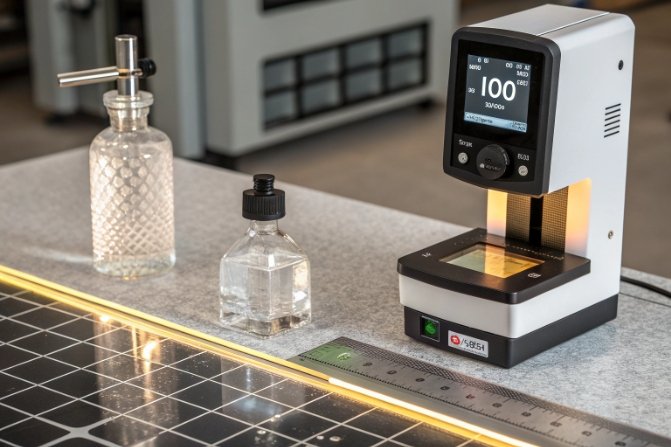
First, lock the measurement conditions
A workable specification includes:
-
Fixed sample thickness (often 10 mm coupon, or a standard bottle)
-
Fixed illuminant and observer setting (lab standard)
-
Defined wavelength range for visible transmittance 9 (commonly 380–780 nm)
Without this, b* and transmittance numbers are not comparable.
What b* means in simple buyer terms
-
*b positive:** more yellow
-
*b negative:** more blue
For water-white, b should sit close to zero. In real container production, a slightly positive b is often tolerated because many “clear” glasses carry a faint warm tone.
Practical targets that match what customers notice
Below is a buyer-ready target set that usually works at common bottle thicknesses used in food, cosmetics, and pharma. These are practical goals used to define premium flint, not theoretical lab limits.
| Segment | Suggested b* target (fixed thickness) | Visible transmittance goal (fixed thickness) | Notes buyers care about |
|---|---|---|---|
| Food (premium sauces, oils) | 0.0 to +0.8 | ≥89–91% | Slight warm tone is often acceptable |
| Cosmetics (premium skincare) | -0.2 to +0.5 | ≥90–92% | “Crystal” look matters in photos and retail |
| Pharma (inspection and premium OTC) | 0.0 to +0.6 | ≥90–92% | Neutral look helps fill-level inspection |
Add one more metric that prevents “clear but dull”
For high-transmittance, haze and micro-bubbles can reduce brilliance even if iron is low. So a strong spec also includes:
-
Haze limit 10 (internal method)
-
Seed/bubble class limit (plant method)
-
A “no grey” visual limit, because overdosed decolorizers can lower perceived clarity
A simple acceptance language that prevents arguments
This wording prevents most buyer-supplier disputes:
-
“Measured on a 10 mm polished coupon cut from production glass, using the same instrument method each lot.”
-
“b* must remain within the target window for three consecutive production days.”
-
“Visible transmittance must meet the stated minimum at the defined thickness.”
When b* and visible transmittance are specified together, “high-transmittance” becomes measurable, and extra-flint becomes a repeatable product, not a marketing promise.
Conclusion
Extra-flint success comes from low and stable total iron, a tight Fe²⁺ share, disciplined cullet control, and a clear b* plus visible-transmittance spec tied to one thickness and one test method.
Footnotes
-
The initial raw material handling stage defines the baseline purity for high-transmittance glass production. ↩
-
Managing oxidation states is crucial for controlling the final color expression of iron in glass. ↩
-
Recycled glass quality is the primary variable affecting total iron levels in the furnace. ↩
-
Ferrous iron is the specific ion responsible for the unwanted green tint in clear glass. ↩
-
Additives that neutralize iron’s color or shift its valence to improve optical clarity. ↩
-
A physical decolorizer that adds a pink tone to neutralize green iron tints. ↩
-
A powerful decolorizer that adds blue to complement selenium in neutralizing yellow-green tints. ↩
-
A chemical decolorizer that oxidizes iron to its less colorful ferric state. ↩
-
A key metric defining how much light passes through the glass in the visible spectrum. ↩
-
Quantifies scattering defects like micro-bubbles that reduce the brilliance of extra-flint glass. ↩






