
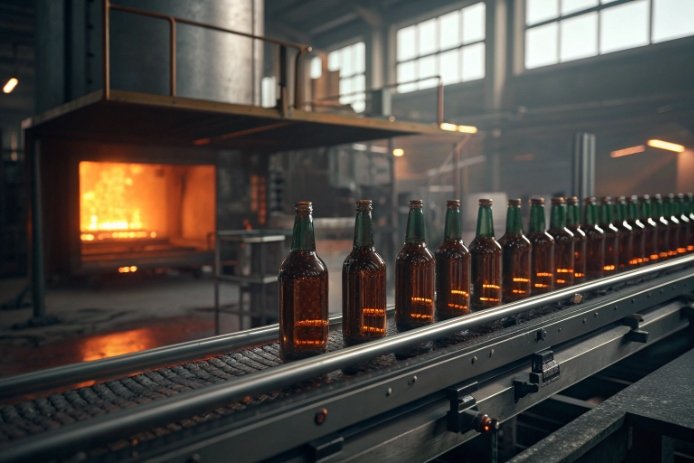
Sulfur can look like a small batch detail, but one bad swing can cause foam, color drift, and stones. Then yield drops and customers complain.
Sulfur control keeps melting and fining stable, protects bottle color, and prevents sulfate scum and stones. When SO₃ stays in a narrow band, the furnace runs calmer and defects stay predictable.
Sulfur in container glass is a double-edged tool. In many soda-lime bottle furnaces, sulfur enters as sulfate in the batch, as residues on cullet, and sometimes as contamination from fuels or raw materials. In return, sulfur helps the melt fine. It creates refining gases that enlarge small bubbles, so they can rise out. That benefit is real, but it only stays positive when sulfur is controlled like a critical ingredient.
A stable sulfur program starts with a simple idea: the plant needs a sulfur budget. The budget includes what enters, what stays dissolved in the glass as SO₃, and what leaves as emissions or scum. If the incoming sulfur changes but the recipe does not, the furnace will correct itself in messy ways. Foam grows, fining becomes unstable, and the melt surface gets more active. Then the forehearth and forming teams chase it with temperature and timing. That raises energy and still does not remove the root cause.
Where sulfur “hides” in real production
Sulfur does not only show up as one lab number. It shows up as:
- SO₃ dissolved in the glass (a quality and reboil risk signal)
- sulfate salts on the melt surface (scum and deposit risk)
- SOx in flue gas (permit and cost risk)
- redox changes that shift color and fining behavior
Why tight control matters more at high cullet
Higher cullet reduces virgin batch reactions, which can make melting easier. At the same time, it can make the furnace more sensitive to sulfur swings because the cullet stream can carry organics and sulfate residues. The result is that sulfur and redox can move faster than the team expects. (See cullet quality impact 1)
| Sulfur control area | What can go wrong when it drifts | What it hurts first | Best “first response” control |
|---|---|---|---|
| Batch sulfate dosage | foam, unstable fining | seeds and blisters | adjust sulfate with redox check |
| Cullet sulfate/organics | redox swings, scum | color and reboil | tighten cullet LOI + wash/sort |
| SO₃ in glass | reboil, blisters | mold and feeder quality | stabilize forehearth + reduce carryover |
| Sulfur emissions | compliance risk | cost and permits | optimize combustion + capture systems |
A sulfur program is successful when operators do not need to “feel” sulfur. The melt behaves the same, shift after shift. Keep reading, because the next sections break sulfur down into clear roles, clear risks, and clear monitoring tools that work in mass production.
What roles do sulfates play in melting and fining?
Sulfates can look like a simple additive. In practice, they behave like a process lever that touches melting speed, foam, and bubble removal.
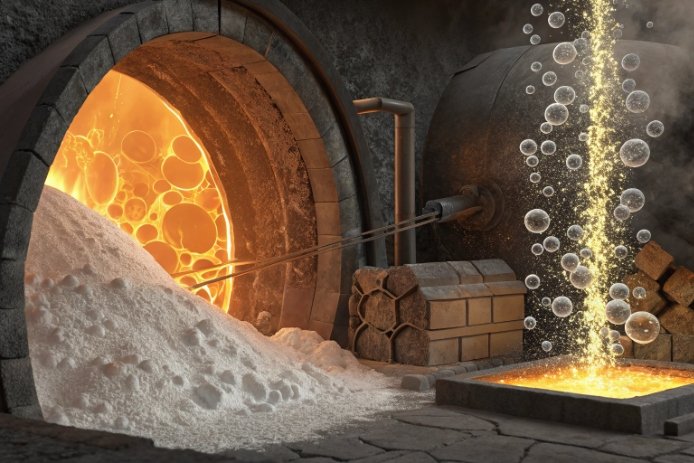
Sulfates support fining by generating refining gases at high temperature and by stabilizing an oxidizing potential in the melt. The same sulfates can also raise foam, scum, and SOx if dosage and redox are not balanced.
Sulfates as fining “fuel”
In soda-lime melts, sulfate sources can release gases during refining. These gases help small bubbles grow and join together. Bigger bubbles rise faster (Stokes’ Law), so seed count drops. This is the main reason sulfates exist in many bottle recipes. The fining benefit is strongest when the refining zone is hot enough and the melt is well mixed. (Read about sulfate fining mechanism 2)
Sulfates as a redox stabilizer
Sulfates also influence oxidation potential. A melt that is too reducing can create sulfide species and cause color issues, especially in flint and amber production. A melt that is too oxidizing can change iron state and shift tint. Sulfates sit inside that balance, so they must be managed with the rest of the redox package, not as a stand-alone knob.
The downside: foam, scum, and volatility
If sulfate is too high, or if the melt trajectory forces sulfate reactions into the wrong temperature zone, the surface can become more active. Foam can build. Scum can form as alkali sulfate salts and other sulfate-rich phases. Foam reduces heat transfer, which then forces higher firing to maintain pull. That loop can raise emissions and still leave seeds behind. (See foam control strategies 3)
A practical approach is to treat sulfate dosage as “minimum effective.” The target is not maximum fining gas. The target is enough fining gas at the right time, with a calm surface.
| Sulfate behavior | What helps production | What creates defects | What to control together |
|---|---|---|---|
| Gas release in refining | fewer seeds | reboil risk if carried | temperature profile + residence time |
| Oxidizing influence | stable fining window | color drift if overdone | iron redox + cullet organics |
| Surface salt formation | none (avoid it) | scum, stones, deposits | sulfate level + surface conditions |
When sulfates are controlled correctly, they feel invisible. When they are not, they dominate the furnace. That is why sulfur balance also shows up in color and stones, which is the next topic.
How does sulfur balance impact color and stones?
A plant can meet a sulfur spec in the lab and still lose color consistency on the line. That usually means sulfur is interacting with redox and impurities in ways the team did not track.
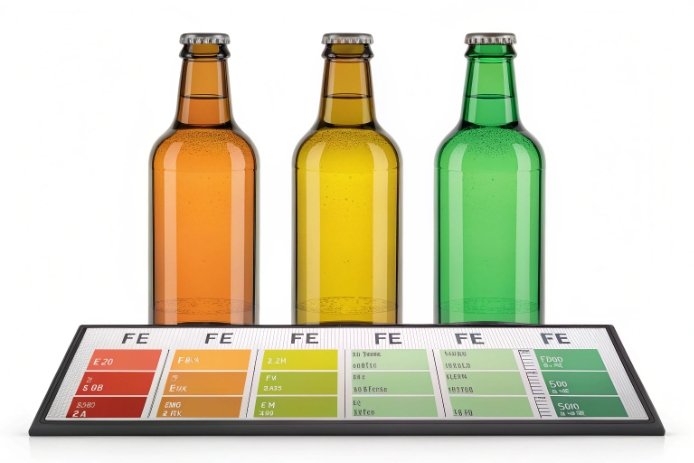
Sulfur balance affects color by shifting sulfur species and iron oxidation state, which changes tint in flint and stability in amber/green. It affects stones by forming sulfate scum, by promoting deposits and carryover, and by creating local chemistry pockets that crystallize into hard defects.
Color: sulfur is chemistry plus redox
Sulfur can exist in different forms in the melt depending on oxygen potential. That matters because different sulfur forms influence color and clarity. In flint production, a reducing swing can push the melt toward sulfide behavior and can create unwanted tint changes. In amber production, sulfur chemistry is tied to color development and stability (iron-sulfide chromophore), so swings can push amber tone off target. (See amber glass color chemistry 4)
The key point is simple: sulfur does not move alone. It moves with:
- iron redox (Fe²⁺/Fe³⁺)
- carbon load from batch and cullet
- furnace atmosphere and leakage
- nitrate or other oxidizing tools, if used
Stones: sulfur can turn into solids
Stones linked to sulfur often come from surface behavior and carryover:
- Sulfate scum can break off and enter the melt as hard inclusions.
- Alkali sulfate salts can form in cooler spots, then drop into the glass stream.
- Deposit cycles in the superstructure or flues can send particles back into the melt, especially when conditions change quickly.
- Local chemistry pockets rich in alkali and sulfate can also change liquidus behavior. That can create crystal seeds that grow into visible stones later in the forehearth. (Guide to glass defect analysis 5)
Stones are rarely caused by sulfur alone. Sulfur usually acts as an amplifier. If the melt is already unstable, extra sulfur makes the surface more reactive and increases the chance of solids forming and falling in.
| Symptom | What sulfur is doing | Why it shows up | Best confirmation check |
|---|---|---|---|
| Flint tint drift | redox shifted toward reduction | cullet organics or firing change | Fe redox proxy + ΔE trend |
| Amber tone swing | sulfur species changed | redox window moved | color data + sulfate dosage log |
| “Snowy” scum | sulfate salts formed | surface too cold or too rich | surface inspection + SO₃ trend |
| Hard stones after scum events | scum carried into melt | turbulence or level swings | inclusion ID + timing correlation |
A stable sulfur balance protects both appearance and furnace cleanliness. It also reduces the need to run hotter to “burn off” problems. That is why monitoring methods must be simple and frequent, not only detailed and rare.
Which monitoring methods keep SO₃ within spec?
Controlling sulfur without measurement is a guessing game. A good system uses a few fast checks every shift, plus deeper checks on a slower rhythm.
The best monitoring program combines glass chemistry checks (SO₃ in glass), redox proxies, cullet quality tests, and process signals like foam and scum events. Control charts and lot traceability keep the plant from chasing noise.
Measure what matters: SO₃ in glass, not only sulfate in batch
Batch sulfate dosage is useful, but the furnace does not ship batch. It ships glass. The most useful KPI is SO₃ in the finished glass, tracked by SKU and by color. When SO₃ in glass drifts upward, reboil risk often rises. When it drifts downward, fining efficiency and color stability may change, depending on the system.
Common lab tools to quantify sulfur in glass include:
- routine XRF for composition control (with a validated sulfur method if available). (See XRF analysis standards 6)
- wet chemistry or specialized sulfur analysis where higher accuracy is needed
- periodic third-party confirmation to lock the method and the bias
Use redox and process proxies to predict sulfur behavior
SO₃ numbers alone can lag. A practical system also tracks:
- a redox proxy, such as Fe²⁺/Fe total or another agreed internal indicator
- cullet LOI / organics trend (dirty cullet drives reduction)
- foam and scum event logs tied to lot IDs and recipe changes
- forehearth temperature stability, since instability can trigger late gas release
Make the monitoring system “actionable”
Every KPI should connect to a clear action, not a debate. A simple structure works:
- target band
- warning band
- corrective steps tied to responsible teams (batch, cullet, furnace, forehearth)
| Monitoring item | Frequency | What it predicts | Typical corrective action |
|---|---|---|---|
| SO₃ in glass | daily / per shift | carryover and reboil risk | adjust sulfate package, check cullet |
| Fe redox proxy | daily | sulfur species behavior, color drift | stabilize combustion, control organics |
| Cullet LOI / moisture | per lot | reducing load swings | tighten wash/sort, quarantine lots |
| Foam/scum score | per shift | surface instability | tune temperature profile, reduce sulfate |
| Inclusion trend + stone ID | weekly / event-driven | scum carryover and deposits | trace to source, adjust operations |
When this system runs well, sulfur stops being an emergency topic. It becomes a controlled variable. That stability is also the base for exploring low-SOx approaches, which is the next question.
Will low-SOx fluxes replace traditional sulfates?
Many teams want a sulfate-free story because it sounds cleaner. The reality is that sulfates are popular because they work across many furnace designs and product mixes.
Low-SOx approaches can reduce reliance on traditional sulfates, but full replacement is not universal yet. The most realistic path is a hybrid: higher clean cullet, better bubbling and mixing, tighter redox control, and lower “minimum effective” sulfate dosage, supported by emission controls.
What “low-SOx” really means in container glass
A low-SOx strategy can mean different things:
- reduce sulfate dosage while holding seed performance
- shift to alternative refining methods that need less sulfate
- keep sulfate but reduce stack emissions with better capture and combustion control
In practice, the most achievable win is usually lower dosage, not zero sulfate.
What can reduce sulfate dependence today
Several controls reduce how much sulfate is needed:
- higher cullet with stronger cleanliness (less batch gas, faster melting)
- strong bubbling and good circulation (more physical fining power) (See bubbling systems 7)
- stable combustion and redox (less “insurance” sulfate)
- better batch mixing and grain control (fewer late-melting clusters)
These controls are often cheaper than a brand-new chemical system, and they reduce defects at the same time.
Where alternative fining tools may grow
Some plants explore physical or advanced methods, such as:
- improved bubbling strategies and gas selection
- refining-zone design changes for longer residence time
- localized vacuum concepts in special applications (See vacuum refining 8)
- new sensor-driven controls that keep forehearth and refining stable (See Industry 4.0 in glass 9)
These can reduce chemical fining demand, but they must survive 24/7 container economics. For many bottle plants, the best path is to treat sulfate as a controlled tool and drive it down step-by-step, while watching seeds, scum, and emissions.
| Approach | Sulfate reduction potential | Best fit | Main risk |
|---|---|---|---|
| Clean, high cullet | medium to high | stable supply regions | contamination creates stones |
| Better bubbling/mixing | medium | plants with seed issues | maintenance and tuning discipline |
| Tight redox control | medium | flint and amber lines | needs strong cullet QA |
| New “low-SOx” additives | uncertain | niche trials | side effects and cost |
| End-of-pipe controls | no dosage change | strict permit sites | operating cost |
A replacement of traditional sulfates may happen first where emissions limits are tight and cullet quality is strong. Until then, the winning strategy is simple: reduce sulfate to the minimum effective level, keep redox stable, and prove it with monitoring. (See sustainable glass melting 10)
Conclusion
Sulfur control protects fining, color, and stone rates. When SO₃ stays stable, the furnace calms down, defects drop, and emissions control becomes easier.
Footnotes
-
FEVE report on the environmental benefits of glass recycling and cullet quality. ↩
-
Study on sulfate fining efficiency and gas release mechanisms in glass melts. ↩
-
Technical article on sulfate foam formation and control in glass furnaces. ↩
-
Detailed guide on controlling iron and sulfur redox for consistent glass color. ↩
-
Guide to identifying and troubleshooting common glass defects like stones and seeds. ↩
-
ASTM C169 standard test methods for chemical analysis of soda-lime glass. ↩
-
Overview of furnace bubbling systems and their benefits for melt homogeneity. ↩
-
Review of advanced glass melting technologies, including vacuum refining. ↩
-
Siemens article on digitalization and process control in the glass industry. ↩
-
Strategies for sustainable and optimized glass melting processes. ↩






