
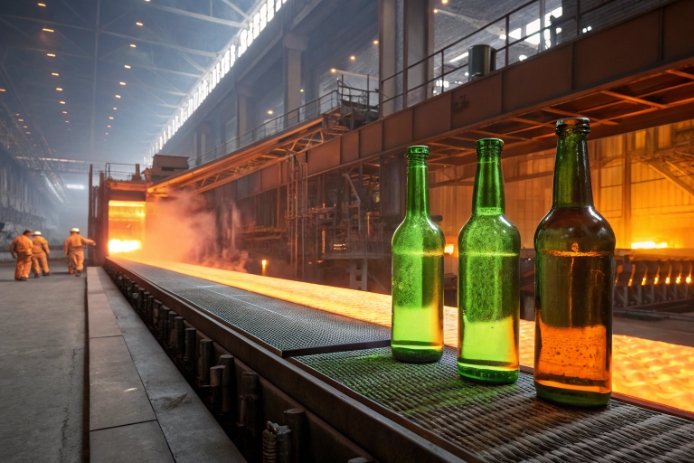
High cullet sounds like free margin and easy ESG wins. Then one unstable cullet load triggers foam, stones, and color drift, and the furnace becomes a daily fight.
In modern container furnaces, 50–60% cullet is common, and 70–80% is reachable with strong sorting and control. Some plants and products run near 90% recycled content, but the practical “maximum” depends on color tolerance, contamination risk, and furnace heat balance.
The real meaning of “maximum cullet” in bottle plants
The word “maximum” creates the wrong goal. A bottle plant does not need the highest cullet number on a slide. A bottle plant needs the highest stable cullet number that still hits defect PPM, color limits, and delivery. That stable number changes by color, by region, and by supply chain.
Maximum depends on what “recycled content” means
Many buyers mix three different ideas:
- Total cullet in the batch (internal + external).
- Post-consumer cullet share (what marketing teams often mean).
- Recycled content in the finished bottle (which can differ from batch share due to batch losses and yield).
A plant can run high total cullet if internal cullet is clean and consistent. A plant can only run high post-consumer cullet if the local collection and sorting system delivers clean, color-correct material. (See cullet types defined 1)
Maximum is different for flint vs amber/green
Flint is the hardest because customers see small color shifts and small inclusions. Green and amber are more tolerant to slight color mix, so those colors often reach higher cullet rates faster.
A practical way to set the “maximum” for a SKU
The best rule is simple: the “maximum cullet” for a SKU is the highest rate that still keeps the coldest glass path safely above your devit risk and safely below your defect limits, week after week.
| Bottle type | What usually limits cullet first | What “maximum” feels like in practice |
|---|---|---|
| Flint food jars | color mix + ceramics | stable control matters more than peak % |
| Amber beer | redox + sulfur balance | high % is possible with steady chemistry |
| Green wine | supply + sorting discipline | often the easiest path to very high % |
The next sections answer the real questions behind “maximum”: what limits high-cullet soda-lime melts, how cost and energy drop, which controls make >60% realistic, and how policy may push 80–90% in some regions.
Keep reading, because the fastest way to raise cullet is not only a purchasing decision. It is a full QA and furnace-control system.
What limits high-cullet ratios in soda-lime melts?
High cullet can make a furnace look stable for days and then fail fast. Most failures come from one thing: cullet does not behave like a perfect raw material.
High-cullet soda-lime melts are limited by cullet purity, color mix, and volatile dirt. Ceramics, stones, and metals create defects. Organics and sulfates change foaming and redox. Flint glass is limited most by tiny color contamination that customers can see.
Limit 1: Insolubles and “hard” contamination
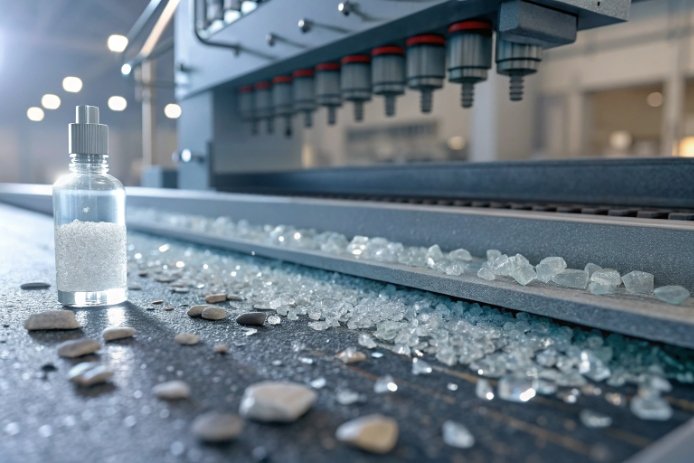
Ceramics, porcelain, stones, and refractory crumbs do not melt fast. These particles become nuclei for devit stones or act as hard inclusions that scratch molds and trigger customer complaints. (Read about CSP contaminants 2) At high cullet rates, a small contamination rate turns into a big defect rate because the furnace receives more of that material per ton.
Limit 2: Color mix and optical tolerance
Color mix is the silent limiter for flint. A small amount of amber or green cullet can push flint into a visible tint. Even when the tint stays inside spec, customers can see shifts under retail lighting. That means the real limiter is often not chemistry. The limiter is the local sorting quality and the plant’s blending discipline.
Limit 3: Chemistry drift that moves redox and liquidus behavior
Cullet chemistry can drift in Fe, alkalis, SO₃, Ti, and Zr. These changes shift redox state 3, fining response, viscosity, and devit tendency in the forehearth. A high-cullet furnace has less “buffer” because the batch share is smaller, so the cullet stream controls the melt more strongly.
Limit 4: Furnace heat balance and batch blanket behavior
High cullet reduces the amount of raw batch reactions. That often improves melting. But it also changes the batch blanket thickness and the radiative heat flow. Crown temperatures, port balance, and foaming behavior can shift. Operators then compensate with combustion changes, and that creates more variation.
| Limiter | What it looks like on the line | Why it gets worse at high cullet | Best control lever |
|---|---|---|---|
| Ceramics/stones | hard stones, devit streaks | more inclusion load per ton | optical sorting + rejects |
| Color mix | ΔE drift, customer mismatch | flint tolerance is low | color-separated supply + blending |
| Organics/labels | foam cycles, redox swings | extra carbon changes fining | washing + LOI limits |
| Sulfates/salts | scum, unstable fining | volatility changes melt behavior | SO₃ tracking + supplier rules |
| Particle size | melting swings, cords | blanket and heat transfer shift | screening + size spec |
A plant can push cullet very high only when these limiters are controlled like any other critical raw material. Without that discipline, the “maximum” exists only during short trials.
How do high cullet rates reduce cost and energy?
Cullet is not only a recycled-content story. It is a furnace-efficiency tool. The savings are real, but the plant must protect them from quality losses.
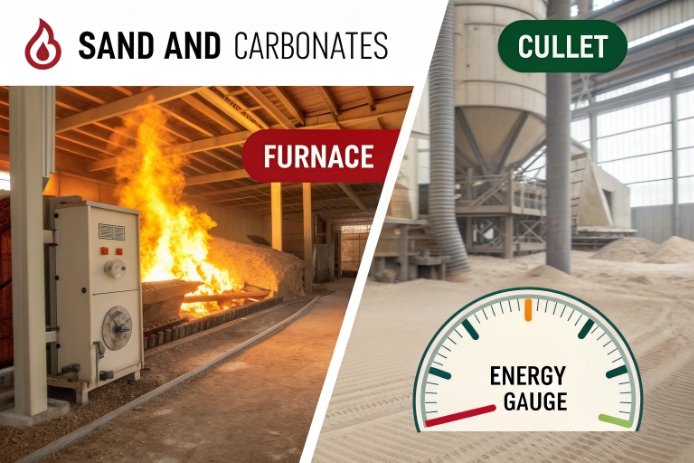
High cullet reduces cost by cutting virgin raw materials and lowering energy demand, because cullet melts faster and avoids carbonate decomposition. Many plants see measurable energy and CO₂ savings for each 10% cullet increase. The net savings stay positive only when defects and downtime stay flat.
Less virgin batch and fewer “loss” reactions
Virgin batch contains soda ash, limestone, and dolomite. These release gases and need extra heat to finish melting. Cullet arrives already as glass. That means:
- less gas release from decomposition
- faster melt kinetics
- less load on fining chemistry
- more stable glass level and pull at the same fuel rate
Lower energy per ton and lower emissions
The main energy win comes from melting speed and reduced reaction heat. The CO₂ win comes from two places: less fuel and less carbonate breakdown. In practice, even small increases in cullet can create meaningful savings when the furnace runs 24/7. (See energy savings data 4)
Hidden costs that can erase the benefit
A high-cullet plan fails when the cullet stream creates:
- more stones and customer claims
- higher reject and re-melt loops
- more foam and lower pull
- more forehearth correction and downtime
Those costs can exceed fuel savings. So the plan must measure both savings and quality.
| Cullet increase lever | What cost drops | What energy drops | What can go wrong if uncontrolled |
|---|---|---|---|
| Replace virgin batch | raw materials spend | melting energy | chemistry drift if cullet varies |
| Faster melt | downtime risk drops | fuel per ton drops | crown/port balance can shift |
| Lower fining load | additive spend | less volatility | redox swings if organics vary |
| Less carbonate gas | defect risk drops | lower CO₂ | foam can still rise from labels |
A stable high-cullet operation turns savings into a repeatable number. An unstable operation turns savings into a weekly argument between production, QA, and purchasing.
Which controls allow >60% cullet without defects?
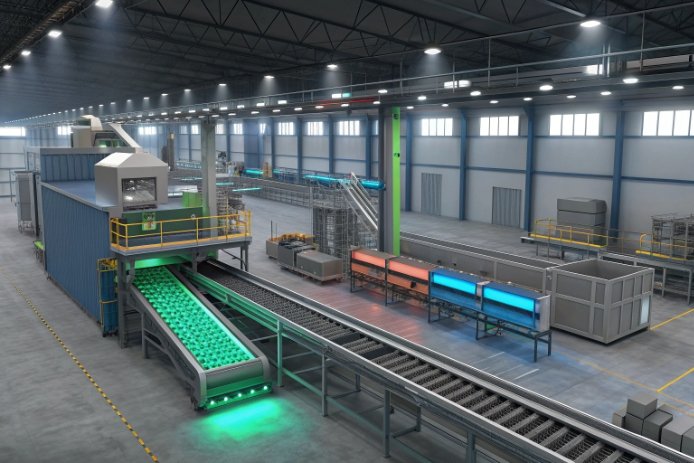
A plant reaches >60% cullet when cullet becomes a controlled feedstock, not a waste input. The core is simple: measure, pre-treat, blend, and then run the furnace in a tight window.
Controls that enable >60% cullet include strict cullet specs, strong sorting and cleaning, silo-based blending, and fast chemistry and defect monitoring. Furnace-side controls like stable redox, bubbling, and steady conditioning temperatures keep the melt forgiving when cullet fluctuates slightly.
Control 1: Cullet specs that match your bottle color
A working spec has four categories:
- color mix limits (especially for flint)
- ceramics and stones (count-based limits)
- ferrous and non-ferrous metals (ppm or count limits)
- LOI / organics and moisture
- particle size distribution (fines and oversize)
The spec must also define sampling frequency per lot. A monthly average is not a control system.
Control 2: Pre-treatment that removes what the furnace cannot fix
Most strong cullet lines use a mix of:
- screening to control fines
- magnets and eddy-current separation for metals
- optical sorting for ceramics and color (see sorting technologies 5)
- washing or air-cleaning for labels and organics
- covered storage and drying rules to control moisture swings
This step is where “high cullet” becomes realistic for flint.
Control 3: Blending that smooths the real world
Blending is a big lever because cullet variability is normal. A plant needs:
- at least two silos for different cullet grades
- a rolling blend recipe that changes slowly
- retention samples and lot IDs
- a rule that the blend changes before the furnace is forced to chase
Control 4: Furnace discipline that reduces sensitivity
A high-cullet furnace likes stable operation:
- stable redox window to keep fining and color stable
- steady bubbling to improve mixing and bubble removal (see furnace bubbling 6)
- tight forehearth temperature control to avoid devit
- stable pull strategy to reduce thermal cycling
| Control | Tool | KPI that operators can follow | What it protects |
|---|---|---|---|
| Incoming cullet quality | lot sampling + inspection | ceramic counts, LOI, moisture | stones, foam, redox swings |
| Color stability | spectro on glass | ΔE trend per shift | customer color claims |
| Chemistry stability | XRF / quick chemistry | Fe, SO₃ bands | redox and fining behavior |
| Melt cleanliness | seed/stone tracking | defect PPM by SKU | yield and audits |
| Process stability | bubbling + temperature logs | stable setpoints, low alarms | cords and devit risk |
With these controls, >60% becomes a stable operating range for many plants. Without them, 60% can feel like a ceiling even when the furnace design could handle more.
Are policy targets pushing 80–90% cullet adoption?
Policy pressure is real, but it does not push every region in the same way. Policy also does not create clean cullet by itself. It mainly changes collection, sorting investment, and reporting.
Policy targets mostly push higher collection and higher-quality recycling. In regions with strong separate collection and sorting, 80–90% cullet becomes realistic for some colors and some SKUs. Global adoption will stay uneven because flint supply and contamination control vary by country and by collection system.
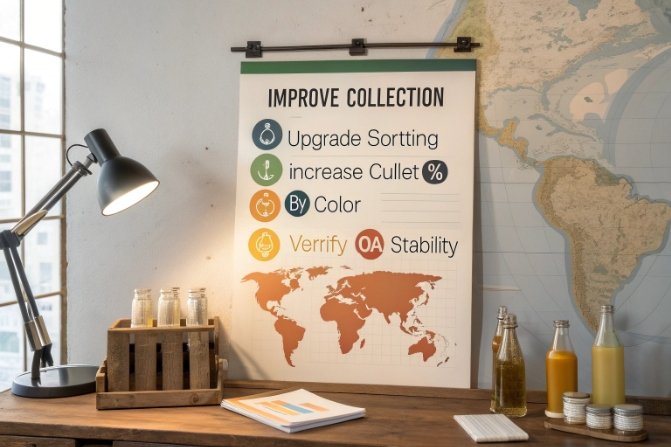
Policy pushes the cullet supply chain, not the furnace
Most regulations focus on:
- recyclability rules
- collection and recycling targets (like EU targets 7)
- clear labeling and sorting rules
- extended producer responsibility funding
These tools increase the volume and quality of available cullet. They do not force a single furnace to run 90%. The furnace still needs clean material and stable control.
The EU direction is a good example of the mechanism
EU policy discussions and industry platforms focus on very high collection and closed-loop recycling (see Close the Glass Loop 8). That improves color-separated cullet availability. When that system works, plants can run higher cullet without extra risk. When separate collection is weak, high recycled content becomes hard, especially for flint.
Premium beverage and food brands now ask for:
- recycled content claims
- lower CO₂ packaging
- proof of closed-loop recycling
That demand pushes glassmakers and cullet processors to invest in sorting, cleaning, and traceability. This is where digital tools and “passport” ideas may help, because buyers want proof, not only promises.
Why 80–90% will not be universal
Even with strong policy:
- flint has tight color tolerance
- ceramics contamination remains a hard barrier
- local collection systems differ
- transport costs can limit cullet movement
- some furnaces are not configured for very high cullet behavior
| Driver | What it changes first | How it can enable 80–90% | What still blocks it |
|---|---|---|---|
| Recycling targets | collection volume | more cullet supply | quality may stay mixed |
| Separate collection | color purity | better flint cullet | needs consumer discipline |
| EPR funding | sorting investment | better removal of ceramics | enforcement varies |
| Brand requirements | proof and contracts | stable long-term supply | cost of upgrades |
| Plant capability | furnace control | stable high-cullet melts | old equipment limits |
The best strategy is to treat 80–90% as a product-and-region target, not as a single global rule. A plant can reach very high cullet on the right SKUs, while keeping other SKUs at a lower but stable level.
Conclusion
The maximum cullet content is the highest stable rate your cullet supply and furnace controls can hold. With clean, sorted cullet and tight process control, 80–90% is possible for some bottle lines. (See sustainable glass melting 9)
Footnotes
-
FEVE report on the CO2 reduction benefits of using recycled glass (cullet). ↩
-
WRAP quality protocol for cullet, detailing contamination limits like CSP. ↩
-
Technical article on controlling glass redox for consistent color and quality. ↩
-
Glass Packaging Institute facts on energy savings from recycling. ↩
-
Overview of sensor-based sorting technologies for glass recycling. ↩
-
Description of furnace bubbling systems to improve melt homogeneity. ↩
-
European Commission packaging waste directive and recycling targets. ↩
-
Industry platform aiming to increase glass collection and recycling rates in Europe. ↩
-
Article on technologies driving sustainable glass melting practices. ↩






