
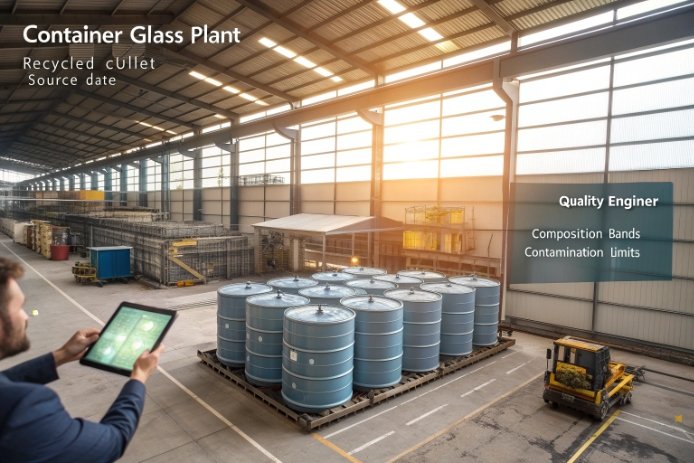
Cullet looks like easy savings, until one dirty load turns into foam, stones, and color drift. Then the furnace pays the bill.
Stable cullet quality means stable chemistry, stable contamination levels, and stable behavior in the melt. A working system uses clear specs, smart pre-treatment, planned blending, and fast melt-quality tests before full-scale production.
A stable-cullet program is chemistry control plus contamination control
Cullet quality stays “stable” only when it is defined in numbers. Many plants say “good cullet” and mean “low price and low color mix.” That is not enough. A stable stream must behave the same way in the doghouse, the melting zone, the refining zone, and the forehearth. That means the batch blanket should look the same, the foam level should stay within a tight band, and the fining response should not swing by shift.
Separate two problems: chemical stability and physical stability
Chemical stability is about oxide composition and redox drivers. Physical stability is about what enters as solids and what enters as volatile dirt. A cullet stream can be chemically “fine” and still cause stones because of ceramics. A stream can be physically “clean” and still shift color if Fe and sulfur swing.
Use cullet benefits without inviting volatility
The business case for cullet is real. More cullet usually lowers melting energy demand and can lower emissions (see cullet CO2 benefits 1). That makes it tempting to push cullet ratio faster than the control system can handle. The right approach is to grow cullet ratio only after the cullet stream becomes predictable.
Build the system like a supplier qualification, not a spot purchase
The most reliable setup uses four layers:
1) Supplier rules and audit points
2) Incoming inspection and sampling
3) Pre-treatment and storage controls
4) Blending logic and furnace feedback
| Stability dimension | What “stable” means in practice | How to measure it | What to control first |
|---|---|---|---|
| Chemistry | key oxides stay in a narrow band | XRF trends, Fe proxy, SO₃ check | supplier source + blending |
| Color mix | flint/amber/green stays predictable | color sort reports + visual checks | optical sorting + silo discipline |
| Insolubles | ceramics, stones, metals stay near zero | ceramic count, metal ppm, screen rejects | sorting + magnets + eddy current |
| Volatiles | organics and moisture stay low | LOI, moisture %, odor/visual checks | drying + washing + storage |
| Particle size | fines and oversize stay controlled | sieve curve, dust rate | screening + handling |
A small story that keeps teams aligned: one time a “cheap” cullet load saved money on paper and then cost more in downtime because foam rose, fining changed, and the forehearth needed constant temperature correction. After that, the purchasing rule changed. Price mattered, but only after the stability score passed.
The next sections explain what “chemical stability” should include, why variability pushes the furnace off balance, how to spec and blend cullet like a QA tool, and what digital passports may change in the next few years.
What defines chemical stability of cullet streams?
Small chemistry swings in cullet can look harmless in the lab. In a running furnace, those swings show up as unstable fining, unstable color, and unstable viscosity.
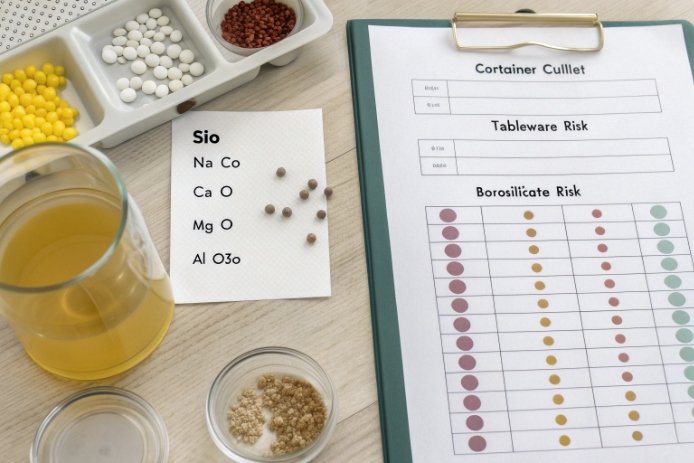
Chemical stability means the cullet stream delivers a repeatable oxide package and repeatable redox drivers. The key is low variation in Fe, alkalis, CaO/MgO balance, sulfur species, and any “nucleation-friendly” oxides like TiO₂ or ZrO₂.
Define “stable” by control charts, not by averages
A cullet supplier can show a nice monthly average and still ship daily swings that hurt the furnace. Chemical stability should be written as:
- A target composition band for key oxides
- A maximum day-to-day variation (or lot-to-lot standard deviation)
- A redox-related proxy rule (Fe state proxy, carbon/organic content, sulfate residues)
For container glass, the “most sensitive” cullet chemistry items are often:
- Total Fe and its effect on base tint and redox behavior 2
- SO₃ / sulfate residues that change fining response and foam risk
- Alkali carryover (Na₂O/K₂O) that shifts viscosity and volatility
- CaO/MgO balance that shifts liquidus behavior in the working range
- Ti and Zr when ceramics or refractory crumbs contaminate the stream
Think in “equivalent batch impact”
A stable cullet stream is not only about glass chemistry. It is about how cullet replaces raw materials. A change in cullet chemistry changes how much soda ash, limestone, and sand the batch needs. If cullet swings, the batch correction swings too. That creates a loop that never settles.
A useful internal metric is “equivalent batch shift per 10% cullet.” If a supplier’s cullet causes frequent batch corrections, the stream is not chemically stable, even if the cullet is “clean.”
| Chemical item | Why it matters | What instability looks like | A practical spec approach |
|---|---|---|---|
| Fe (total + behavior) | base color + redox | tint drift, fining drift | tight ppm band + trend limits |
| SO₃ / sulfate residues | foam + fining + scum | foaming cycles, scum events | max SO₃ + stable band |
| Alkalis (Na₂O/K₂O) | viscosity + volatility | forming temp swing | band + blending rules |
| CaO/MgO ratio | liquidus + devit risk | stones in forehearth | ratio window + alarms |
| TiO₂ / ZrO₂ | nucleation tendency | hard stones appear | low limits + ceramic controls |
When chemical stability is defined this way, the cullet stream becomes a controlled raw material, not a variable waste input.
Why does cullet variability disrupt furnace balance?
Many teams notice the symptoms first: foam goes up, refining looks slow, gob temperature swings, and defects rise. Cullet variability is often the hidden driver.
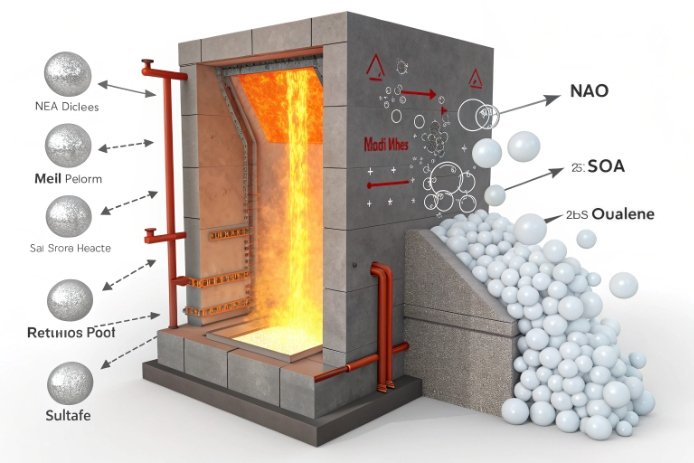
Cullet variability disrupts furnace balance because it changes how fast the batch melts, how much gas is released, and how the melt mixes and fines. Even small shifts in chemistry or dirt can push the furnace into a different redox and temperature behavior.
Variability changes melting speed and blanket behavior
Cullet melts faster than raw batch. That is good, but only when it is consistent. If particle size changes, or moisture changes, the batch blanket changes. If the blanket changes, heat transfer changes. That affects melt rate and the location of hot and cold zones. These shifts show up as unstable pull limits or unstable glass level control.
Variability changes fining and foaming behavior
A cullet stream with more organics, paper, labels, or food residue adds extra carbon and volatiles. That can push the melt more reducing, which changes fining chemistry response and can increase foam. A cullet stream with sulfate residues can also change foam and scum behavior. When foam grows, it blocks heat and traps bubbles. Then operators compensate with temperature or combustion changes. That starts a second loop of instability. (See sulfate foam mechanism 3)
Variability forces operators into “constant correction”
A furnace runs best when operators do not need to chase it. With variable cullet, the furnace needs constant correction:
- burner tuning
- temperature changes in conditioning
- fining-agent tweaks
- changes to pull or gob temperature targets
Each correction increases the chance of cords, bubbles, or color drift. This is why a stable cullet program is also a workforce program. It reduces the need for heroic shift actions.
| Variability type | Furnace impact | Typical symptom | Fastest stabilizer |
|---|---|---|---|
| Particle size / fines | melt rate swings | glass level oscillation | screening + fines control |
| Moisture | energy and blanket swing | cold spots, cords | covered storage + drying |
| Organics / carbon | redox swing | foam cycles, tint drift | washing + reject rules |
| Color mix | absorption shift | ΔE drift, customer mismatch | sorting + blending |
| Ceramics / stones | insoluble nuclei | stones, devit streaks | optical sort + supplier bans |
A stable furnace is a stable input story. If the cullet stream swings, the furnace must swing too. That is the core reason variability hurts both quality and emissions.
How to spec, pre-treat, and blend cullet for QA?
Without specs, cullet “quality” becomes an argument. With specs, cullet becomes a tool. The goal is to design a system that catches bad cullet before it reaches the furnace, and smooths normal variation before it hits the doghouse.
A strong cullet QA plan uses three steps: write specs that match your glass and furnace, pre-treat cullet to remove physical and volatile contaminants, and blend lots using silo strategy and statistical limits so the furnace sees a steady feed.
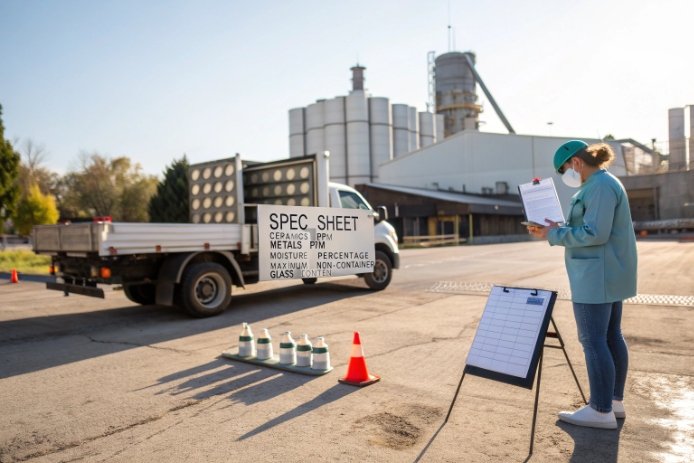
Step 1: Write a cullet spec that matches your defect risks
A working spec has four categories:
- Color mix limits (by SKU: flint, amber, green, mixed)
- Metals limits (ferrous and non-ferrous)
- Insolubles limits (ceramics, stones, refractory) (See CSP standards 4)
- Volatiles and moisture (organics, LOI, water)
The spec must also define sampling frequency and test method. If the method is not written, suppliers will “pass” in different ways.
Step 2: Pre-treat to remove what the furnace cannot forgive
Good pre-treatment usually includes:
- screening to remove fines and oversize
- magnets for ferrous metal
- eddy-current separation for non-ferrous metal (see sorting technology 5)
- optical sorting for ceramics and color
- washing or air cleaning when organics and labels are common
- drying or covered storage to prevent moisture swings
Not every plant needs every tool. The right set depends on the biggest defects and on local cullet sources.
Step 3: Blend for stability, not for cost
Blending is the most under-used lever. The best practice is to blend by design:
- keep at least two silos for different cullet grades
- use a rolling blend recipe (example: 60% stable supplier A + 40% local stream)
- adjust blend only when tests show drift, not on rumor
- track each lot with a clear ID and retention sample
| QA stage | What to check | Typical acceptance rule | What to do when it fails |
|---|---|---|---|
| Incoming | color mix, metals, organics | pass/fail band + trend band | quarantine + re-sort or reject |
| Pre-treatment | ceramic rejects, fines rate | stable reject % target | tune sorter + screen maintenance |
| Blending | XRF trend, ΔE trend, SO₃ trend | control chart stays inside limits | adjust blend recipe, not furnace |
| Furnace feedback | foam index, seed count, scum | stable daily score | trace back to lot ID |
When this system runs well, cullet becomes a stable raw material. It also protects the furnace life and can lower emissions because fewer corrections are needed and the melt stays calm.
Will digital passports standardize cullet quality globally?
Many buyers want a simple answer: “yes, passports will solve it.” The reality is more mixed. Digital systems can improve traceability, yet they do not remove contamination by themselves.
Digital product passports can standardize data fields and chain-of-custody rules, so cullet quality can be compared across regions. Still, global standardization will depend on shared test methods, verified sampling, and enforcement, not only on QR codes and databases.
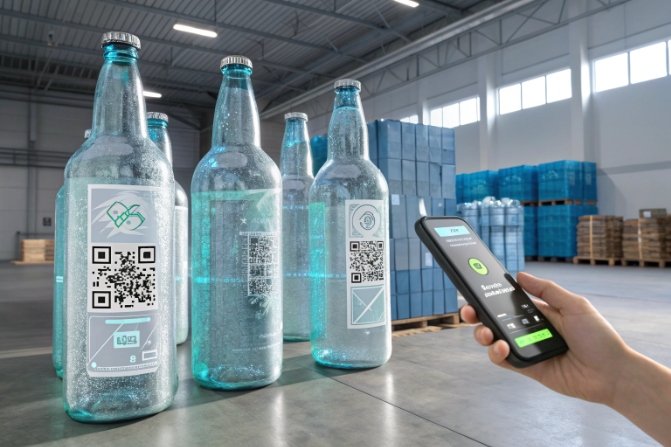
What digital passports can do well
Digital passports can give a common language:
- source category (post-consumer, industrial, returnable system)
- color grade and sorting method
- contamination results with test method
- lot traceability and time stamps
- carbon and recycled-content claims tied to evidence (see EU DPP initiative 6)
This helps brand owners and bottle buyers ask better questions. It also helps cullet processors compete on measurable quality instead of vague promises.
What digital passports cannot do alone
A passport can report “low ceramics,” but the furnace only cares if it is true. So passports must connect to:
- standardized sampling rules (like ASTM C169 7)
- audited lab methods (XRF, ceramic counting, LOI)
- tamper-resistant lot IDs and retention samples
- clear accountability when a lot fails in production
Without these, passports risk becoming marketing labels.
What “global standard” may look like in practice
The likely path is regional standards first, then convergence:
- EU systems may push faster because regulation is tied to circular product data and eco rules.
- Global brands may demand passport-like data from every region, even before local rules exist.
- Third-party verification will become normal for high-recycled-content SKUs.
| Passport data field | Value for bottle plants | Risk if not verified | What to require |
|---|---|---|---|
| Source and sorting route | predicts contamination risk | false confidence | audit trail + process proof |
| Chemistry snapshot | supports blend planning | “one test per month” problem | lot-based sampling + trend |
| Contaminant counts | protects furnace and quality | under-reporting | method standard + limits |
| Recycled-content claim | supports customer marketing | greenwashing claims | chain-of-custody evidence |
| Carbon data | supports ESG reporting | inconsistent boundaries | common calculation rules (see GHG protocol 8) |
Digital passports can help, but stable cullet quality still starts with the same basics: clear specs, strong pre-treatment, disciplined blending, and fast tests that link to furnace behavior. (Read glass recycling best practices 9)
Conclusion
Stable cullet quality comes from strict specs, smart cleaning, planned blending, and real melt tests. With that system, recycled content rises while defects and furnace swings stay low. (See Close the Glass Loop 10)
Footnotes
-
FEVE report on the environmental benefits of glass recycling and CO2 reduction. ↩
-
Technical explanation of redox chemistry in glass melting and color control. ↩
-
Article discussing the causes and control of sulfate foam in glass furnaces. ↩
-
WRAP quality protocol for the production of glass cullet from waste. ↩
-
Overview of sensor-based sorting technologies for glass recycling. ↩
-
European Commission page on the Digital Product Passport initiative. ↩
-
ASTM C169 standard test methods for chemical analysis of soda-lime and borosilicate glass. ↩
-
Greenhouse Gas Protocol standards for carbon accounting and reporting. ↩
-
Review of current trends and technologies in glass recycling. ↩
-
Industry platform aiming to increase glass collection and recycling rates in Europe. ↩






