
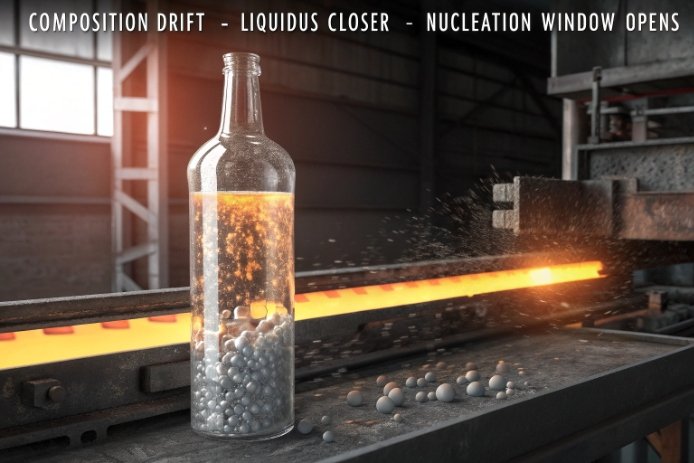
Crystal “seeds” can show up without warning. One week the melt looks clean. Next week stones, cords, and devit streaks ruin yield and customer trust.
Bottle-glass formulation controls nucleation by shaping the liquidus temperature, viscosity, and local chemistry around particles. Small shifts in oxide ratios or impurities can push the melt into a crystal-friendly zone during melting or conditioning.
The formulation knobs that decide whether crystals start
Crystal nucleation in bottle glass is mostly a risk of devitrification. It happens when a hot melt cools into a temperature range where some crystal phase is stable and can grow fast enough to be seen. In real furnaces, crystals do not start “from nothing” very often. Most problems begin on a surface or particle that acts like a starter. That is why formulation and cleanliness must work together.
Why formulation matters even when raw materials look “normal”
A container-glass melt is not uniform. There are zones with different temperature, mixing, and gas. There are also micro-zones near sand grains, cullet chips, and refractory dust. Formulation decides how forgiving those micro-zones are. A glass with a lower liquidus and a wider working range can tolerate small inhomogeneity. A glass close to a liquidus boundary will nucleate with the same level of dirt.
The practical chain from chemistry to defects
In production, nucleation shows up as:
- Devit stones (hard crystalline particles)
- Needles or plates that create streaks and haze
- Surface devit that causes scuffing or poor coating adhesion
These events connect back to three properties the formulation controls: liquidus temperature (TL) (see liquidus definition 1), viscosity in the forehearth, and which crystal phase becomes primary (wollastonite, diopside, cristobalite, spinel-type crystals, or contamination-based phases).
| What changes first | What production sees | Why formulation is involved | What to watch daily |
|---|---|---|---|
| Liquidus creeps up | Devit on forehearth metalwork | Melt enters crystal-stable range earlier | Composition drift, pull swings |
| Viscosity shifts | Cords + local devit lines | Poor mixing leaves local chemistry pockets | temperature profile, bubbling |
| Primary phase changes | New stone type appears | Oxide ratio crosses a phase boundary | CaO/MgO, Al2O3, alkalis |
| More nuclei present | Sudden rise in crystals | Particles seed crystals even at same TL | cullet cleanliness, raw material dust |
The rest of this article breaks down the main triggers: which raw materials start nuclei, how oxide ratios change TL, how cullet contaminants add nucleation sites, and which specs and tests stop surprises before mass production.
Now the details matter, because “crystal seeds” are rarely one single cause. The right approach is to control both the chemistry window and the dirt window, at the same time.
Which raw materials and impurities most commonly trigger nucleation and crystal “seeds” in bottle glass?
Crystals do not need a big mistake to start. A few ppm of the wrong impurity, or a few grams of ceramic dust, can create a stable starter surface in the melt.
The most common nucleation triggers are undissolved batch particles (sand, limestone/dolomite, feldspar/clays), refractory or ceramic contamination, and high-field-strength oxides like ZrO₂ and TiO₂ that promote crystal formation on tiny surfaces.

The “starter particles” that show up in real plants
In bottle glass, the most frequent starters are physical particles that survive long enough to enter the refining or conditioning zones. Common examples:
- Undissolved silica sand or sand clusters. These can act as a surface for cristobalite or quartz-related devit if local chemistry shifts.
- Carbonate carryover from limestone or dolomite. These release CO₂ and can leave local CaO/MgO-rich zones that favor wollastonite or diopside later.
- Feldspar or clay minerals with Al₂O₃. In small amounts Al₂O₃ helps glass stability, but unmelted alumino-silicate fragments can seed crystals.
- Refractory dust from crowns, doghouse, or regenerators. Zr-bearing refractory fragments are classic nucleation sites. (See refractory corrosion 2)
- Ceramics and stones in cullet, like porcelain, cordierite, zircon, and alumina. These do not dissolve fast and they give perfect nucleation surfaces.
Impurities that act like “nucleation accelerators”
Some oxides are famous for encouraging crystal formation because they fit well into crystal lattices or create stable micro-phases:
- ZrO₂: often from zircon-based refractories or ceramic contamination. It can survive as baddeleyite-like crystals or act as a seed for other phases.
- TiO₂: can behave like a nucleating agent (see glass-ceramics 3) in some glass systems and can form Ti-rich micro-domains.
- Cr₂O₃ (when present): can form spinel-type crystals with Fe/Mg, especially in certain colored systems or contamination events.
| Trigger source | Why it causes nucleation | What it looks like in defects | Best prevention lever |
|---|---|---|---|
| Undissolved sand | Long-lived solid surface | devit stones, haze streaks | sand quality + batch mixing |
| Carbonate clusters | Ca/Mg-rich local chemistry | wollastonite/diopside devit | batch fineness + melt time |
| Refractory dust | Zr/Al-rich particles persist | hard stones, scratches | furnace maintenance + filtration |
| Ceramic cullet | insoluble, high melting | sudden “new stone” outbreak | cullet sorting + supplier rules |
| Ti/Zr micro-impurities | promotes stable nuclei | fine crystals, opacity | tight impurity specs |
In my work, the fastest wins come from mapping each stone type to a source, then tightening that source. A formulation tweak helps, but it cannot fully cover a dirty feed. Clean feed plus a safe composition window is what keeps crystals away.
How do oxide ratios (SiO₂, Al₂O₃, Na₂O/K₂O, CaO/MgO) influence liquidus temperature and nucleation tendency?
Oxide ratios decide which crystal phase is “waiting” to form as the melt cools. That is why two glasses with the same total alkali can behave very differently in the forehearth.
Higher SiO₂ often improves devit resistance but raises melting difficulty. Al₂O₃ can improve stability, yet it can also enable spinel-like phases if paired with MgO and Fe. Higher CaO and MgO often raise liquidus and increase devit risk by favoring wollastonite or diopside.

SiO₂: stability vs melt burden
More SiO₂ generally strengthens the network and can reduce crystal growth in some ranges, but it also raises melting demand. If melting is incomplete, undissolved silica becomes a nucleation surface. So the benefit of higher SiO₂ only shows up when the furnace has enough temperature and mixing.
Al₂O₃: a stabilizer that needs balance
Al₂O₃ usually increases chemical durability and can reduce some devit tendencies by tightening the network. But Al₂O₃ also changes viscosity and can support certain crystalline phases when combined with MgO, Fe, and contamination. A plant that pushes Al₂O₃ higher must also keep MgO and iron behavior stable, or spinel-like stones can appear.
Na₂O/K₂O: melting speed and working range
Na₂O and K₂O lower viscosity and help melting. That can reduce undissolved particles, so nucleation risk drops. But too much alkali can also widen the “chemistry swing” between micro-zones, especially near cullet and batch interfaces. K₂O often behaves a bit differently than Na₂O in viscosity and crystallization behavior, so changing the Na/K split can shift the devit window even if total alkali stays the same. (See alkali effects 4)
CaO/MgO: the classic devit lever in container glass
Higher CaO tends to favor wollastonite as a primary devit phase. Higher MgO tends to favor diopside when CaO is also present. Both phases can grow in the conditioning range if TL is high enough. That is why the CaO/MgO ratio is not only a strength and durability decision. It is also a devit decision.
| Ratio knob | Typical direction on TL | Typical direction on nucleation risk | What it can break if pushed too far |
|---|---|---|---|
| SiO₂ up | TL can rise or shift phase fields | often lower growth, but higher unmelt risk | more cords from poor melting |
| Al₂O₃ up | TL can shift; viscosity rises | often safer window, but spinel risk with Mg/Fe | forming difficulty, higher stress |
| Total alkali up | TL often drops, melt faster | fewer solids, but more chemistry swing | soft glass, more volatility |
| CaO up | TL tends to rise | more wollastonite risk | devit in forehearth |
| MgO up | TL can rise in diopside field | more diopside/spinel risk | new stone types |
A useful plant rule is simple: if TL rises or the forehearth runs near TL, devit risk rises fast. A composition that looks fine on paper can still devit if the working range becomes narrow. That is why formulation changes must be tested at real conditioning temperatures, not only at furnace peak temperature.
How do cullet quality and contaminants (Fe, Ti, Zr, sulfates) increase the risk of nuclei forming during melting and conditioning?
Cullet is a powerful tool. It saves energy and stabilizes melting when it is clean. But contaminated cullet is also the fastest way to import nucleation sites and change redox without warning.
Poor cullet quality raises nucleation risk by adding insoluble particles (ceramics, stones, refractory dust) and by shifting melt chemistry through Fe, Ti, Zr, and sulfate residues. These changes can raise liquidus locally and create stable nuclei during melting and especially in conditioning zones.

Physical contaminants: the “hard nuclei” problem
The biggest cullet risk is not oxide chemistry. It is solid inclusions that do not melt:
- Porcelain chips and glass-ceramic fragments (see CSP contaminants 5)
- Alumina and zircon ceramics
- Refractory crumbs
- Metals that cause local reactions and scum
These solids act as ready-made nucleation surfaces. Even if the bulk glass has a safe TL, crystals can start on these surfaces as the melt cools and slows down in the forehearth.
Fe: redox swings and phase behavior
Iron enters from cullet, colorants, and dirt. Higher Fe can change redox behavior and can interact with MgO and Al₂O₃ to support spinel-type crystals in some conditions. Even when crystals do not form, Fe-driven redox swings can change sulfate behavior and fining, and that changes bubble and temperature stability. Instability raises local devit risk.
Ti and Zr: small amounts, big nucleation effect
Ti and Zr often arrive with ceramic contamination. These oxides can remain in tiny clusters or survive in crystalline fragments. Either way, they can encourage nucleation because they create stable micro-domains or surfaces. When a plant sees a sudden rise in “hard stones,” Ti and Zr are common fingerprints.
Sulfates: chemistry residues that change bubble and surface behavior
Sulfate residues can come from batch fining agents, detergent residues on cullet, or salt contamination. Sulfates can change foaming, scum formation, and redox balance. These effects do not only impact bubbles. They also impact temperature uniformity and melt calmness. A rough, foamy melt is more likely to trap particles and keep them as nucleation sites.
| Cullet issue | How it increases nucleation risk | Where it hurts most | Practical control |
|---|---|---|---|
| Ceramics / stones | insoluble surfaces seed crystals | refining and forehearth | sorting + supplier audits |
| High Fe swings | shifts redox and phase stability | fining + conditioning | Fe spec + redox KPI |
| Ti/Zr contamination | nucleation-friendly oxides or fragments | forehearth devit stones | cullet screening + stone ID |
| Sulfate residues | foam/scum and redox changes | melting blanket and refining | wash rules + SO₃ tracking |
A clean cullet program needs more than a “cullet %” target. It needs a cullet quality target with simple acceptance rules. In practice, tight cullet quality can let the plant run closer to a low-finining, low-emission setup, and it also cuts nucleation risk at the same time.
What formulation specs and melt-quality tests can you use to detect and control nucleation before mass production?
A good devit control plan does not wait for customer complaints. It catches risk in lab melts, then confirms it in hot trials with clear acceptance limits.
Use formulation specs that keep liquidus safely below your conditioning temperatures, and add melt-quality tests that expose crystal tendency: liquidus/devit hold tests, stone and inclusion analysis, composition tracking (XRF), and fast optical checks for haze, cords, and devit streaks.

Formulation specs that reduce “surprise crystals”
A practical spec set focuses on what shifts TL and what adds nuclei:
- Tight ranges for CaO, MgO, and their ratio
- A defined range for Al₂O₃ tied to MgO and Fe behavior
- Limits for TiO₂ and ZrO₂ based on your cullet stream reality
- A control range for SO₃ in glass (not only in batch), because sulfate affects melt behavior and stability
- An agreed limit for ceramic contamination in cullet, measured by inspection and by inclusion counts
These specs should be linked to your forehearth setpoints. The key is not chasing an abstract “low TL.” The key is keeping TL far enough below the coldest glass path where crystals can grow.
Melt-quality tests that expose nucleation tendency early
Several tests work well before full-scale production:
- Liquidus temperature test (lab): confirms the onset of primary crystals under controlled conditions. (Standard ASTM C829 6)
- Devit hold test: hold a glass sample at a conditioning-like temperature for a set time, then check for crystals by microscopy. This is often the most honest test for container glass risk.
- Hot-stage microscopy or DSC screening: shows if the glass has a strong crystallization peak in the working range. (See thermal analysis methods 7)
- Inclusion and stone ID: collect stones from production, then use microscopy + XRF/XRD to identify phase type and source. This turns “mystery stones” into a control plan. (Guide to glass defect analysis 8)
- Optical checks: haze, brilliance, cord inspection, and polarized stress patterns. These catch inhomogeneity that often comes before devit.
| Control point | Spec or test | What it prevents | Pass signal you can use |
|---|---|---|---|
| Composition drift | XRF on glass + batch logs | TL creep and phase shift | within control range each shift |
| Devit tendency | devit hold test | forehearth crystals | no visible crystals at set time |
| Nuclei load | inclusion count + stone ID | sudden stone outbreaks | stable PPM and known sources |
| Melt homogeneity | cord/haze inspection | local chemistry pockets | stable haze and low cords |
| Sulfate stability | SO₃ in glass + redox proxy | foam, scum, devit instability | stable band week to week |
Before mass production, it helps to run a staged gate:
1) Lab melt confirms TL and devit hold behavior.
2) Short hot trial confirms no devit at real forehearth temperatures.
3) A longer run checks defect rate stability across pull swings and color changes.
This approach avoids the common trap: a composition that looks safe in a quick trial, but devitrifies after hours when micro-nuclei finally grow large enough to see. (Read about glass stability criteria 9)
Conclusion
Crystal nucleation is a chemistry-and-cleanliness problem. Control oxide ratios to keep a safe liquidus window, and control raw materials and cullet so nuclei never enter the melt. (See cullet quality standards 10)
Footnotes
-
Definition of liquidus temperature and its importance in material science. ↩
-
Technical article on refractory wear mechanisms in glass furnaces. ↩
-
Overview of nucleating agents in glass-ceramics and crystallization control. ↩
-
Research on the effects of mixed alkali systems on glass properties. ↩
-
Discussion on cullet quality and the impact of ceramic contaminants (CSP). ↩
-
ASTM C829 standard practice for measurement of liquidus temperature of glass. ↩
-
Explanation of DSC and other thermal analysis techniques for glass transitions. ↩
-
Guide to identifying and troubleshooting common glass defects like stones and seeds. ↩
-
Scientific study on criteria for glass-forming ability and stability against devitrification. ↩
-
WRAP guide on quality protocols for producing glass cullet. ↩






