
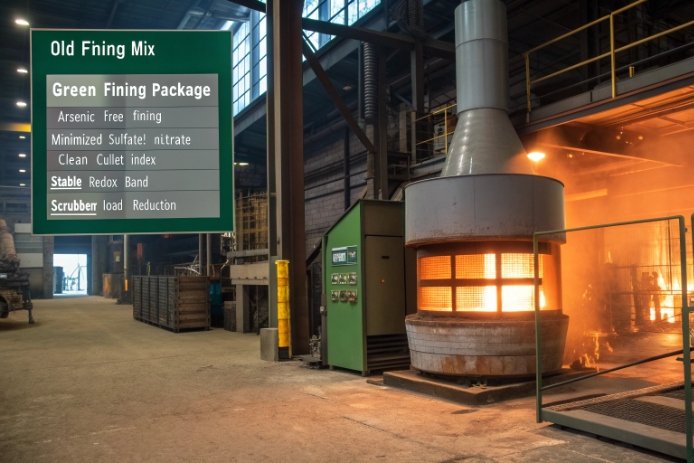
Old fining recipes still hide toxic metals, high SOx, and unstable quality. That mix raises costs, hurts audits, and creates customer claims when defects show up.
An eco-friendly fining system uses low-toxicity chemistry plus process control: stable redox, strong bubbling, and higher cullet. The goal is fewer seeds and cords with less sulfate, lower emissions, and repeatable color at scale.
%
A practical blueprint for “green fining” that still runs at high pull
A “green” fining system is not just a new additive. It is a package: batch recipe, redox window, furnace atmosphere, melt circulation, and QC rules. In mass production, the cleanest approach is usually minimize fining chemistry, then use physics (heat, time, mixing, bubbles) to finish the job.
Start from the defect map, not the supplier brochure
Most bottle plants fight the same defects: seeds (small bubbles), blisters (large bubbles), cords/striae, stones, and scum. Each defect points to a different root cause. If seeds come from sand carryover, no “magic fining” will fix a dirty batch. If blisters come from reboil, extra sulfate can make the problem worse.
Pick a fining route that matches your color and furnace
For flint glass, sulfate-based fining with tight redox control 1 is common. For amber, the redox window is narrower because sulfide-based color chemistry can drift. Oxy-fuel or oxygen-enriched furnaces can also change the oxidizing power, so the same additive dosage will behave differently.
Design targets and limits before the trial
A green fining program needs simple targets that production can follow every shift. These targets must link to customer requirements like clarity, color, and defect rate. At the same time, the plan needs hard limits for SO3 in glass, sulfate carryover, and emission constraints.
| Design item | What to control | “Green” intent | Typical risk if ignored |
|---|---|---|---|
| Fining chemistry | Sulfate level, nitrate level, carbon reducers | Avoid Sb/As; reduce total dosage | Seeds, reboil, high SOx |
| Redox window | Fe2+/Fe total, furnace O2 potential | Stable color and fining efficiency | Color drift, cords, amber haze |
| Melt mixing | Bubbling rate, port balance, pull stability | Replace chemistry with physics | Hot spots, seed lines, blisters |
| Cullet strategy | Cullet %, cullet cleanliness, grain size | Lower energy and batch gas | Stones, inclusions, foam |
| QC rules | Seed count, color ΔE, SO3, leachables | Prove performance at scale | Claims, recalls, audit failure |
A small story that keeps the team aligned
A few years ago, a beverage customer asked for “antimony-free flint” and also demanded tighter color. That sounded like two opposite goals. The solution was not a new additive. The solution was a redox standard plus bubbling discipline plus cullet cleaning. The fining additive became a smaller piece of the total system. That is the mindset that makes green fining real.
Keep reading, because the next sections break down the best replacements for Sb/As, and how to lower dosage without trading quality for emissions.
Which eco-friendly fining agents can replace arsenic- and antimony-based fining in bottle glass?
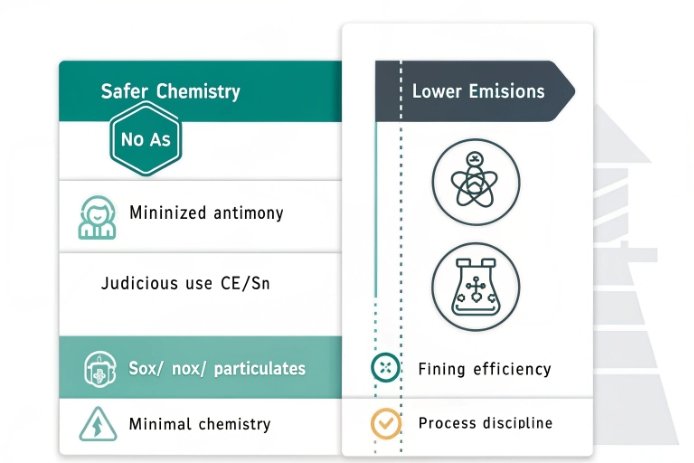
Sb and As work because they support gas release and bubble growth over a useful temperature range. But they create compliance risk and can trigger customer restrictions. A replacement must cover the same technical job with safer chemistry and strong process control.
Eco-friendly replacements usually combine sulfate-based fining (like sodium sulfate) with controlled redox tools (carbon or nitrate balance) and better melt mixing. In some cases, low-toxicity oxidizers or specialty mineral fining aids can support bubble removal without Sb/As.
The main “green” fining toolbox
1) Sulfate-based fining (Na2SO4 / gypsum sources)
Sodium sulfate is widely used in industrial glass as a fining agent. Its key reaction in oxidized melts releases SO2 and O2 at high temperature, which supports refining. (See sulfate fining mechanism 2)
2) Redox pair control (sulfate + carbon / organics)
Sulfate fining depends on the oxygen potential in the melt. A small amount of carbon-based reducer can tune the redox window so sulfate fining happens efficiently, with less total additive. The goal is stable Fe oxidation state, not “more reduction.”
3) Nitrate as an oxidizing helper (carefully)
Nitrates can push the melt more oxidizing and reduce sulfide risk. But they can raise NOx at the stack, so the “green” result depends on your furnace and permit limits. This is a tool, not a default. (See nitrate environmental impact 3)
4) Specialty fining aids (site-specific)
Some plants test low-toxicity mineral systems that change bubble behavior, surface tension, or melt structure. These can help, but they are not universal. The safest approach is to validate them with a clear defect and emission plan.
| Option | Why it can replace Sb/As | Best use case | Key watch-outs |
|---|---|---|---|
| Sulfate-based fining | Proven fining gas behavior | Flint and many colored bottles | SOx emissions, sulfate scum |
| Sulfate + controlled carbon | Higher fining efficiency per kg | When color drift is under control | Risk of sulfide tint if too reducing |
| Sulfate + limited nitrate | Stabilize oxidizing power | Plants fighting sulfide/amber drift | NOx impact, redox overshoot |
| Specialty mineral aids | Can improve bubble coalescence | Plants with unique defect patterns | Cost, supply consistency, unknown side effects |
A practical replacement strategy that scales
The best “replacement” is usually a two-step switch:
1) Remove Sb/As from the fining package.
2) Recover fining power by upgrading process control: redox measurement, bubbling tuning, and cullet quality.
That approach avoids a trap: adding a new chemical to hide a process instability. Stable melting is the real fining agent.
How can redox control, bubbling, and higher cullet ratios reduce fining-agent dosage and furnace emissions?
When fining dosage goes up, emissions often go up too. That is because extra sulfate or oxidizers create more volatile gases. So the clean win is to make each gram of fining chemistry do more work.
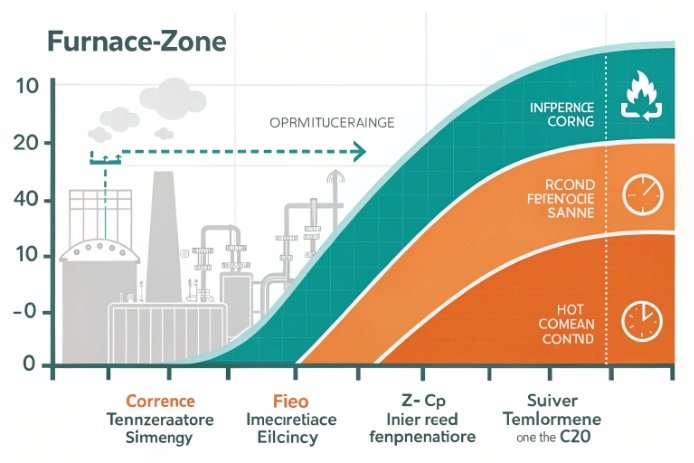
Redox control keeps fining reactions inside the best oxygen window, bubbling improves bubble rise and melt mixing, and higher cullet cuts energy and batch gas. Together, these levers let the plant lower fining dosage while also reducing CO2 and stack pollutants.
Redox control: keep the melt in a narrow “good zone”
Container glass always has iron in it, even in flint. Iron exists as Fe2+ and Fe3+. The ratio changes color and also changes how sulfate behaves. So redox control is a quality tool and an emission tool. (Read about iron redox control 4)
Practical redox control uses:
- Stable fuel/air ratio at each port
- Known carbon contribution from batch and cullet contaminants
- Tight nitrate use, if any
- A simple redox KPI, like Fe2% of total iron, tracked daily
This lowers fining dosage because sulfate reactions become more predictable. Less “extra” sulfate is needed as insurance.
Bubbling: replace chemistry with physics
Bubbling (air, oxygen, or mixed gas) creates convection and helps bubbles collide, grow, and rise. It also reduces temperature stratification. That matters because seeds often survive in colder zones or dead zones. (See bubbling benefits 5)
Good bubbling practice looks boring on purpose:
- A fixed bubbling pattern tied to pull rate
- No “hero adjustments” during shifts
- Maintenance rules to keep bubble stone performance stable
When bubbling is consistent, fining can be reduced because the melt has a better path to clear.
Higher cullet: lower energy and lower batch gas
Cullet melts faster than raw batch. More cullet means:
- Lower specific energy per ton
- Less CO2 from carbonate decomposition (see cullet CO2 savings 6)
- Less foam and batch blanket gas generation
- Often a shorter fining job, because fewer batch reactions remain
But cullet must be clean. Dirty cullet brings organics, labels, metals, and stones. That raises defects and forces higher fining again.
| Lever | How it reduces fining dosage | How it reduces emissions | Common failure mode |
|---|---|---|---|
| Redox control | Higher fining efficiency | Less “extra” sulfate/oxidizers | Color drift, sulfide tint |
| Bubbling | Faster bubble removal | Lower need for volatile fining | Uneven bubbling, seed lines |
| Higher cullet | Fewer batch reactions | Lower CO2, often lower SOx need | Dirty cullet increases defects |
A simple implementation order
Most plants get the fastest result by doing this order:
1) Fix cullet cleanliness and sizing.
2) Stabilize bubbling and port balance.
3) Then cut fining dosage step-by-step while tracking seeds and color.
That order avoids chasing defects with chemicals.
How do sulfate-based fining systems impact bottle color consistency, clarity, and defect rates?
Sulfate fining can be clean and stable, but it has a personality. It is sensitive to redox and temperature. So it can improve clarity while also creating new defects if the system is not balanced.
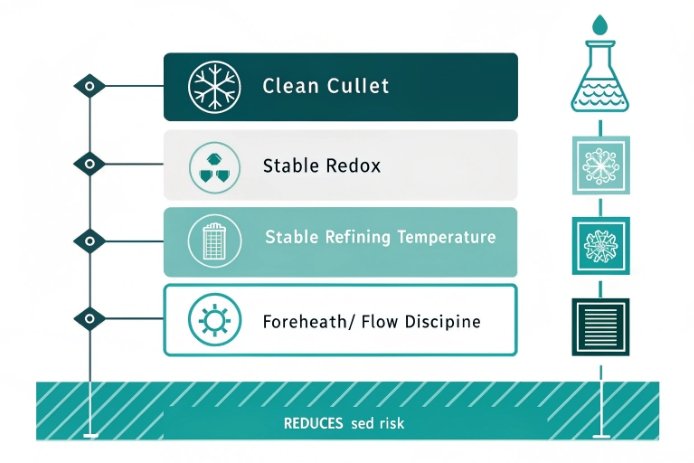
Sulfate-based fining can deliver very good clarity when redox and temperature are stable. But it can also shift color (through iron oxidation changes), raise the risk of sulfate scum or reboil, and change defect rates if SO3 balance and furnace atmosphere are not controlled.
Color consistency: sulfate links directly to redox
Color in bottle glass is not only about pigments. It is also about the oxidation state of iron and sulfur species. A more oxidizing melt pushes iron toward Fe3+. That can make flint look slightly greener or change the base tone that customers notice under retail lights. In amber glass, sulfur chemistry is part of the color system, so sulfate and redox changes can create bigger shifts.
This is why sulfate fining should be paired with:
- A defined redox window (not “as oxidizing as possible”)
- Stable furnace atmosphere, especially near the refining zone
- Controlled carbon input from batch and cullet
Clarity: sulfate can be excellent when the melt is calm
Sulfate fining helps small bubbles grow. That reduces seed count and improves brilliance. But it works best when:
- The refining zone is hot enough
- Residence time is sufficient
- Mixing is strong but not chaotic
Too much turbulence can trap bubbles, and too much sulfate can cause reboil when the glass cools in the forehearth or conditioning zones. (See reboil causes 7)
Sulfate can increase or decrease defects depending on balance:
- Sulfate scum / salt cake carryover: can show as surface defects or inclusions.
- Reboil: bubbles form again during cooling if dissolved gases come out.
- Foam: high sulfate and unstable batch conditions can increase foam, reducing heat transfer. (Read sulfate foam issues 8)
| Topic | Positive impact of sulfate fining | Risk if sulfate is too high | Process control that prevents problems |
|---|---|---|---|
| Color consistency | Stable oxidizing power | Fe oxidation drift; sulfide tint risk if redox swings | Redox KPI, stable combustion |
| Clarity | Lower seed count | Reboil in downstream zones | Temperature profile + bubbling |
| Defect rate | Fewer seeds when balanced | Scum, foam, blisters | SO3 balance, batch carryover control |
A “color-first” rule that reduces claims
For customer-facing bottles, color complaints often arrive before seed complaints. So the green fining plan should treat color as a primary control variable, not a secondary check. That means setting a tight ΔE limit, then tuning sulfate and redox together to stay inside it.
What QC tests and compliance documents should you require to prove a “green” fining system works in mass production?
A green fining change is a process change and a compliance change. Customers will ask for proof, and internal teams will need fast signals when quality drifts.
To prove a green fining system works, require evidence in three layers: glass quality tests (seeds, cords, color), chemical verification (SO3, Sb/As-free confirmation, redox indicators), and compliance documents (SDS, REACH/RoHS-style declarations where required, and product safety or food-contact statements based on your target market).
QC tests that catch fining failure early
These tests give fast feedback and connect to real defects:
- Seed count: manual inspection with standard lighting, or camera-based bubble counting where available.
- Clarity and haze: simple haze measurement or visual standards on a light box.
- Cord/striae check: polariscope inspection for stress patterns and flow lines.
- Color control: spectrophotometer with CIE Lab* and a tight ΔE rule per SKU. (See Delta E explained 9)
- SO3 in glass: routine chemistry check to confirm sulfate balance.
- Redox indicator: Fe2+/Fe total, or another agreed proxy, tracked daily.
For higher confidence:
- XRF composition for batch stability
- ICP analysis to confirm Sb/As are below agreed limits
- Chemical durability tests for your market (especially for food and beverage)
Emissions and furnace health checks
A green system should also show better furnace behavior:
- Stack trend tracking for SOx and NOx (based on your plant monitoring setup)
- Dust and deposit monitoring around regenerators or filter equipment
- Condenser or crown inspection notes if sulfate volatility was a historic issue
Documents that procurement and auditors actually use
The exact list depends on market, but these are common in global B2B packaging:
- SDS for every fining additive and batch chemical
- Certificate of Analysis (CoA) per lot for the fining package
- Declaration of Sb/As-free with test method and limits
- REACH-style SVHC statement for EU-bound products, when required by customers (see ECHA REACH 10)
- RoHS-style heavy metal declaration when customers request it for internal policy reasons
- Food-contact or packaging safety statements for food and beverage customers, aligned to the target market rules
- Change control packet: trial plan, results, control limits, and mass-production sign-off
| Proof type | What to collect | Pass/fail signal | Why customers trust it |
|---|---|---|---|
| Product quality | Seeds, cords, haze, color ΔE | Meets spec across full shift/week | Directly matches bottle appearance |
| Chemistry | SO3, Fe redox proxy, Sb/As analysis | Inside control limits | Shows the fining system is real |
| Compliance | SDS, CoA, declarations, market statements | Complete and consistent | Supports audits and brand policies |
| Production stability | Defect PPM, furnace trends | No hidden cost increase | Proves scalability, not just a lab win |
A mass-production rule that avoids “pilot success, factory failure”
Pilot trials often look perfect because the furnace is watched closely. Mass production fails when control limits are not simple. So every KPI should have:
- A target
- A warning band
- A clear action step for operators
That is how a green fining system stays green after the first month.
Conclusion
A truly eco-friendly fining system cuts toxic metals, lowers sulfate load, and uses redox discipline, bubbling, and clean cullet to hold clarity and color at scale.
Footnotes
-
Technical article explaining glass redox and its impact on color. ↩
-
Study on sulfate fining efficiency and gas release mechanisms in glass melts. ↩
-
Research on the environmental impact of nitrates in glass manufacturing. ↩
-
Detailed guide on controlling iron redox for consistent glass color. ↩
-
Overview of furnace bubbling systems and their benefits for melt homogeneity. ↩
-
Information on the sustainability benefits of using cullet in glass production. ↩
-
Analysis of reboil phenomena and fining agent behavior in glass. ↩
-
Discussion on sulfate fining and foam formation issues in glass furnaces. ↩
-
Explanation of Delta E as a standard metric for color difference. ↩
-
Official ECHA page explaining REACH regulations for chemical substances. ↩






