
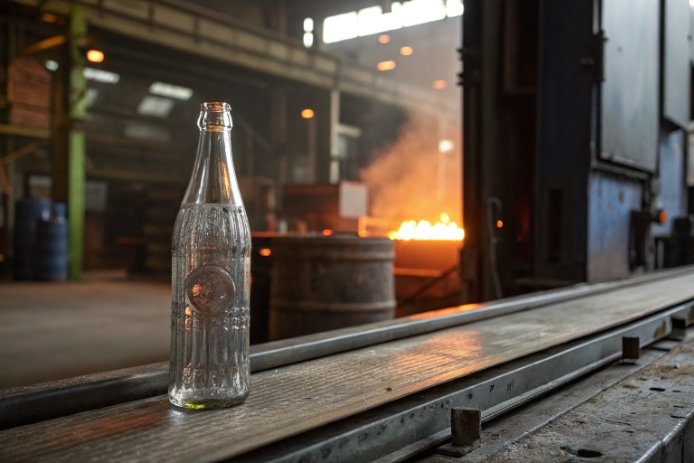
Bottles break after shipping, not after inspection. That hurts brands and costs money. Most teams blame packing, but the stress was already inside the glass.
Thermal stress relief is the controlled removal of internal stress while glass is still able to relax. Composition sets the annealing and strain behavior, so it sets how forgiving the lehr is, how low residual stress can go, and how stable QA yields stay at high line speed.
The real link: composition controls how fast stress can relax
Stress relief in bottle glass is not a “lehr only” topic. It starts in the formulation because formulation controls viscosity, structural relaxation 1, and thermal expansion. Those three items decide whether stress disappears, or whether it locks in and hides until the bottle sees impact or temperature change.
Stress relief is a race between two clocks
A bottle cools unevenly. The skin cools first. The core cools later. …That temperature difference creates thermal stress. Stress relief happens only while the glass still has enough mobility to flow on a microscopic level. That mobility is tied to viscosity. The classic reference points are the annealing point (viscosity about 10^13 Poise) and the strain point (viscosity about 10^14.5 Poise). Stress relaxes in minutes near the annealing point and in hours near the strain point. :contentReference[oaicite:0]{index=0}
So the “race” looks like this:
-
Clock A: how fast the temperature gradient 2 forms and changes
-
Clock B: how fast the glass structure can relax stress at that temperature
Composition shifts clock B. That is why two bottles with the same shape can show very different polariscopic stress results.
Why QA yields depend on chemistry stability
Residual stress is not only about breakage. It is also about inspection stability. When stress is high or uneven, bottles show more random failures in impact tests, thermal shock tests 3, and even some sealing outcomes. This increases sorting, rework, and customer complaints. So a stable formulation often raises QA yields even when the lehr profile stays the same.
The control mindset that works on a production line
Instead of asking “Is stress low today?”, it helps to ask “Is the process robust today?”. Robust means the lehr has margin even when:
-
cullet percentage drifts,
-
raw material chemistry moves,
-
ambient airflow changes,
-
belt loading changes.
| Formulation lever | What it changes | What it does to stress relief risk |
|---|---|---|
| Na2O / K2O level | Viscosity curve and CTE | Can tighten the window if it makes the curve steeper and expansion higher |
| CaO + MgO balance | Stability, viscosity shape, CTE | Can shift how forgiving the anneal range is |
| Al2O3 | Network strength and relaxation | Often improves durability, but can raise viscosity and narrow forming margin |
| SiO2 | Network former and CTE | Can reduce expansion but raises melting and forming temperature needs |
This is the reason formulation work and lehr work should be one meeting, not two. The next sections break the problem down in the same way a plant team thinks about it.
If the goal is higher yield, the fastest path is to define what “stress relief” means in bottle terms, then link it to the measurements already used in QA.
What is thermal stress relief in bottle glass?
Many plants say “the bottle is annealed” when it leaves the lehr. That statement is only true if the internal stress had time to relax before the glass became too stiff.
Thermal stress relief is the reduction of internal thermal stress during controlled cooling, mainly while the glass is between the annealing point and strain point. It works when the bottle reaches a uniform soak in that range, then cools through it without rebuilding stress.
…How thermal stress is created
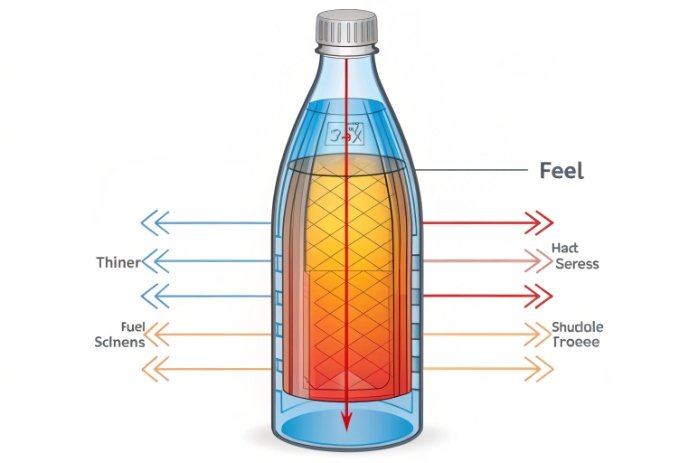
Thermal stress 4 starts when different parts of the bottle cool at different rates. The finish holds heat. The heel and base can be thick. …The body can be thin. Airflow and radiation in the lehr also change across the belt. …When the surface contracts while the core is still hot, stress builds. If cooling continues too fast, stress grows.
How stress is relieved
Stress relief needs two steps:
1) Soak: bring the whole bottle close enough to the annealing temperature so stress can relax quickly.
2) Controlled cooling: cool through the strain region at a rate that does not lock high stress into the structure.
The key idea is that below the strain point, stress relaxation becomes too slow for production time. That is why the time spent in the critical range matters. The viscosity-based definitions for annealing and strain points are widely used in glass engineering references. :contentReference[oaicite:1]{index=1}
How QA proves stress relief happened
Most QA teams use polariscopic methods to check the “state of anneal.” …For glass containers, ASTM C148 describes polariscopic examination 5 and reports optical retardation values 6 tied to residual stress. :contentReference[oaicite:2]{index=2}
This is a practical tool because it links directly to the risk of delayed breakage and the risk of thermal shock failure.
| QA question | Practical check | What “good” looks like in practice |
|---|---|---|
| Is residual stress low? | Polariscope / retardation | Low, stable readings across shifts |
| Is stress evenly distributed? | Scan heel, shoulder, finish | No sharp stress bands or hot spots |
| Does stress drift with speed? | Stress vs belt speed trend | A wide speed band with stable stress |
| Do complaints match stress? | Correlate breaks to stress data | Break spikes show up in stress first |
Thermal stress relief is not a mystery process. It is controlled cooling plus measurable proof. Once this definition is clear, the next question becomes the money question: how composition can reduce residual stress and raise QA yields without slowing the line.
How does composition lower residual stress for QA yields?
Residual stress is not only caused by a bad profile. It is also caused by a glass that is too sensitive to small profile drift.
Composition lowers residual stress when it makes stress relaxation more forgiving and reduces stress creation during cooling. In practice, that means a viscosity curve that does not “flip” fast near the anneal range, plus a lower and more stable thermal expansion behavior for the same bottle geometry.
…Two composition paths to lower stress
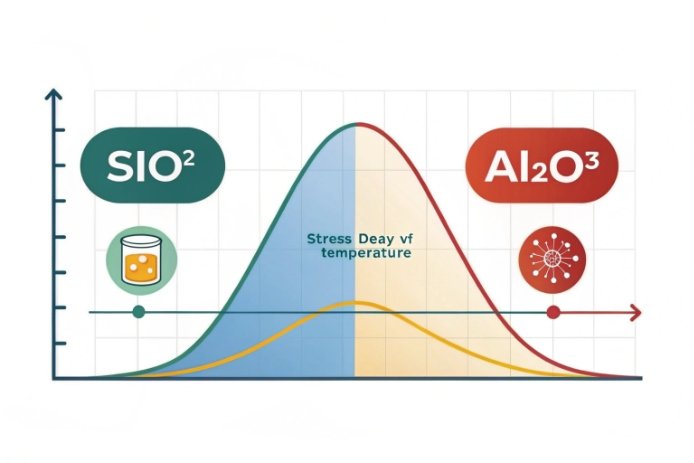
Path 1 is relax faster at the same temperature. If the glass can relax stress more easily in the critical range, the lehr does not need perfect setpoints every minute.
Path 2 is create less stress during cooling. …Thermal expansion (CTE) 7 matters because stress is driven by contraction differences. A formulation with lower CTE tends to reduce stress for the same temperature gradient.
What oxides usually do in soda-lime container glass
-
Higher alkali (Na2O/K2O): helps melting and working, but it often raises CTE and can make stress more sensitive to cooling rate.
-
More SiO2 and Al2O3: tends to strengthen the network and can lower CTE, but it increases viscosity and can push forming temperatures higher.
-
CaO and MgO tuning: changes the stabilizer structure and the viscosity shape. This is a strong knob because it can shift working range and stress behavior without changing color.
The biggest yield gain often comes from reducing day-to-day variation. If raw materials drift and the formulation is already close to a tight stress limit, then QA yields swing. When composition is set in a more stable window, the same lehr becomes easier to run.
| Composition change (small step) | Stress effect direction | What to watch so nothing else breaks |
|---|---|---|
| Slightly reduce total alkali | Often lowers CTE and stress sensitivity | Higher gob temperature need, melting load |
| Slightly increase SiO2 | Often lowers CTE and can stabilize cooling stress | Energy, fining, seeds risk |
| Add small Al2O3 | Often improves durability and stability | Forming marks if viscosity rises too much |
| Tune CaO/MgO | Can widen or narrow the anneal window | Liquidus and devit risk, stones trend |
This is not a “pick one oxide and win” game. The right move depends on what limits the line today: lehr capacity, forming stability, or breakage after packing. When the limiting factor is annealing, batch tweaks should be chosen to make the lehr more forgiving at the speed target.
Which batch tweaks improve annealing windows on your line?
When a line runs fast, the lehr has less time. If the annealing window is narrow, the belt speed band becomes tight, and rejects rise.
Batch tweaks improve the annealing window when they reduce viscosity sensitivity near the anneal range and reduce thermal expansion stress. The best tweaks are small, controlled moves in alkali, Al2O3, and CaO/MgO, while keeping total stabilizers and cullet quality stable.
Before changing chemistry, the fastest win is to reduce drift:
-
Keep cullet chemistry stable by supplier and color.
-
Control sulfate and fining behavior so temperature profiles do not wander.
-
Control raw material moisture so batch-to-batch ratios do not shift.
This matters because an “annealing problem” is often a drifting formulation problem.
Step 2: pick tweaks that match the lehr limitation
If the lehr is short or the soak zone is limited, the glass needs to relax stress faster in the available time. If the main issue is stress created during cooling, lowering CTE and improving temperature equalization helps more.
Practical tweak set A: reduce stress creation
-
Reduce total alkali slightly, if the furnace and forming can handle it.
-
Increase SiO2 slightly, if melting capacity is strong.
These moves often lower expansion and reduce stress build for the same gradient.
Practical tweak set B: make relaxation more forgiving
-
Add a small Al2O3 increase to stabilize structure and durability.
-
Tune CaO/MgO to adjust the viscosity curve near Tg.
These moves often help stress relaxation behavior, but they must be watched for forming stiffness and devit risk.
Step 3: validate with stress data, not only with chemistry sheets
Use a simple trial plan:
-
Change one lever at a time.
-
Hold the lehr profile constant for a short baseline, then retune to best profile.
-
Track polariscopic stress 8 using the same bottle locations each time (heel, shoulder, finish).
ASTM C148 is a common reference for polariscopic state-of-anneal checks on glass containers, so it is a strong backbone for trial validation. :contentReference[oaicite:3]{index=3}
| Line target | Best batch tweak direction (typical) | Fast confirmation metric |
|---|---|---|
| Higher belt speed with same stress | Make relaxation more forgiving | Stress vs speed curve flattens |
| Lower delayed breakage | Lower CTE and stress peaks | Fewer high-stress hot spots in scans |
| Stable QA yields across shifts | Reduce chemistry drift sources | Lower stress standard deviation |
| Less sensitivity to zone drift | Widen usable temperature band | Fewer stress alarms and fewer tweaks |
On most lines, the biggest improvement comes from small, disciplined chemistry moves plus tighter raw material control. Big recipe changes usually create new problems in melting, forming, or color.
Will new stress models reshape bottle specs in the next 3 years?
Specs usually lag behind plant reality. Plants measure stress and breakage daily, but many customer specs still talk in broad terms.
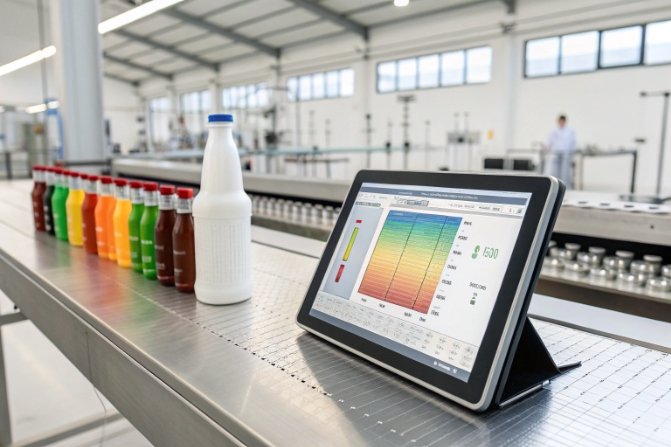
New stress models are likely to reshape bottle specs because they link process history to residual stress and failure risk. Models based on structural relaxation, combined with live data, can support tighter and more meaningful stress limits, and they can reduce over-design in weight and thickness.
What “new stress models” means in real terms
Many modern annealing simulations use structural relaxation ideas. The Tool–Narayanaswamy–Moynihan (TNM) 9 family is widely referenced for glass structural relaxation behavior, and it is supported in commercial simulation tools for predicting relaxation in glass. :contentReference[oaicite:4]{index=4}
When these models are tied to bottle geometry and real lehr temperature histories, they can estimate stress outcomes without testing every single change by trial and error.
Why this can change specs
Specs often use simple limits like “maximum retardation” or “state of anneal class.” Those are good, but they are not always tied to the real failure modes of a specific bottle in a specific supply chain.
A stronger future spec can connect:
-
where stress is located (heel vs shoulder vs finish),
-
how stress changes after filling temperature,
-
how stress combines with impact risk,
-
how variation across a shift affects failure probability.
This makes specs more predictive and less subjective.
What is likely to happen in the next 3 years
A realistic view is not “all specs will change.” Some brands will keep simple limits. But more plants will use model-based tuning to run closer to the optimum. Industry activity around digital twins 10 in glass manufacturing is growing, and some projects already describe digital-twin development for glass container equipment using simulation and data integration. :contentReference[oaicite:5]{index=5}
That same approach fits lehr control very well because the lehr is a controlled thermal system with repeatable boundary conditions.
| Spec topic | Today (common) | Next 3 years (likely direction) |
|---|---|---|
| Stress acceptance | Single max value | Profile-based limits by bottle zone |
| Sampling plan | Periodic manual checks | More in-line tracking and trending |
| Root cause | “Lehr issue” label | Model shows if chemistry, geometry, or profile caused it |
| Design margins | Extra weight “just in case” | Better modeling supports targeted thickness, not blanket weight |
A careful prediction is this: stress models will not replace polariscope QA soon, but they will change how specs are written and how quickly new bottles and new recipes are approved.
Conclusion
Thermal stress relief lives between anneal and strain behavior, and chemistry controls that behavior. Small, controlled oxide tweaks can widen the window, raise QA yields, and support smarter stress specs soon.
Footnotes
-
[Explains the time-dependent rearrangement of glass structure towards a more stable state.] ↩
-
[A physical quantity that describes in which direction and at what rate the temperature changes.] ↩
-
[Standardized testing methods to determine the resistance of glass containers to sudden temperature changes.] ↩
-
[Mechanical stress created by any change in temperature of a material, leading to potential fracture.] ↩
-
[Standard method for evaluating the annealing quality of glass containers using polarized light.] ↩
-
[A measure of the phase shift between polarization components, directly indicating the level of residual stress.] ↩
-
[A critical property defining how the dimensions of glass change in response to temperature variations.] ↩
-
[Visual assessment of internal stress patterns in transparent materials using a polariscope.] ↩
-
[A widely referenced mathematical model used to predict the non-linear structural relaxation behavior of glass.] ↩
-
[Virtual replicas of physical manufacturing systems used for simulation, monitoring, and optimization.] ↩






