
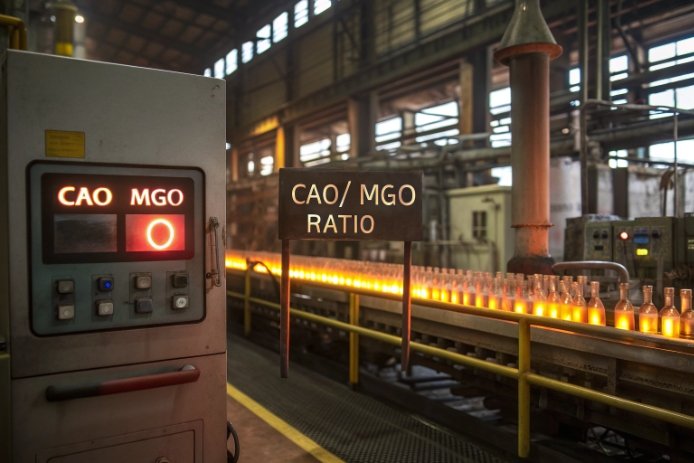
Fast lines and tough distribution can ruin a bottle that looks perfect on paper. A small chemistry drift can turn into checks, scuffs, and more rejects.
Determine alkaline-earth ratios by measuring CaO and MgO in the finished glass or by calculating from batch and cullet inputs. CaO and MgO work as stabilizers, but the Ca/Mg balance changes durability, thermal expansion, viscosity, and liquidus risk, so it also changes how hard the line can run.
Alkaline-earth ratios: what they mean and how to measure them
“Alkaline earth” in container glass usually means the CaO and MgO fraction in soda-lime-silica glass. In daily plant talk, people say “lime and magnesia.” The ratio sounds simple, but it must be defined clearly or two teams will argue while both are correct.
Define the ratio before anyone starts comparing data
Most plants use one of these three:
– Weight ratio: CaO/MgO (wt%/wt%)
– Molar ratio: (mol% CaO)/(mol% MgO)
– Fraction of the alkaline-earth pool: CaO/(CaO + MgO) in wt% or mol%
The “pool” ratio is often best for process control because it stays meaningful when total stabilizer level changes.
Two practical ways to determine Ca/Mg
1) Measure the finished glass (what the line really sees).
Quality teams often use XRF 1 on a ground glass sample because it is fast and stable. ICP-OES also works well if the lab already runs digestions for other elements. Either method gives Ca and Mg, and the results convert to CaO and MgO by standard factors. This approach captures everything, including cullet variation and volatilization effects.
2) Calculate from batch + cullet (what the furnace is fed).
This is the fastest way to manage drift. A batch calculation uses the CaO and MgO contribution from limestone, dolomite 2, cullet, and any other MgO sources. It does not replace real glass chemistry checks, but it helps predict shifts before they hit the forehearth.
A simple calculation workflow that works on a production floor
1) Take the latest lab values (wt% CaO and wt% MgO) from glass samples.
2) Convert to mol% when you care about structure, durability, and expansion.
3) Track CaO/(CaO + MgO) as the main control number.
4) Put it on a control chart and link alarms to real outcomes (checks, scuffs, seeds, forming stability).
| Item | What to use | Why it matters |
|---|---|---|
| Routine tracking | CaO/(CaO + MgO) by wt% | Easy to compare across shifts and suppliers |
| Structure + leaching models | Molar CaO/MgO | Field strength effects follow moles, not mass |
| Batch planning | Raw material CaO and MgO assays | Predict drift before glass chemistry shifts |
| Confirm with reality | XRF or ICP on finished glass | Captures cullet and furnace behavior |
A plant does not need a perfect model to benefit. It needs one ratio definition, one trusted measurement method, and a link to real line performance.
A short note from experience: when a flint bottle program starts to show random scuff changes, the root cause is often not “coating” first. It is usually small chemistry and coating interaction, and Ca/Mg drift is one of the first things worth checking.
This is where CaO and MgO start to matter beyond “two numbers on a lab sheet.”
A good ratio is not “high” or “low.” It is the ratio that keeps durability stable while the line speed stays where the business needs it.
What roles do CaO and MgO play together?
When rejects rise, teams often blame molds, air, or coatings. But the glass structure sets the baseline. CaO and MgO sit in the structure as network modifiers. They also stabilize soda-lime glass against water attack.
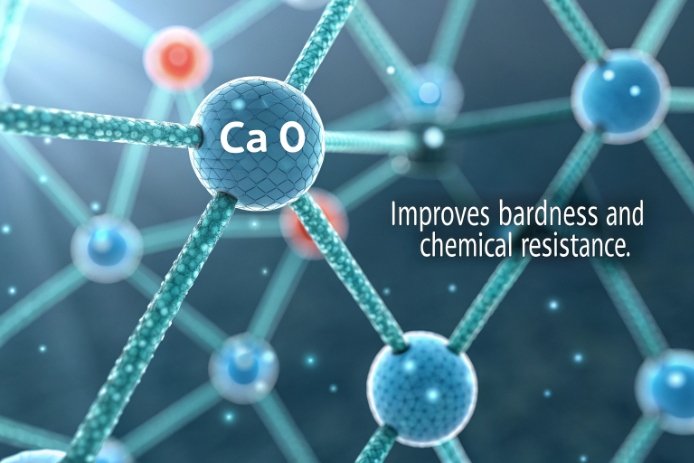
CaO and MgO work together as stabilizers that reduce alkali leaching, strengthen the network, and help the glass survive water and handling. CaO tends to support classic container durability and forming stability, while MgO can shift viscosity, working range, and expansion, so the “best” mix depends on the forming and use case.
Stabilizers, but not identical stabilizers
Both Ca2+ and Mg2+ charge-balance non-bridging oxygens 3 created by alkali fluxes. That reduces how easily Na+ can exchange and leach in water. This is a main reason soda-lime glass uses alkaline earths at all.
But Ca2+ and Mg2+ do not behave the same:
– Mg2+ has higher field strength and a smaller ionic radius. It can “hold” oxygen more tightly in many structures. This can change how the surface hydrates and how fast ions move.
– Ca2+ is larger and often supports a broader practical process window in container recipes. Many container plants rely on CaO as the main stabilizer and use MgO as a smaller tuning knob.
The mixed alkaline-earth effect is real in practice
When two different alkaline earth modifiers exist together, the system can show non-linear behavior. Small shifts can change leaching dynamics and surface exchange in ways that a straight-line assumption misses. This is why a “same total CaO + MgO” rule does not always guarantee “same durability.”
Typical container glass context
Container glass compositions vary by plant and region, but soda-lime-silica container recipes often sit near a stable window where SiO2 is the main former, Na2O is the key flux, and CaO + MgO provide durability. A container line also faces cold-end coating 4 behavior and carton rub. That makes the modifier balance important in real distribution.
| Change in recipe direction | What usually improves | What can get worse | What to watch on the line |
|---|---|---|---|
| More CaO, less MgO (same total) | Classic hydrolytic stability in many recipes | Thermal expansion can rise a bit | Checks, anneal lehr margin |
| More MgO, less CaO (same total) | Expansion can drop in some windows | Viscosity can rise and forming can tighten | Gob temperature stability, forming marks |
| Higher total CaO + MgO | Water durability and stiffness can improve | Melt can be harder and energy use can rise | Furnace pull rate, fining behavior |
In short, CaO and MgO are a team. But they are not interchangeable parts. The best ratio is the one that keeps durability stable while still letting the furnace and forming do their jobs at speed.
Why does Ca/Mg balance affect durability and thermal expansion?
A bottle can pass dimensional checks and still fail in the market. The surface reacts with water, detergents, and time. The glass also expands and contracts every day in filling, cooling, and shipping.
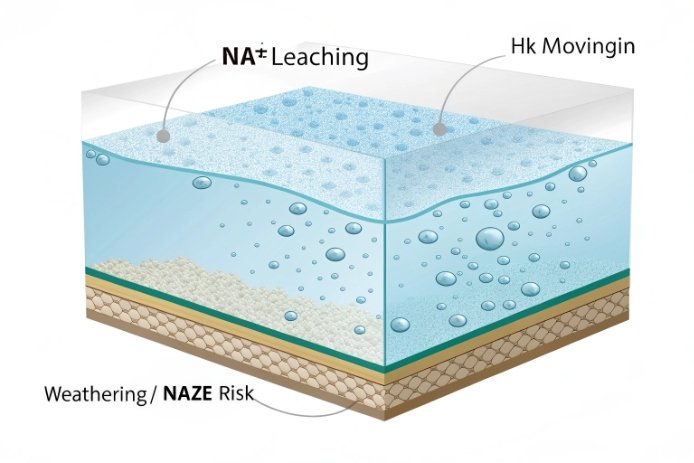
Ca/Mg balance affects durability because CaO and MgO change how easily alkali ions exchange and leach at the surface. It affects thermal expansion because modifier type changes bond stiffness and how the silicate network responds to heat, which changes internal stress risk and thermal shock margin.
Durability: what “better” means for container glass
For most beverage and food bottles, the concern is hydrolytic behavior and surface stability. If the surface becomes more reactive, it can haze, it can label poorly, and it can change friction and scuff behavior. In special cases, it can also matter for returnable glass and repeated washing.
Durability testing often uses standardized hydrolytic resistance 5 methods on glass grains because they give repeatable data. Those tests do not copy every real use case, but they show how composition shifts can move leaching behavior.
Ca/Mg balance matters because Ca2+ and Mg2+ change the local environment around non-bridging oxygens. That changes ion mobility and how fast the surface layer forms. A balanced recipe can slow down the leaching of alkali ions under water exposure.
Thermal expansion: why the line should care
Thermal expansion 6 is not just a datasheet number. It controls stress build during cooling and reheating. It also controls how sensitive a bottle is to thermal shock events, like cold filling followed by warm storage, or hot rinse followed by cool air.
A common pattern in soda-lime silicates is that alkali raises thermal expansion. Alkaline earth modifiers usually have a lower expansion effect than alkali, but CaO and MgO still shift the number. If MgO replaces part of CaO, the coefficient of thermal expansion can move, and the anneal lehr margin can change. That can show up as more checks, more breakage, or a tighter safe zone on line temperature.
| Property area | If MgO fraction rises (holding many things constant) | Why it matters |
|---|---|---|
| Hydrolytic surface behavior | Can change in a non-linear way | Mixed modifier effects can shift leaching |
| Viscosity at forming | Can rise in some recipe windows | A hotter gob may be needed for same shape |
| Thermal expansion | Often trends lower in many windows | Stress and thermal shock risk can shift |
| Anneal margin | Can tighten if viscosity/CTE shifts | Lehr settings may need retune |
The key is to treat Ca/Mg as a durability and stress lever, not only as a batch cost lever. A small ratio change can look harmless in chemistry numbers but still move lehr stability and surface behavior.
How to set Ca/Mg ratio for line speed targets?
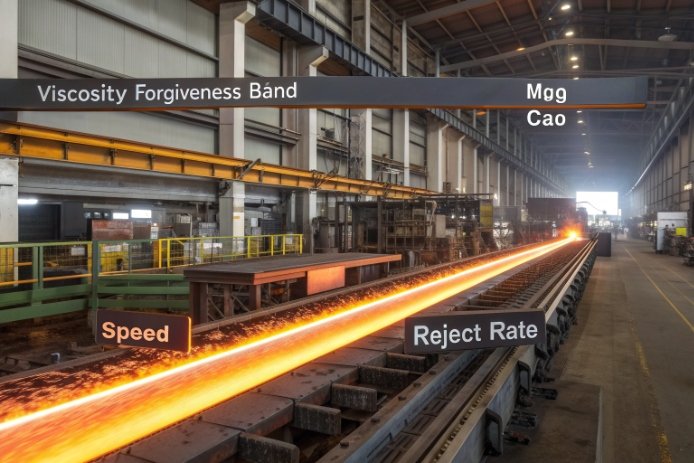
Line speed targets push the forming window. The furnace must supply glass at stable viscosity. The forehearth must keep temperature stable. The mold must fill cleanly. Small shifts in viscosity and liquidus risk show up as defects fast.
Set Ca/Mg ratio by linking it to the viscosity curve and working range that the forming machine needs. Keep total stabilizers in a controlled band, then adjust Ca/Mg in small steps while tracking gob temperature, forming marks, and defect trends. Use models for direction, but confirm with plant trials and glass chemistry checks.
Start with the bottleneck, not with the ratio
A line speed limit usually comes from one of these:
– Glass is too stiff at the current gob temperature.
– The working range is narrow, so the safe forming window is small.
– Liquidus or devitrification risk increases, so stones and cords rise.
– Annealing margin is tight, so checks rise when speed increases.
Ca/Mg affects each one. But it rarely fixes everything at once. So the best plan starts with a clear target, like “reduce forming viscosity at the same temperature,” or “increase working range without raising expansion too much.”
Use viscosity targets as the main control language
Many plants define target viscosities at key steps, like gob delivery and forming. A small Ca/Mg move can shift the viscosity-temperature relationship. Some studies show that replacing CaO with MgO can increase viscosity in certain soda-lime windows. That means a higher MgO share can require a hotter gob for the same mold fill, which can fight against speed and energy goals.
So the workflow becomes:
1) Lock SiO2 and alkali in their normal bands.
2) Lock (CaO + MgO) in a narrow band first.
3) Move Ca/Mg by a small step.
4) Watch gob temperature needs and forming stability.
5) Check liquidus indicators and stone rate.
6) Retune lehr if expansion shifts.
Treat line speed as a system KPI
Line speed is not only “machine cycles.” It is also reject rate, downtime, and complaint risk. A fast but unstable line is slow in real cost.
| Line symptom when speed rises | Likely glass-property driver | Ca/Mg direction that may help | What to confirm |
|---|---|---|---|
| More forming marks, poor finish | Viscosity too high at gob temp | Raise Ca fraction or reduce Mg fraction (small steps) | Viscosity proxy, gob temp trend |
| More stones or devit | Liquidus window too tight | Avoid moves that raise liquidus risk in your recipe | Liquidus checks, stone counts |
| More checks after lehr | Stress/CTE or anneal mismatch | Adjust Ca/Mg, then retune lehr | Polariscopic checks, breakage data |
| More scuff and carton rub change | Surface + coating interaction | Keep Ca/Mg stable, avoid drift | CoF tests, rub tests, coating audit |
A plant can hit line speed targets with Ca/Mg tuning, but it must be done with a trial plan and a clear stop rule. The best ratio is the one that holds viscosity and stress stable while the business pushes more bottles per hour.
Are dolomite specs tightening to improve consistency?
Raw materials look simple on purchase orders. But a small shift in dolomite chemistry or size can shift melting, foam, color, and Ca/Mg ratio. That can turn into downtime fast.
Many glass buyers are paying more attention to dolomite chemistry and particle size because it drives CaO and MgO consistency. Specs often focus on tighter Fe2O3 for flint clarity, tighter CaO/MgO for stable ratios, and tighter particle size distribution for steady melting and less segregation. Published “industry-wide tightening” is hard to prove, but buyer emphasis on consistency is clear in technical guidance and supplier positioning.
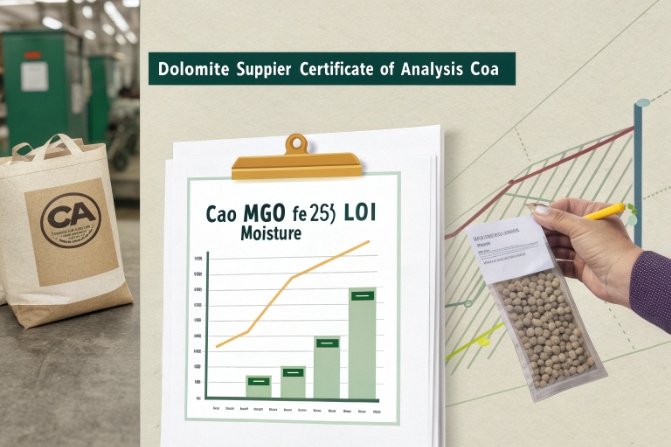
What dolomite controls in one raw material
Dolomite is a combined Ca and Mg source. That means one truckload can move two oxides at once. If a plant uses dolomite heavily, dolomite variation can show up as Ca/Mg drift in the finished glass, even if limestone stays stable.
Key dolomite spec items that matter for bottles:
– CaO and MgO (or CaCO3 and MgCO3) content: sets the core ratio.
– Fe2O3 and other coloring impurities: critical for flint.
– SiO2 and Al2O3 impurities: can shift melt behavior and stone risk.
– LOI (Loss on Ignition) 7 and moisture: affect batch weight control and furnace energy.
– Particle size distribution (PSD): affects melting rate, segregation, and dust.
Technical guides for glassmaking carbonates often stress PSD measurement and controlled preparation because melting and batch homogeneity depend on it. In real operations, tighter PSD means fewer “hot and cold spots” in the batch blanket. That helps furnace stability and fining.
Why consistency pressure is higher now
Several trends push buyers toward tighter raw material control:
– Higher line speeds reduce defect tolerance.
– Higher cullet use can add variability, so the virgin batch must be steadier.
– Flint bottles face strong market pressure on clarity and color.
– Energy targets push for stable melting and fewer corrections.
Even when a spec sheet does not look “tighter,” procurement teams often add stronger receiving controls. They also request more frequent certificates and tighter lot tracking.
| Dolomite spec item | Why it matters to bottle consistency | Common control action | Simple receiving check |
|---|---|---|---|
| CaO/MgO variability | Moves alkaline-earth ratio and viscosity window | Narrow acceptance range by supplier lot | XRF on incoming sample |
| Fe2O3 | Drives tint, especially in flint | Lower maximum Fe2O3 for premium flint | Color audit + chemistry |
| PSD (coarse/fines balance) | Affects melting speed and segregation | Sieve spec, avoid excess fines | Sieve test, dust check |
| Moisture/LOI | Affects batch accuracy and energy | Covered storage, set max moisture | Moisture test, weight checks |
| Insolubles | Can raise stone risk | Max insoluble content | Melt test or supplier audit |
The practical answer is simple: dolomite specs often become more detailed when a plant targets higher speed and tighter color. Consistency is the real goal, not a specific magic number on Ca/Mg.
Conclusion
Measure CaO and MgO with one clear ratio definition, then tune Ca/Mg for viscosity and stress stability. Stable raw materials, stable ratios, and the line runs faster with fewer surprises.
Footnotes
-
XRF: X-ray Fluorescence, a standard non-destructive technique used for rapid elemental analysis of glass composition. ↩
-
Dolomite: A mineral composed of calcium magnesium carbonate, a primary raw material for introducing CaO and MgO into glass batches. ↩
-
Non-bridging oxygens: Oxygen atoms in the glass network bonded to only one silicon atom, affecting glass stability and viscosity. ↩
-
Cold-end coating: A protective layer applied to glass containers after annealing to reduce friction and improve scratch resistance. ↩
-
Hydrolytic resistance: A measure of how well glass resists chemical attack by water, critical for pharmaceutical and food containers. ↩
-
Thermal expansion: The tendency of matter to change in volume in response to a change in temperature, affecting thermal shock resistance. ↩
-
LOI (Loss on Ignition): A test used in inorganic analytical chemistry, particularly for minerals, where the loss of mass upon heating is measured. ↩






