
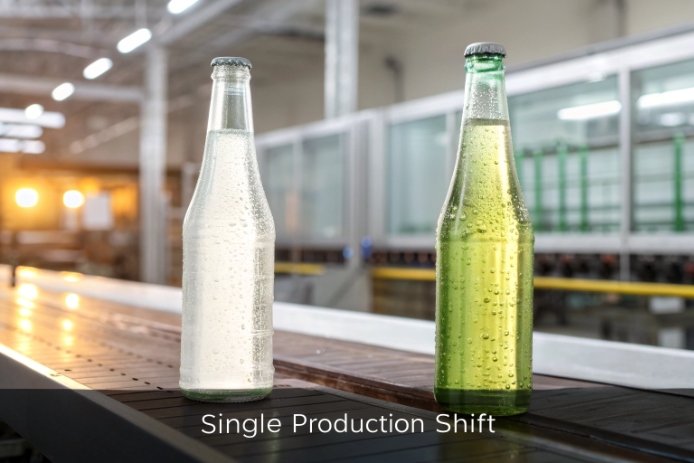
A “clear” bottle can turn slightly green, and a “UV-protective” bottle can lose its edge. That small shift often starts with iron and redox.
Controlling iron oxide and redox keeps bottle glass predictable. Total iron sets the color and UV absorption “ceiling,” and redox sets the Fe²⁺/Fe³⁺ split that decides what customers actually see on the shelf.
Bottle glass looks simple, but it behaves like a chemical system with a memory. A few ppm change in total iron can show up as a tint change when the brand is using white labels, minimal ink, and bright lighting in retail. The same small change can also push UV transmission up or down, which matters for beer, kombucha, cold-pressed juice, and many pharma or nutraceutical products.
The part that surprises many buyers is this: “iron” is not one thing in glass. It is a mix of oxidation states 1. Fe³⁺ and Fe²⁺ absorb light in different places. So the same total Fe₂O₃ number can still produce different shades if the furnace redox moves. That is why color can drift even when the lab report says “iron is on target.”
Redox also touches more than color. It changes fining behavior, bubble removal, sulfate stability, and the risk of defects like seeds and cords. When redox swings, operators often “chase” it with oxidizers or reducers, and that can create a loop of over-correction. The best plants treat iron control as a chain problem: sand → batch → cullet → melting → refining → forehearth, with tight feedback.
Where iron and redox hit the bottle business
| What customers notice | What is happening in the glass | Typical root cause in production | What stabilizes it |
|---|---|---|---|
| Clear bottle looks greener | More Fe²⁺ fraction, or higher total Fe | More iron in sand/cullet, or a more reducing furnace | Lock raw material Fe and hold steady redox |
| Amber/green shade drifts | Fe²⁺/Fe³⁺ ratio changed | Fuel/air ratio swings, cullet mix changes | Combustion control + cullet segregation |
| UV protection varies | UV absorbance changes with iron state and level | Iron swings, redox swings, or recipe tweaks | Tight Fe spec + optical verification at line |
| More seeds (bubbles) | Fining chemistry shifts under redox change | Sulfate retention changes, reducing hot spots | Stable redox + stable SO₃ strategy |
A practical way to think about “spec”
In my work with bottle programs, the best specs treat iron in two layers:
1) Total iron (reported as Fe₂O₃): the “amount” layer.
2) Redox (Fe²⁺/total Fe or FeO/Fe₂O₃ style ratio): the “state” layer.
When both are controlled, color and UV behave like a stable product. When only one is controlled, the plant gets surprises.
If this feels like a lot of chemistry for a bottle, that is exactly the point. Most color issues are not a single mistake. They are a small drift across several steps, and iron is the easiest place for that drift to hide.
Now let’s break down the specific questions and make them operational.
What impacts do Fe₂O₃ and redox exert?
A tiny redox shift can turn a stable color into a moving target. That hurts brand consistency and raises rejects.
Fe₂O₃ measures total iron input, while redox decides how that iron shows up as Fe³⁺ or Fe²⁺ in the melt. Together they drive visible color, UV absorption, and also influence fining, sulfate behavior, and bubble quality.
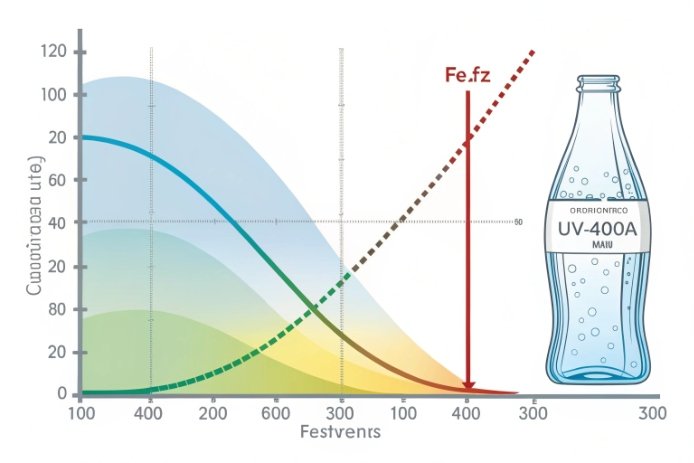
Fe³⁺ vs Fe²⁺: same iron, different optics
Total iron is often reported as Fe₂O₃ because that is a standard way labs express iron in oxide form. But inside molten soda-lime glass, iron is split mainly into Fe³⁺ and Fe²⁺. These two forms absorb light differently:
-
Fe³⁺ tends to push a yellow-brown tone and contributes strongly to absorption in the UV and near-UV region.
-
Fe²⁺ tends to push blue-green absorption bands, which is why a more reducing melt 2 often looks greener or bluish.
So a plant can hold Fe₂O₃ constant, yet still see color drift because the Fe²⁺ fraction moved. That is the “redox trap.” It is also why some teams argue about whether the issue is “iron” or “furnace.” Many times it is both.
Redox affects refining, not just shade
Redox changes the chemistry of gases in the melt and the behavior of fining agents. In many container furnaces, sulfate chemistry matters. Under more reducing conditions, sulfate can be reduced and release gas at different times. That can help or hurt bubble removal 3 depending on temperature profile and residence time. A redox swing can also change how foamy the melt surface becomes, which then affects heat transfer and creates more variability.
What redox swings do to quality signals
-
More reducing: higher Fe²⁺ fraction, stronger green/blue cast, and sometimes a different bubble pattern.
-
More oxidizing: higher Fe³⁺ fraction, less green cast, but it can shift amber tone and can change how certain colorants behave.
A simple control map operators can use
| Variable | If it rises | If it falls | What to watch on the line |
|---|---|---|---|
| Total Fe₂O₃ | More baseline tint and more UV absorbance | Cleaner look, less UV absorbance | Color coordinates, UV transmission, label appearance |
| Reducing strength (lower oxygen potential) | More Fe²⁺, greener/bluer look | Less Fe²⁺, less green | Shade drift during burner swings |
| Oxidizing strength | More Fe³⁺, yellower/less green | Less Fe³⁺, more chance of Fe²⁺ dominance | UV curve stability, amber tone stability |
The key is to treat Fe₂O₃ as the “budget” and redox as the “spending pattern.” Both must be stable, or the bottle will not look stable.
Why iron control stabilizes color and UV blocking?
One week a bottle passes the brand’s color panel. The next week it looks off under store LEDs. Iron drift is often the reason.
Iron control stabilizes color because total iron sets the absorption strength and redox sets the absorption shape. UV blocking stays consistent only when the iron level and iron state stay consistent across batch, cullet, and furnace conditions.

Color stability is really “spectrum stability”
Color in glass is not a single number. It is a spectrum. Iron adds absorption bands, and the location and strength of these bands depend on Fe²⁺/Fe³⁺. When total iron drifts, the whole spectrum intensity shifts. When redox drifts, the spectrum shape shifts. Customers notice both.
That is why stable color needs two anchors:
-
A narrow Fe₂O₃ window in raw materials and cullet mix.
-
A narrow operating window for furnace redox and forehearth 4 conditions.
UV blocking depends on what kind of product the bottle protects
UV protection is often discussed like a yes/no feature, but it is a curve. Many beverages and vitamins are sensitive to parts of UVA and UVB. Amber glass 5 is the classic solution, but many brands want lighter tints or “almost clear” with some protection. In those cases, iron and its state become part of the strategy, sometimes along with other UV absorbers.
Iron can help UV absorption, but it can also create unwanted visible tint. So control is the only way to get both “brand look” and “protection” at the same time.
Common situations where iron control matters most
-
Flint (clear) bottles: iron is a contaminant, so total iron must be low and redox must not push Fe²⁺ up.
-
Green bottles: iron is partly a functional colorant, so both total Fe and redox must be stable to keep the green consistent.
-
Amber bottles: iron still matters because it interacts with other colorants and redox-sensitive components that set the amber tone.
-
Cosmetics and pharma: consistency is strict because the bottle is part of the product identity, and UV claims can be regulated by customer specs.
Practical acceptance checks that actually protect the brand
| Check method | What it catches | Where to run it | Why it helps |
|---|---|---|---|
| Lab Fe₂O₃ on batch + cullet | Total iron drift | Incoming + daily | Stops slow supply drift |
| Fe²⁺/total Fe on glass sample | Redox drift | Furnace/forehearth | Predicts tint shift early |
| Inline color (L*a*b*) | Visible shade drift | Cold end | Finds real customer-visible change |
| UV-Vis 6 transmission test | UV drift | Lab or QA | Confirms functional performance |
When these checks are linked, the plant stops arguing about symptoms. The team sees the chain: iron in → redox state → spectrum → customer perception.
How to monitor iron from sand to furnace?
If iron is only checked at the end, the plant is already late. The best control starts at the sand pile and ends at the forehearth.
Monitor iron by building a traceable path: sand and other raw materials (Fe₂O₃), cullet segregation (color and chemistry), batch mixing control, and furnace/forehearth testing for both total iron and Fe²⁺ fraction.
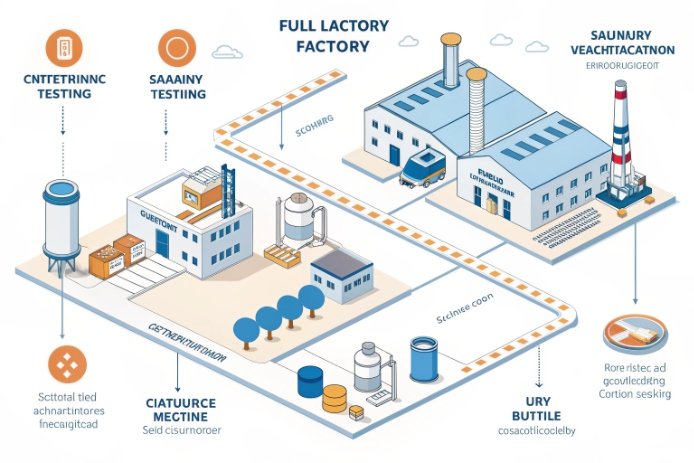
Step 1: Control the biggest source first: sand and cullet
For many bottle recipes, sand is the main raw material by mass. If the sand Fe spec is loose, the furnace will never be tight. The same is true for cullet. Cullet 7 is powerful because it melts fast and carries whatever iron and color history it had before.
Actions that work in real plants:
-
Sand qualification: set a practical Fe₂O₃ range, then audit it with routine testing.
-
Lot-based receiving: do not treat sand as “always the same.”
-
Cullet discipline: separate flint, green, amber, and “mixed.” Mixed cullet is often where iron control dies.
Step 2: Measure iron in a way that matches decisions
Different tools fit different decision points:
-
XRF is common for oxide composition checks on raw materials and sometimes on glass samples.
-
Wet chemistry / colorimetric methods are often used to determine Fe²⁺ fraction on glass samples because oxidation state matters.
-
UV-Vis on glass samples can be a fast “what will the customer see” check when tied to historical limits.
The goal is not fancy testing. The goal is fast feedback that matches the risk.
Step 3: Build a simple “iron balance” mindset
An iron balance does not need perfect math. It needs consistency. Track:
-
Fe₂O₃ in sand lots
-
Fe₂O₃ contribution from other batch materials (dolomite, limestone, feldspar, etc.)
-
Cullet percentage and cullet type
-
Finished glass color and Fe²⁺ ratio
When a drift appears, this structure narrows the cause quickly.
Step 4: Tie monitoring to control actions
Monitoring is useless if it does not trigger a controlled response. Good responses are small and steady, not big and reactive:
-
Adjust cullet ratio or cullet sorting, first.
-
Adjust oxidizer/reducer additions carefully, with limits.
-
Adjust combustion trim and burner balance to reduce hot spots.
A workable monitoring plan
| Stage | What to measure | Frequency | Typical trigger action |
|---|---|---|---|
| Sand receiving | Fe₂O₃, particle consistency | Per lot | Hold/reject lot or blend strategy |
| Cullet yard | Color sorting rate, contamination | Daily/shift | Adjust sorting, tighten supplier rules |
| Batch house | Recipe compliance, weigh accuracy | Continuous | Stop and correct feeders |
| Furnace glass | Fe²⁺/total Fe, color sample | Daily to per shift | Trim redox strategy, check combustion |
| Cold end | Inline color and defects | Continuous | Alert upstream, reduce over-correction |
This approach keeps iron control from becoming a “lab-only” problem. It becomes a production habit.
Are sensors enabling tighter real-time redox control?
Redox control used to be slow and reactive. Now it can be closer to real time, but only if sensors and data are used with discipline.
Modern sensors can tighten redox control by measuring combustion oxygen, CO/CO₂ balance, temperature fields, and sometimes optical signals from the melt. The win is faster detection and smaller corrections, but sensor drift and process lag still require smart models and good maintenance.
What “real-time redox” really means in a glass furnace
Redox inside the melt cannot be measured instantly at every point like a simple pH probe in water. Glass is hot, corrosive, and slow to mix. So real-time control is usually done by controlling the drivers:
-
Furnace atmosphere oxygen potential
-
Fuel/air ratio and burner balance
-
Electric boost patterns (if used)
-
Batch and cullet feed stability
Then the plant confirms outcomes with periodic glass sampling and optical checks 8.
Sensor types that are making a difference
Several sensor families are now common in modern container plants:
-
Zirconia oxygen probes in flue gas to track excess oxygen.
-
CO/CO₂ analyzers to detect reducing conditions and incomplete combustion.
-
Optical pyrometers and thermal cameras to track temperature uniformity and hot spots that change redox locally.
-
Inline color measurement at the cold end to catch drift early, even if it is not “redox” in name.
-
Batch house weighing and moisture sensors because batch variability 9 can shift melt conditions and redox demand.
None of these alone controls Fe²⁺/Fe³⁺. Together they create a strong control net.
The control layer is as important as the sensor
The best results come when sensor data feeds a stable control strategy:
-
Set a tight oxygen trim band, not a wide one.
-
Use alarms for burner imbalance, not only average values.
-
Apply small corrections, then wait for the system response time.
-
Avoid “ping-pong” between oxidizing and reducing additions.
Some plants add model-based control 10, where the system learns the lag between a trim change and a color change at the cold end. That is often where the biggest improvement comes from.
Limits and traps to plan for
-
Sensor drift: high-temperature environments cause drift, so calibration and redundancy matter.
-
Spatial variation: one measurement point may not represent the whole furnace.
-
Residence time: the glass responding at the cold end may reflect conditions hours ago.
-
Cullet shocks: a change in cullet source can shift iron and redox demand at the same time.
A practical “sensor + action” table
| Signal | What it suggests | Fast action | Slow confirmation |
|---|---|---|---|
| Rising CO or falling O₂ | More reducing combustion | Adjust air/fuel trim, check burners | Fe²⁺ ratio on glass sample |
| Temperature hot spot | Local reduction risk | Rebalance firing, adjust batch cover | Color trend at cold end |
| Cold-end color drift | System outcome shifted | Hold steady and trace drivers | Lab Fe₂O₃ + Fe²⁺/total Fe |
| Batch moisture change | Melt chemistry demand changed | Adjust batch settings | Defect and color stability review |
Sensors are enabling tighter control, but the real win comes from linking signals to disciplined, small, repeatable actions.
Conclusion
Iron and redox control turns bottle glass from “mostly consistent” into “predictably consistent,” so color, UV blocking, and quality stay stable from sand pile to shelf.
Footnotes
-
[Chemical concept describing the degree of oxidation of an atom, crucial for iron’s behavior in glass.] ↩
-
[Glass melting condition with low oxygen availability, favoring the formation of ferrous iron (Fe²⁺).] ↩
-
[Process of eliminating gas bubbles from molten glass, influenced by redox conditions and refining agents.] ↩
-
[Channel that conditions molten glass to a uniform temperature before it reaches the forming machine.] ↩
-
[Glass colored with iron, sulfur, and carbon to block UV light, essential for light-sensitive products.] ↩
-
[Analytical technique measuring light absorption in the UV and visible spectrum to determine material properties.] ↩
-
[Recycled glass added to the batch to lower melting temperature and reduce raw material usage.] ↩
-
[Inspection methods using light to measure glass color and detect defects in finished products.] ↩
-
[Changes in raw material composition and moisture that can disrupt the glass melting process.] ↩
-
[Advanced control strategy using mathematical models to predict and optimize furnace behavior.] ↩






