
One unstable recipe can ruin a stable product. A small leaching issue can trigger taste change, pH drift, haze, and a failed compliance review.
Optimize chemical stability by tightening the glass network (SiO₂ + Al₂O₃), balancing modifiers and stabilizers (Na₂O/K₂O vs CaO/MgO), and locking impurity and cullet rules. Then prove it with ISO/USP/EP hydrolytic and leach tests before bulk shipment.
Chemical stability is really about ion release, not “glass is inert”
What “chemical stability” means in bottle work
Chemical stability is the glass bottle’s ability to resist releasing ions into the product over time. It is also the ability to keep the inner surface from changing. A stable bottle does not create taste drift, pH shift, color change, haze, or label problems. This matters more for long shelf life, warm storage, and repeated washing.
The buyer usually sees the result as “product stayed the same.” The factory sees it as lower claims and fewer re-tests. Both sides want the same thing. The issue is that soda-lime glass is not a single recipe. It is a family of recipes. Small oxide shifts can change leaching speed and surface durability.
The three main chemical attack paths in real fills
Most bottle stability issues follow one of these paths:
-
Ion exchange: H⁺ from water swaps with Na⁺/K⁺ in the glass surface. This can raise product pH and release alkali.
-
Network dissolution: the silicate network slowly breaks down in high-pH conditions or harsh detergents. This can dull the surface and increase roughness.
-
Surface hydration/weathering: a thin hydrated layer forms in humid storage or long contact with water. This layer scratches easier and can haze.
Formulation mainly controls how fast these reactions start and how fast they grow.
A buyer-friendly “match recipe to product” map
| Fill type | Typical chemical risk | What formulation direction helps most | What to watch in storage |
|---|---|---|---|
| Water, tea, functional drinks | pH drift, taste drift | Lower alkali swing, stable CaO/MgO, modest Al₂O₃ | pH and conductivity |
| High-acid foods (vinegar, pickles) | surface attack near defects | Strong stabilizers, higher Al₂O₃ window, tight impurities | haze, surface dulling |
| High alcohol | slow extraction risk over time | stable network + low impurity seeds | clarity and off-notes |
| Cosmetics with actives | ingredient sensitivity | higher durability window, controlled colorants | color shift, turbidity |
| Pharma liquids | compliance and leach limits | treated soda-lime or borosilicate, strict testing | elemental leach profile |
A stable formulation is not the same for every SKU. The best plan is to define a durability “core recipe” and then tighten windows for higher-risk products.
The next step is to turn this into oxide targets and ratio thinking, because ratios usually prevent more problems than single-number specs.
Which key oxides and ratio targets most improve chemical durability and leaching resistance in bottle glass?
Leaching problems rarely come from one oxide. They come from an unbalanced system that makes the surface too mobile.
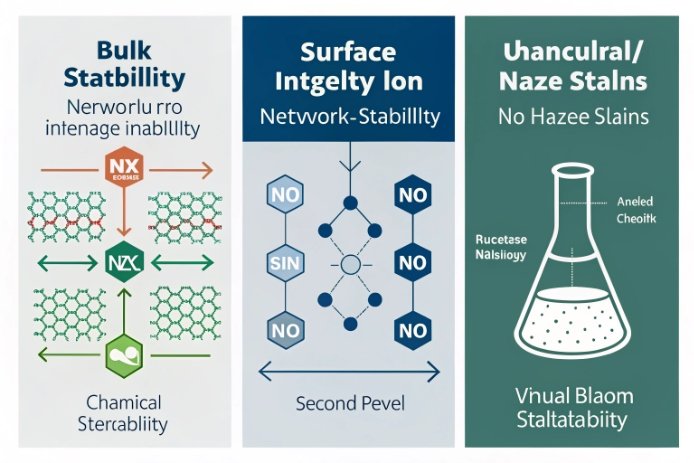
SiO₂ and Al₂O₃ improve durability by strengthening the network. CaO and MgO stabilize the network and slow ion release. Na₂O and K₂O are needed for meltability, but excess alkali raises leaching risk. Ratio control keeps the recipe stable when cullet and raw sources drift.
Network backbone: SiO₂ and Al₂O₃
SiO₂ is the backbone of soda-lime bottle glass. Higher SiO₂ generally improves chemical resistance because it increases network connectivity. Al₂O₃ 1 is the practical “durability booster” in many bottle programs. It helps reduce hydrolytic attack and supports lightweighting without losing durability. Still, Al₂O₃ must stay inside a melting-safe window. Poorly melted alumina can create inclusions and defects.
Stabilizers vs modifiers: CaO/MgO vs Na₂O/K₂O
Na₂O and K₂O help melting and forming. They also create more mobile ions, so the surface exchanges faster with water. CaO and MgO reduce that mobility and improve stability. MgO often helps long-term weathering and alkaline detergent exposure. CaO often supports structural stability in the classic soda-lime system. The best durability often comes from a stable alkaline-earth package, not from chasing one stabilizer.
Ratios that make bulk orders repeatable
Single oxide limits help, but ratios explain behavior better. These are common ratio ideas used in stable programs:
| Ratio target | What it controls | Direction that usually improves stability | Why it matters in bulk |
|---|---|---|---|
| (Na₂O + K₂O) / (CaO + MgO) | ion mobility vs stabilization | keep moderate, avoid spikes | prevents pH drift and leaching swings |
| MgO / CaO | stabilizer balance and long-term durability | keep stable in a narrow band | prevents devit and durability drift |
| Al₂O₃ / (Na₂O + K₂O) | network tightening vs charge balance | keep consistent | prevents “good on paper, unstable in melt” |
| Fe₂O₃ + impurities trend | impurity-driven variability | keep low and stable for clear glass | protects clarity and repeatability |
A practical purchase spec should include both oxide windows and two or three key ratios. This keeps durability stable even when cullet chemistry shifts slightly.
Now it helps to connect these oxide moves to real product risk: ion migration, pH shift, and shelf life.
How do Na₂O/K₂O and CaO/MgO adjustments affect ion migration, pH shift, and product shelf life?
Shelf life problems often start as ion release problems. The product changes slowly. The claim arrives suddenly.
Higher Na₂O/K₂O usually increases ion migration and pH shift because alkali ions exchange more easily with water. Higher CaO/MgO usually slows that migration by stabilizing the network. A stable balance protects taste, clarity, and long storage performance.
Ion migration is the first step in many failures
When water or a water-rich product sits in glass, H⁺ can exchange with Na⁺/K⁺ in the surface. This can raise product pH 2. It can also change flavor in sensitive products. In cosmetics and pharma liquids, it can shift stability of actives or preservatives.
If Na₂O rises, the surface usually becomes more mobile. If CaO/MgO rises in a balanced way, the surface often becomes less mobile. The key is “balanced.” A big stabilizer increase without a matching network backbone can raise other risks like devitrification 3. So stability tuning should be done as a controlled window, not as a one-time jump.
pH shift is a buyer metric, not only a lab metric
Some customers do not care about ion release numbers. They care about pH drift, turbidity 4, and taste change. This is why formulation specs should be tied to product-level checks when the fill is sensitive. A simple pH drift test at elevated temperature can expose a recipe that looks fine on COA.
Shelf life depends on storage and cleaning reality
A bottle for a one-way beverage has one set of needs. A returnable bottle or a bottle that sees alkaline wash has a different need. In alkaline detergent exposure, network dissolution can become the driver. MgO and Al₂O₃ often help here because they improve long-term stability. Still, process control and surface condition also matter. A scratched surface leaches faster because the surface area is higher and defects trap liquids.
| Adjustment | What usually changes first | Shelf-life impact | Typical trade-off |
|---|---|---|---|
| Increase Na₂O/K₂O | melt gets easier, surface gets more mobile | higher pH drift risk | durability drops |
| Decrease Na₂O/K₂O (too far) | melt gets harder, viscosity rises | better durability if melted well | forming cost rises |
| Increase CaO (balanced) | stability improves | lower leaching | devit risk if pushed |
| Increase MgO (balanced) | long-term wash stability improves | better weathering resistance | working window can tighten |
| Increase Al₂O₃ (within window) | network tightens | lower leaching and better stability | viscosity rises |
This is why the best durability program uses small, controlled moves and validates them with both glass tests and product-level checks.
The next question is the decision point many buyers ask: when is soda-lime enough, and when does borosilicate or higher Al₂O₃ become the right answer?
When should you choose borosilicate or increase Al₂O₃ to handle high-acid foods, alcohol, cosmetics, or pharmaceutical liquids?
Some fills are forgiving. Some are not. The wrong glass family can pass early tests and fail at month six.
Choose borosilicate when you need the highest hydrolytic resistance and stable performance across harsh thermal and chemical conditions. Choose higher Al₂O₃ soda-lime when you need a step-up in durability but still need high-speed container production economics.

High-acid foods and vinegar-style products
Many acids are not aggressive to glass the way strong alkali is, but high-acid foods often include salt, spices, and long storage time. The real risk becomes surface defects and repeated thermal cycles (hot-fill, pasteurization). A higher Al₂O₃ soda-lime recipe with stable CaO/MgO often works well. If the process includes large thermal swings or very strict taste stability, a more resistant glass family can reduce risk.
Alcohol itself is not always the harshest chemical driver, but long storage time and brand sensitivity make small changes visible. The best approach is stable composition, stable redox, and low impurities that can create haze or color drift. A durability-focused soda-lime recipe with tight cullet control is often enough. Borosilicate is chosen less for spirits and more for extreme thermal or pharma-style requirements.
Cosmetics and pharmaceutical liquids
Cosmetic formulas can include actives that are sensitive to metals and pH shift. Pharma liquids have strict compliance requirements and often require higher hydrolytic resistance. This is where borosilicate 5 becomes a clear option, especially for high-risk or regulated applications. Some soda-lime containers can be surface-treated to improve hydrolytic resistance for specific pharma uses. The choice should be based on test data, not on assumptions.
| Product category | Practical glass choice | Why it fits | Minimum proof to request |
|---|---|---|---|
| High-acid foods, hot-fill | higher-durability soda-lime (Al₂O₃ window + stable CaO/MgO) | balances cost and durability | surface hydrolytic test + storage check |
| Alcohol, long shelf life | stable soda-lime with tight impurities | protects clarity and taste | L*a*b* + leach trend + retains |
| Cosmetics with sensitive actives | higher durability soda-lime or borosilicate for strict programs | reduces pH drift and metal leach risk | ICP leach report + stability data |
| Pharma liquids (regulated) | borosilicate or qualified pharma glass system | highest hydrolytic resistance | USP/EP/ISO compliance package |
The best decision is the one that reduces total risk. A cheaper bottle that fails compliance is not cheap. A higher-grade glass that protects shelf life can reduce returns and improve brand trust.
Now the final step is how to prove chemical stability before bulk orders. This is where ISO/USP/EP methods and clear documents matter.
What chemical stability tests and compliance documents should you request before bulk orders?
Many disputes start with a missing document. A good compliance pack prevents arguments and speeds approvals.
Request hydrolytic resistance tests (ISO/USP/EP), leach testing reports with elemental results, and traceable COAs for raw and cullet streams. A strong QC report should link chemistry windows to bubble/defect trends and lot release sampling.

The core standards buyers recognize
For glass hydrolytic resistance, these are common references used in qualification work:
-
ISO grain tests for hydrolytic resistance classification (useful for comparing glass types).
-
ISO surface tests for the inner surface of containers at elevated temperature.
-
USP <660> and EP 3.2.1 for pharmaceutical glass container requirements and hydrolytic resistance concepts.
The key is to match the method to the risk. For container performance, inner surface testing is often more relevant than grain tests, because products touch the inner surface.
What a leach testing report should include
A useful leach report is not only “pass/fail.” It should show:
-
test method and extraction conditions (time, temperature, ratio)
-
sample description (bottle type, inner surface state, thickness)
-
elemental results (Na, K, Ca, Mg, Al, B, Fe as relevant) by ICP-OES 6 or ICP-MS
-
pH and conductivity change (when relevant)
-
lot ID and traceability
For sensitive products, it helps to request a trend: two or three lots over time, not only one test.
A bulk-order document list that reduces risk
| Document or test | What it proves | When to require it | What to check for consistency |
|---|---|---|---|
| Finished-glass chemistry COA (XRF) | oxide windows and ratio control | every lot for critical SKUs | MgO/CaO, alkali level stability |
| ISO 4802 7 inner surface test report | container inner surface hydrolytic resistance | pharma-like or strict programs | same method, same bottle zone |
| ISO 719 / ISO 720 grain test report | glass material hydrolytic class | qualification and change control | compare vs master glass |
| USP <660> 8 / EP 3.2.1 statement | pharmacopeial alignment | pharmaceutical orders | latest revision used, scope clear |
| Elemental leach report (ICP) | real ion release profile | cosmetics, pharma, sensitive drinks | lab method, detection limits, repeats |
| Cullet and raw material COAs | impurity and drift control | every bulk campaign | Fe, Ti, Zr, ceramics control notes |
| Retain-sample and traceability plan | claim resolution | every shipment | lot mapping and retention time |
A simple rule keeps projects clean: no bulk shipment should leave without a clear lot ID, a matching COA 9, and the agreed chemical stability proof for that product type. This is how chemical stability stops being a “trust me” topic and becomes an approval-ready package 10.
Conclusion
Chemical stability improves when SiO₂ and Al₂O₃ strengthen the network, CaO/MgO stabilize it, and alkalis stay controlled. ISO/USP/EP tests and clear leach reports make bulk orders safe.
Footnotes
-
[Role of Alumina (Al₂O₃) in glass manufacturing to improve chemical durability and mechanical strength.] ↩
-
[Measurement of acidity or alkalinity in water-based solutions, critical for product stability.] ↩
-
[Process where glass loses its amorphous structure and crystallizes, often causing defects.] ↩
-
[Measure of water cloudiness caused by suspended particles, indicating potential precipitation or contamination.] ↩
-
[High-quality borosilicate glass known for low thermal expansion and high chemical resistance.] ↩
-
[Inductively Coupled Plasma Optical Emission Spectroscopy used for detecting trace metals in solutions.] ↩
-
[ISO standard for testing the hydrolytic resistance of the inner surfaces of glass containers.] ↩
-
[United States Pharmacopeia standard defining requirements for glass containers used in pharmaceuticals.] ↩
-
[Certificate of Analysis verifying that a product meets its specified quality criteria.] ↩
-
[FDA guidance on packaging systems ensuring drug safety and efficacy through proper material selection.] ↩






