

Bottles can look perfect and still fail later. A small MgO drift can raise defects, change durability, and create claims after filling or washing.
MgO is a key stabilizer in soda-lime glass 1. It improves water resistance and long-term durability, helps hardness, and tunes viscosity and forming stability when it is balanced with CaO and controlled with tight QC.
MgO is the quiet “stabilizer oxide” that protects both performance and production
Why MgO matters even when customers never ask for it
Most buyers talk about color, breakage, and lead time. MgO sits behind all of that. MgO enters the silicate network as an alkaline-earth modifier. It does not build the network like SiO₂, but it changes how the network behaves. It reduces ion mobility and helps the glass resist water attack. It also changes how the melt flows in the forehearth. That affects gob stability and defects.
MgO is also a practical oxide because it often comes from dolomite 2. That means the MgO story is always tied to CaO control and raw purity. When dolomite quality drifts, MgO/CaO can drift together, and the furnace starts to “feel different” even if operators do not change temperatures.
What MgO does well, in simple terms
-
Durability: MgO helps slow leaching and surface hydration. That supports taste stability, label life, and wash resistance.
-
Hardness: MgO often improves long-term surface stability, so bottles keep a smoother surface after rubbing and cleaning.
-
Forming stability: MgO can make the melt less “nervous” when it is balanced well, but it can also tighten the working range if pushed too far.
What must be balanced carefully
MgO is not a “more is better” lever. If MgO rises without the right CaO and Na₂O balance, the liquidus 3 risk can rise and stones can appear. If MgO drops too low, durability and weathering resistance often suffer, especially in alkaline detergent exposure.
| Target outcome | What MgO helps with | What else must be stable | Main risk if pushed |
|---|---|---|---|
| Better water resistance | Lower leaching and surface attack | Na₂O, CaO, Al₂O₃, cullet chemistry | Higher liquidus risk |
| Better scuff resistance | More stable surface over time | Coatings, handling, anneal | Narrower forming window |
| Better forming repeatability | Smoother viscosity response | Forehearth profile, redox, fining | Devit and stones if imbalanced |
In practice, the best MgO programs do not chase a single MgO number. They lock a chemistry window and connect it to durability tests and defect trends.
The next sections explain the “why” behind durability, the “how” behind viscosity 4 control, the best MgO/CaO balance strategy, and the QC targets that keep bulk orders consistent.
How does MgO improve chemical durability and water resistance in soda-lime glass bottles?
A bottle can pass drop tests and still fail in service. Water resistance is often the hidden weakness, especially after storage, hot-fill, or repeated washing.
MgO improves durability by stabilizing the silicate network and reducing the mobility of alkali ions 5. This slows ion exchange and leaching, so the surface stays harder, clearer, and less reactive in water and mild chemicals.

MgO reduces alkali mobility and slows leaching
In soda-lime glass, Na₂O is needed for meltability, but Na⁺ is also the ion that tends to exchange with H⁺ from water. This exchange starts the surface reaction. MgO helps in two ways:
-
It increases network stability, so the surface holds together better during early hydration.
-
It reduces how easily alkali ions move and escape.
This is why MgO-rich (often dolomitic) recipes often perform better in long-term weathering and alkaline detergent exposure than low-MgO mixes.
MgO supports durability without relying on colorants
Some buyers assume amber protects everything. Amber blocks light. It does not block chemical attack. Durability still comes from oxide balance. MgO and CaO are the stabilizers that protect the network. If stabilizers are low, even amber bottles can show faster surface attack in harsh wash systems and repeated use.
What MgO cannot do alone
MgO is not a replacement for silica 6 and Al₂O₃. High silica and alumina still strengthen the network. MgO works best when:
-
SiO₂ is high enough for a stable backbone
-
Al₂O₃ is present in a safe window to tighten the structure
-
Na₂O is controlled so durability does not collapse
-
CaO is balanced so the glass stays stable and formable
| Service environment | Main chemical attack mode | How MgO helps | Extra oxide support that matters |
|---|---|---|---|
| Water and mild acids | Ion exchange and leaching | Slows alkali release | Al₂O₃ + adequate CaO |
| Alkaline detergents | Network dissolution risk | Improves long-term stability | Higher Al₂O₃ and stable CaO/MgO |
| Humid storage | Surface hydration and dulling | Keeps surface more stable | Lower Na₂O swings, stable cullet |
| Reuse cycles | Cumulative surface damage | Reduces weathering sensitivity | MgO + handling + coatings |
When durability is the goal, MgO is one of the safest stabilizers to use, but it must be managed with melt behavior in mind. That is why the next question is always about viscosity and forming.
How does MgO affect viscosity, melting behavior, and forming stability during bottle production?
Many plants try to solve defects by chasing temperature. That often treats the symptom, not the cause. MgO shifts the viscosity curve, so the same temperature can produce different gob behavior.
MgO generally increases melt stability and can raise viscosity compared with high-alkali mixes. It can improve forming consistency when balanced, but it can also tighten the working range and raise liquidus risk if MgO/CaO drifts.

What MgO does to the melt curve
MgO behaves as a stabilizing modifier. In many soda-lime systems, MgO:
-
makes the melt less “runny” at the same temperature compared with higher Na₂O
-
can make viscosity response more predictable when chemistry is stable
-
shifts how the glass reacts to forehearth temperature changes
This can be good for forming stability. A predictable gob reduces weight drift and helps wall thickness uniformity. Still, if MgO rises too far, the glass can become harder to condition at the same line settings, and operators may need higher temperatures to hit the same working viscosity.
A bottle furnace does not only need the right viscosity. It also needs a safe liquidus margin. If the alkaline-earth balance drifts, crystals can form more easily in colder zones. This shows up as stones, cords, or dull specks. When teams blame “raw sand,” the real driver can be a drifting CaO/MgO ratio that changed the devitrification 7 tendency.
A practical “forming stability” view
In production, MgO shows up as:
-
forehearth setpoint sensitivity
-
feeder shear behavior
-
defect mix changes (seeds vs stones vs blisters)
| If MgO moves… | What the forehearth often shows | What defects may change | What to check first |
|---|---|---|---|
| MgO increases (small) | Slightly higher setpoint need | Fewer weathering issues later | Viscosity stability and gob weight |
| MgO increases (too much) | Bigger temperature chase | Stones/devit risk rises | Liquidus margin and cold spots |
| MgO decreases | Melt feels “softer” | Durability drops, more surface issues | Na₂O drift and leaching trend |
| MgO fluctuates lot-to-lot | Unstable working window | Mixed defect pattern | Cullet chemistry and dolomite purity |
MgO can improve forming stability, but only when it stays inside a proven chemistry window. That leads to the hardest question to answer with one number: the best MgO/CaO balance.
What is the best MgO/CaO balance to increase hardness and strength without raising defect risk?
Hardness and strength sound like simple goals. In reality, they are a balance between durability, devit risk, and a viscosity window that your line can hold.
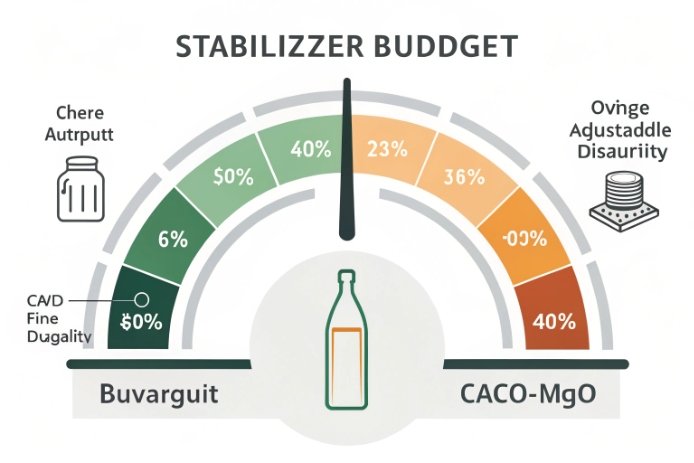
The best MgO/CaO balance is the one that increases stability and hardness while keeping liquidus and viscosity inside your forming window. In many soda-lime bottle programs, MgO is often kept in a moderate band and paired with CaO in a stable ratio, not at extremes.
Why ratio thinking works better than “more MgO”
CaO and MgO are both stabilizers, but they do not behave the same way. CaO often supports stability and durability in a familiar way, but too much CaO can raise devit sensitivity in certain systems. MgO can improve long-term weathering and detergent resistance, but too much MgO can tighten the window and raise liquidus concerns depending on the full recipe.
So the goal is not maximum MgO. The goal is a stable alkaline-earth package that supports:
-
surface durability (so scratches do not grow fast)
-
hardness retention after handling and washing
-
a safe liquidus margin
-
predictable viscosity at forming
A practical starting window for container glass planning
Exact targets depend on the plant and the SKU. Still, many bottle recipes live in broad industrial windows such as:
-
CaO: often in the high single digits to low teens (wt%)
-
MgO: often a few percent (wt%)
-
MgO/CaO ratio: often roughly 0.2–0.4 as a starting point for many dolomitic soda-lime bottles
This should be treated as a baseline, then tightened after trials and defect mapping.
How to choose balance by end-use
| End-use focus | MgO/CaO direction (practical) | Why it helps | What defect risk to watch |
|---|---|---|---|
| Premium clear with heavy base | Moderate ratio, tight window | Keeps clarity stable and avoids devit | Stones and cords in cold zones |
| Returnable / wash-heavy programs | Slightly higher MgO share (within window) | Better alkaline detergent resistance | Liquidus margin and haze risk |
| High-speed beverage lines | Stable mid-range ratio | Predictable viscosity and fewer surprises | Forehearth chase and weight drift |
| Amber / colored bottles | Stable ratio, stabilizers stay high | Color does not replace durability | Cullet drift and redox swings |
The best balance is always “what stays stable for months,” not “what looks best in one lab run.” A stable MgO/CaO ratio is one of the strongest ways to protect bulk order repeatability.
Once the ratio is set, the final job is to write QC targets so the plant can hold it and the buyer can trust it.
Bulk buyers do not want chemistry stories. They want performance that repeats. MgO control must show up in data that both sides can accept.
Specify MgO control using a chemistry window (MgO, CaO, and MgO/CaO ratio), a process stability bundle (viscosity proxy and defect trends), and performance checks (durability, hardness, abrasion). Tie all of it to lot traceability and change control.

Write MgO into the chemistry spec the right way
A practical spec includes:
-
MgO target range (wt%) in finished glass
-
CaO target range (wt%) in finished glass
-
MgO/CaO ratio control band (internal SPC or shared acceptance, depending on program strictness)
-
“no-change” rules when cullet source or dolomite source changes
Finished glass chemistry should be verified by XRF 8 (or a plant-equivalent method) on a defined schedule. Cullet chemistry must be part of the program because cullet can dilute stabilizers or raise alkalis.
Link MgO to process proxies operators already trust
Operators do not run hardness tests every hour. Operators see:
-
forehearth setpoint needed to hold gob weight
-
defect map shifts (stones vs seeds vs blisters)
-
inspection reject rates by cavity
These are powerful MgO drift signals when chemistry is tracked alongside them.
Add performance checks that match end-use risk
For food, pharma-like, or wash-heavy programs, include:
-
chemical durability 9 trend (class-based or internal method)
-
abrasion/scuff test trend (pack and transit simulation)
-
hardness checks (surface indentation or scratch proxy) on a defined schedule
| QC layer | What to measure | MgO-related acceptance idea | Why it prevents disputes |
|---|---|---|---|
| Incoming raw | Dolomite MgO/CaO and impurity limits | “Dolomite COA + periodic verification” | Stops hidden source drift |
| Finished glass chemistry | MgO, CaO, MgO/CaO, Na₂O | “Stay inside window; alert on trend” | Keeps properties stable |
| Process proxies | Forehearth demand, gob stability | “Control chart limits” | Catches drift before defects explode |
| Defect mapping | Stones, cords, blisters, seeds | “Zone-based defect thresholds” | Links chemistry to real risk |
| Performance verification | Durability + abrasion + hardness trend | “Quarterly or lot-based verification” | Matches customer service reality |
| Traceability | Lot ID + retain samples | “Retain bottles per lot” | Solves claim arguments fast |
A strong MgO quality control 10 program treats MgO as a stability variable, not as a one-time design number. When chemistry, process proxies, and performance tests are tied together, MgO becomes easy to control at scale.
Conclusion
MgO is a stabilizer that boosts durability, supports hardness, and tunes viscosity. The best results come from a stable MgO/CaO balance, tight chemistry windows, and QC that links composition to defects and performance.
-
Explains the composition and properties of the most common type of glass used for beverages and containers. [↩] ↩
-
A sedimentary carbonate rock and key raw material source for magnesium oxide in glass manufacturing. [↩] ↩
-
The temperature above which the glass is completely liquid; critical for preventing crystal defects. [↩] ↩
-
Understand how fluid resistance to flow impacts the glass forming process and bottle shape consistency. [↩] ↩
-
Group 1 elements like Sodium that affect glass melting point but can degrade durability if unchecked. [↩] ↩
-
Silicon dioxide, the primary glass-forming oxide that provides the structural network and thermal stability. [↩] ↩
-
The unwanted process of crystallization in glass which causes defects like stones and weakens the bottle. [↩] ↩
-
X-ray Fluorescence, a non-destructive analytical technique used to verify chemical composition in glass production. [↩] ↩
-
Learn about the resistance of glass surfaces to weathering and chemical attack from water and detergents. [↩] ↩
-
Systematic processes and standards used to ensure products meet defined quality criteria and specifications. [↩] ↩






