

Heavy bottles can feel “premium,” but the same weight can also raise freight costs and increase breakage risk in long routes.
Glass density is set by oxide chemistry and network packing. Heavy oxides raise specific gravity, while lighter or more open-network oxides can lower it. The best recipe balances density, strength, clarity, and the customer’s “feel in hand.”
Density is a chemistry outcome that buyers feel and logistics pay for
Density is not only mass, it is how the network is built
Glass density is the mass per volume of the final glass. In daily work, people often talk about bottle weight. Weight is shape plus thickness plus density. Density is the material part. It changes when the oxide mix changes.
Two effects drive density changes:
-
Atomic weight effect: how the atomic weight 1 of cations usually raises density.
-
Packing effect: some oxides tighten the network and reduce free volume, and that can raise density even if the oxide is not very heavy.
This is why density cannot be predicted from one oxide alone. The whole recipe and the network structure matter.
Why “specific gravity” shows up in real buying decisions
Specific gravity 2 is density compared to water. Many buyers do not ask for it directly, but they feel it in hand. When a spirits brand wants a heavier feel, the glass often needs either more mass (thicker or heavier base) or a slightly denser composition, or both.
At the same time, freight and carbon targets push the other way. A small density shift can multiply into a big tonnage change across a full container load. This is why density is both a design signal and a cost line.
The trap: chasing density can break clarity and formability
When a team pushes density by adding “heavier” oxides, it can create side effects:
-
color drift from iron or titanium impurities
-
higher devitrification risk if the stabilizer balance moves the wrong way
-
viscosity drift that forces higher forming temperature
-
more stones if the melt is harder to fine and mix
So the best approach is not “make the glass dense.” The best approach is “deliver the target feel and strength with the lowest risk recipe.”
| Goal | What density change does | What else must be checked | What the buyer will notice |
|---|---|---|---|
| Premium heft | Higher mass or slightly higher density | CTE, viscosity, clarity | “Feels expensive” |
| Lower freight cost | Lower mass or slightly lower density | Strength and scuff resistance | “Feels light” if design is not smart |
| Stable optics | Stable density and stable impurity control | Fe, Cr, redox, cullet | Consistent color and brightness |
| Stable forming | Stable viscosity curve | forehearth setpoints | Consistent dimensions and weight |
A simple rule keeps projects calm: density is easy to change, but it is hard to change safely. The next sections break down the oxide effects, the business impact, and the ways to balance performance while keeping the premium feel.
The first step is to be clear on which oxides usually push specific gravity up or down.
What oxides raise or lower glass specific gravity?
Dense glass is not magic. It is chemistry. Still, “add heavy oxides” is not a complete strategy because network packing can change the result.
Oxides with heavy cations (like barium, strontium, zinc, and high iron) usually raise specific gravity. Oxides that build a lighter or more open network (like B₂O₃) can lower it. The final result depends on both atomic weight and packing.
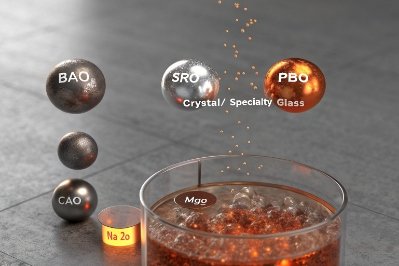
Heavy oxides raise density fast, but they come with baggage
In general, heavier elements raise density. That includes oxides like BaO, SrO, and ZnO. Some of these are common in special glasses, but they are less common in high-volume container glass because cost and supply can be hard to justify. Iron oxides also matter. Even small swings in iron content can change both density and color in clear glass programs.
Still, the plant does not need exotic oxides to manage density. Even within soda-lime chemistry 3, density can shift when the CaO/MgO/Al₂O₃ balance shifts, because the packing changes. Al₂O₃ can tighten the network. MgO often changes packing and stability. These changes are more subtle, but they are easier to scale.
Lower-density directions usually come from boron or more open structures
B₂O₃ is a classic route for reducing CTE and changing density in borosilicate systems 4. It can also reduce density compared to heavy-stabilizer systems because the borate network often reduces mass per volume. Still, B₂O₃ is not a minor tweak in many bottle plants. It often means a different glass family and a different process window.
Within soda-lime, lowering density is more often done by reducing heavy stabilizers and controlling impurities, but the safer lever is usually lightweighting by design 5 rather than chasing material density.
A practical “oxide direction” map for procurement conversations
Heavier densities often translate into a higher logistics cost 6, and the customer’s first impression.
| Oxide group | Typical density direction | Common use in bottles | Common risk |
|---|---|---|---|
| BaO, SrO, ZnO (heavy modifiers) | Up | Specialty/premium projects | Cost, supply, viscosity shift |
| Fe₂O₃ and some colorants (at higher levels) | Up | Colored glass | Color drift and optical loss |
| Al₂O₃ (network tightening) | Often up slightly | Durability and strength tuning | Higher viscosity if pushed |
| MgO vs CaO balance | Can shift up or down slightly | Dolomitic stability tuning | Devit window sensitivity |
| B₂O₃ (borate network) | Often down | Borosilicate families | Process change and cost |
In real bottle programs, density is not only a chemistry decision. It is a product positioning decision. Some brands want “heavy in hand” even if freight rises. Others want the lowest mass possible. That is why the next question matters: density changes logistics cost and the customer’s first impression.
Why density impacts logistics and feel in hand?
A bottle can be perfect in the lab and still fail in the market because it feels “too light,” or it fails in the supply chain because pallets become too heavy.
Density impacts logistics because heavier glass increases pallet weight, freight cost, and handling strain. Density impacts feel in hand because weight signals quality, especially in spirits and cosmetics, even before the customer reads the label.

Logistics: small grams become big tons
Freight does not care about brand story. Freight cares about mass. A simple example shows why density and weight matter:
If one bottle design adds 100 g per unit, and a shipment includes 10,000 bottles, that is 1,000,000 g, which equals 1,000 kg, which equals 1 metric ton. One ton can change freight cost, handling limits, and damage risk in long routes. It also changes how many finished goods fit inside the same weight-limited container.
Even when the density change is small, it often triggers a wall thickness change or a base thickness change. Those design changes can multiply weight faster than the density change alone.
Many premium buyers link weight to quality. This is strongest in spirits, perfume, and gifting. The bottle needs a stable center of gravity 7 and a solid base feel. This is why heavy-base designs are common. The “premium feel” often comes from weight distribution, not only from raw density.
One short story helps explain it. A spirits customer once asked for a bottle that “feels like a stone.” The first idea was a heavy overall bottle. That raised freight too much. The better solution was a thick base, a refined shoulder, and a stable recipe that kept clarity. The customer still got the premium feel, and the shipment stayed inside cost limits.
Density also affects line behavior and damage risk
Heavier bottles can increase wear on conveyors and increase impact energy during collisions. That can raise scuff and breakage rates. So the “premium weight” must be balanced with handling realities, especially at high speed.
| Density/weight choice | Logistics effect | Brand effect | Line risk |
|---|---|---|---|
| Heavier overall bottle | Higher freight and pallet weight | Strong premium signal | More collision energy and scuffs |
| Heavy base, lighter wall | Moderate freight increase | Premium feel stays | Better handling balance if design is smooth |
| Light bottle, same shape | Lower freight | Can feel less premium | Higher need for strength and scratch control |
| Density shift via chemistry | Subtle weight change | Usually not felt alone | Can change viscosity and defects |
Density matters because it touches both cost and emotion. The next question is the engineering one: how to balance density with strength and clarity so the bottle still performs.
How to balance density with strength and clarity?
Many teams chase low weight and then lose clarity, or they chase premium heft and then lose yield. The balance needs clear rules.
Balance density with strength and clarity by separating “feel” from “material density.” Use composition (SiO₂, Al₂O₃, CaO/MgO balance) to protect durability and clarity, and use design to place mass where the hand feels it most.
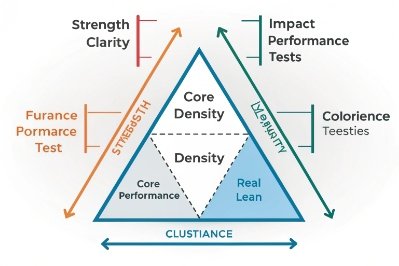
Strength does not come from density alone
A denser glass is not always stronger. Strength in real bottles is controlled by surface flaws, residual stress, and thickness distribution. Composition helps by improving durability and keeping the surface stable over time, but a heavier glass does not automatically resist cracks better.
The most reliable composition moves for strength and durability are:
-
Modest Al₂O₃ increase for network strength and hydrolytic resistance.
-
Adequate CaO and MgO to stabilize the Na₂O–SiO₂ system and reduce leaching.
-
Avoid excess Na₂O/K₂O that can weaken durability and raise CTE and stress sensitivity.
These moves can slightly affect density, but the bigger value is stable performance and fewer surprises.
Clarity is usually lost through impurities and defects, not through density targets
Clear and extra-white programs fail when iron, chromium, or mixed cullet enters the stream. Heavy oxides and colorants can also reduce clarity if they are not controlled. A density-focused project must protect optical controls:
-
stable cullet chemistry
-
stable redox control
-
low contamination and good fining
A denser recipe that produces more stones or cords will look worse, not better.
Use “density where it matters” instead of “density everywhere”
A premium feel can be created by:
-
thicker base and punt design
-
local thickening in panels that customers touch
-
smooth transitions that reduce scuff marks
This approach often preserves logistics targets better than making the whole bottle heavier.
| Goal | Best lever | Why it works | What to validate |
|---|---|---|---|
| Premium feel | Base weight distribution | Hand feels base and balance | drop tests + scuff tests |
| High clarity | Raw and cullet purity | Optics depend on impurity control | ΔE and haze trend |
| High strength | Stress control + durable composition | Flaws and stress dominate strength | stress check + breakage SPC |
| Stable forming | Viscosity window stability | Prevents weight drift | forehearth setpoint trend |
The balance is achievable when composition supports stability and design supports feel. The last question is where many brands are going now: can lightweight recipes still feel premium?
Many brands want lower freight and lower carbon, but they still want a “premium hand feel.” That is the new normal in bottle programs.
Yes. Lightweight recipes can preserve premium tactility when the design puts mass in the base, the glass stays clear and durable, and surface protection reduces scuffing so the bottle still looks and feels high-end.

“Lightweight” should mean smart mass, not cheap feel
A lightweight program often fails when the bottle becomes thin everywhere and the base loses presence. Customers pick it up and feel “budget.” A smarter approach keeps the premium cues:
-
thick base or weighted punt
-
crisp finish and stable neck
-
smooth surfaces that stay glossy after handling
This approach is mostly design and process, but composition supports it by keeping durability high so the surface does not weather and dull.
A lightweight bottle needs more margin because the wall is thinner. Composition can support that margin:
-
Al₂O₃ helps maintain durability and strength at lower wall thickness.
-
Balanced CaO/MgO improves stability and long-term surface condition, which helps the bottle stay “clean” in appearance.
-
Controlled alkali reduces leaching and weathering, which helps coatings and surface treatments last longer.
A lightweight bottle that scratches easily will not feel premium. So surface durability is part of tactility.
Hybrid tactics that work at scale
Many premium programs use hybrid tactics:
-
a stable, durability-focused soda-lime recipe
-
hot-end and cold-end surface treatments
-
controlled packaging friction to reduce rub marks
This combination preserves both appearance and feel. The bottle stays smooth. The label stays clean. The customer feels quality even if grams were removed.
| Lightweight tactic | What it protects | Why it feels premium | Main risk |
|---|---|---|---|
| Heavy base + thin wall | Balance and hand feel | Heft stays where it matters | stress at thickness transitions |
| Higher Al₂O₃ (within window) | Strength and durability | Less dulling over time | viscosity rise if pushed |
| Strong cullet control | Clarity and repeatability | Stable “extra-white” look | supply constraint |
| Surface treatments | Scratch resistance | Smooth, glossy touch | adhesion and aging control |
Lightweight does not need to feel light. The bottle can still feel premium if the design and composition work as one system.
Conclusion
Glass density follows oxide mass and network packing. The best bottles use stable chemistry for clarity and strength, and smart design for premium feel without freight waste.
Footnotes
-
Understanding how atomic weight influences the mass and density of glass formulations at a molecular level. ↩ ↩
-
Definition of specific gravity as the ratio of a material’s density to the density of water. ↩ ↩
-
A technical guide to soda-lime chemistry, the most common composition for high-volume glass container manufacturing. ↩ ↩
-
Explore the unique properties and density characteristics of borosilicate glass systems used in high-performance applications. ↩ ↩
-
A strategic approach to glass lightweighting by design to reduce mass without compromising structural integrity. ↩ ↩
-
How logistics costs are influenced by the movement and management of materials within the supply chain. ↩ ↩
-
Learn how the center of gravity impacts the stability and handling of filled glass containers during logistics. ↩ ↩






