

Too little cullet wastes energy and money. Too much cullet, used the wrong way, can trigger color drift and buyer rejections that hit delivery plans.
There is no single “best” cullet percentage. The right cullet rate depends on color targets, quality risk, and supply stability. Many bottle programs run a moderate-to-high cullet share with tight sorting and chemistry control.
Cullet rate is a business decision with technical guardrails
Cullet percentage is set by three hard constraints
Cullet is recycled glass that goes back into the furnace. It melts faster than virgin batch 1 because it already finished the glass-forming reactions. That sounds like a free win, yet the “how much” question is not only about melting. It is about three constraints that always fight each other:
1) Color and appearance risk
Clear and extra-white bottles are unforgiving. Small contamination can push a green or gray tint. Amber and dark colors are more tolerant, but they still suffer if mixed-color cullet enters the stream.
2) Supply stability
A recipe can be perfect on paper, then fall apart when cullet supply changes week to week. If cullet is not stable in composition, the furnace becomes unstable in chemistry. That becomes unstable quality.
3) End-use risk
Food and pharma buyers care about consistency. Premium spirits care about shelf look. Refillable bottles care about long-term durability and scuff resistance. Each end-use sets a different “risk ceiling” for cullet variability.
So the right cullet rate is the highest level that still keeps color, chemistry, and defects inside a controlled window for the SKU.
A practical starting range by bottle family
In daily work, a cullet plan is often built by SKU family, not by “one plant number.” A plant can run higher cullet on amber, then run more conservative on flint or extra-white. This is a common structure:
| Bottle family | Typical cullet strategy | Why it works | What must be controlled |
|---|---|---|---|
| Amber / dark colors | Higher cullet is easier | Color hides small contamination | Stones, cords, mixed ceramics |
| Standard flint (clear) | Moderate-to-high but strict sorting | Balances energy savings with color stability | Fe contamination, mixed-color, fines |
| Extra-white / premium clear | Conservative or closed-loop first | Tiny tint shifts create buyer disputes | Fe, Cr, organics, label ash |
| Refillable / returnable | High internal cullet when controlled | Closed-loop keeps chemistry stable | Cleaning residues, coatings, mixed streams |
These are not rules. They are safe starting points. The final number must match what the plant can sort, test, and hold stable.
The KPI dashboard that keeps cullet benefits without surprises
A strong cullet plan is never “set and forget.” It is monitored like a critical raw material, because it is one. The most useful dashboard links cullet rate to real defects and real buyer risks.
| KPI | What it tells me fast | What to do when it drifts |
|---|---|---|
| Color values (Lab* / ΔE) | Mixed-color or iron drift is rising | Tighten sorting, adjust cullet mix, check incoming |
| Seeds and blisters | Melting or fining is unstable | Check cullet fines, moisture, furnace profile |
| Stones and cords | Contamination or poor dissolution | Audit cullet cleaning, magnet/ceramic removal |
| Chemistry by shift (XRF) | Hidden batch drift is happening | Rebalance batch, verify cullet composition |
| Customer complaints by lot | Real risk is reaching market | Freeze cullet changes, run root-cause quickly |
When these signals are stable, the plant can push cullet higher with confidence. When they become noisy, the plant should reduce cullet or move to cleaner streams before buyers force the change.
A good cullet story is not about a big percentage. It is about repeatable bottles and fewer disputes.
The next sections break down the key questions buyers and procurement teams ask before they approve a cullet plan.
What defines cullet and its melting behavior?
Cullet is often described as “recycled glass,” but in production it behaves like a powerful process ingredient. If it is misunderstood, the furnace becomes the test lab, and that is expensive.
Cullet is crushed glass that re-enters the batch. It melts faster than virgin raw materials because it is already glass, so it skips part of the chemical reaction path and lowers the energy needed to reach a workable melt.

What cullet really is in bottle manufacturing terms
Cullet can come from several sources:
-
Internal cullet: in-house rejects and trimmed glass, usually the cleanest and most consistent.
-
Pre-consumer cullet: factory scrap from other plants, often consistent but needs verification.
-
Post-consumer cullet: collected from recycling systems, often the most variable and contamination-prone.
The melting advantage comes from the fact that cullet is already a finished glass network. Virgin batch materials must decompose, release gases, and then react into the glass structure. Cullet avoids much of that path. This usually supports faster melting and can help fining when the furnace conditions are stable.
Why cullet melts “easier” but can create new melting problems
Cullet benefits are real, yet cullet can also bring melting issues when its physical form is wrong:
-
Too many fines (very small particles) can increase dusting and change batch blanket behavior.
-
Wet cullet adds a hidden energy load and can disturb furnace stability.
-
Large chunks can dissolve slowly and contribute to stones if the residence time is tight.
Also, cullet can carry contaminants that do not melt like glass. Ceramics, stones, metals, and some heat-resistant glass fragments can survive and become defects.
How to describe cullet melting behavior in a supplier-facing spec
Procurement needs simple controls that match plant reality. The most useful cullet spec includes both chemistry and physical controls:
| Cullet attribute | Why it matters | Practical spec idea | Common failure if ignored |
|---|---|---|---|
| Color class | Controls tint drift | Color-separated streams only | Green/gray tint in clear bottles |
| Contamination level | Controls stones and inclusions | Ceramic/metal limits + screening | Stones, cords, weak points |
| Particle size range | Controls dissolution and blanket behavior | PSD window, limited fines | Foaming, seeds, melt delay |
| Moisture | Controls energy and stability | Moisture cap and storage rules | Bubbles, instability, yield loss |
When cullet is defined this way, it stops being a “recycling topic” and becomes a controlled process input that supports stable bottles.
Why higher cullet saves energy yet risks color drift?
Cullet is one of the fastest levers to lower furnace energy. It is also one of the fastest ways to lose a clear-color customer if sorting is weak.
Higher cullet saves energy because cullet melts with less reaction energy than virgin batch. It risks color drift because recycled streams can carry iron, chromium, mixed colors, and coatings that shift the glass spectrum even at small levels.

Why the energy savings show up quickly
Virgin batch has to decompose carbonates 2, drive off gases, and build the glass network. Cullet is already a network. So more cullet often means:
-
lower melting energy per ton
-
faster melt rate at the same furnace conditions
-
potential reduction in CO₂ linked to raw decomposition steps
This is why plants like cullet. It supports cost control and sustainability goals. It can also help capacity when the furnace is near limits.
Why color drift is the price of “dirty” cullet
Color drift happens because clear glass is sensitive to trace colorants and impurities. Post-consumer cullet can bring:
-
iron (often pushes green)
-
chromium (can push green hues strongly)
-
mixed amber or green fragments
-
label inks, coatings, and organics that change redox in the melt
Even when the cullet looks “mostly clear,” small contamination can push ΔE beyond buyer tolerance. The risk is higher for extra-white glass because the target is tight and the customer’s eye is strict.
How to reduce color drift while still increasing cullet
The practical solution is not “avoid cullet.” The solution is to build cullet tiers:
-
Use internal cullet first for high-clarity SKUs.
-
Use verified pre-consumer cullet next.
-
Use post-consumer mainly for darker colors, or only after strong sorting and chemistry checks prove it is safe.
Also, the plant should tie cullet shifts to fast measurements. Color control must happen before shipment, not after a buyer complains.
| Risk source | How it causes drift | Best prevention tool | What to monitor daily |
|---|---|---|---|
| Mixed-color fragments | Direct tint contamination | optical sorting 3 + color-separated bins | ΔE trend vs master |
| Iron / chromium | Strong green shift | Supplier COA + periodic chemistry checks | Fe₂O₃/Cr trend in melt |
| Coatings and inks | Changes redox and haze | Pre-wash/cleaning + rejection of coated glass | Haze and seeds trend |
| Variable cullet mix | Unpredictable chemistry | Closed-loop streams for strict SKUs | XRF chemistry by shift |
Higher cullet is a strong strategy. It just needs the same discipline as any other critical raw material. This is why the next question matters: how to set cullet specs by color and end-use, so buyers and suppliers stop arguing.
How to set cullet specs by color and end-use?
A cullet percentage is not a spec by itself. Buyers care about outcomes. A useful cullet spec links the cullet stream to the bottle’s optical and functional requirements.
Set cullet specs by defining the allowed cullet source, color class, contamination limits, and verification method. The strictness should match the bottle’s color target and the fill’s sensitivity.

Build cullet specs around risk tiers
The clean approach is to create tiers that match customer risk:
-
Tier A (high clarity / premium / strict ΔE): internal cullet + closed-loop only
-
Tier B (standard clear): internal + verified external pre-consumer, limited post-consumer
-
Tier C (amber/dark): broader cullet access, still controlled for stones and ceramics
This tier system keeps procurement honest. It also protects sales, because a premium buyer does not want a “sustainability story” that creates visible drift.
Define cullet with measurable limits, not vague words
Words like “clean cullet” create disputes. A spec should state:
-
allowed cullet source types
-
acceptable color mix level (often “no mixed colors” for clear)
-
maximum ceramics/stone content
-
metal removal requirements (magnets, eddy current where relevant)
-
particle size distribution and fines cap
-
moisture limit and storage rules
-
test frequency and what documents ship with the lot
Tie cullet specs to bottle tests the buyer already trusts
A bottle buyer rarely audits cullet directly. The buyer audits the bottle results. So it helps to connect cullet control to:
-
spectral transmittance or UV band %T 4 (for light-sensitive fills)
-
ΔE vs master (for appearance)
-
hydrolytic or leaching trend (for stability)
-
defect rates (stones, cords, seeds)
| End-use | Main risk | Cullet spec focus | Bottle test that proves control |
|---|---|---|---|
| Food and beverage (clear) | Color drift and taste stability | Color-separated cullet + low contamination | ΔE + durability trend |
| Premium spirits | Shelf look, clarity | Tight ΔE and haze control | ΔE + haze + visual standard |
| Pharma-like programs | Stability and consistency | Closed-loop, documented chemistry | Chemistry + durability + optical band tests |
| Amber functional protection | UV blocking consistency | Mixed-color control still needed | UV band %T + curve report |
When cullet specs are written this way, it becomes easier to increase cullet without increasing arguments. The plant knows what must be controlled. The buyer knows what proof to expect.
The last question looks at the best tool for optical stability: closed-loop cullet streams.
Are closed-loop cullet streams improving optical stability?
Post-consumer recycling is valuable, but it is also messy. Closed-loop systems solve that mess by keeping glass inside a controlled cycle.
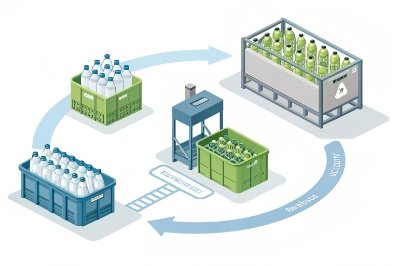
Yes. Closed-loop cullet streams often improve optical stability because the glass composition and color stay consistent. They reduce mixed-color contamination and make it easier to keep ΔE and transmittance stable across lots.
What “closed-loop” means in bottle terms
A closed-loop cullet stream usually means cullet that comes from:
-
the same plant’s internal rejects, or
-
a controlled network where the same color and glass composition 5 and family is collected, processed, and returned
The key is traceability. If the stream is known, the chemistry is more predictable. If the chemistry is predictable, the optics are more predictable. That is the full chain.
Why closed-loop helps transmittance and color at the same time
Optical stability is not only about visible color. It is also about spectral transmittance 6. Mixed cullet can change:
-
iron content, shifting UV/blue absorption
-
redox balance 7, changing tint and sometimes haze
-
inclusion risk, changing scattering and measurement variability
Closed-loop reduces these swings. It does not remove the need for controls, but it makes controls easier and cheaper.
How to build a closed-loop plan that procurement can defend
A good plan has three parts:
1) Collection discipline: only one color class, strict rejection rules.
2) Processing discipline: remove ceramics, metals, and fines; control moisture.
3) Verification discipline: regular chemistry checks, plus bottle optical checks tied to customer specs.
For strict clear programs, closed-loop is often the fastest way to push cullet higher without losing optical stability.
| Closed-loop element | What it improves | What can still go wrong | Best control tool |
|---|---|---|---|
| Single-color capture | ΔE stability | Wrong color enters the stream | Sorting audit + bin discipline |
| Consistent chemistry | Stable transmittance curve | Cullet from other glass families | XRF checks + supplier agreements |
| Low contamination | Fewer stones and haze | Ceramics and heat-resistant glass | Multi-stage screening + monitoring |
| Traceability | Buyer confidence | Documentation gaps | COA + lot tracking system |
Closed-loop cullet is not only a sustainability story. It is a quality stability strategy. It supports higher cullet use without turning clear-bottle programs into daily firefighting.
Conclusion
Use as much cullet as the SKU can tolerate while keeping color, chemistry, and defects stable. Closed-loop streams let clear bottles run higher cullet with fewer optical surprises.
Footnotes
-
Explanation of how virgin batch raw materials are calculated and combined to form the base glass structure. ↩ ↩
-
Chemical compounds like soda ash and limestone that decompose in the furnace to release necessary glass-forming oxides. ↩ ↩
-
Automated technology used to identify and separate glass fragments by color and material type for higher purity. ↩ ↩
-
A measurement of how much ultraviolet light passes through glass to protect light-sensitive contents from degradation. ↩ ↩
-
The specific chemical makeup of glass, defining its physical properties, durability, and compatibility with various production processes. ↩ ↩
-
The ratio of transmitted light to incident light across the spectrum, determining the color and clarity of glass. ↩ ↩
-
Managing the oxidation-reduction state of the melt to control color stability and fining performance in glass production. ↩ ↩






