
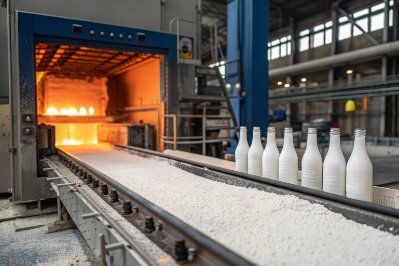
When bottles fail durability tests, the root cause is often hidden in the batch. Limestone looks simple, but small shifts can trigger big quality pain.
Limestone (CaCO₃) is a key calcium source in container glass. After it decomposes, it supplies CaO that strengthens the glass network, improves chemical durability, and helps control viscosity—if CaO is kept in a tight, non-devitrifying window.
Limestone is a performance lever, not just a cheap raw material
Limestone’s real job in soda-lime container glass
In container glass, limestone 1 is mainly there to deliver calcium oxide (CaO). CaO is a classic “stabilizer.” It supports a durable glass network that resists water attack, acids, and repeated contact with products. This matters for food, beverage, and many daily chemical fills where clarity is important but chemical stability is still a hard requirement.
In practical production terms, limestone influences performance through three paths:
-
Chemistry: CaO adjusts the balance between network formers (SiO₂) and modifiers (Na₂O, etc.).
-
Process: CaO shifts viscosity and working range. That affects forming and dimensional stability.
-
Defect risk: Too much effective CaO or poor melting can increase devitrification risk, stones, cords, and local haze.
Many quality disputes start because teams talk about “limestone % in the batch,” but what matters is final CaO in the glass and how stable it stays across lots. A limestone shipment with high loss-on-ignition (LOI), variable moisture, or variable particle size can change melt behavior even when the batch recipe stays the same.
Where limestone affects the buyer’s experience
From a buyer’s view, limestone-driven CaO control shows up as:
-
better scratch and abrasion resistance on handling lines
-
fewer alkaline leaching issues that can change taste or stability
-
more stable shelf appearance (less haze growth over time)
-
better resistance to dishwasher cycles for reuse programs
A simple map from limestone control to bottle performance
| Limestone / CaO factor | What changes in the glass | What buyers notice | What QA should watch |
|---|---|---|---|
| CaO too low | Glass is less stable, more water-sensitive | Higher extractables, dulling, label issues | Hydrolytic/chemical tests, leaching trend |
| CaO in target window | Balanced durability and formability | Stable quality and low complaint rate | XRF chemistry, viscosity stability, reject rate |
| CaO effectively too high | Higher devitrification tendency, crystals risk | Haze, stones, weak points | Devit checks, stones count, furnace hot-spot control |
| Limestone variability | Melt stability changes | Lot-to-lot shifts in color/haze/durability | Raw material COA, LOI, particle size, moisture |
A clean limestone story is never just “we add CaCO₃.” The real story is stable CaO, stable melt, and stable performance. That leads to the first technical question: after limestone decomposes, what does it really contribute?
A good spec begins with that decomposition step, because that is where chemistry becomes reality.
What does CaCO₃ contribute after decomposition?
If CaCO₃ is treated as inert powder, the batch plan will be wrong. CaCO₃ is active chemistry in the furnace, and it changes gas release and melt speed.
After decomposition, CaCO₃ supplies CaO (the stabilizer) and releases CO₂ gas. CaO enters the glass network, while CO₂ affects fining, bubbles, and melting kinetics.
The decomposition reaction and why it matters
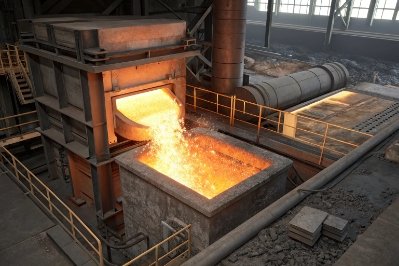
In the hot zone, limestone decomposes:
- CaCO₃ → CaO + CO₂↑
This does two important things at once. First, calcium oxide 2 becomes available to react with silica and other batch materials to form the final glass structure. Second, CO₂ is released as gas. That gas release is not only “waste.” It can influence fining and bubble behavior, especially if other fining agents and redox conditions are also in play.
If decomposition happens too late or too unevenly, it can create localized foaming and slow melting. If it happens early and smoothly, it supports a more uniform melt. Particle size, impurity content, and moisture all change this behavior. This is why limestone consistency is often linked to furnace stability.
How CaO integrates into the glass network
CaO acts as a modifier-stabilizer in container glass. It ties up non-bridging oxygens and helps prevent the network from being too “open.” The result is improved chemical stability compared with a high-alkali, low-calcium melt. In everyday terms, the bottle resists water and product contact better.
CO₂ release can support fining if the melt conditions are right, but it can also create defects if the timing is wrong. On the line, this shows up as:
-
seeds (small bubbles)
-
cords (composition streaks linked with poor mixing)
-
stones (unmelted or devit pieces that act like stress points)
A tight raw material 3 spec reduces this risk.
| Decomposition-related factor | Impact on melting | Common defect if uncontrolled | Practical control |
|---|---|---|---|
| Limestone particle size | Changes reaction rate and gas release timing | Foaming, bubbles, melt delay | Sieve spec + supplier control |
| LOI / purity variation | Changes effective CaO delivery | Chemistry drift, devit risk | COA + incoming LOI check |
| Moisture in limestone | Adds extra gas and energy load | Seeds and instability | Storage control + moisture limit |
| Mixing uniformity | Changes local CaO concentration | Cords, stones | Batch mixing SOP + audit |
Once decomposition is understood, the next step is the reason buyers care: CaO’s role in durability and chemical stability.
This is where limestone stops being “raw material talk” and becomes “product risk talk.”
Why does CaO boost durability and chemical stability?
A bottle that looks perfect can still fail chemical durability. That failure often shows up later, after filling, shipping, and weeks on shelf.
CaO improves durability because it stabilizes the silica network and reduces the glass’s tendency to leach alkali into water or products. It helps bottles stay chemically quiet over time.

CaO’s stabilizer role in simple terms
Container glass often balances three big players:
-
SiO₂ builds the backbone.
-
Na₂O/K₂O lower melting temperature but can increase leaching if too high.
-
CaO “locks” the structure into a more stable state.
When CaO is too low, alkali can be more mobile. That can increase surface attack by water, especially at elevated temperatures. It can also raise the risk of surface dulling and long-term haze.
When CaO is in the right window, the glass becomes more resistant to:
-
water extraction
-
mild acids in foods and beverages
-
product interactions that cause taste shifts or instability
In my experience with buyer audits, the easiest way to build trust is to link chemistry targets to durability results 4. When CaO control is tight, durability trends become smoother and corrective actions become faster.
Durability is not only a lab number
Durability matters because it affects:
-
product taste stability (for beverages)
-
ingredient stability (for acidic or reactive formulas)
-
label adhesion and print stability (surface changes can reduce adhesion)
-
complaint risk and shelf-life confidence
A buyer may not say “CaO.” The buyer says “no haze,” “no flakes,” “no off-taste,” “no change after storage.” CaO control supports those outcomes.
Where CaO can cause tradeoffs
CaO is not a free win. If the effective CaO rises too high relative to other oxides, the melt can become more devit-prone and harder to fine. So durability gains must be balanced with process stability.
| Performance goal | How CaO helps | What can go wrong if pushed too far | How to keep balance |
|---|---|---|---|
| Chemical durability | Reduces leaching and surface attack | Devitrification risk increases | Keep CaO in window, manage MgO/Al₂O₃ balance |
| Scratch resistance | Supports a stronger surface | Higher forming stress if process is not tuned | Align working range with forming settings |
| Long-term clarity | Slows haze growth from surface change | Crystals/stones create haze immediately | Furnace uniformity + devit monitoring |
| Stable quality | Makes composition more tolerant | Still sensitive to raw swings | Incoming raw control + cullet control |
Durability is the reason CaO exists in the recipe. But procurement also wants “hardness” and handling strength. That question comes with a risk: devitrification. The next section focuses on how to control CaO for hardness without inviting crystals.
How do you control CaO for hardness without devitrification?
Hardness and durability targets often push CaO upward. But devitrification can appear fast when the composition and thermal history are not aligned.
CaO control needs a chemistry window plus process discipline. Hardness can improve with CaO, but devitrification risk rises when local CaO-rich zones or slow-cooling regions allow crystals to form.

Why devitrification becomes a risk
Devitrification is crystal formation in glass. In container glass, it often shows up as:
-
stones or crystalline specks
-
haze patches
-
weak points that reduce impact strength
High CaO, especially when paired with certain SiO₂ ratios and local composition swings, can raise the chance that crystal phases nucleate during cooling or in furnace cold spots. The risk is not only the chemistry number. The risk is also temperature history and mixing quality.
Even when the lab chemistry looks fine, devit can be triggered by:
-
batch segregation (heavy particles settling)
-
insufficient melt mixing
-
furnace hot/cold zones
-
slow cooling in certain bottle areas
Practical controls that keep CaO useful and safe
A strong control plan works in layers:
1) Raw material control: keep limestone purity and particle size stable.
2) Batch mixing control: prevent local CaO-rich pockets.
3) Furnace control: stabilize temperature profile and residence time.
4) Cullet control: track CaO contribution from cullet 5 and coatings/labels.
5) Product monitoring: watch stones, haze, and breakage trends by lot.
When hardness targets are aggressive, it often helps to control supporting oxides that affect devit tendency and working range. The exact balance depends on the full recipe, but the principle stays the same: avoid sharp local composition gradients and avoid thermal conditions that sit in a crystal-friendly zone.
A simple operational dashboard for CaO vs devit risk
| Control point | What to measure | Target behavior | Fast signal of trouble |
|---|---|---|---|
| Finished glass chemistry | XRF 6 CaO trend by shift | Tight band, low drift | CaO drift without recipe change |
| Raw limestone | LOI, moisture, particle size | Stable inputs | Foaming, melting delay, seeds |
| Furnace profile | Hot spot vs cold spot delta | Stable and repeatable | Rising stones near cold zones |
| Reject reasons | Stones, cords, haze rate | Low and stable | Spike in stones after raw change |
| Mechanical performance | Impact / breakage trend | Stable across lots | Local weak points linked to devit |
The best practice is to treat CaO as a controlled performance tool, not a number that can be pushed freely. When hardness is requested by a buyer, the answer should include a devit-risk check and a test plan.
After CaO control is locked, the next question is sourcing. Some teams ask if alternative calcium sources can reduce variability and improve consistency.
That is a fair question, because raw stability often decides whether specs stay calm or become arguments.
Are alternative calcium sources improving consistency?
When limestone quality swings, the batch becomes harder to control. Some plants look for alternative calcium sources to smooth variation and stabilize melting.
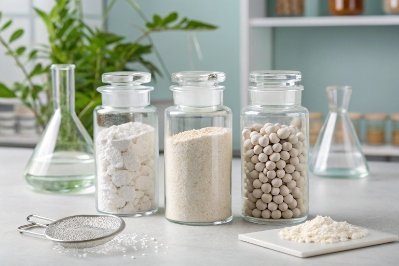
Alternative calcium sources can improve consistency when they provide cleaner chemistry, tighter particle size control, or more predictable decomposition. Options like dolomite, calcium hydroxide, or controlled calcium silicates can reduce variability, but each brings new process tradeoffs.
Why plants consider alternatives
The common reasons are simple:
-
limestone purity varies by quarry and season
-
moisture and particle size drift affects melting and fining
-
impurity swings can shift color, devit tendency, or durability
If a plant is running tight buyer specs, those swings can cause lot-to-lot changes that procurement will notice.
Typical alternative sources and what they change
Several options appear in real recipes:
-
Dolomite (CaMg(CO₃)₂): supplies both CaO and MgO. It can help balance durability and working range, but it also changes viscosity behavior and devit tendencies.
-
Calcium hydroxide (Ca(OH)₂): decomposes differently and can change gas release patterns. It can be reactive and moisture-sensitive, so storage and handling become critical.
-
Calcium silicate sources: can reduce gas release because part of the calcium is already bound with silica. This can support melting stability in some setups, but supply and cost can be limiting.
-
Cullet management: improving cullet sorting and chemistry tracking 7 is often the cheapest “alternative calcium source,” because cullet chemistry swings can override raw stability.
No alternative is automatically better. The win comes when the plant needs tighter chemistry control and the alternative source has better supplier consistency.
How procurement should write a calcium-source flexible spec
When alternative sources are used, procurement should focus on the final glass chemistry and performance, not only the batch recipe. A buyer does not need to know if calcium came from limestone or dolomite 8. The buyer needs stable durability and stable optics.
| Calcium source strategy | Consistency benefit | New risk introduced | Best control method |
|---|---|---|---|
| Higher-quality limestone grade | Better purity and tighter PSD | Higher cost | Supplier audit + incoming tests |
| Dolomite partial substitution | Stabilizes CaO+MgO balance | Recipe sensitivity increases | Finished glass chemistry SPC |
| Calcium silicate addition | Lower gas release variability | Supply and cost constraints | Melt stability monitoring + COA |
| Stronger cullet control | Reduces hidden chemistry drift | Sorting cost and discipline | Cullet chemistry tracking + limits |
In many projects, improving limestone incoming control and cullet control delivers most of the benefit without changing the recipe. When recipe changes are needed, the change control should include both melt behavior checks and bottle performance checks, since buyers will ask for evidence.
Conclusion
Limestone matters because it delivers CaO, which drives durability 9 and stability. Tight CaO control, devit risk 10 management, and consistent calcium sourcing keep bottle performance predictable.
Footnotes
-
[Geological properties and industrial uses of sedimentary limestone rocks.] ↩
-
[Chemical data and safety information for Calcium Oxide from PubChem.] ↩
-
[Overview of raw materials and batch calculations in glass manufacturing.] ↩
-
[Standard test methods for resistance of glass containers to chemical attack.] ↩
-
[Information on recycled glass (cullet) usage and benefits in production.] ↩
-
[Application of X-Ray Fluorescence for analyzing glass chemical composition.] ↩
-
[Analytical services for tracking chemical variations in glass production.] ↩
-
[Mineral fact sheet explaining the properties and uses of dolomite.] ↩
-
[Pharmaceutical guidelines on glass container durability and stability requirements.] ↩
-
[Technical lecture on devitrification kinetics and avoidance in glass processing.] ↩






