
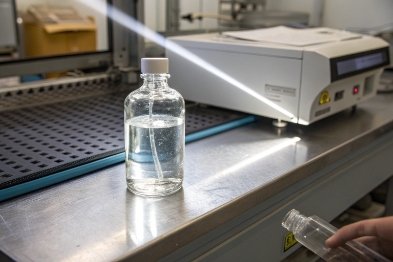
When light protection is unclear, the product pays the price. A bottle can pass appearance checks and still leak the wrong wavelengths. That is how shelf-life claims get risky.
Borosilicate bottles tend to show stable, repeatable spectral behavior because the glass chemistry is “neutral” and consistent. Clear borosilicate often transmits UV deeper than many people expect, so UV protection usually comes from amber color or UV-absorbing dopants, not from “borosilicate” alone.
The transmittance “signature” of borosilicate bottles
Clear borosilicate is usually high-transmission, not high-shielding
A common buyer assumption is that borosilicate automatically blocks more UV. In real testing, clear borosilicate often behaves like a clean optical material. It can transmit a lot of visible light and some near-UV 1, depending on thickness and impurity levels. So the “trait” is not strong UV blocking. The trait is spectral smoothness and repeatability.
This matters because many disputes come from curve shape drift. Soda-lime container glass can swing more when raw material iron changes or when the furnace redox changes. Borosilicate is not immune, but it is easier to hold stable when the melt chemistry is controlled.
In practical procurement terms, clear borosilicate is often the right choice when the fill is not light-sensitive, but the brand wants:
-
a clean, premium look
-
stable color lot-to-lot
-
predictable transmission for inline vision inspection
But when the fill is light-sensitive, “clear borosilicate” is usually not enough. The spec needs amber borosilicate, a UV-absorbing composition, or an added barrier.
Amber borosilicate shifts the curve where shelf life lives
The most useful transmittance trait for light-sensitive fills is a low transmission band in UV and blue. Amber borosilicate does this by absorbing more short wavelengths. Many pharma and lab bottle programs use a simple pass rule like “low spectral behavior 2 from 290–450 nm.” That band is not random. It covers UV and the blue edge where photo reactions start for many ingredients.
This is why amber borosilicate is often written into project specs for sensitive liquids. It gives a strong protection story without adding a second component like a sleeve label or a coating. It also stays compatible with many sterilization and storage workflows.
Surface chemistry helps spectral stability over time
Another hidden trait is that borosilicate is “neutral” glass in pharma language. That does not only mean chemical durability. It also means the inside surface changes less when it contacts aqueous products. If the surface changes less, then optical behavior stays closer to the master over long storage and over repeated thermal cycles.
| Bottle type | Typical transmittance behavior | What it is good at | What it is not good at |
|---|---|---|---|
| Clear borosilicate | High visible, can pass some near-UV | Premium clarity and repeatable spectra | UV shielding for sensitive fills |
| Amber borosilicate | Low UV/blue transmission (band-dependent) | Shelf-life protection for many liquids | Crystal-clear appearance |
| Standard soda-lime | Often high visible, UV depends on impurities | Cost and mass availability | Tight spectral stability programs |
What Optical Properties Distinguish Borosilicate From Soda-Lime?
Small spec gaps create big misunderstandings. A buyer expects borosilicate behavior, but the supplier quotes soda-lime values. Then the test report becomes an argument.
Borosilicate and soda-lime can look similar in basic clarity, but they differ in composition-driven durability and in how stable their optical curve stays under heat, sterilization, and long storage.
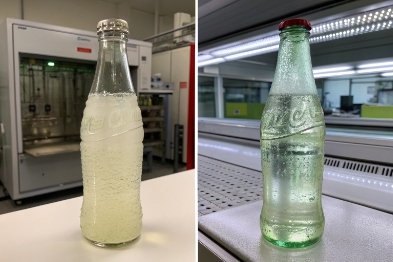
Refractive index is not the main story for packaging
Some teams start with refractive index. In packaging, refractive index 3 rarely drives acceptance unless the bottle is used for optical inspection in a special way. Also, typical refractive index ranges can overlap between families, so it is not a clean ID tool by itself.
What matters more is how the bottle behaves in real use:
-
Does it stay visually consistent after thermal cycles?
-
Does it keep the same spectral curve lot-to-lot?
-
Does it keep low haze and stable appearance after filling and storage?
UV cut-off and transmission depend on thickness and impurities
UV behavior is often misunderstood. Many “normal” glasses cut off more UV as thickness increases. But the cut-off edge is not a fixed property like a melting point. It shifts with thickness, iron levels, and oxidation states.
Thermal behavior supports optical stability
Borosilicate is known for low thermal expansion 4 compared with soda-lime. Even when the buyer is not worried about thermal shock, that low expansion often means less residual stress for a similar forming process and more stable geometry after thermal steps.
Why Do Pharma Buyers Favor Borosilicate Spectral Stability?
Pharma teams do not enjoy tight specs for fun. They do it because failures show up late, and the cost is high. A slight drift can turn into a stability issue after months.
Pharma buyers favor Type I borosilicate because the glass is classified as neutral with high hydrolytic resistance, and because its composition is easier to keep consistent, which supports stable spectral performance over qualification and long shelf life.
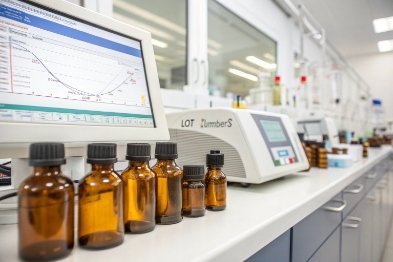
“Type I” is a trust shortcut, but it still needs optical limits
Many pharma projects start with glass type classification. Type I borosilicate 5 is widely used for injectable packaging because of its chemical durability. That durability reduces risk of interaction with the product. It also reduces surface change that can add variability.
Spectral stability matters because qualification is long
Pharma qualification cycles can stretch. Stability studies run for months. Validation repeats. Sites compare data. If the bottle spectrum drifts between lots, the buyer loses confidence and expands testing.
Stable spectral behavior helps in three ways:
-
fewer out-of-spec investigations
-
tighter correlation between supplier and buyer labs
-
simpler change control when raw materials or furnace settings change
Radiation and “solarization” concerns also shape choices
Some pharma workflows use sterilization or irradiation steps. Some glass compositions can discolor under ionizing radiation 6 or strong UV exposure. This is one reason cerium-doped borosilicate tubing exists in the market.
How to Specify Borosilicate Grades for Light-Sensitive Fills?
A vague spec creates a vague result. “Borosilicate amber” sounds strong, but it can still leave room for different curves, different test heights, and different pass/fail logic.
A strong spec names the borosilicate grade system, the container form, and the spectral transmission limits in a defined wavelength band, with a matching test method and reporting template.
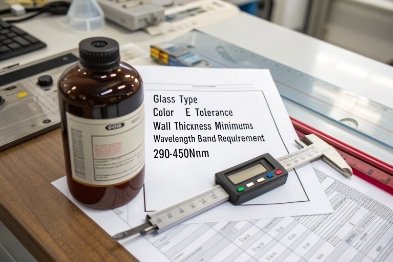
Start with the grade language your buyer already uses
Different industries talk about borosilicate in different ways. Lab glass often talks about “3.3 expansion borosilicate.” Pharma talks about “Type I neutral glass” and tubing or molded container forms. Both can be correct, but mixing language without a bridge causes errors.
Define the light protection target as a band, not a single wavelength
For light-sensitive fills, a band spec is safer than a single-point spec. A single wavelength can be gamed by curve shape. A band limit is harder to hide from.
A simple template that works well:
-
Report spectrum across the band.
-
Use a worst-case metric like maximum %T in the band.
-
Add a visible limit only if appearance or line inspection needs it.
Are Low-Alkali Borosilicates Advancing UV Shielding Options?
Many buyers want stronger UV blocking, but they also want clear labeling, clean appearance, and pharma-friendly chemistry. That creates pressure for better glass solutions.
Low-alkali borosilicates support chemical durability and stable surfaces, but UV shielding still comes mainly from colorants or UV-absorbing dopants. The progress is in controlled compositions and doped borosilicate options that add UV protection while staying within pharmacopeial expectations.
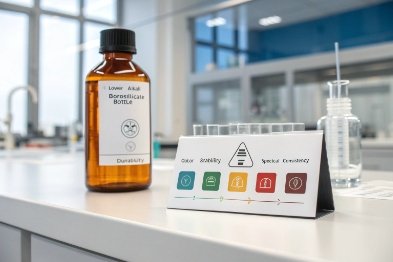
Low alkali helps chemistry, and chemistry supports stable optics
Low alkali content matters because alkali ions drive many leaching and surface-change concerns. When the surface stays stable, the bottle tends to stay stable in haze and appearance over time.
Doped borosilicates and amber borosilicates are where the UV story grows
In the market, there are well-known examples of amber borosilicate meeting strict UV band limits for lab and pharma-like uses. The goal is to meet pharmacopeial expectations 7 while adding UV protection through controlled dopants.
| UV shielding approach | How it works | What improves | Best fit |
|---|---|---|---|
| Amber borosilicate | Absorbs UV/blue with colorants | Shelf-life protection | Light-sensitive liquids |
| Cerium-doped | Shifts absorption behavior | Processing stability | Irradiated workflows |
| Coated borosilicate | Adds external UV barrier | Strong UV cut | Premium cosmetics |
Conclusion
Borosilicate bottles offer smooth, repeatable spectra and strong stability, but UV shielding is usually added through amber or dopants. The best specs lock band limits, geometry, and reporting.
Footnotes
-
Learn about the ultraviolet spectrum and its impact on sensitive cosmetic and pharmaceutical products. ↩ ↩
-
Understanding how borosilicate glass interacts with the light spectrum to ensure product stability. ↩ ↩
-
A measurement of how light bends as it enters different glass types for optical precision. ↩ ↩
-
How borosilicate glass resists breakage and maintains shape under extreme temperature changes. ↩ ↩
-
The industry standard for high-durability pharmaceutical grade glass containers used in medical storage. ↩ ↩
-
High-energy radiation that can affect the optical clarity and safety of standard glass containers. ↩ ↩
-
International quality standards for medicines and their packaging containers ensuring global safety compliance. ↩ ↩






