
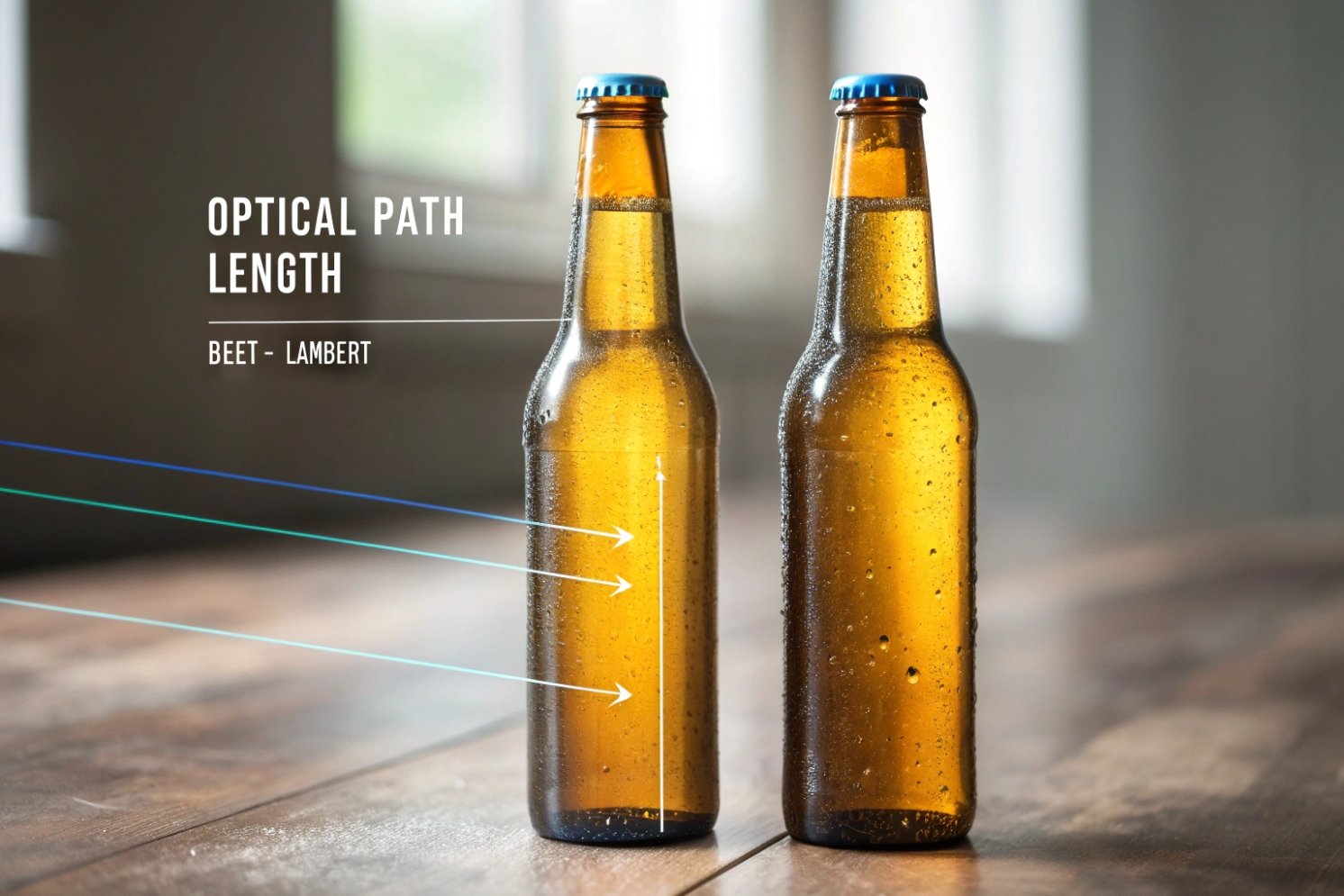
Everyone obsesses over glass color, but quiet failures often come from thickness. A few tenths of a millimeter can decide whether your light-sensitive formula survives a summer display.
Glass thickness controls the optical path length. According to Beer–Lambert, transmittance decays exponentially with thickness, so the thinnest wall section sets real protection. Buyers must specify and control thickness or lightweighting will quietly raise UV exposure and shorten shelf life.
Most drawings show a single “nominal wall”, but real bottles have thick shoulders, thinner panels and local thin spots. Light does not average this geometry. It hunts for the easiest optical path length 1. That detail matters a lot for beer, pharma and any formula that hates UV.
Why does wall thickness alter optical path and attenuation?
Two bottles can share the same color code, yet one bleaches your product while the other protects it. The missing piece is often how thick the light path really is.
Wall thickness changes how far light must travel inside the glass. Longer paths mean more absorption and scattering, so percent transmittance drops exponentially with thickness, especially in the UV–blue region where many products are most vulnerable.
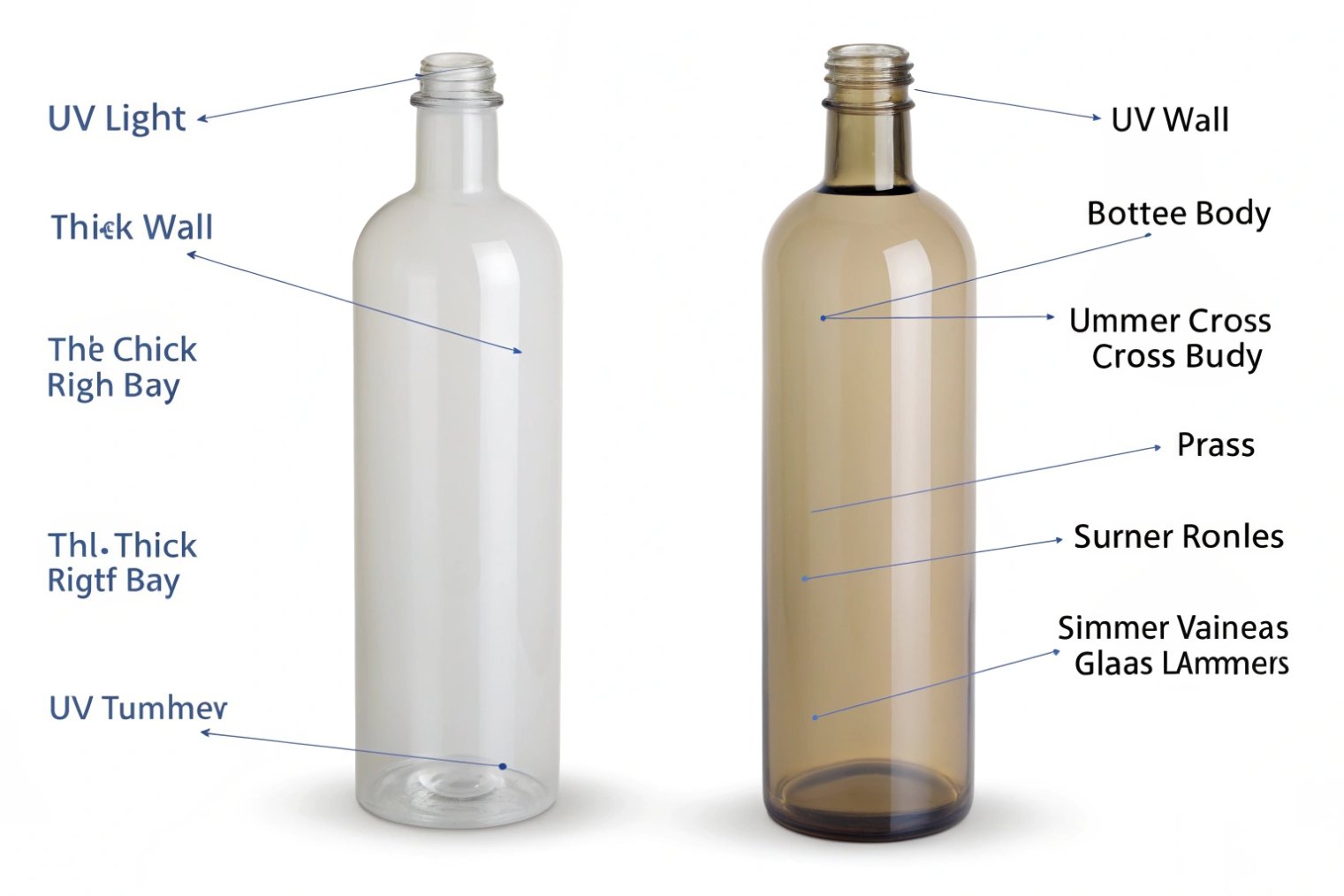
Beer–Lambert in simple packaging language
The physics is compact, but the impact is big. The Beer–Lambert relationship 2 can be written in a simple form:
I = I₀ · e^(−α·d)T = I / I₀ = e^(−α·d)
Where:
I₀is light intensity before the glassIis light intensity after the glassαis the absorption coefficient 3 of that glass at a given wavelengthdis wall thickness
So when thickness d increases, the exponential term gets smaller and transmittance drops. If thickness decreases, even a little, transmittance rises fast. This is most visible in UV and short-visible wavelengths where α is high.
For clear or lightly tinted bottles, the glass does not absorb much in the visible range. So a 10–20% change in thickness may only slightly change visible light. In the UV band, the same thickness change can double the transmitted energy.
Geometry and the “weakest link” section
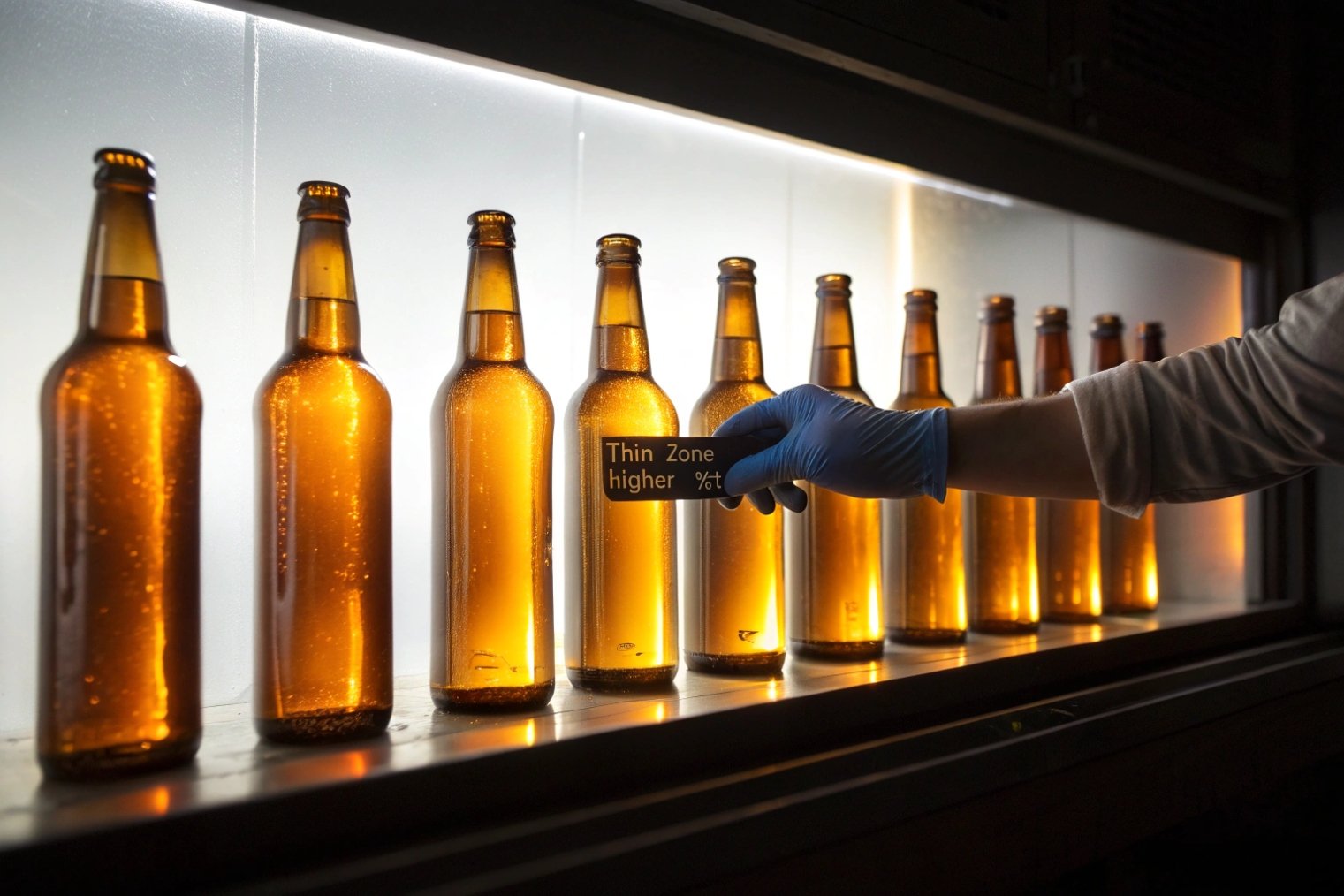
Real bottles are not uniform plates. There are thick bases, heavy shoulders, seams, engravings and label panels. Each area has a different optical path length. Thick zones behave like a strong barrier. Thin zones behave like windows.
Light on a shelf does not care about average thickness. It flows along the easiest path. A narrow, slightly thinned sidewall band can become the main gateway for damaging wavelengths. This is why good transmittance methods measure several positions and treat the worst value very seriously.
We also need to remember that reflection at the air–glass interfaces is almost constant for a given glass type. So thickness mainly changes how much light is absorbed inside, not how much is reflected at the surface.
Wavelength dependence: UV vs visible
Thickness matters most where the glass absorbs strongly. That is usually in the UV and blue region 4 for amber and many protective glasses. There, a small increase in thickness can drive %T toward zero. At longer visible and near-IR wavelengths, changes become less dramatic.
You can think about it like this (illustrative ranges, not exact values):
| Wall thickness | Dark amber glass 320–430 nm | Clear flint glass 320–430 nm |
|---|---|---|
| 0.8 mm | 5–15% T | 30–60% T |
| 1.2 mm | 1–5% T | 20–40% T |
| 1.8 mm | <1% T | 10–25% T |
The exact numbers depend on your recipe, furnace, and colorants, but the trend holds: thickness multiplies whatever protection your chemistry gives. For light-sensitive products, this makes wall control a primary design lever, not just a mechanical one.
What risks arise from thickness variability for light-sensitive fills?
One pallet from a production run can look perfect, but a few bottles on that pallet still let in too much light. Often the only difference is a local dip in wall thickness.
Thickness variability creates weak zones where more UV and blue light enters, so product degradation becomes uneven and unpredictable. Sensitive fills can pass stability in the lab, yet fail on shelf when a thin band in the real bottle breaks the light barrier.
From smooth lab curves to noisy real life
In development, we often measure spectral transmission 5 on ideal samples:
- Cut panels with uniform thickness
- Carefully oriented bottle sections
- Clean, dust-free surfaces
Those curves look nice and smooth. Production bottles are rougher. Mold wear, temperature drift, gob weight variation and forming differences create:
- Thinner areas in the body or shoulder
- Uneven bases
- Variations between cavity numbers
Even small thickness dips at one location can move %T above your limit in the most sensitive wavelength range. For products with tight UV specs, that small local change can flip a bottle from safe to risky.
Uneven stability and customer complaints
Light-sensitive products do not fail all at once. They often show:
- A few discolored or off-odor bottles per case
- Faster fade in certain shelf positions
- Complaints that seem random and hard to repeat in the lab
When we back-trace such issues, we often find a combination of:
- Thin wall zones on the bottle
- Stronger local lighting in store
- Long dwell times near windows or under LEDs
Because degradation is exponential with light dose, a thin band plus a strong spotlight can age one bottle much faster than its neighbors.
Combined path: glass plus product
For filled-pack tests, the optical path is not only the glass. It is:
path length = glass wall in + product + glass wall out
If glass thickness varies, total path changes even when fill level is perfect. Thicker glass lowers total %T, but we should not rely on random “lucky thick” bottles. A few thin-wall bottles in a batch can still let enough UV through to hurt product stability.
This is why good plants pair:
- Thickness maps (from optical or mechanical gauges)
- Spectral transmittance curves
By comparing both, teams can separate true glass-recipe problems from simple “too thin here” issues.
A simple risk view:
| Variability pattern | Main risk for light-sensitive fills |
|---|---|
| Thinner body panel, normal rest | Localized UV hotspot, uneven degradation |
| One cavity consistently thinner | Cavity-specific failures, cluster complaints |
| Global lightweighting without control | Whole SKU shifts closer to UV limit |
When buyers ask for thickness tolerances plus transmittance data, they reduce these blind spots.
How to specify minimum/maximum thickness to hit target transmittance?
Many drawings state a nominal wall and a wide tolerance that was set for mechanical reasons years ago. Light protection was never in the equation.
To hit target transmittance, define UV transmission limits first, then back-calculate a minimum wall for your glass recipe, and lock this into both bottle drawings and QC thickness checks. Maximum thickness stays driven by weight, cost and forming limits.

Start with the light, not the wall
The first step is to agree the protection level, for example:
- “≤10% transmission anywhere between 290–450 nm”
- “≤2% transmission at 350–430 nm” for very sensitive fills
Once this band and limit are fixed, the Glass + Product + Light team can run lab tests on panels at different thicknesses. From those curves, you can estimate a minimum wall that keeps %T under the limit with some safety margin.
In simple Beer–Lambert terms:
- If
T = e^(−α·d)is your transmission at a wavelength, and you knowαfor this glass, you can solve fordthat gives your targetT. - In practice, we do this empirically from measured curves rather than pure theory.
Translate optics into drawing tolerances
After you know the minimum optical wall, you can update:
- Bottle drawing: define a nominal wall and realistic min/max at critical zones (body panel, shoulder).
- Sampling plan: specify how many thickness points per bottle and how many bottles per lot you will measure.
- Acceptance rules: link thickness tolerances 6 to transmittance qualification.
A typical structure:
| Spec item | Example approach |
|---|---|
| Target UV limit | ≤10% T, 290–450 nm |
| Qualified thickness range (body) | 1.3–1.7 mm for a given amber recipe |
| Drawing tolerance | Nominal 1.5 mm, −0.2 / +0.3 mm |
| QC thickness check | 6 points per bottle, n bottles per hour |
| Transmittance re-check trigger | If average or min thickness drops below 1.3 mm |
This way, thickness is no longer just a mechanical property. It becomes a controlled parameter that supports the UV spec.
Align supplier, filler and brand owner
Thickness spec only works if everyone along the chain sees the same numbers:
- The glass plant must know which minimum wall ties to which UV requirement.
- The filler must understand where to measure thickness on incoming bottles.
- The brand owner must lock these values into stability reports and change controls.
When we update glass weight or shape, we redo this chain: first confirm new thickness vs transmittance in the lab, then update drawings and QC limits, then document the change in regulatory and customer files. That discipline keeps “creeping lightweighting” from eroding protection over time.
Will lightweighting compromise protection without new chemistries?
Every buyer wants less weight on the truck and more space on the sustainability slide. The risk is that light protection silently becomes the trade-off.
Lightweighting always raises transmittance if glass chemistry stays the same, but you can protect sensitive products by combining thickness reductions with stronger colorants, coatings, protective secondary packaging and updated transmittance validations.
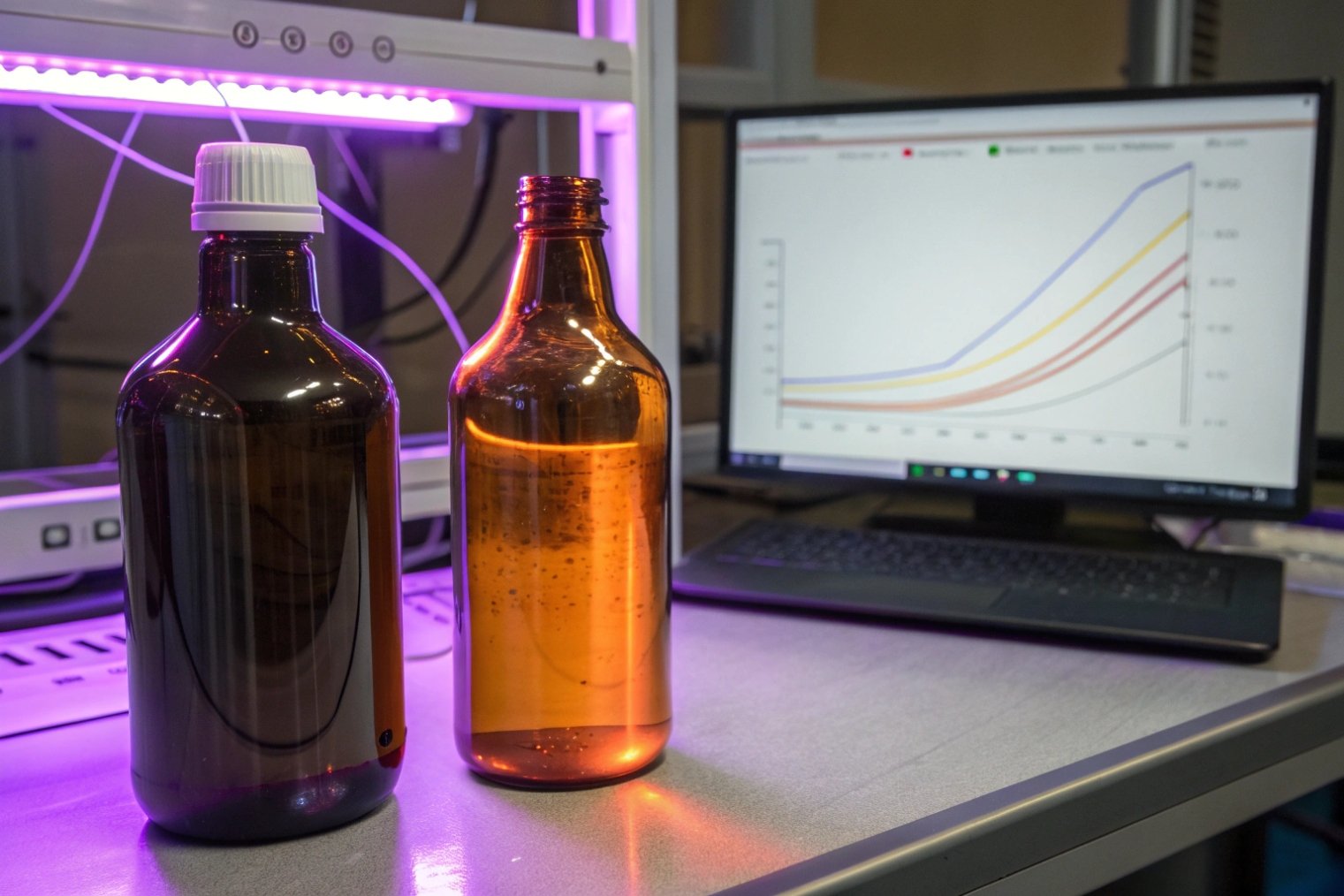
The honest answer: physics does not give discounts
If we keep:
- The same glass type
- The same colorant package
- The same filling and display conditions
Then removing thickness will increase %T in the UV–blue band. That is not negotiable. The Beer–Lambert relationship guarantees it. The only open questions are:
- How much does %T rise for the thickness change we propose?
- Is the new curve still under the acceptance limit with safety margin?
This is why every serious lightweighting project 7 for light-sensitive fills should include fresh spectral transmission tests, not just strength and impact checks.
Design tools to keep protection while cutting weight
To keep both protection and lower mass, we can use several levers:
-
Stronger or optimized colorants
Adjust the amber or other protective color recipe so the absorption coefficient in the UV–blue band increases. This lets you remove some thickness and keep similar %T. There is a practical limit, because very strong color can make glass too dark for branding or filling inspection. -
Redistribute thickness
Reduce thickness in low-exposure areas and keep more glass where light hits hardest (for example, maintain a solid shoulder thickness, but refine the base design). That way, the most exposed zones keep their barrier. -
Functional coatings or treatments
In some advanced projects, thin functional layers are applied on the glass surface to add UV protection or modify optical properties without heavy extra mass. -
Secondary packaging and merchandising
Cartons, sleeves, or opaque labels can shield sensitive regions of the bottle. Shelf design and lighting also matter. For some SKUs, a slightly lighter bottle plus better secondary protection gives a better balance than a heavy bottle in harsh, open light.
Lightweighting with clear guardrails
From a B2B perspective, the safe way to run these programs is:
| Step | Purpose |
|---|---|
| 1. Baseline measurement | Capture current thickness map and %T curve |
| 2. Lightweight design | Propose new wall distribution and total mass |
| 3. Lab verification | Measure new %T 290–450 nm vs target limits |
| 4. Stability check | Confirm critical SKUs under new packaging |
| 5. Line and QC updates | Update drawings, thickness tolerances and checks |
This way, lightweighting becomes a managed trade-off. You gain logistics and cost benefits without walking blind into higher UV exposure. New chemistries help, but they are not the only tool. The key is to treat light protection as a hard design constraint, not a soft hope.
Conclusion
Thickness is a powerful optical lever. When we design and control wall profiles with light in mind, we can protect sensitive products, enable smart lightweighting and keep packaging performance predictable from furnace to shelf.
Footnotes
-
Learn how optical path length determines the distance light travels through glass walls. ↩ ↩
-
The Beer-Lambert law relates the attenuation of light to the properties of the material through which it travels. ↩ ↩
-
An absorption coefficient determines the distance light of a specific wavelength penetrates into a material before being absorbed. ↩ ↩
-
Detailed insights into how UV radiation affects the chemical stability and shelf life of sensitive commercial products. ↩ ↩
-
Spectral transmission measurements quantify the percentage of light passing through glass at various specific wavelengths. ↩ ↩
-
Industry standards for measuring glass thickness to ensure consistent optical and mechanical performance in packaging. ↩ ↩
-
Lightweighting reduces container mass to improve sustainability while requiring careful management of structural and protective properties. ↩ ↩






