
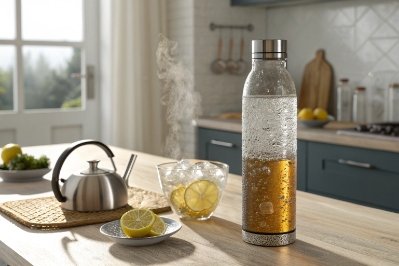
Plastic smells, metal dents, and normal glass cracks when the temperature jumps. One broken bottle can ruin a whole batch and a whole review page.
Borosilicate wins because it handles big temperature swings, stays inert with acidic or alkaline drinks, and keeps a premium clear look after years of washing. The trade-off is cost, so the decision should be proven with ΔT thermal-shock and impact tests.
Borosilicate bottles feel “better” for a simple reason: the material solves several problems at the same time. Thermal shock is the first one people notice. A bottle that survives a hot rinse, a hot-fill trial, and then a cold fridge is not just convenient. It also lowers complaint rates and returns. Chemical stability is the second. Many drinks are slightly acidic, some are salty, and a few are alkaline. A container should not add any taste, smell, or haze, even after long contact and many washes. Optical clarity is the third. When a drink is clear, bright, and clean-looking, buyers trust it more. That trust is easy to lose if the bottle starts to cloud or stain.
What borosilicate changes at the material level
Borosilicate glass is designed around a low thermal expansion profile1. Low expansion means lower stress when the temperature changes fast. Less stress means fewer cracks. The same network structure also helps chemical resistance, so the glass surface stays stable instead of slowly dissolving or roughening. In many specs, the “3.3” family is formalized by documents like the ISO 3585 borosilicate glass 3.3 specification2.
A bottle can look premium on day one and still fail the real job: repeated cleaning, repeated temperature cycling, and daily knocks. Borosilicate supports premium branding because it keeps the “new” look for longer, and it does it without adding coatings that can scratch or peel.
| What brands care about | What customers notice | What borosilicate helps with | What still depends on design |
|---|---|---|---|
| Hot-fill and cleaning safety | “It didn’t crack” | Lower thermal expansion supports higher ΔT | Wall thickness, shoulder geometry, annealing, closures |
| Flavor purity | “It tastes clean” | Inert, nonporous surface reduces interaction | Closure liners, gasket materials, and cleaning habits |
| Shelf appearance | “It looks clear” | High clarity and lower staining tendency | Surface finish, printing, sleeves, and dishwasher chemistry |
| Long life | “It lasts” | Better performance through repeated cycles | Impact protection, sleeve fit, and drop-risk use cases |
A borosilicate bottle is not magic. It is still glass. It can still break from a hard impact. The smart move is to treat borosilicate as a stronger starting point for heat and chemistry, then use design and testing to close the gap on impact.
If the goal is a bottle that survives real life, the best question is not “Is borosilicate good?” The best question is “Which failure mode matters most for this drink and this customer?”
A bottle choice looks simple, but it is rarely only about the glass type. The right answer comes from the process, the drink chemistry, and the test data. The next sections break that down in a practical way.
Does better thermal-shock resistance enable hot-fill use?
Hot-fill can kill microbes, but it can also kill a packaging launch. One crack on the line is expensive, and ten cracks become a recall story.
Yes, better thermal-shock resistance makes hot-fill more realistic, but it does not remove the need for controlled cooling, correct headspace, and a closure that matches the thermal cycle.
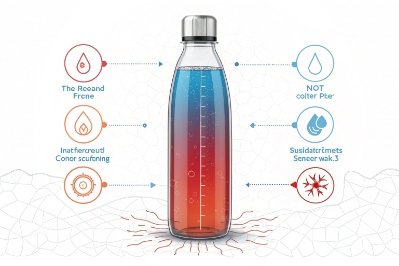
Thermal-shock resistance is the ability to survive a sudden temperature difference, usually written as ΔT. Hot-fill is basically a planned thermal shock. Many hot-fill systems run in the rough range of 85–95°C, and the container then moves toward room temperature and often ends in chilled storage. A practical_toggle to align teams is a shared definition of the hot filling process3 so operations, QA, and design are modeling the same temperature journey.
Hot-fill is a system, not a single temperature
A bottle sees several shocks:
- a hot rinse or sterilization step,
- hot liquid contact inside,
- cooler air outside,
- then cooling water sprays or tunnels,
- then cold-chain storage for some products.
A low-expansion glass helps because the same temperature gradient creates less stress in the wall. But hot-fill success still depends on geometry and process control. A sharp shoulder, a thick-to-thin transition, or poor annealing can create local stress risers. That can defeat a good material.
Practical design rules that reduce breakage
Small changes often do more than a material upgrade:
- keep wall thickness transitions smooth,
- avoid sharp internal corners,
- control fill temperature and cooling rate,
- match closure torque and gasket compression to the hot-to-cold shrink.
| Hot-fill risk point | What goes wrong | What borosilicate improves | What to control in production |
|---|---|---|---|
| Fill at high temperature | Inside is hot, outside is cooler | Lower stress at the same gradient | Fill temp, line speed, ambient drafts |
| Rapid cooling | Outer wall cools first, inner wall stays hot | Higher ΔT margin | Cooling profile, spray pattern, dwell time |
| Vacuum on cooling | Internal pressure drops | Material stays stable | Paneling, headspace, closure venting behavior |
| Rework and rewash | Extra temperature cycles | Better repeatability | Handling damage, micro-scratches, inspection |
The best way to answer “Can this bottle be hot-filled?” is not a brochure claim. It is a thermal-shock test that mimics the line and a pilot run that measures breakage and micro-cracks. Better thermal-shock resistance enables hot-fill use, but the real win is that it gives a wider process window. That wider window is what makes operations calm.
Is chemical durability superior for acidic/alkaline drinks?
A drink can be clean, but the bottle can still leave a trace. Off-flavor, haze, or surface dullness shows up slowly, then it shows up everywhere.
Yes, borosilicate is generally more chemically durable than soda-lime glass, and it is a safer choice when pH is extreme, when temperatures are high, or when long reuse and dishwashing are part of the product promise.
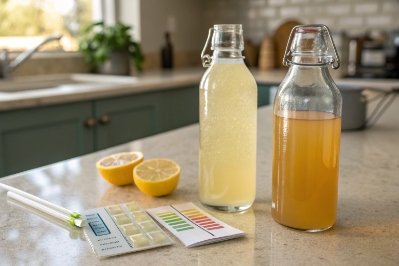
Most beverages are mild. Water, tea, coffee, juice, and electrolyte drinks usually do not attack glass fast at room temperature. The problems start when one of three things happens: the drink is aggressive (very acidic or very alkaline), the temperature is high (hot-fill, sterilization, dishwashing), or the contact time is long (refill culture, storage, and repeated cycles). Under those conditions, a less durable glass can release small amounts of alkali ions or form a slightly altered surface layer. That can lead to haze, a “rough” look, or in rare cases visible flakes under extreme heat and time.
Acid and alkali are not equal threats
Acids often attack glass slowly in daily conditions, but strong alkali can be much more aggressive. That is why chemical durability discussions often separate “hydrolytic resistance” from “alkali resistance.” For the hydrolytic side, methods like the ISO 719 hydrolytic resistance test at 98°C4 are often used as a baseline classification reference when teams want a shared way to talk about “how durable is this glass?”
What “inert” should mean in a beverage bottle
“Inert” should mean:
- no taste change from the container,
- no odor retention after cleaning,
- no visible staining or clouding after real use,
- stable surface even after hot rinses and detergents.
| Drink or use case | Main chemical stress | Typical risk in reuse | What to test or monitor |
|---|---|---|---|
| Citrus juice, kombucha | Acid + organics | Staining on closures, not glass | Sensory panel, surface clarity after cycles |
| Electrolyte drinks | Salts + flavor oils | Odor retention in gaskets | Closure material migration and wash validation |
| Alkaline water | Higher pH | Surface dulling over time | Alkali resistance screening + dishwasher cycles |
| Herbal infusions | Tannins and pigments | Staining perception | Stain release test, visual grading after wash |
| Sterilization / dishwashing | Heat + detergent | Clouding and micro-etching | Repeated wash cycles + haze measurement |
Borosilicate helps because it holds up better when conditions get harsh. Still, chemical durability is not only “glass vs glass.” It is also closures, sleeves, inks, and cleaning chemistry. A perfect bottle with a cheap gasket can still create taste issues. If dishwashing is part of the promise, it also helps to validate that repeated wash conditions do not accelerate surface damage, because glass surface changes after machine dishwashing5 can be driven by the combined effects of heat, detergent chemistry, and time.
If the bottle looks premium but costs too much, the project dies in a spreadsheet. If the bottle costs less but fails in use, the project dies in reviews.
Often yes for reusable and premium positioning, but not always for mass-market price points. Weight and clarity matter most when the bottle is part of the brand experience, not just a disposable container.
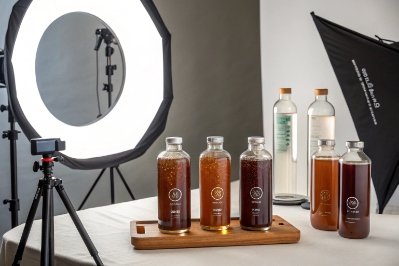
Borosilicate has a lower density than typical soda-lime glass, so it can be lighter for the same volume. The difference is not huge by density alone, but it becomes meaningful when the design can use thinner walls without losing the safety margin for thermal cycling. For daily carry, every gram matters. A bottle that feels lighter and balanced is used more, and repeat use is the whole story behind “sustainable” in practice.
Clarity is the other side of the value. Clear glass makes the drink look honest. It also makes color and texture part of the product. Cold brew, infused water, fruit tea, and craft beverages all sell with visuals. When the bottle stays clear after dishwashing, the product stays premium without extra work.
Why cost goes up
Cost premiums usually come from production realities:
- higher melting and forming requirements,
- slower forming windows for certain shapes,
- tighter quality control to avoid stress and warpage,
- more careful packaging to avoid breakage in shipping.
Sustainability is real, but it needs honest framing
Borosilicate can be reused many times, and that can reduce waste. But glass recycling streams are often optimized for soda-lime container glass. Mixed compositions can create problems in large recycling operations. The sustainable story is strongest when the brand designs for long life and reuse, and when end-of-life pathways are clear in the target market.
| Business scenario | What matters most | Borosilicate value | When the premium is hard to justify |
|---|---|---|---|
| DTC reusable bottle brand | Repeat use + low returns | Big win: thermal cycles + clarity + “clean taste” | If shipping drop damage is high and sleeves are skipped |
| Premium RTD tea / water | Shelf look + trust | Strong: clarity and inert feel | If the product is single-use and price-sensitive |
| Hospitality refill programs | Wash cycles + hygiene | Strong: repeated sterilization tolerance | If breakage handling is weak and staff training is low |
| Mass-market soda | Cost per unit + recycling stream | Limited: glass already works well | When cost, weight, and logistics dominate |
The simplest test for “Is it worth it?” is to map cost premium against failure cost. If one crack or one odor complaint loses a customer for good, the premium can pay back fast. If the product is fully disposable and the brand sells on price, the premium can be wasted.
Which tests confirm ΔT and impact performance?
Belief is not a spec. A real bottle program needs numbers that the factory can hit and the brand can defend.
Thermal-shock performance is confirmed with controlled ΔT test methods, and impact performance is confirmed with repeatable pendulum or drop-impact protocols that match handling and shipping risks.
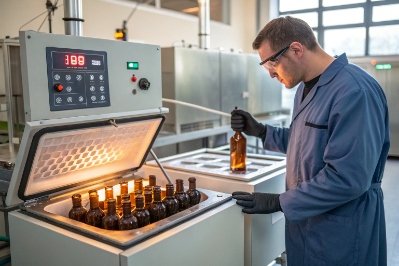
Testing should answer two different questions: “How much temperature shock can this bottle survive?” and “How much abuse can this bottle survive?” A bottle can pass one and fail the other. That is why thermal and impact testing should be treated as a pair.
Thermal shock: resistance vs endurance
In practical terms:
- Thermal-shock resistance asks for a pass/fail at a given ΔT.
- Thermal-shock endurance looks for the failure curve across multiple ΔT steps and often reports a midpoint like 50% failure.
A good ΔT number is only useful if it matches the real process. A hot-fill line can have uneven cooling and uneven fill levels, so a “perfect lab shock” may still be too kind. For that reason, the best approach is to run a recognized standard method (often referenced via the ISO 7459 thermal-shock test method for glass containers6) and also run an internal simulation that copies the process steps.
Impact: where glass actually fails
Most “glass breaks” come from:
- side knocks in handling,
- bottle-to-bottle contact on the line,
- corner drops during consumer use,
- micro-scratches that grow into cracks.
Borosilicate can still break. The best protection usually comes from design: sleeves, bumper rings, base geometry, and controlled surface quality.
| What to prove | Common method | What you measure | What a good report includes |
|---|---|---|---|
| Thermal-shock pass/fail at ΔT | Hot bath / cold bath cycles | Breakage count at target ΔT | Sample size, ΔT, dwell times, failure locations |
| Thermal-shock endurance curve | Progressive ΔT steps | Failure curve and endurance estimate | Graph of cumulative failures vs ΔT, photo evidence |
| Side impact resistance | Pendulum impact on defined points | Breakage energy or breakage rate | Impact energy settings, hit locations, repeatability |
| Real-life drop survival | Controlled drop tests | Breakage at defined heights and orientations | Surface type, drop height, orientation, pass criteria |
| Post-test integrity | Leak and visual checks | Micro-crack screening | Leak rate, dye penetration option, visual grading |
A simple test plan that teams can execute
1) Define the real temperature profile: fill temperature, cooling steps, and storage temperature.
2) Run a standard ΔT method to get a baseline number.
3) Run a process-simulation cycle that copies the line, including closure torque and headspace.
4) Run pendulum impact at the most common hit points (body, shoulder, base edge).
5) Run packed-case drop tests using a defined protocol (for example, guidance aligned to ISO 2248 drop testing for filled transport packages7).
6) Combine results into a single “safe operating window” that includes both temperature and impact limits.
When these tests are done well, borosilicate earns its place with data, not hype. The material choice becomes a risk-control tool, not a marketing phrase.
Conclusion
Borosilicate is “best” when heat cycles, chemical stability, and long-life clarity matter, and when ΔT and impact tests confirm the bottle survives real filling, washing, and daily handling.
Footnotes
-
SCHOTT DURAN® borosilicate 3.3 technical data sheet (PDF):
https://www.schott.com/dam/jcr:cb38c8d1-4dd4-4a43-92bb-48f75eaa353d/DURAN_Borosilicate_3_3_Technical_data.pdf↩︎ ↩ -
ISO 3585:1998 borosilicate glass 3.3 (PDF copy):
https://www.building.govt.nz/assets/Uploads/building-code-compliance/h-vehicle-access-routes/asvm/h1-vehicle-access-routes-2nd-edition-amendment-1/iso-3585-1998.pdf↩︎ ↩ -
Hot filling process overview:
https://en.wikipedia.org/wiki/Hot_filling↩︎ ↩ -
BSI page for ISO 719 (hydrolytic resistance test at 98°C):
https://knowledge.bsigroup.com/products/glass-hydrolytic-resistance-of-glass-grains-at-98-degrees-c-method-of-test-and-classification↩︎ ↩ -
Research paper on glass surface damage after machine dishwashing:
https://www.researchgate.net/publication/258445907_Glass_surface_damages_after_machine_dishwashing↩︎ ↩ -
DIN EN ISO 7459 listing (thermal shock resistance/endurance test methods):
https://store.accuristech.com/standards/din-en-iso-7459?product_id=1156158&srsltid=AfmBOorw3lWNLjFXksgRQys8fuc5TUf74tITAHLlCT57z13NU_E4wcFe↩︎ ↩ -
Overview of ISO 2248 drop testing for filled transport packages:
https://www.matest.com/blog/iso-2248-drop-test-filled-transport-packages↩︎ ↩






