
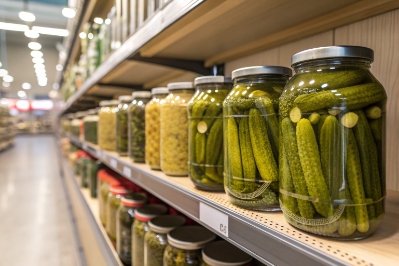
Pickles sell on trust. If the brine looks cloudy, the lid feels weak, or the jar smells odd, buyers walk away and never come back.
Most pickles use glass because it stays neutral with acidic brine, blocks oxygen and moisture well, survives heat processing, and lets shoppers see color and crunch before they pay.
The real reasons glass wins for pickles
Pickles are not a gentle product. The liquid is acidic, the aroma is strong, and the process often uses heat to make the product safe and shelf-stable. That combination punishes weak packaging. In regulatory terms, many pickled products fit the logic behind acidified foods 1, where acidity and process control matter.
A jar must hold pressure changes during hot-fill or pasteurization. It must keep oxygen out so color and flavor stay stable. It must also keep odors in so the shelf does not smell like garlic and dill.
Glass fits these needs in a very direct way. The glass body does not react with vinegar brines, and it does not absorb spice odors. The wall is also an impermeable barrier against outside influences 2, so water vapor and oxygen do not pass through like they can in some plastics. That helps the brine ratio stay consistent. It also helps slow quality drift in long storage.
Merchandising is the other half. Pickles are visual. People want to see spear length, cut style, and how much dill sits at the bottom. Clear glass gives that instant proof. A clear jar also helps brands show “homemade” cues, even when production is industrial. That visual trust can lift price without changing the recipe.
At the same time, glass is rigid. It protects whole pickles and spears from being crushed in case packs. It also pairs well with metal vacuum lids that give a simple safety signal: the lid looks and sounds sealed.
| What pickles demand | Why it matters | How glass helps | What the brand should still control |
|---|---|---|---|
| Acid resistance | brine must stay clean tasting | glass stays neutral | lid liner and metal coating choice |
| Strong barrier | protects flavor and crunch | low gas and moisture transfer | tight cap application and seam quality |
| Heat tolerance | hot-fill and pasteurization | no warping | thermal-shock risk and handling |
| Visual trust | shoppers judge before buying | clear display | label design that does not hide too much |
| Reseal use | jars live in fridges | rigid threads and rim | cap torque and consumer-friendly opening |
If the goal is stable taste, safe processing, and strong shelf appeal at once, glass becomes the simple default. The next questions are about details: acid and odor, wide-mouth access, heat cycles, and how clarity supports selling.
Pickles look like a basic product, but the jar works like a silent salesperson. When the jar looks clean and opens well, repeat purchases follow.
Does glass resist acidic brines and odor staining better?
Acid and spices can turn weak packaging into a slow failure. Off-smells, stained walls, and strange aftertastes make customers doubt the whole brand.
Yes. Glass resists acidic vinegar brines and does not soak up garlic, chili, or dill odors, so flavor stays true and the container stays clean-looking after months.
Why acid resistance is a big deal for pickles
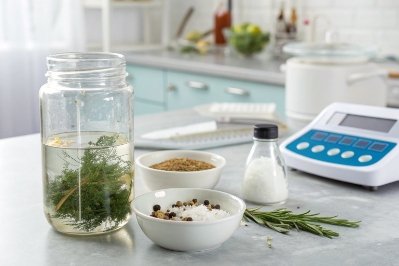
Pickle brine often uses vinegar, salt, and spice extracts. This liquid can stress some packaging materials over time. Glass stays chemically stable in normal food conditions, so the brine does not pull unwanted notes from the container. That keeps the taste predictable from first jar to last jar.
The main risk area is not the glass body. The risk area is usually the closure system. If the lid liner is low quality or not matched to acid, it can soften, hold odors, or allow slow gas movement. That can change headspace smell and can also reduce seal strength over long storage. A good brand treats the lid liner as part of the recipe, not as a cheap accessory.
Why odor and stain resistance matters in real kitchens
Pickles leave smells. Garlic and chili oils love to cling. Plastic can hold those smells and sometimes show color staining from turmeric or paprika. Glass stays much cleaner because it does not absorb—and because glass is nonporous and impermeable 3. That is why reused pickle jars are popular at home. They clean well and do not “remember” the last product.
Practical packaging choices that support this benefit
- Choose a lid liner that is designed for acidic foods.
- Control cap application so the liner compresses evenly.
- Keep the rim clean at filling so the seal is not compromised by brine.
| Issue | What causes it | Why glass helps | What else fixes it |
|---|---|---|---|
| Off-flavor | material interaction | glass stays inert | acid-safe lid liner |
| Odor staining | porous surfaces | glass does not absorb | wash and dry habits for reuse |
| Color staining | spice pigments | glass stays clear | avoid scratches that trap pigments |
| Seal drift | liner creep | rigid glass finish | correct torque and liner selection |
Glass gives a stable, neutral home for acidic brine, and it keeps the jar looking fresh. That stability is one reason brands stay with glass even when plastic is cheaper.
Do wide-mouth shapes improve access and resealing?
A great pickle becomes annoying if a hand cannot reach the last spear, or if the lid never closes cleanly after the first opening.
Yes. Wide-mouth jars improve hand access, reduce product damage during removal, and make rim cleaning easier, which helps resealing and keeps brine from crusting on threads.
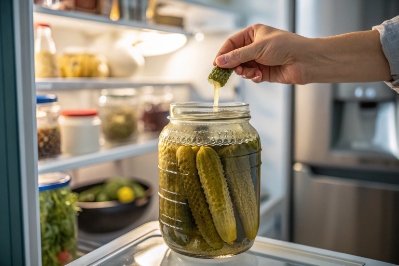
Access is a quality feature, not a convenience extra
When a jar opening is narrow, users reach in with forks and tongs. That can crack spears and disturb the pack. It can also chip the rim if metal tools strike the glass repeatedly. A wide mouth reduces that struggle. It also helps keep the pack looking good after opening, which matters when the jar sits in a fridge for weeks.
Wide-mouth shapes also support certain pickle styles. Whole pickles, thick spears, and stacked chips load easier through a wide opening. That can improve line efficiency because the fill process has more tolerance.
Resealing depends on the rim and thread design
Resealing is not only about the lid. The jar finish needs:
- clean thread geometry
- a smooth rim land
- consistent roundness
A wide mouth makes it easier for consumers to wipe the rim before closing. That small act matters. If brine or spices sit on the rim, the lid liner cannot compress evenly. Then the jar leaks in the fridge, or the brine slowly evaporates and leaves a salty crust.
What wide-mouth can cost
A wider opening can increase lid size cost and may change case pack density. It can also reduce top-load strength if the neck design is weak. These issues are manageable with proper glass distribution and standard finishes.
| Jar mouth choice | Consumer benefit | Production benefit | Trade-off to plan for |
|---|---|---|---|
| Standard mouth | familiar and compact | efficient case packing | harder access for spears |
| Wide mouth | easy reach and clean rim | easier filling for large cuts | larger lid cost and carton space |
| Deep lug finish | strong reseal feel | stable capping | needs good liner control |
| Short finish | modern look | less glass use | can feel cheap if not balanced |
Wide-mouth jars fit the real way people eat pickles. They reduce mess, reduce breakage from tool scraping, and support a cleaner reseal. That improves the day-to-day experience, which protects repeat sales.
Are hot-pack/pasteurization cycles safer in glass?
Heat processing is where packaging can fail fast. Warping, paneling, and seal loss create safety risk and brand damage.
Yes. Glass handles hot-fill and pasteurization temperatures well without warping, and it supports vacuum metal lids that give a clear sealed indicator, as long as thermal-shock and handling rules are respected.
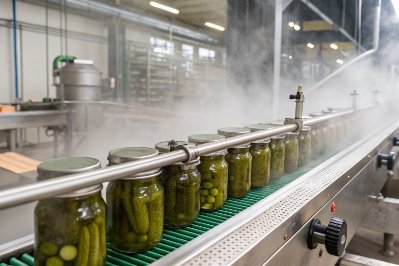
Why heat pushes brands toward glass
Many pickle processes use hot brine filling or a pasteurization step to control microbes and extend shelf life. Heat changes pressure inside the container. Materials that soften with heat can distort and change seal geometry. Glass stays rigid at these food-processing temperatures, so the finish and lid interface stays consistent.
This stability makes vacuum sealing more dependable. Metal lug lids can “button” or show a clear concave shape when vacuum forms, which is why vacuum capping 4 is such a common and trusted system in jars. Consumers may not know the science, but they know what a sealed lid looks like.
Thermal shock is the real glass risk
Glass can crack if temperature changes too fast—classic thermal shock 5—especially if the jar has uneven thickness or if cold jars meet very hot liquid. This is not a reason to avoid glass. It is a reason to control the process:
- pre-warm jars when needed
- manage brine fill temperature ramps
- avoid wet cold spots on glass during hot fill
- use proper cooling profiles
A brand also needs to protect decorated jars. Some inks and coatings can craze or lose adhesion if heat cycles are aggressive. It helps to validate decoration and labels with the real process.
Process and packaging must match
Hot-pack systems also need:
- liner materials that keep compression after heat
- correct cap application torque
- cooling that does not pull the seal unevenly
For teams setting process specs, the low-temperature pasteurization treatment 6 framework is a clear example of why time/temperature control and container compatibility matter.
| Heat step | What can go wrong | Why glass helps | What to validate |
|---|---|---|---|
| Hot fill | container warps | glass stays rigid | fill temp and jar pre-warm |
| Pasteurization | seal relaxes | stable finish geometry | liner heat resistance |
| Cooling | thermal shock | good glass distribution | ΔT profile and handling |
| Storage | vacuum loss | strong barrier | cap torque retention |
Glass is a strong choice for hot-pack and pasteurization because it keeps shape and seal geometry stable. The safety comes from the full system: controlled process, correct lid liner, and sensible thermal management.
How do labels and clarity support merchandising?
Pickles compete in a crowded aisle. If the jar does not build trust fast, shoppers move on. Clear glass is one of the easiest trust tools a brand can use.
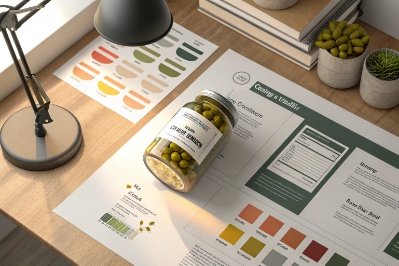
Clarity helps shoppers judge cut size, color, and fill level, while labels on glass stay crisp and premium. Brands can use partial label coverage to show product while still leaving room for bold identity.
Clarity sells “real product”
Pickles are not like sauces where the label does all the work. Buyers want to see:
- spear thickness and uniformity
- brine clarity
- spice load and herbs
- how tightly the pack is filled
Clear glass turns the product into the hero. It also reduces suspicion. When customers see the actual pickles, they feel safer paying a higher price. This is one reason many “homestyle” brands keep glass even when cost pressure rises.
Clarity also helps manage natural variation. Some batches are slightly darker or lighter due to cucumbers and spices. A brand can either show that as authenticity or hide it. Glass allows the brand to choose. If a brand worries about variation, it can use heavier label coverage or a printed back label that frames the product view.
Glass provides a stable surface for labels, direct print, and premium finishes. Paper labels sit flat. Foil accents look sharper. Emboss and deboss on the glass can work with the label rather than fighting it. Clear glass also plays well with neck labels and tamper bands, which add a safety cue.
The balance: show product, still own the shelf
A brand should decide how much glass “window” to leave. Too much label coverage hides the product and reduces the benefit of glass. Too little coverage can make the jar look generic. The sweet spot often uses:
- strong front label for identity
- clear window for product proof
- back label for story and nutrition
- cap top print for shelf-down recognition
Retailers also plan space using planograms 7, so standard jar shapes and consistent label “read” help the product win shelf blocking.
| Merchandising tool | What it communicates | Why glass helps | Common mistake |
|---|---|---|---|
| Clear window | honesty and quality | product is visible | hiding the best view with heavy graphics |
| Front label | brand signal | clean adhesion | labels that wrinkle on curves |
| Back label | compliance and story | stable placement | tiny text that looks cheap |
| Cap design | safety and recognition | metal lids accept print | weak tamper cues |
| Embossed glass | authenticity and anti-copy | permanent detail | overdoing emboss that traps label edges |
Clarity and labeling work together. The glass body builds trust. The label builds identity. When both are designed as a system, the jar becomes a shelf advantage, not just a container.
Conclusion
Pickles use glass because it stays neutral in acidic brine, survives heat processing, reseals well in real kitchens, and sells better on shelf through clarity and clean labeling.
Footnotes
-
Defines acidified foods and processing expectations that often apply to pickled products. ↩ ↩
-
Explains why glass is an impermeable barrier that protects food from outside contamination and migration. ↩ ↩
-
Details glass being nonporous/impermeable, supporting flavor neutrality and easy odor removal. ↩ ↩
-
Shows how vacuum capping creates a visible “button” seal cue on lug lids for jarred foods. ↩ ↩
-
Explains thermal shock and why rapid temperature jumps can crack rigid materials like glass. ↩ ↩
-
Practical reference for controlled pasteurization time/temperature steps used with pickles and jars. ↩ ↩
-
Explains planograms and why standard pack footprints and clear on-shelf readability matter. ↩ ↩






