
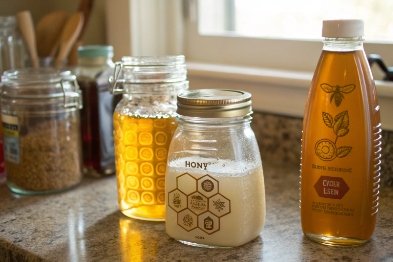
Honey can look “fine” for months, then pick up a weird smell, a wet surface, or a ferment note. That is usually a container and seal problem, not the bees.
For long-term storage, glass is the safer choice because it blocks odor pickup and stays chemically stable. Plastic is fine for short-term use, but it is more likely to absorb smells and let tiny gas and moisture movement happen over time.
What “long-term” honey storage really means?
Honey does not spoil easily, but it can change
Honey is naturally low in water and high in sugar, so it typically has low water activity in honey 1. That is why it can last for years. Still, quality can drift. The biggest risks are moisture uptake, flavor change, and contamination at the lid. A poor seal lets humid air in and out. That can raise water content at the surface and increase the chance of fermentation. A practical reference point is the National Honey Board’s honey fermentation conditions 2, which emphasize how moisture and storage conditions shift the risk.
The container is only half the system
The other half is the closure. A perfect glass jar with a bad lid still fails. A decent plastic jar with a strong liner can do fine for everyday kitchen use. For storage that runs into years, the safest system is a glass jar + airtight lid with a good liner.
| Storage goal | Best container | Best closure style | Biggest thing to control |
|---|---|---|---|
| Daily squeeze use (weeks) | Food-grade plastic | Flip-top or spout cap | Keep neck clean |
| Pantry storage (months) | Glass or plastic | Screw or lug with liner | Tight seal + dry storage |
| Long-term storage (1–5+ years) | Glass | Metal lug/screw with gasket | Moisture barrier + odor protection |
| Gift / resale presentation | Glass | Lug/screw + tamper band | Clean look + repeatable seal |
Glass usually wins for long-term storage because it stays inert, it does not hold smells, and it handles gentle reheating better. Plastic wins for weight, drop safety, and convenience. The best choice depends on how long “long-term” is and how the jar will be used.
A simple way to move forward is to decide what matters most: purity and stability, or handling and convenience. The next sections break that down in a practical way.
If the goal is the least worry over years, the safest move is to choose glass, then put most attention on the lid and storage habits.
Does glass reduce odor transfer and chemical migration?
Plastic can be convenient, but it can also become a silent flavor risk. Honey is a strong flavor sponge. It holds aromas well, which is great until it starts holding the wrong ones.
Yes. Glass is non-porous and more inert than plastic, so it reduces odor transfer and lowers the risk of chemical migration, especially during warm storage or repeated heating.
Why odor transfer matters more than people expect
Plastic can absorb odors from its surroundings and from what it previously held. Even food-grade plastics can hold a “cabinet smell,” spice smell, or a faint detergent note. Honey can pick that up over time. Glass does not behave that way. It does not absorb and re-release smells in normal use, because it is nonporous and impermeable glass packaging 3.
This is most noticeable with strong honeys like buckwheat or manuka, because the aroma is intense and any off-note becomes obvious. It is also noticeable when honey is stored near onions, spices, coffee, or scented cleaners.
Migration risk is mostly a heat and time story
Food-grade plastic is generally designed to be safe, but long-term storage plus heat can increase the chance of tiny compound movement. Honey is acidic enough to make some materials less comfortable over long time windows, and heat makes everything move faster. Glass stays stable across normal kitchen conditions.
That does not mean plastic is “unsafe.” It means glass is more predictable when the storage time is long and the environment is not controlled.
A practical way to choose at home
If honey will be stored for a year or more, glass gives more protection with less thinking. If honey will be used quickly and handled a lot, plastic is fine.
| Factor | Glass | Plastic | Best home use |
|---|---|---|---|
| Odor pickup | Very low | Medium | Glass for delicate flavor |
| Chemical stability | Very high | Depends on resin and heat | Glass for long storage |
| Light exposure | Can be improved with amber glass | Often clear | Store both in the dark |
| Drop safety | Lower | Higher | Plastic for kids/travel |
| Cleanup | Easy, no smell memory | Can hold odors | Glass for reuse cycles |
For long-term honey storage, glass is the low-risk choice because it protects aroma integrity and stays stable even if the pantry gets warm.
Do airtight lug lids slow crystallization and moisture uptake?
Crystallization scares people, but it is usually a sign of real honey, not a problem. The real enemy is moisture, because moisture can push fermentation.
Airtight lug lids help a lot with moisture control, but they do not “stop” crystallization. Crystallization is driven mainly by honey chemistry and storage temperature, not by air exposure.
Crystallization is mostly about sugars and temperature
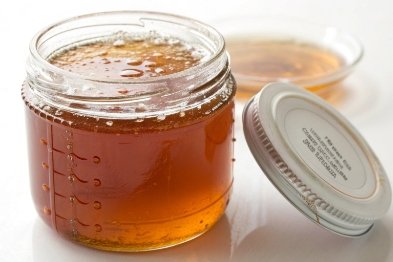
Honey crystallizes when glucose forms crystals. Some honeys crystallize fast. Some stay liquid longer. Temperature also matters. Honey often crystallizes fastest around cool room temperatures, and it can crystallize slower when stored a bit warmer. That is why one jar turns solid while another stays runny.
A lid does not change the glucose-to-fructose ratio. It also does not remove the tiny particles that act as crystal “seeds.” So an airtight lid is not a crystallization control tool in the main sense.
Airtight sealing still matters a lot
Even if the lid does not stop crystals, it protects honey in other ways:
- It reduces moisture uptake in humid kitchens.
- It reduces surface wetness, which can support yeast activity.
- It keeps the aroma cleaner, because air exchange is reduced.
- It limits sticky mess at the rim, which attracts dust.
A lug lid with a good gasket (often plastisol-lined lug lids 4) can create a strong vapor barrier when applied correctly. A weak lid, a dented lid, or a lid with a damaged liner can let humidity creep in over time.
How to tell if your lid is doing its job
- The lid should close smoothly and feel firm at the end.
- The liner should be intact, not cracked, not sticky, and not smelly.
- The rim should be clean before closing, because honey on the rim can stop a good seal.
| Closure type | Moisture barrier | Ease of reuse | Best match |
|---|---|---|---|
| Metal lug lid with liner | High | Medium (inspect liner) | Long-term pantry storage |
| Screw cap with foam liner | Medium to high | High | Daily use jars |
| Flip-top/spout cap | Medium | High | Squeeze convenience, short-term |
| Loose cap / no liner | Low | High | Not for humid kitchens |
So yes, airtight lug lids help with moisture and freshness. Just do not expect them to control crystallization. For crystals, the best lever is storage temperature and gentle reheating when needed.
Are weight and breakage trade-offs manageable at home?
People often avoid glass because it feels fragile. That concern is real, but it can be managed with simple habits and the right jar style.
Yes. For home storage, glass weight and breakage are usually manageable if jars are stored low, away from edges, and handled with dry hands. Plastic still makes sense for travel, kids, and high-drop-risk kitchens.
When glass is easy at home
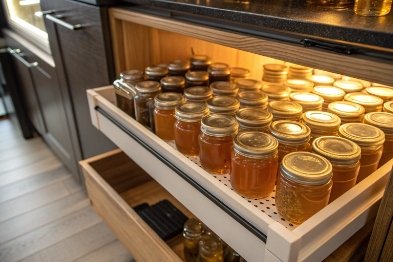
Most honey storage is not high movement. It is pantry storage. In that setting, glass is simple:
- Store jars on a lower shelf.
- Avoid stacking glass-on-glass without a buffer.
- Keep the shelf dry to prevent slip accidents.
- Choose jars with a wider base if the pantry shelf is narrow.
If the jar will be used daily, it helps to use a smaller “working jar” and keep a larger glass jar as the reserve. That reduces drops and also reduces air exposure on the bulk stock.
When plastic is the smarter choice
Plastic is great when the jar is:
- Used by kids
- Carried outdoors
- Kept near a busy stove area
- Squeezed and handled one-handed
Most squeeze bottles are made from resins like high-density polyethylene (HDPE) 5, which are convenient and shatter-resistant for daily use.
Plastic is also useful when the honey is used quickly. If it is gone in weeks, the long-term stability advantage of glass matters less.
A realistic home strategy that works well
A simple setup is:
- Bulk jar in glass for long storage (cool, dark spot).
- Small daily jar in plastic or glass depending on risk.
- Refill the daily jar and keep the bulk jar closed most of the time.
| Home situation | Best material | Why | Simple tip |
|---|---|---|---|
| Quiet pantry, adult handling | Glass | Stability and odor protection | Store low, away from edges |
| Kids in the kitchen | Plastic | Drop safety | Use a squeeze bottle for daily use |
| Small apartment, tight shelves | Plastic or small glass | Less break risk | Avoid tall heavy jars |
| Gifting / display | Glass | Premium look and clarity | Add a tamper band or clean label |
For most homes, glass is not hard to manage. It just needs a calmer storage spot and a plan for daily handling.
How do labeling and reheating practices differ by material?
Honey storage is not only about keeping it safe. It is also about keeping it usable. Labels help rotation, and reheating helps when crystals form.
Glass is easier for clean labeling and safer for gentle water-bath reheating. Plastic works for labeling too, but it should not be heated aggressively, and many people prefer moving crystallized honey into glass before warming.
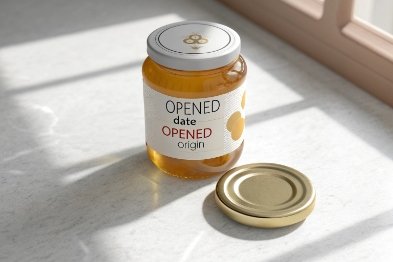
Labeling: what changes by container
Glass has a smooth surface that holds labels well and cleans up easily later. Plastic flexes, and some adhesives peel or wrinkle over time. For home labeling, simple wins:
- Write the date opened and date filled.
- Add the floral source if known.
- Add a batch note if the honey is special or raw.
For glass, paper labels and removable labels work well. For plastic, use labels designed for flexible surfaces, or write directly with a permanent marker on a dry area.
A small detail that helps: put labels on the side, not on the lid, because lids get sticky and get replaced.
Reheating: glass is more forgiving
Crystallized honey can be softened with gentle heat. The safest home method is a warm water bath.
- Glass jars can go into warm water more safely, as long as the temperature change is not extreme.
- Plastic jars can warp or pick up odor if heated too hot, especially in microwaves or near direct heat.
If the honey is in plastic and needs warming, the simplest low-risk move is to transfer it into a glass jar first.
A practical temperature habit:
- Use warm water, not boiling.
- Keep heat gentle and slow.
- Stir if possible to even out warming.
If you want a simple, widely used baseline, the National Honey Board describes the warm-water-bath method for crystallized honey 6.
One more long-term detail: plastics are “good enough” for many daily jobs, but they are still semi-permeable, meaning slow gas and water-vapor permeation 7 can happen over long time windows. That matters more when storage is measured in years.
| Task | Glass best practice | Plastic best practice | Common mistake |
|---|---|---|---|
| Labeling | Removable label or marker | Flexible-surface label or marker | Labeling the lid only |
| Rotation | Date opened + date filled | Same | No date, old jars forgotten |
| Decrystallize | Warm water bath, slow heat | Transfer to glass first | Microwaving plastic |
| Cleanup | Hot rinse, no odor memory | Wash quickly to avoid odor | Storing damp lids |
Labeling and reheating are small habits, but they decide whether long-term storage stays practical instead of turning into a sticky mess.
Conclusion
For long-term honey storage, glass plus an airtight lined lid is the safest system. Plastic is great for daily handling, but glass protects flavor, odor, and reheating flexibility over years.
Footnotes
-
Explains why honey’s low water activity makes it naturally resistant to spoilage. ↩ ↩
-
Lists conditions where honey fermentation is unlikely, highlighting moisture as the key control. ↩ ↩
-
Summarizes why glass is nonporous and doesn’t change food flavor through container interactions. ↩ ↩
-
Quick guide to plastisol liners and how they create an airtight seal on lug and metal closures. ↩ ↩
-
Background on HDPE and why it’s common for squeeze bottles and everyday food containers. ↩ ↩
-
Simple consumer instructions for safely liquefying crystallized honey with gentle warming. ↩ ↩
-
Clear explanation of permeation and why plastics allow slow gas/vapor movement over time. ↩ ↩






