
A great wine can be ruined by a tiny leak or a sloppy seal. Most “faults” blamed on winemaking are really packaging mistakes.
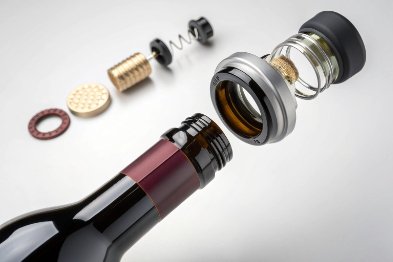
A wine bottle closure is the sealing system at the neck that keeps wine inside and controls oxygen exposure over time. It protects against leakage, contamination, and unwanted oxidation while shaping how the wine evolves in the bottle.
A closure is not only the plug or cap. It is a system: closure + liner (if used) + capsule/TE features + the bottle finish geometry that the closure seals against. When these parts match, sealing is consistent. When they do not, aging becomes unpredictable.
How do corks, technical corks, and Stelvin screw caps differ?
A closure choice sends a quality signal, but it also changes oxygen flow, consistency, and line requirements.
Natural cork is traditional and variable. Technical corks reduce variability and taint risk while keeping a cork look. Stelvin screw caps are highly consistent and rely on liner choice to tune oxygen ingress and performance.

Natural cork (one-piece)
Natural cork comes from cork oak bark 1. It is elastic and compresses to seal inside the neck. It is also variable because it is a natural material. Premium corks can be very good, but variation is real.
Strengths:
- classic ritual and premium perception in many markets
- good sealing when cork is high grade and bottling is controlled
- supports long-term cellaring in many traditional programs
Weaknesses:
- variability in oxygen transfer from cork to cork
- risk of cork taint (TCA) 2 is lower than decades ago, but not zero
- storage humidity and cork care matter more
Technical corks (agglomerated, micro-agglomerated, composite)
Technical corks use cork granules bonded together, sometimes with natural cork “disks” at the ends, or engineered structures with controlled density.
Strengths:
- more consistent sealing and OTR than many natural cork programs
- lower taint risk, especially for modern micro-agglomerated types 3
- often cost-effective for large runs and brand consistency
Weaknesses:
- not always chosen for ultra-premium “heritage” positioning
- still needs correct insertion and bottle finish control
- some types are best for mid-term aging, not extreme long-term
Stelvin screw caps (aluminum cap + liner)
Stelvin is often used as shorthand for screw caps in wine. The seal is created by the liner compressing against the bottle finish, not by a plug inside the neck.
Strengths:
- very consistent at scale when the bottling line is set correctly
- low leakage risk and strong consumer convenience
- excellent protection for aromatic whites and wines meant to stay fresh
Weaknesses:
- liner choice matters a lot; wrong liner can push reduction risk
- some markets still carry perception bias against screw caps
- bottle finish tolerance must be tight for perfect liner compression
Quick comparison table
| Closure type | Seal mechanism | Consistency | Typical best fit |
|---|---|---|---|
| Natural cork | compression inside bore | medium (variable) | premium tradition, long cellaring with good supply |
| Technical cork | engineered compression | higher | brands needing consistent aging + cork ritual |
| Stelvin screw cap | liner compression on finish | very high | freshness-driven wines, high-volume consistency |
No closure is “best” in every case. The best closure is the one that matches wine style, target shelf life, and the bottling line’s capability.
Do closures change oxygen ingress and aging potential?
Aging is controlled oxidation and reduction. The closure is the gate that decides the pace.
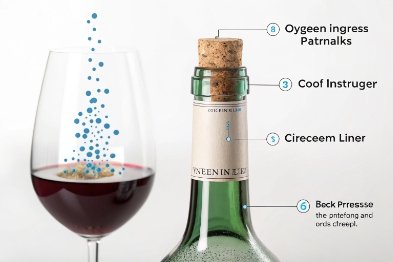
Yes. Oxygen transmission rate (OTR) varies by closure type and even by grade within the same type. Natural cork often has wider variation, technical corks are more consistent, and screw caps tend to be very consistent with low oxygen ingress, which can preserve freshness but may increase reduction risk in some wines.
What oxygen ingress actually does
A small oxygen flow can:
- soften tannins over time
- reduce sharp edges in young red wines
- help some wines develop complex tertiary aromas
Too much oxygen can:
- dull fruit aromas
- brown whites
- flatten acidity and freshness
Too little oxygen can:
- trap sulfur compounds
- increase reductive aromas (struck match, rubber) in some styles
So “more oxygen” is not always better. “Less oxygen” is not always better either. In practice, teams often track oxygen transmission rate (OTR) 4 to keep aging outcomes predictable.
Why consistency is often more important than average OTR
Brands suffer when the same SKU tastes different bottle to bottle. That problem often comes from variability in closures. Natural cork can be excellent, but it can also vary across a lot. Technical corks and screw caps are often chosen because they reduce variability.
Some screw-cap programs now offer cap types with different oxygen transmission rates 5 so producers can tune aging behavior without changing the bottle.
Matching closure to wine intention
A practical alignment often looks like this:
- Drink-now whites and rosé: consistency and freshness matter most → screw cap or consistent technical cork often fits.
- Aroma-driven reds: consistent oxygen control matters → technical cork or high-grade natural cork with strict QC.
- Long-cellar icons: tradition and proven behavior matter → high-grade natural cork or premium technical systems depending on brand stance.
| Wine intent | Biggest risk | Closure direction that helps |
|---|---|---|
| Fresh and aromatic | oxidation and aroma loss | lower OTR, high consistency |
| Mid-term aging | bottle variation | consistent OTR lots |
| Long aging | premature oxidation or random faults | strict cork QC or proven engineered closure |
The closure does not create quality. It preserves the winemaker’s target path.
Which capsule/foil and tamper-evidence features improve compliance?
Compliance is not only about food contact. It is also about anti-tamper, traceability, and consumer trust.
Capsules and tamper-evidence (TE) features help compliance by showing first-opening integrity, protecting the closure area from dirt, and supporting traceability with lot codes. Heat-shrink capsules with TE bands, perforation lines, and printed batch codes are common solutions.

What the capsule actually does
A capsule:
- covers the closure and finish area
- improves shelf appearance
- reduces dust and abrasion on the closure top
- can carry branding and legal marks (where required)
For cork-finished bottles, capsules also guide consumer expectation. For screw caps, TE is often built into the cap itself, but an added sleeve can still enhance appearance in some programs.
Useful TE features in real markets
Common TE choices include:
- tear tabs
- perforation rings
- TE bands that separate visibly on first opening
- laser or inkjet coding for traceability
- holograms or unique marks for higher anti-counterfeit needs
If you need a general reference point for what qualifies as tamper-evident packaging 6, it helps clarify what consumers recognize as “opened vs unopened.”
The best TE feature is the one that is obvious to the consumer and hard to fake, while still running well on the line.
One warning about capsules and corrosion
Capsules can trap moisture around the finish. If the storage environment is humid, that moisture can:
- stain the finish area
- encourage corrosion on some cap metals
- create moldy odors if the capsule is not breathable
So capsule design should match the storage reality. For export routes with high humidity, better ventilation and material choice matter.
How do neck and finish tolerances ensure perfect sealing?
A closure can be high-end and still fail if the bottle finish is out of spec. The seal happens on microns, not on marketing.
Perfect sealing requires the bottle finish diameter, ovality, height, and sealing surface to match the closure design. Corks need the correct bore and insertion profile. Screw caps need precise finish geometry so the liner compresses evenly and the thread engages without damage.

For corks: bore and surface quality decide the seal
Cork sealing relies on compression against the inner bore. So these factors matter:
- bore diameter and taper
- smoothness of the inner neck
- absence of chips at the lip
- correct cork moisture and insertion depth
If the bore is too wide, the cork may not seal. If it is too tight, the cork can tear or buckle. If the lip is chipped, micro-leaks happen during temperature swings.
For screw caps: liner compression and thread quality decide the seal
Screw caps seal by pressing a liner onto the finish. So these factors matter:
- finish outside diameter and roundness
- top sealing surface flatness
- thread profile accuracy
- consistent application torque
If the finish is oval, liner compression becomes uneven and leaks can appear. If threads are rough, caps can cross-thread and damage the liner during application.
One common hidden issue is finish damage from handling:
- small nicks from depalletizing
- scratches from rails
- chips from glass-to-glass contact
A bottle can pass a gauge check and still leak if the sealing land is scratched. That is why good bottling lines use:
- air rinsers and gentle handling
- finish protection and breakage controls
- regular torque checks and capper maintenance
For dimensional references and terminology, many packaging teams align specs to CETIE bottle finish data sheets 7.
Practical QC checks that prevent sealing failures
| Control | What it verifies | Why it matters |
|---|---|---|
| Finish gauges | diameter, thread, height | closure fits and seals consistently |
| Roundness/ovality checks | sealing uniformity | prevents micro-leaks |
| Torque monitoring | correct liner compression | reduces leaks and over-torque damage |
| Leak tests | real seal integrity | catches line drift fast |
| Visual finish inspection | chips and scratches | prevents field failures |
When sealing is perfect, oxygen control becomes predictable. That is when aging potential becomes a choice, not a gamble.
Conclusion
A wine bottle closure is a sealing system that controls oxygen and protects wine. Natural cork, technical cork, and Stelvin caps differ mainly in consistency and oxygen control, and the best results come from matching closure design to bottle finish tolerances and strong TE features.
Footnotes
-
Explains cork oak and why its bark works for wine stoppers. ↩︎ ↩
-
Details what causes TCA cork taint and how to reduce risk. ↩︎ ↩
-
Shows how micro-agglomerated corks are engineered for consistency and low taint risk. ↩︎ ↩
-
Practical overview of closure OTR and total package oxygen impacts on wine aging. ↩︎ ↩
-
Research discussion of screw caps with different OTR liners and aging outcomes. ↩︎ ↩
-
Quick definition of tamper-evident packaging and common first-open indicators consumers recognize. ↩︎ ↩
-
Standard finish references used to match closure designs to bottle geometry. ↩︎ ↩






