
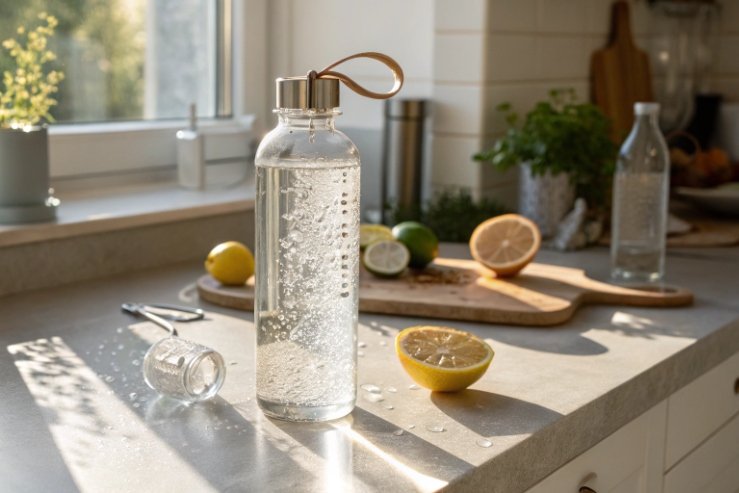
Water should taste like nothing. Yet many people notice a “plastic” smell after a few hours in the sun or a weird aftertaste after repeated washing.
Glass water bottles protect taste because glass is inert and nonporous. They clean easily, handle hot/cold use better than many plastics, and can be cost-effective over time when reused and recycled. The trade-off is breakage risk, which sleeves and smart handling can reduce.
The best way to judge a glass water bottle is not only the look. It is how it behaves after months of daily use: does it stay odor-free, does it survive washing, and does it still feel safe and pleasant to drink from?
Does glass preserve taste by preventing odor and chemical leaching?
Many “water tastes” are not from the water. They come from the container and what it holds onto.
Glass is nonporous and impermeable 1, so it does not absorb odors and it is highly resistant to flavor carryover. That makes taste more stable across time, and it also makes it easier to switch between drinks without “ghost flavors.”
Some plastics can also show aroma scalping 2 (absorption of aroma compounds), which can mute delicate flavors over time. Glass avoids this because it is nonporous and does not absorb typical beverage aromas.
Leaching concerns vary by material and use conditions. In regulated markets, packaging materials used with drinks are evaluated as food-contact substances 3. Many consumers still prefer glass for “nothing-added” taste confidence, especially when bottles sit warm for long periods.
Taste is also a closure issue
The bottle body can be perfect, yet the cap can add odor. Many lids use silicone gaskets and plastic parts. If the gasket traps moisture, it can create smells. So for true taste neutrality, the full system matters:
- choose caps with food-grade silicone that can be removed and cleaned
- avoid deep crevices that trap residue
- dry the cap fully after washing
| Taste risk source | Glass bottle body | Cap / gasket | Best habit |
|---|---|---|---|
| Odor absorption | very low | medium | remove and wash gasket |
| Soap residue | low | medium | rinse well, air-dry |
| Flavor carryover | very low | medium | use wide-mouth + brush |
If the goal is “water tastes like nothing,” glass does more of the work than any other common material, but the lid design still deserves attention.
Are glass bottles safer for hot/cold cycling and dishwashing?
People want one bottle for iced water, hot tea, and dishwasher cleaning. That is where materials behave very differently.
Glass stays dimensionally stable and does not warp in heat. Many glass bottles handle dishwashing well, while sudden temperature shocks can still crack standard glass if the change is extreme. Designs made with low thermal expansion 4 (typical of borosilicate families) can improve hot/cold cycling tolerance—especially when users frequently alternate hot and cold drinks.
Dishwashing realities
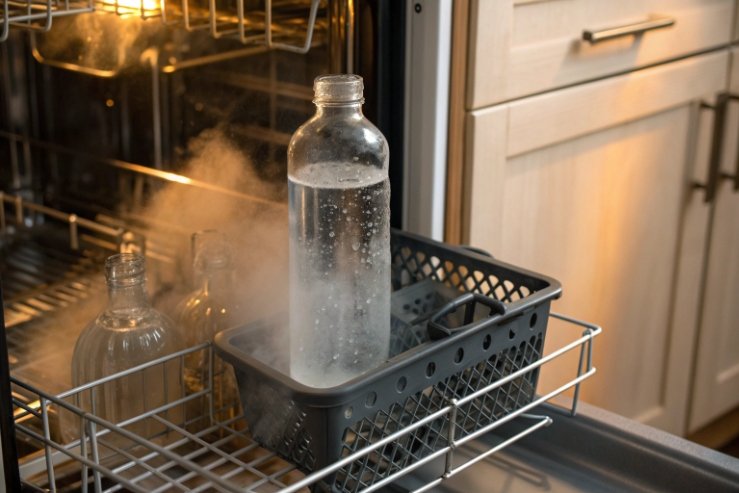
Most daily-use glass water bottles handle dishwashing well, but caps and sleeves vary:
- Some sleeves trap water and grow odor if not dried.
- Some caps deform or discolor over time.
- Some printed decorations can fade if they are not dishwasher-rated.
A practical hygiene habit is to follow daily cleaning guidance 5 (warm soapy wash + thorough drying), and to clean gaskets and caps as carefully as the bottle.
Practical “thermal shock safe use” habits
- Do not pour boiling water into an ice-cold bottle.
- Let hot liquids cool slightly before filling.
- Do not place a hot bottle directly on a cold stone counter.
- Avoid freezing a full glass bottle, since ice expansion can break it.
| Use case | Glass performance | Key risk | Best solution |
|---|---|---|---|
| Iced water daily | excellent | drops | use sleeve + handle carefully |
| Warm tea | good | thermal shock if extreme | borosilicate, avoid sudden cooling |
| Dishwasher cleaning | good | cap/sleeve wear | removable gasket, dry fully |
| Freezer storage | risky | expansion breaks | avoid freezing full bottle |
How do durability and sleeve options mitigate breakage?
The biggest barrier to glass is fear of breaking. That fear is valid, but it can be managed.
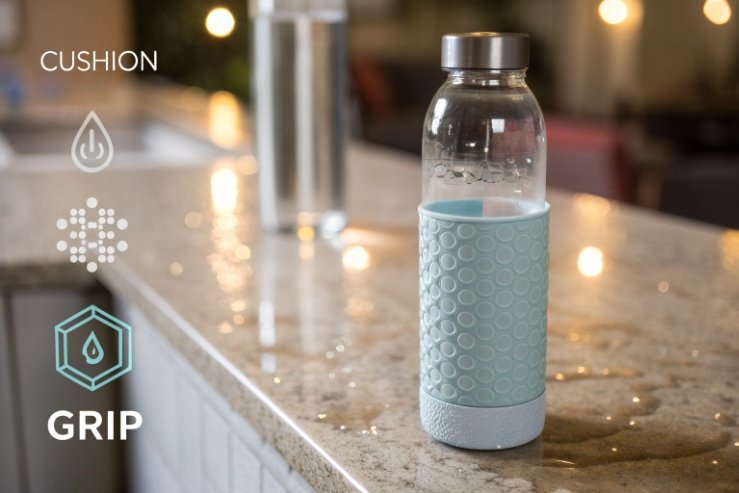
Sleeves and protective designs reduce breakage risk by adding grip, cushioning impacts, and preventing bottle-to-surface abrasion. They cannot make glass unbreakable, but they can lower day-to-day damage rates a lot, especially for drops from desk height.
What makes a glass bottle break in real life
Most breaks come from:
- edge hits on tile or concrete
- small chips at the base or mouth
- bottle-to-bottle impacts in bags
- twisting forces when the bottle is jammed in a tight cup holder
A sleeve helps in three ways:
- cushion: reduces peak impact energy
- grip: reduces slips from wet hands
- scratch control: reduces micro-damage that can become crack starters
Sleeve types and what they do
- Silicone sleeves: best grip, good impact damping, easy to clean, can trap water if not dried.
- Neoprene sleeves: good insulation, good grip, can hold odors if it stays damp.
- Textile wraps: good grip, less impact protection, often more “fashion” than safety.
For commuting and gym use, a silicone sleeve with firm base-edge coverage is usually the most practical.
Design features that also matter
A sleeve is not enough if the bottle design is weak. Better durability often comes from:
- thicker heel area
- rounded shoulder transitions
- a protected mouth rim
- wide-mouth designs that reduce rim chipping from cleaning tools
- a cap that does not transmit impact to the glass lip
| Breakage risk | What reduces it | What to watch |
|---|---|---|
| desk-height drop | silicone sleeve + thicker heel | sleeve must cover base edge |
| bag impacts | sleeve + carry loop | avoid glass-to-glass contact |
| rim chips | protected mouth + good cap | avoid metal cap edges on glass |
| hidden scratches | sleeve + gentle washing | avoid gritty sponges |
Do recyclability and refill programs reduce lifetime cost?
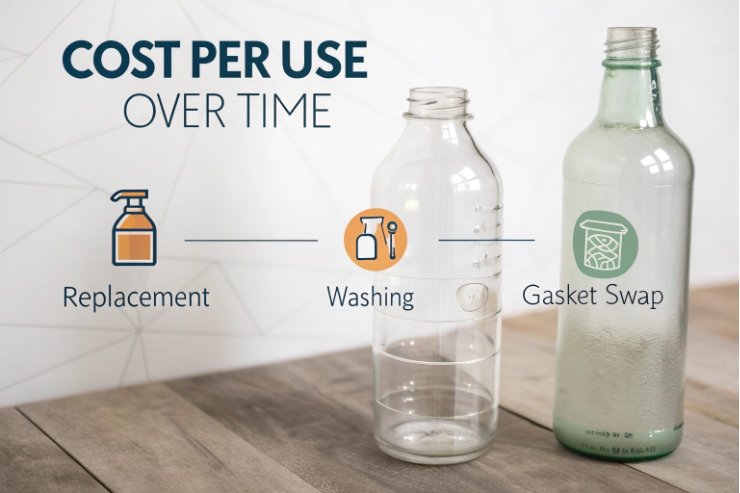
Many people compare only the purchase price. The better comparison is cost per use.
Glass can reduce lifetime cost when it is reused many times, because the bottle stays odor-free and washable longer than many plastics. Glass is also infinitely recyclable 6 in practice when collection and remelt loops are available, which strengthens end-of-life options.
Refill habits can cut spend over months and years—whether through office filtration, gym stations, or public refill points. Programs like the Refill scheme 7 show how refill networks can support reusable-bottle routines.
Lifetime cost is about replacement frequency
A cheap bottle that gets smelly or stained often gets replaced. A glass bottle that stays neutral can last much longer. Even if glass costs more upfront, the cost per use can drop if it survives daily routines.
The biggest lifetime cost drivers:
- how often the bottle is replaced
- how often caps and gaskets need replacement
- how often the bottle breaks due to handling
- whether refill is convenient at work, gym, or travel
| Cost lens | How glass helps | What can hurt cost | Best approach |
|---|---|---|---|
| Cost per use | long service life | breakage events | sleeve + careful handling |
| Cleaning cost | easy to sanitize | cap gasket odor | removable gasket + drying |
| Refill savings | reduces single-use water buying | low refill access | pick routes with refill points |
| End-of-life | recyclable | local recycling limits | check local acceptance rules |
Conclusion
Glass water bottles keep taste clean, clean easily, and support refill habits, while sleeves and smart design reduce break risk enough for daily use and better lifetime cost.
Footnotes
-
https://www.gpi.org/glass-is-sustainable/what-is-glass — Background on glass as nonporous, impermeable packaging. ↩︎ ↩
-
https://oeno-one.eu/article/view/3149 — Research context for aroma compound sorption (“scalping”) in packaging materials. ↩︎ ↩
-
https://www.fda.gov/food/packaging-food-contact-substances-fcs/food-contact-substances — Overview of U.S. food-contact substance evaluation for packaging. ↩︎ ↩
-
https://www.vidrasa.com/products-and-services/domestic-glass/duran-borosilicate-3-3-glass — Borosilicate properties and low thermal expansion context. ↩︎ ↩
-
https://apnews.com/article/water-bottle-cleaning-germs-8e7b6e2f30e03e9e3bf3c24a7b45b2cf — Practical cleaning guidance for reusable water bottles and lids. ↩︎ ↩
-
https://feve.org/wp-content/uploads/2021/05/FEVE_Facts-and-figures.pdf — Container glass facts and figures, including recyclability context. ↩︎ ↩
-
https://www.refill.org.uk/ — Example of a public refill network supporting reusable bottle habits. ↩︎ ↩






