
A sauce can win on taste and still lose on shelf. The wrong bottle leaks, stains, or looks low-end, and the brand pays for returns and slow repeat buys.
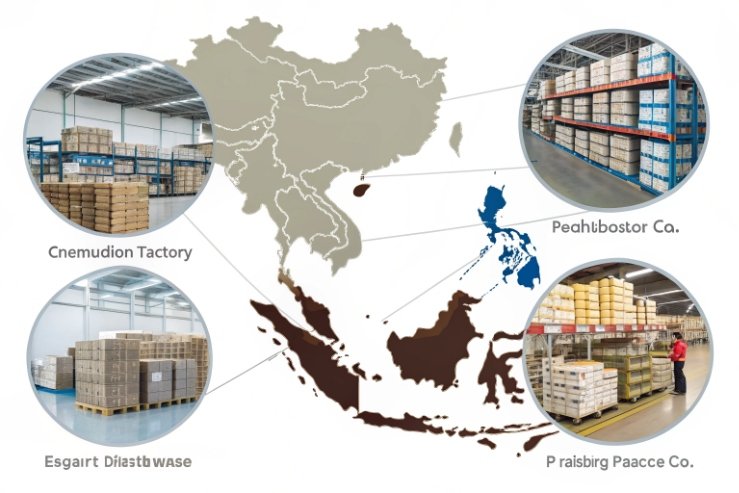
In Southeast Asia, glass sauce bottles are mainly purchased by condiment manufacturers, export packers, co-packers, and foodservice distributors. Modern trade drives the biggest branded demand, while HORECA and e-commerce shape fast-growing premium and specialty niches.
Demand is not coming from one “buyer type.” It comes from a mix of factories, brand owners, and channel-driven pack formats. When a buyer understands who is buying, and why, bottle specs become easier to standardize and easier to sell.
Who are the core buyers of glass sauce bottles in Southeast Asia?
A new sauce brand often thinks packaging is a small detail. Then the first big order arrives, and the buyer realizes packaging is the product’s first quality test.
The core buyers are sauce and condiment manufacturers, export-oriented producers, contract packers, private-label programs, and foodservice distributors. Smaller but important buyers include specialty gourmet brands, gift sellers, and refill-store operators in major cities.
Local manufacturers and national brands
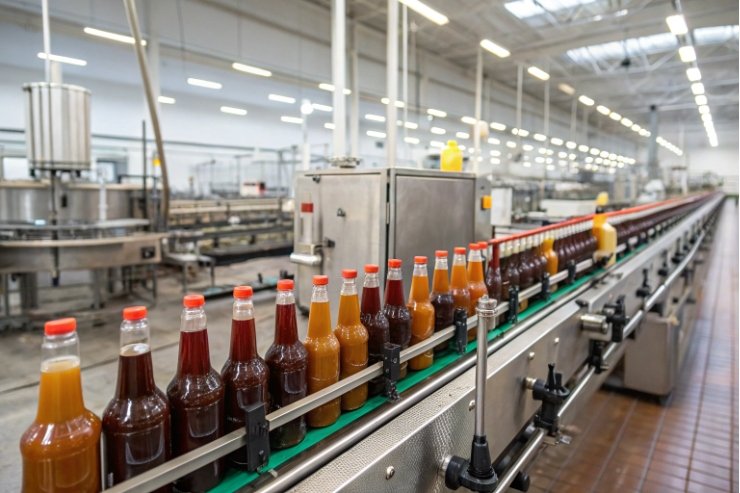
Most volume comes from local sauce makers that bottle everyday staples: fish sauce, soy sauce, chili sauce, vinegar, oyster sauce (often jars), and cooking sauces. These producers buy glass for two reasons. Glass holds aroma and color well, and it communicates “authentic” and “safe” in a region where home cooking is tied to trust. The Southeast Asia sauces, dressings, and condiments market is also growing, which keeps packaging demand steady even when price pressure rises. In practice, these buyers want dependable supply, consistent neck finishes, and low defect rates because their lines run many SKUs.
Export packers and compliance-driven buyers
Thailand, Vietnam, Indonesia, and the Philippines all have exporters selling sauces to the US, EU, Japan, and regional ASEAN markets. Export buyers often prefer glass because importers like the stability of glass, and because glass packaging “looks right” for traditional Asian sauces overseas. These buyers usually demand tighter QC: dimensional consistency, stronger cartons, and closures with proven leakage performance.
Co-packers, private label, and retailer programs
Many brands rely on contract packers (co-packers) 1 to bottle sauces for multiple labels and markets. Retail-led private-label programs 2 also buy glass because it helps them run many SKUs through one line without worrying about staining, odor carryover, or container compatibility. These buyers care about standardization: one or two bottle families that cover many sauces.
| Buyer type | What they sell | Why glass is chosen | What they optimize first |
|---|---|---|---|
| Local sauce manufacturers | Daily cooking staples | Trust, inertness, stable shelf look | Cost + line speed |
| Export producers | Global shelf sauces | Import expectations, premium cue | QC + transit protection |
| Co-packers/private label | Many SKUs | Standardization + brand look | Availability + flexibility |
| Foodservice distributors | Restaurant supply | Refillable, presentable | Leakage + handling |
| Premium/specialty brands | Gifts, gourmet | Differentiation | Decoration + shelf identity |
Which channels—modern trade, HORECA, or e-commerce—lead demand?
Channels are not just “where it sells.” Channels decide pack size, closure type, and how strict cosmetic standards must be. A bottle that survives modern trade pallets may fail in a restaurant back kitchen, and a bottle that looks perfect on shelf may not survive parcel delivery.
Modern trade leads branded household demand, HORECA drives bulk and tabletop formats, and e-commerce is the fastest-growing channel for premium and niche sauces. The strongest glass demand usually appears where shoppers pay for perceived quality and where packaging must look clean and authentic.
Modern trade: the “visibility and trust” engine
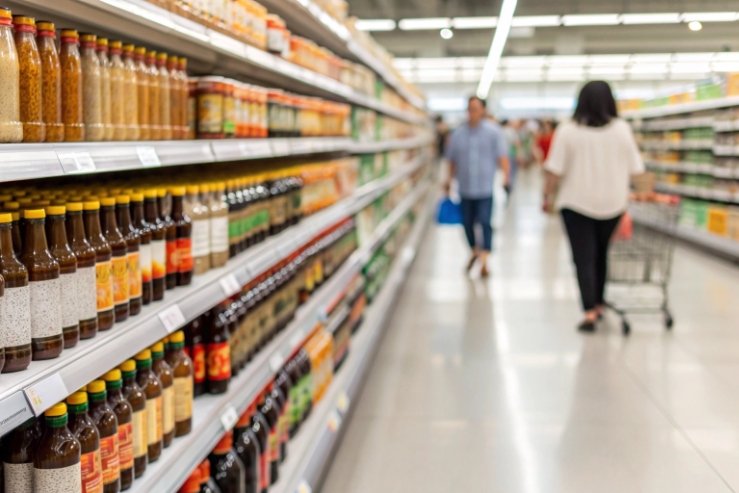
Urban Southeast Asia is seeing a continuing shift toward supermarkets, minimarts, and convenience chains. This matters because modern trade rewards packaging that sells at a glance and survives handling without looking tired. Glass performs well here because consumers can see the product and trust the material. If you are sizing demand, it helps to benchmark the region’s modern trade grocery retail transition 3. When modern trade grows, standardized glass bottle programs grow with it: consistent sizes, consistent caps, and reliable labeling surfaces.
HORECA: volume and refill behavior
Foodservice demand in Southeast Asia is large and still expanding. Restaurants and hotels buy sauces in larger formats, and they often decant into tabletop bottles for service. That creates two types of glass demand:
1) Primary packaging for bulk sauces sold to restaurants (often 630ml–1L glass for soy/fish/vinegar, depending on brand positioning), and
2) Service bottles for tables (smaller, sturdy glass, often reused or refilled).
For buyers selling into HORECA (Hotel, Restaurant, and Catering) 4, grip, pour control, and breakage reduction usually matter more than “perfect shelf cosmetics.” They also care about fast cleaning and “always looks clean,” which is where glass wins.
E-commerce: smaller base, higher spec
E-commerce is growing fast in Southeast Asia, driven by platforms and social commerce behavior. For sauces, online sales favor premium, giftable, or “authentic origin” positioning. Many teams use the e-Conomy SEA report 5 to track how quickly regional online demand is scaling. These brands often choose glass because it signals quality, but they must pay more attention to protective packaging, leak-proof liners, and tamper evidence.
| Channel | What leads demand | Typical bottle expectation | Common failure mode |
|---|---|---|---|
| Modern trade | Branded retail SKUs | Clean look, consistent labeling | Cosmetic scuff and label lifting |
| HORECA | Bulk + tabletop | Strong pour control, durability | Breakage in back-of-house handling |
| E-commerce | Premium and niche | Leak-proof + drop-ready packs | Damage and leakage in parcels |
In many categories, plastic wins on cost. Sauces are different. Sauces are emotional. People tie them to family meals, tradition, and health. That makes the pack a trust signal, not only a container.
Yes. Premium brands use glass to signal craftsmanship and “clean material” safety. Local brands also use glass to signal authenticity and stability, especially for fermented, oily, or strongly scented sauces where consumers worry about off-flavors and staining.
Premium perception: glass is the easiest shortcut
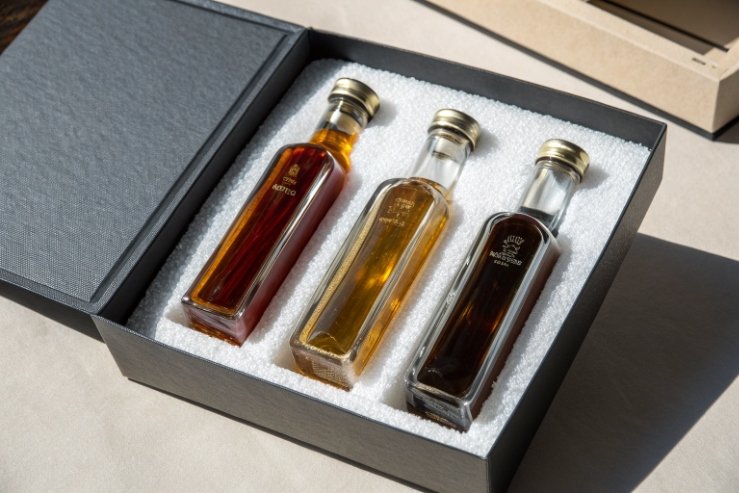
Across Southeast Asia, middle-income and upper-middle-income consumer groups are expanding, especially in large cities. When more shoppers trade up, packaging becomes part of the value story. Heavy or well-shaped glass, embossed logos, and clean label design help a brand justify a higher price.
Cobalt/green/amber colored glass also shows up in premium lines, not only for function but for signature recognition. Even when the sauce is not light-sensitive, colored glass helps the bottle feel like a “brand object,” not a commodity.
Safety and food-contact confidence
Glass is inert and nonporous. That means:
- it does not absorb aroma or oily residues
- it does not stain easily with turmeric, chili, or fermented pigments
- it is easier to wash and sanitize in reuse or restaurant settings
For many local brands, this “clean and stable” message matters more than any technical claim. It is simple. Consumers understand it.
Local authenticity: glass matches tradition
Many Southeast Asian sauces are fermented or heritage-linked. Fish sauce, shrimp paste-derived liquids, soy sauces, and vinegar-based condiments often carry a story of place. Glass matches that story because it looks traditional and feels “honest.” This is why many brands keep glass even when plastic could reduce cost.
| Brand position | Why glass helps | What they usually add | What they avoid |
|---|---|---|---|
| Premium gourmet | Luxury cue + display value | embossing, foil, custom caps | cheap-feeling lightweight plastics |
| Mainstream local | Authentic + trusted | clear labeling, stable standard bottles | discoloration, odor carryover |
| Export-focused | Global expectation | strong cartons, tamper evidence | leakage risk, inconsistent finishes |
| Modern “healthy” | Clean-material story | minimal labels, recycled messaging | anything that looks “chemical” |
How do spice, oil, and acid formulations drive bottle specs?
A buyer can sell the same bottle to ten sauce brands, and then one sauce fails in three months. The reason is usually the formula, not the glass. The formula decides the closure, liner, headspace control, and pour design.
Spicy, oily, salty-fermented, and acidic sauces each push different specs. Glass is stable for all of them, but closures and liners must be chosen for oil resistance, acid resistance, corrosion control, and pour accuracy.
Fermented and high-salt sauces: fish sauce and soy sauce
Fish sauce and soy sauce are high-salt systems with strong aroma. The glass body is rarely the weak point. The weak point is the closure system:
- liners must keep a tight seal to prevent odor loss and leakage
- metal components must resist corrosion or be properly coated
- tamper evidence is common for modern trade and export
These products also benefit from controlled pour features, because consumers often dose by habit. A steady pour reduces mess and increases repeat purchase.
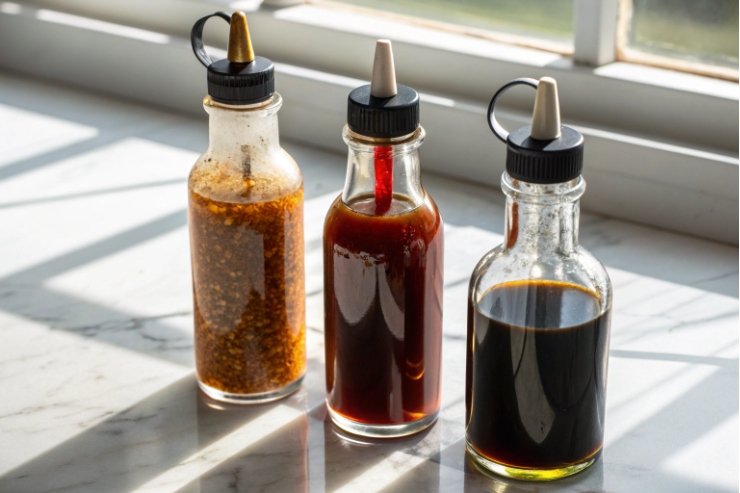
Chili oils and infused oils: oil migration and pour control
Chili oil and garlic oil blends demand:
- oil-resistant liners and inserts
- clean pour spouts or reducers to prevent dripping
- neck finishes that hold inserts securely
Oil also makes labels more vulnerable. If oil creeps to the outside during use, paper labels can stain. Many brands switch to film labels or high-coverage shrink sleeves for oily sauces.
Vinegar, tamarind, and acid-forward sauces: liner compatibility
Acidic sauces push a different risk: long-term interaction with the liner and cap materials. Glass stays inert, which is why many vinegar brands still favor glass. But the cap system must be selected to avoid seal degradation over shelf life.
| Formula type | Common SEA examples | Main packaging stress | Spec focus |
|---|---|---|---|
| High-salt fermented | fish sauce, soy sauce | corrosion + odor loss | liner choice + seal integrity |
| Oily and aromatic | chili oil, infused oils | seepage + label staining | oil-resistant liner + pour spout |
| Acidic | vinegar, tamarind sauces | liner compatibility | acid-resistant liner + stable torque |
| Thick/paste-like | sambal, satay sauce | dosing mess | wide mouth or controlled-dispense closures |
| Highly spiced/pigmented | turmeric blends | staining and residue | cleanable surface + robust labeling |
A practical way to sell specs is to ask one question early: “Is this sauce more like water, more like oil, or more like paste?” That single answer usually points to the right closure family and the right liner approach.
What sizes and closures dominate by cuisine in Southeast Asia?
Buyers often ask for “the most popular sizes,” but cuisine patterns matter. A Thai kitchen doses fish sauce differently than a Filipino kitchen doses vinegar. A Vietnamese household may buy a larger fish sauce bottle for daily cooking, while a modern retail shopper may prefer smaller bottles to manage freshness.
Home-use sizes often cluster around 200ml–750ml for soy and fish sauces, while chili sauces and oils frequently sit in 150ml–330ml formats. Closures are usually screw caps with liners, plus pourer inserts, reducers, or flip-top options depending on whether the sauce is thin, oily, or thick.
A practical “by cuisine” view
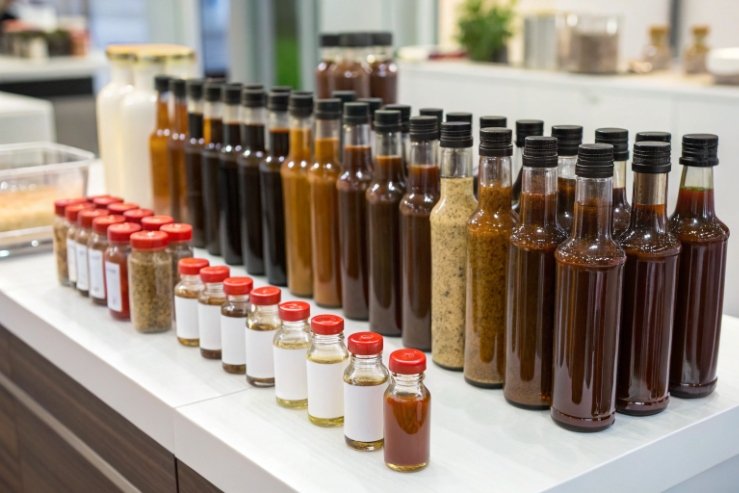
Instead of chasing one universal bottle, it is smarter to build a small family of bottles:
- Slim pour bottles (for thin sauces like soy, fish sauce, vinegar)
- Shorter, wider bottles (for thicker sauces or blended chili sauces)
- Oil-style bottles (for chili oils and infused oils with clean spouts)
Then closures do the rest of the work.
What dominates in the market
Across Southeast Asia, several closure patterns show up repeatedly:
- Continuous-thread screw caps with good liners for general sauces
- Pourer inserts for soy/fish sauces and restaurant-style dosing
- Orifice reducers for hot sauces and thin chili blends
- Flip-top or dual-dispense caps for convenience-driven modern trade SKUs
- Tamper evidence (bands, shrink, or induction-style inner seals 6) for modern trade and export
A sizing and closure map that buyers actually use
| Cuisine / use case | Sauce types | Common bottle sizes | Closures that sell best |
|---|---|---|---|
| Vietnamese home cooking | fish sauce (nước mắm), soy | 200ml, 500ml, 700ml | screw cap + pourer insert |
| Thai home cooking | fish sauce, sweet chili | 200ml, 300–700ml | screw cap, controlled pour |
| Indonesian cooking | kecap manis, sambal | 330ml, 600ml; sambal often jars | screw cap; for sambal: wide mouth |
| Filipino cooking | soy, vinegar (suka), chili | 200–350ml, 500ml | screw cap + pour aid; strong seal |
| Malaysian/Singapore premium | chili oil, specialty sauces | 150–250ml, gift sizes | premium caps, drip-free spouts |
| HORECA tabletop | soy, vinegar, chili | 150–250ml | flip-top pourers, durable glass |
| HORECA back-of-house | soy, fish sauce, vinegar | 630ml–1L | secure caps, easy-pour fitments |
The most reliable strategy is to match closure to behavior:
- If the sauce is thin, customers want pour control.
- If the sauce is oily, customers want drip-free design.
- If the sauce is thick, customers want wide openings or squeeze behavior (often not glass).
- If the sauce is fermented, customers want sealing that preserves aroma.
When this logic is used, specs become easier to defend in purchasing meetings. It also reduces the “trial-and-error” cost that hits many new brands.
Conclusion
Glass sauce bottles in Southeast Asia are bought by manufacturers, exporters, co-packers, and foodservice distributors. Modern trade leads volume, HORECA shapes formats, and e-commerce accelerates premium demand—while formula and cuisine decide the winning specs. If sustainability messaging matters, remember that color-sorted cullet streams 7 can affect how “closed loop” claims perform by market.
Footnotes
-
Defines co-packers/contract packagers and why they’re key buyers for multi-brand bottling capacity. ↩ ↩
-
Explains how private-label works and why retailers push standard bottle families for cost and consistency. ↩ ↩
-
Useful context on Southeast Asia’s modern trade shift that drives standardized branded packaging demand. ↩ ↩
-
Clarifies HORECA as a channel and why its handling needs differ from supermarket retail. ↩ ↩
-
Tracks Southeast Asia’s e-commerce growth, helping estimate premium online demand for glass-packaged sauces. ↩ ↩
-
Shows how induction seals work for tamper evidence and leak protection in export and modern trade. ↩ ↩
-
Explains color sorting in glass recycling and why cullet color affects closed-loop feasibility. ↩ ↩






