
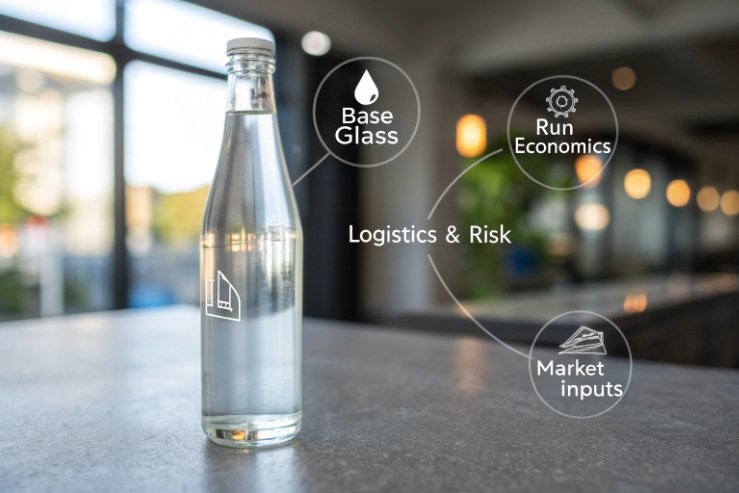
The frustrating part of bottle pricing is that two bottles that “look” similar can sit in completely different cost tiers with every quote you receive.
Wholesale pricing for glass bottles comes from four layers: base glass (weight, color, geometry), run economics (MOQ, tooling, decoration), logistics and risk (freight, duties, breakage), and market inputs (lead times, cullet and energy costs) 1.
Once you see how each layer works, price spreads stop feeling random. You can design bottles and contracts that land in the right cost band instead of letting the factory decide for you.
Do weight, color, and mold complexity set base cost tiers?
Most price conversations jump to “What’s your best unit price?” The real starting point is physics: how much glass, what color, and how hard is the shape to form at speed?
Yes. Bottle weight, color family, and mold complexity define your base cost tier by deciding glass usage, furnace conditions, forming speed, and scrap rates before any decoration or logistics 2.
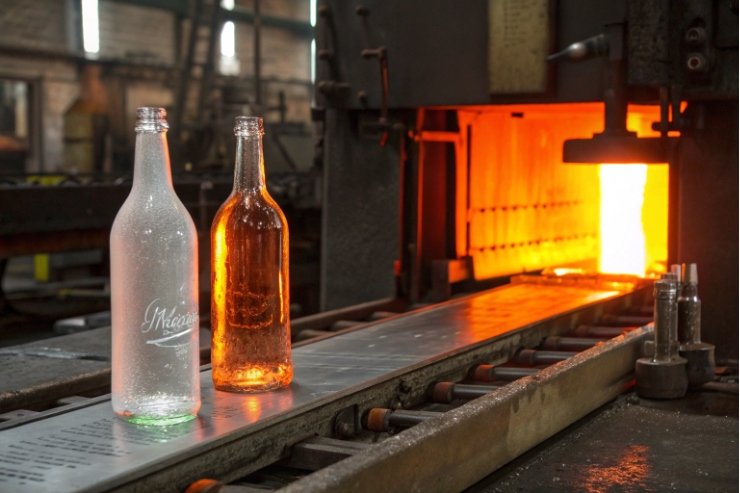
How weight and capacity drive glass cost
Every extra gram is more raw material and more energy burned in the furnace. Larger formats (750 ml vs 500 ml, 1 L vs 750 ml) scale roughly with volume, but thick bases and heavy shoulders move the price even faster because they concentrate glass in one zone that is harder to form.
Key points:
- Heavier bottles use more batch and cullet, and they raise freight cost per unit because glass is dense 3.
- “Right-weight” designs use smarter geometry and better forming control (like NNPB) to cut weight while keeping strength; those can sit in a lower base tier once tooling is dialed in 4.
From the factory side, weight is one of the cleanest levers. Less glass per unit directly means more bottles per furnace hour at the same pull rate.
Why color changes both cost and scrap
Color is not only an aesthetic decision. It also changes furnace behavior and batch chemistry.
- Standard greens and ambers can often use higher cullet ratios and are common in many lines, so they sit in mainstream pricing 5.
- Flint and “extra flint” require tighter raw material purity and tighter color control, so they carry a raw-material and yield premium.
- Niche tints (smoky, blue, custom hues) usually run on shorter campaigns and can raise changeover and scrap costs.
If the plant must switch color for your job alone, you are paying for more downtime and waste, even if the quote hides it.
Mold complexity and geometry: the invisible cost jump
A simple Bordeaux or Burgundy round bottle is easy for an IS machine. A square, sharp-shouldered, or heavily embossed bottle is not.
Complex geometry can:
- slow forming speed
- raise mold wear
- increase wall-thickness variability and scrap
So on the factory quote, complex molds push your bottle into a higher base tier even before you add decoration.
| Design lever | Effect on cost tier | What usually happens in quotes |
|---|---|---|
| Total weight | Direct raw material & energy cost | Heavier = higher base tier |
| Capacity (volume) | More glass, larger footprint | Larger formats sit above small formats |
| Color (standard) | Efficient campaigns, high cullet | “Normal” tier (green/amber) |
| Color (special) | Lower cullet, more changeovers | Premium tier for small runs |
| Mold complexity | More scrap, slower forming | Non-round / embossed priced higher |
If you want a better price, the easiest wins are often weight, geometry simplification, or sticking to a standard color the plant runs every week.
How do MOQs, tooling, and decoration affect unit price?
It is common to focus on “glass price” and ignore the shape of the project: how many units, how many SKUs, how many finishes, and how much one-time tooling is buried in the quote.
MOQs, tooling, and decoration decide whether fixed costs are spread thin (cheap per unit) or thick (expensive per unit). That is why small custom runs often cost more than big stock runs, even from the same factory 6.
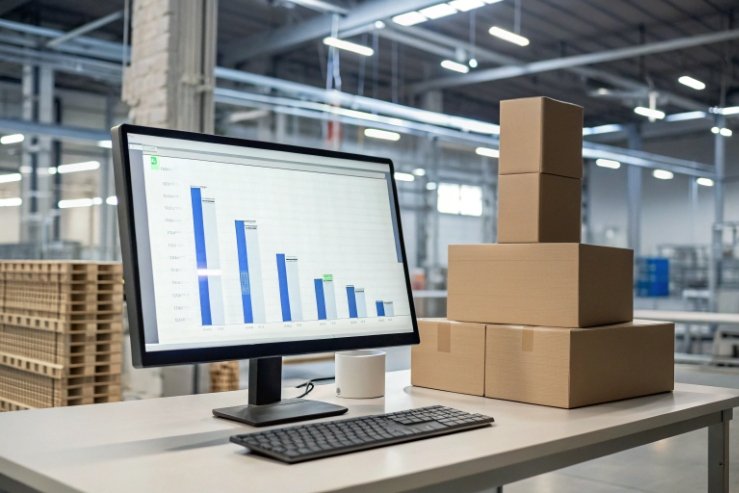
MOQs and run length: where economics really flip
Each production run has fixed costs:
- mold setup and alignment
- line tuning and sampling
- forming trials and QC
- color and coating stabilization
On a 30,000-bottle run, these costs vanish into the unit price. On a 3,000-bottle run, they are easy to feel.
Patterns you will see:
- Unit price drops significantly when you cross the plant’s preferred MOQ for that bottle family.
- Repeat orders of the same spec usually price better than one-off experiments.
- Multi-SKU families that use a common mold and only change labels or minor decoration often unlock per-SKU discounts.
Tooling: one-time cost that must land somewhere
Custom molds, engravings, special neck finishes, and custom punts need engineering plus steel or cast-iron tooling.
Tooling can be:
- charged as a one-time mold fee (common in China and some EU sites), or
- amortized into the bottle price over an agreed volume (common when brands want to avoid big upfront numbers) 7.
If you do not discuss tooling openly, you still pay. It just hides inside the unit price and makes your first orders look expensive.
Decoration: the second price ladder
Decoration can easily cost more than the naked bottle:
- color spray / frosting
- screen print / ceramic ink
- hot stamping, decals, or metallizing
Each extra pass adds:
- another handling step
- more quality checks
- more scrap risk
Decorated bottles sit on a higher unit price ladder, often with their own MOQs and setup fees. Complex multi-pass decoration can require:
- additional jigs
- test prints
- color approvals
All of that is real cost, especially for limited editions.
| Cost driver | How it enters pricing | How to manage it smartly |
|---|---|---|
| MOQ / run length | Fixed cost allocation per unit | Consolidate SKUs and plan fewer, bigger runs |
| New mold tooling | One-time fee or hidden amortization | Negotiate clear tooling terms and lifespan |
| Special finishes | Setup + pass-by-pass cost + scrap | Limit SKUs or keep a “core” undecorated bottle |
| Multi-SKU families | Artwork adaptation and prepress | Template designs to keep per-SKU cost low |
When planning budgets, treat the bottle, the finish, and the run pattern as a single economic system, not separate decisions.
Which freight, duties, and breakage risks shape landed cost?
A “cheap” bottle at the factory gate can become expensive by the time it reaches your filler if freight, duties, and breakage are not under control.
Landed cost often includes as much for freight, duties, warehousing, and breakage as for glass, especially on heavy export shipments. Route-to-market, pallet efficiency, and damage rates decide whether a low EXW price is actually low 8.
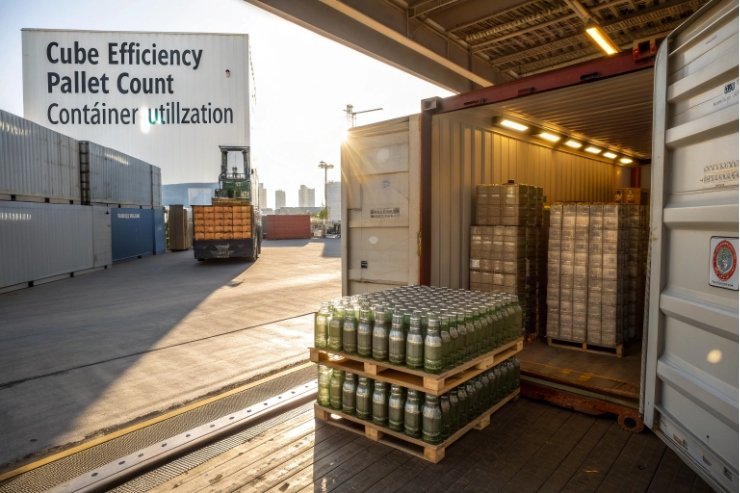
Freight: heavy, bulky, and sometimes half the story
Glass is dense and non-compressible. You move a lot of air around the bottles, no matter what.
Freight cost depends on:
- distance from plant to your filler or port
- mode (truck, rail, ocean, intermodal)
- cube efficiency (how many bottles per pallet, per container)
- fuel surcharges and seasonal capacity
On long lanes, it is common for freight to equal or exceed the ex-works bottle value, especially for low-cost SKUs. Choosing a plant closer to your filler or port can pull down delivered cost even if unit pricing is a bit higher 9.
Duties, tariffs, and local fees
Cross-border trade adds:
- MFN import duty on glass containers
- special tariffs (for example, US or EU trade actions on specific origins or categories) 10
- customs brokerage fees
- inland port and terminal fees
Some markets also add:
- EPR (Extended Producer Responsibility) or “packaging taxes” on glass packaging
- environmental levies tied to recycling and waste schemes
These are usually passed straight through in pricing. When comparing local vs offshore supply, you must look at duty-paid cost, not just FOB.
Breakage and damage: the silent landed cost
If your breakage rate in transit is 3–5%, you are not buying bottles at list price. You are buying 100% and only receiving 95–97% in usable stock.
Breakage is shaped by:
- bottle strength and annealing quality
- pallet pattern, divider quality, and corrugated grade
- container loading discipline
- route conditions (ocean vs short truck hops)
Many brands accept breakage as “normal” instead of treating it like a cost line. But a quiet 2–3% loss can erase small price wins from cheaper factories.
Pulling it together: landed cost view
A useful habit is to build a simple landed cost sheet:
| Cost line | Example components |
|---|---|
| Bottle ex-works | Base glass + decoration + local packaging |
| Freight & insurance | Inland + ocean/air + insurance premiums |
| Duties & tariffs | MFN duty + trade measures + brokerage |
| Local handling | Port charges + drayage + warehouse in/out |
| Loss & breakage | Transit loss + QC rejects on arrival |
Only after you see the full picture does a “cheap supplier” stay cheap.
Do lead times and cullet/energy markets move pricing?
Sometimes your price changes even when your bottle spec does not. That is usually not the sales rep “being difficult”; it is the input markets and capacity picture.
Yes. Lead times and wholesale pricing move with cullet and raw material availability, energy markets, furnace utilization, and overall supply-demand balance. Contracts and volume commitments can buffer some of this volatility 11.
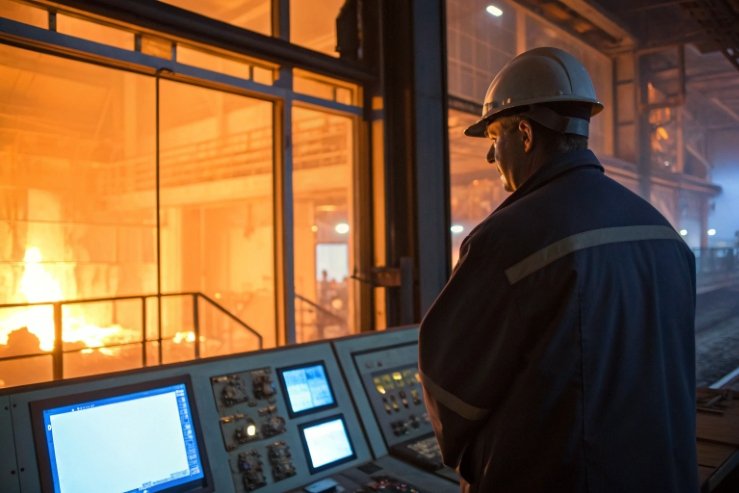
Cullet, raw materials, and energy
Key inputs:
- silica sand, soda ash, limestone
- recycled cullet
- natural gas, electricity, or other fuels
When cullet is plentiful and clean, it reduces energy use and raw-material needs, which stabilizes costs. When cullet is scarce or contaminated, plants must use more virgin batch and may see energy costs rise 12.
Energy is a huge slice of glass production cost. Spikes in gas or electricity prices almost always show up in bottle pricing with a lag. Some suppliers add energy surcharges that float with indexes.
Lead times and furnace utilization
Glass furnaces like to run full and steady. When a plant is:
- underutilized, they may discount to fill capacity
- fully booked, they prioritize large, stable customers and raise prices for short or irregular jobs
Longer lead times are often a symptom of high demand and tight furnace capacity, not just poor planning. In those periods, you can see:
- longer quoted lead times
- larger MOQs
- fewer time slots for small custom runs
Contracts and price stability
To smooth cycles, some buyers:
- sign multi-year or volume-commitment contracts with indexed adjustments for raw materials and energy 13
- agree to base-load the plant with a minimum monthly volume
- work with suppliers to standardize bottle families and colors
This helps suppliers run furnaces efficiently and lets them give more stable pricing instead of constantly repricing spot orders.
| Market driver | How you feel it in pricing | Possible mitigation |
|---|---|---|
| Energy spikes | Surcharges or broad price hikes | Indexed contracts, timing large buys |
| Cullet shortages | Higher base cost, color limitations | Plan colors and specs long-term |
| Capacity tightness | Longer lead times, higher MOQs | Volume commitments, earlier ordering |
| New regulations (EPR) | Added “glass tax” or fees | Design for recyclability, local supply |
When you plan a new SKU, it helps to ask not just “What’s today’s price?” but “What will move this price over the next two years?”
Conclusion
Wholesale bottle pricing is a chain: design and weight set the tier, MOQs and tooling shape unit cost, logistics and breakage define landed cost, and energy and cullet markets keep the whole system moving.
-
Learn how wholesale pricing for glass bottles is shaped by multiple factors, including raw material availability and energy costs. Back to Text ↩
-
Understand how base factors like weight and color directly impact the cost structure of glass bottles. Back to Text ↩
-
Discover how glass weight affects raw materials, energy, and freight costs, influencing bottle pricing. Back to Text ↩
-
Learn how optimized bottle geometry can reduce production costs by minimizing material waste. Back to Text ↩
-
Find out why certain glass colors can impact cost, scrap rates, and factory efficiency. Back to Text ↩
-
Explore how MOQs and tooling influence the unit price of glass bottles, especially for smaller orders. Back to Text ↩
-
Learn about the implications of one-time tooling costs for custom bottle designs. Back to Text ↩
-
How logistics and freight costs are integral to determining the final landed cost of glass bottles. Back to Text ↩
-
Tips on reducing freight costs by selecting plants closer to your filler or port. Back to Text ↩
-
Understand duties and tariffs in cross-border trade and how they affect glass bottle pricing. Back to Text ↩
-
How market fluctuations, like energy and raw material shortages, affect the price of glass bottles. Back to Text ↩
-
Why cullet and raw material availability impact production efficiency and pricing. Back to Text ↩
-
Explore contract options for stabilizing bottle prices, even with market fluctuations. Back to Text ↩






