
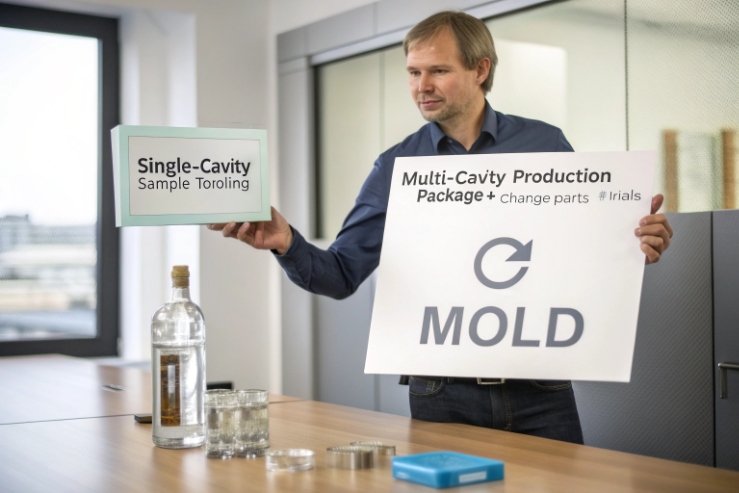
A custom bottle looks simple, but one wrong assumption can turn “mold fee” into a runaway budget. Many brands only discover the real costs after sampling starts.
Most custom glass bottle mold packages land anywhere from a few thousand dollars for a single-cavity sample tool to $15,000–$75,000+ for a proprietary production-ready tooling program, depending on complexity, supplier region, and how many cavities you buy at once.
Pricing stays confusing because people use the word “mold” to mean different things. One quote might be for a single cavity sample set. Another might include full IS machine (Individual Section) cavity sets 1, change parts, engraving, and trial runs. The clean way to budget is to break the program into: tooling scope, complexity drivers, change parts and artwork, and sampling/PPS costs.
What does a realistic mold budget look like for a spirits or wine bottle?
Most teams ask for “the mold price” as one number. In real projects, there are at least two numbers: a sample tool to prove shape and decoration, and the production tool package to run stable output at speed.
A common path looks like this:
- Phase 1: design + sample mold (to make a small number of glass samples)
- Phase 2: production molds + change parts + ramp-up trials
In many Asia-sourced projects, sample or “private” molds for a 700–750 ml bottle are often quoted in the low-thousands, while North American or European programs for proprietary bottles are commonly quoted in the tens of thousands. As public examples, Rockwood has published private mold pricing starting around $3,800–$4,500 for a 750 ml bottle, and separate sample mold pricing in the low-thousands; United Bottles & Packaging states custom moulds can range roughly $15,000–$75,000. Those numbers are not universal, but they are useful anchors for budgeting.
The biggest misunderstanding: “one set” vs “full set”
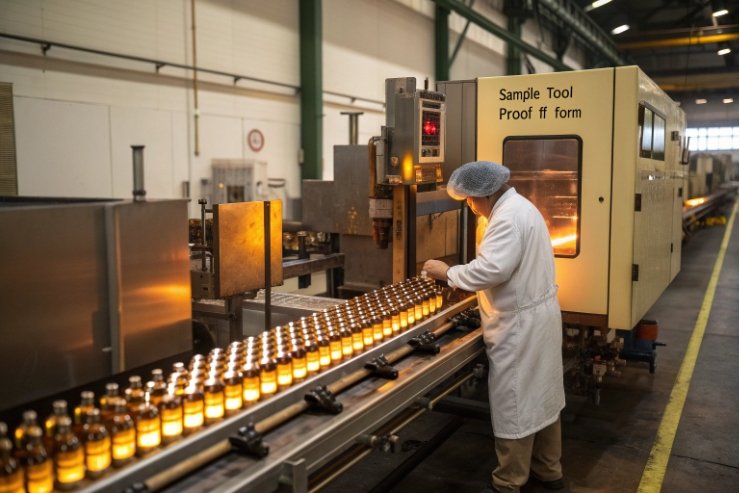
In container glass manufacturing 2, “one set” often means tooling for one cavity (one section). A full production run may require multiple cavities across an IS machine configuration. If the supplier quotes “one set,” confirm whether that is:
- one cavity only, or
- a full multi-cavity production package
A practical budget framework
Use a simple budget table so nobody is surprised later:
| Budget line | What it usually includes | Typical cost direction | Why it surprises teams |
|---|---|---|---|
| Industrial design + engineering | 3D files, drawings, design for manufacturability (DFM) 3 | Low to medium | revisions and approvals add cycles |
| Sample mold + sampling | one cavity tooling + a few bottles | Medium | not all suppliers include trials |
| Production mold package | multiple cavities + critical parts | High | “set count” changes price fast |
| Change parts | neck rings, plungers, inserts | Low to medium | needed for flexibility and uptime |
| PPS / trials | setup, trial runs, lab tests | Medium | paid even if you reject and adjust |
A solid rule is to carry a contingency for adjustments after the first glass samples. It is normal to do at least one correction loop on emboss sharpness, punt depth, label panel flatness, or finish fit.
Which cost drivers move the quote most: cavity count, alloy, finish, and geometry?
A mold quote is not only about machining time. It also reflects expected service life, speed, and reject risk. The major drivers are easy to rank.
Cavity count and tooling scope move price the most, then geometry complexity, then mold material/steel grade and surface finish requirements. Tight tolerances around the finish and neck rings also push cost because they protect sealing performance.
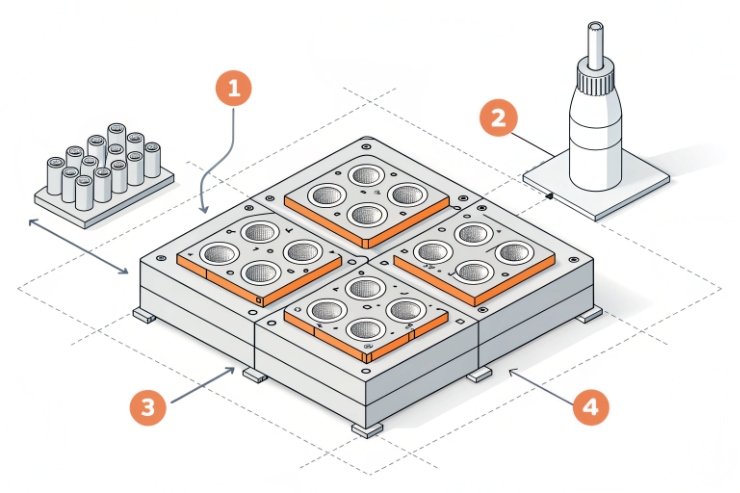
1) Cavity count and what parts are included
For a narrow-neck spirits bottle, the tooling package can include blank molds, blow molds, neck rings, plungers (for the press-and-blow forming process 4), baffles, bottom plates, and other section parts. Quotes vary because one supplier includes more of these “change and wear parts” than another.
Questions that prevent confusion:
- How many cavities are included in the price?
- Are neck ring tooling 5 included for each cavity?
- Are plungers included (if NNPB)?
- Are spare neck rings or critical wear parts included?
2) Mold alloy and build spec
People say “steel grade,” but container molds are often alloy cast iron or copper-based alloys (bronze) in some zones. Higher conductivity and higher wear resistance can cost more. The payoff is fewer defects and longer time between refurbishments, especially for premium flint bottles that show every scuff.
3) Finish detail and tolerance
Cost rises when the finish needs:
- tight bore ID control for cork or bar-top fit
- stable thread geometry for screw caps
- clean parting lines with minimal seam offset
4) Shape complexity and decoration-ready surfaces
Complex shapes demand more machining and more risk management:
- non-round cross sections
- sharp shoulders
- deep emboss/deboss
- narrow waist designs that stress release and scuff control
| Driver | Cost impact | Why it costs more | What to specify clearly |
|---|---|---|---|
| More cavities | High | more complete tooling sets | exact cavity count needed |
| Premium alloy / inserts | Medium | wear + heat control | which zones use which alloy |
| Tight finish tolerance | Medium | QA + precision tooling | closure type and finish spec |
| Heavy emboss / textures | Medium | electrical discharge machining (EDM) 6 time and polishing | artwork depth and crispness |
In one past spirits project, a “cheap” mold quote looked great until it was confirmed to be single-cavity only. Once the quote expanded to a multi-cavity production package plus spare neck rings, the real budget appeared. That is why scope questions matter more than negotiating $200 off a line item.
Do deep punts and heavy bases increase tooling fees, or just bottle unit cost?
Deep punts and heavy bases are popular in premium spirits because they signal weight and stability. They also change how the bottle forms and cools.
Yes, deep punts and heavy bases can raise tooling fees, but the larger impact is often on production economics: longer cycle time, higher glass consumption, and tighter control needs at the heel and base where breakage risk lives.
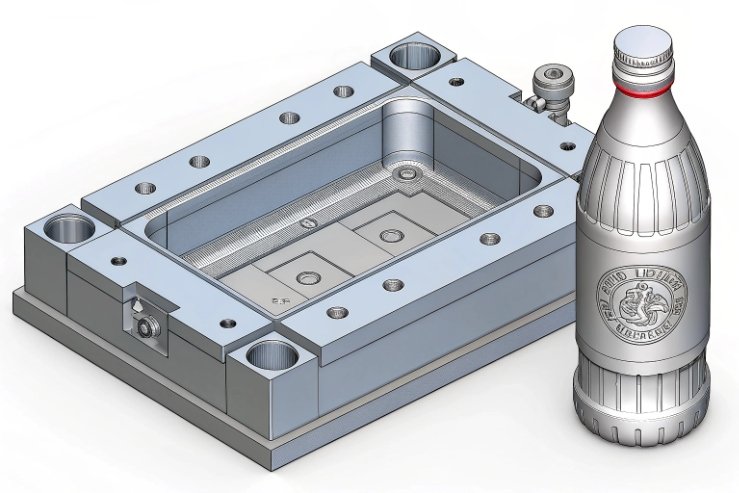
Why a deep punt can cost more in tooling
A deeper punt and thicker heel can require:
- deeper cavity machining in the blow mold
- stronger bottom plate/baffle design
- tighter cooling balance to avoid checks and scuff rings
- extra polishing to keep the punt looking clean in flint
If the punt has a sharp step or complex geometry, EDM and polishing time rise. If the punt includes a brand mark or medallion, the base tooling becomes more detailed.
Why the bigger cost is often in running the bottle
A heavy base usually means:
- more glass per bottle (direct unit cost)
- higher energy to melt and form that mass
- longer cooling and annealing sensitivity
- greater scuff risk if coatings and packing are not tuned
So a bottle with a very heavy base can be expensive even if mold cost only rises modestly. It also makes breakage claims more painful because the bottle “should be strong,” yet base defects can still crack under impact if thickness distribution is uneven.
How to decide if heavy base is worth it
The decision should be tied to real business goals:
- If the brand needs a high-end shelf cue, heavy base can lift perceived value.
- If the brand ships long distance and sees freight cost pressure, moderate base weight may win.
| Feature | Tooling fee effect | Unit cost effect | Quality risk to manage |
|---|---|---|---|
| Deeper punt | Low to medium | Low to medium | base checks, polish uniformity |
| Heavy heel/base | Low to medium | High | cooling stress, drop performance |
| Sharp base geometry | Medium | Medium | scuff rings, cracking at heel |
| Base emboss medallion | Medium | Low | crispness, defect visibility |
If the goal is premium, the best approach is often “smart weight,” not just “more weight.” Strong heel radii, stable base ring, and clean polish can deliver premium feel without extreme mass.
How should change parts, artwork, sampling, and PPS be budgeted before mass production?
Even if the mold fee is approved, most projects still fail on the “hidden” costs: change parts, artwork revisions, and paid trials before a stable mass run.
Change parts and artwork should be amortized over the expected volume and product life. Budget separately for sampling and PPS because those costs happen before revenue, and they often repeat if finish fit, emboss sharpness, or color targets shift.
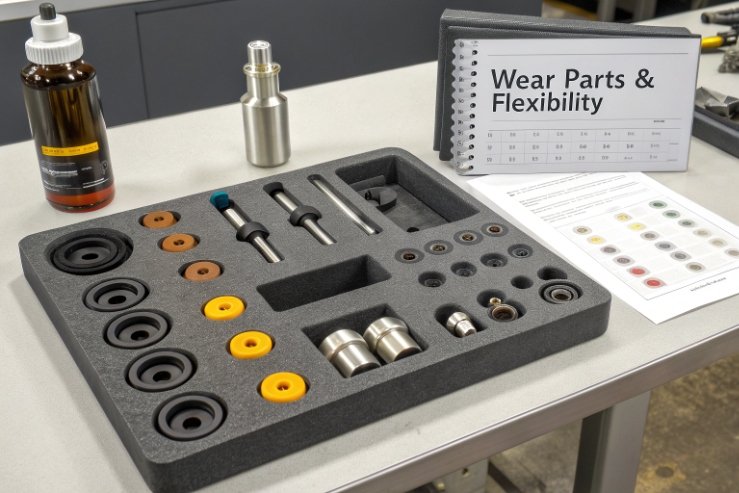
Change parts: pay once or pay later
Change parts are not “extra.” They are insurance.
Common change parts include:
- neck rings (most frequently replaced)
- plungers (for NNPB)
- finish inserts or thread change rings
- emboss inserts if you want flexibility for limited editions
If a program runs multiple SKUs (700 ml and 750 ml) with the same body, change parts can be cheaper than cutting a full new mold set. If a brand expects seasonal editions, emboss inserts save time and protect the base mold.
Artwork: embossing and debossing cost behavior
Embossing can be “free” in some supplier offers when it is simple and placed in easy zones. Cost increases when:
- emboss depth is high
- fine line detail is required
- the area needs high polish around it
- multiple revisions are expected
The clean method is to treat artwork as a controlled deliverable: one master file, one revision window, and clear acceptance standards for edge crispness.
Sampling and PPS: what to budget beyond the molds
Before mass production, budget for:
- sampling setup and trial runs
- dimensional and closure fit checks
- decoration trials (frost, print, hot stamp)
- packaging trials (cartons, dividers, ISTA vibration testing procedures 7)
- lab tests if required by the brand (impact, thermal shock, internal pressure where relevant)
A practical budgeting table helps:
| Pre-mass cost | What it covers | When it hits cash flow | How to control it |
|---|---|---|---|
| Sample mold + samples | first glass proof | early | lock drawings, limit revisions |
| PPS trial run | stable process confirmation | before mass | define pass/fail metrics |
| Closure trials | torque, leak, fit | before decoration approval | test real closures, not showroom parts |
| Decoration trials | frost/print adhesion | mid | run in the real supply chain conditions |
| Packaging validation | scuff and breakage risk | late | test with final dividers and pallets |
A simple amortization approach is to spread tooling, change parts, and approved artwork over the expected bottle volume in the first 12–24 months. If volume is uncertain, it is safer to start with a more standard bottle and spend on decoration. When volume is committed, proprietary molds become easier to justify.
Conclusion
Custom glass bottle molds can cost from a few thousand dollars to tens of thousands because the real price is driven by cavity scope, complexity, finish tolerances, and the sampling/PPS work needed to make the bottle run reliably.
Footnotes
-
Learn what an I.S. machine is and how cavity count impacts tooling packages. ↩ ↩
-
Industry reference for container glass manufacturing terms used in tooling quotes and production discussions. ↩ ↩
-
Explains DFM basics so bottle geometry changes happen before machining, not after sampling. ↩ ↩
-
Background on press-and-blow forming so you know when plungers and related parts belong in scope. ↩ ↩
-
Supplier context for neck ring tooling, a high-wear item that often needs spares and change parts. ↩ ↩
-
Quick explainer on EDM, the common method for crisp emboss details that increases tooling time and cost. ↩ ↩
-
Official ISTA procedures for vibration and distribution testing to validate cartons, dividers, and pallets before launch. ↩ ↩






