
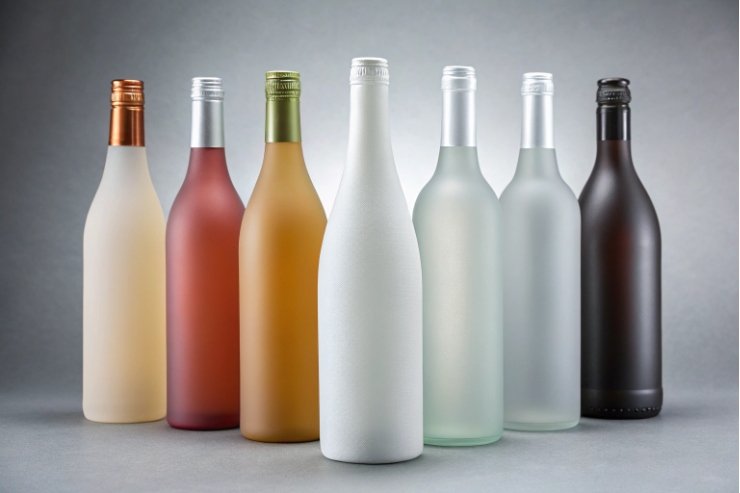
A frosted bottle can look luxury in photos, then arrive scuffed, stained, or hard to label. Most failures come from choosing the wrong frosting method.
Common frosted-glass types include acid-etched satin, abrasive sandblasted matte, spray-on matte coatings, ceramic-frit “baked” frost, molded/textured glass, and film/sleeve-style faux frosting. Each option trades off feel, durability, and line compatibility.
Frosted glass is not one finish. It is a family of surface states. The right choice depends on how the bottle will be handled, cleaned, labeled, packed, and shown under retail lighting.
What are the common types of frosted glass used for bottles and packaging?
Many buyers say “frosted” but mean very different outcomes. That mismatch causes pricing fights, QA disputes, and rework after sampling.
For packaging, the most common frosted types are acid-etch satin, sandblasted matte, spray-frost coatings, ceramic-ink/frit matte, and molded texture that imitates frosting without surface removal.
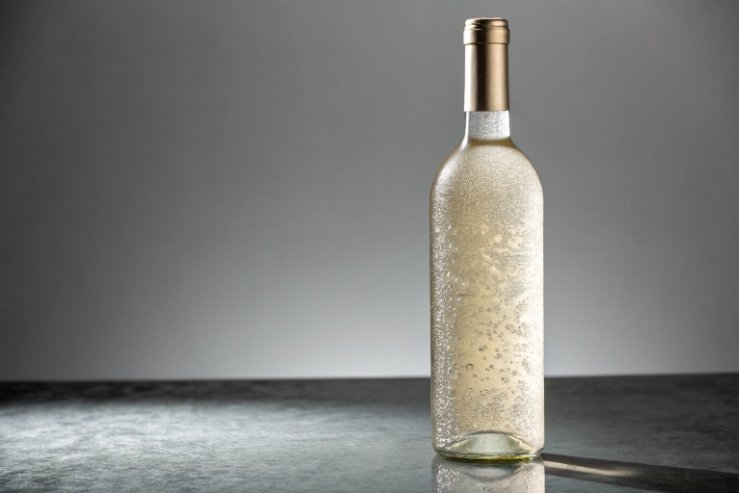
Acid-etched satin (chemical frosting)
This is the acid-etched glass etching process 1 that produces a “premium smooth haze” finish. The surface feels soft and even. It diffuses light without a gritty touch. It is popular for spirits and high-end food bottles because it looks refined under bar lighting.
Sandblasted matte (abrasive frosting)
This is the abrasive sandblasting (abrasive blasting) method 2 that creates a “tactile matte” finish. It can be full coverage or localized patterns using masks. It often looks whiter and feels rougher than acid-etch, which some brands love because it feels “handcrafted.”
Spray-frost coatings (matte lacquers / UV coatings)
These create a frosted look by adding a thin film. Coatings scale fast and can hit tight visual uniformity, but the durability depends on the coating chemistry, UV-curing of coatings 3, and packing rub conditions.
Ceramic-frit / baked-on matte (screened enamel + firing)
This is common in architectural glass and can be used for specialty packaging decoration via ceramic printing on glass 4. It is durable and washable when done well, but it changes the surface into a fused layer that must be managed for label systems and contact wear.
Molded or “textured” glass
Instead of treating the surface after forming, texture is built into the mold. This can mimic a matte look while keeping the surface chemistry as pure glass. It is great for durability, but the look is different from true frosting.
| Type | How it’s made | Feel | Best fit | Main risk |
|---|---|---|---|---|
| Acid-etch satin | Chemical surface removal | Smooth matte | Premium spirits, clean look | Chemical control and rinse quality |
| Sandblasted | Abrasive erosion | Rough matte | Tactile brands, sharp patterns | Strength loss if over-blasted |
| Spray-frost coating | Film on glass | Varies | High-volume visual uniformity | Scuffing/chipping if packaging rub is high |
| Ceramic-frit matte | Fired enamel layer | Hard matte | Durable graphics/patterns | Process complexity, thickness control |
| Mold texture | Texture in mold | Subtle texture | Durability, cost control | Less “satin haze” appearance |
How do acid-etch and sandblasting finishes compare?
Two bottles can both be “matte,” yet one wipes clean and the other holds fingerprints. One labels easily and the other causes edge lift. That difference is not cosmetic. It is physics.
Acid-etch typically produces a smoother, more uniform satin haze, while sandblasting produces a rougher micro-topography with stronger tactile grip and sharper masked graphics. Acid-etch often cleans easier; sandblasting often keys coatings better but can raise strength risk if too aggressive.
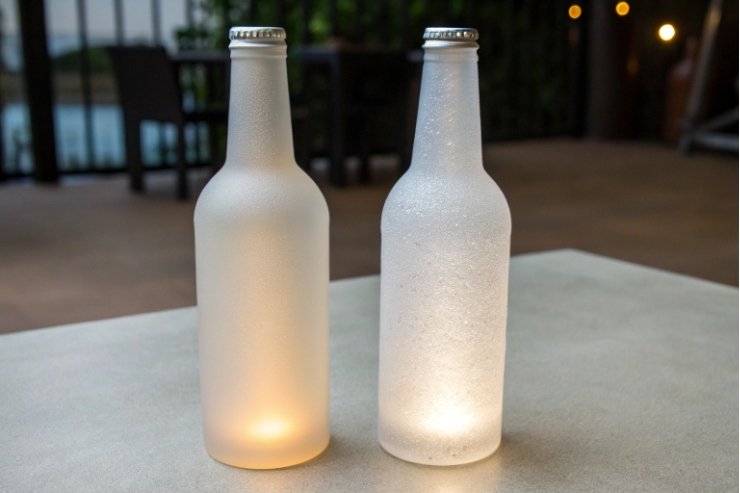
Texture and optics: satin diffusion vs chalky scatter
Acid-etch removes a thin surface layer more evenly, so light diffusion looks “soft.” Sandblasting creates deeper pits and peaks, so the diffusion can look “whiter” and sometimes slightly mottled if the blast energy varies across the bottle.
Strength and defect sensitivity
Glass strength is dominated by surface flaws. Sandblasting can create deeper micro-notches if blast pressure, media size, or dwell time is too high. Those notches can become crack starters, especially near the heel, shoulder, or sharp design edges. Acid-etch can also reduce strength if it is too aggressive or uneven, but in many packaging programs it is easier to keep the surface in a “fine” micro-roughness range.
Cleanability and bar reality
A smoother matte surface usually wipes faster. Sandblasted surfaces can trap oils and dust more easily because the valleys are deeper. In bars, that means more visible smudges and more effort to keep the bottle looking premium.
Labeling and decoration behavior
Sandblasting can help some inks and coatings grip because of mechanical keying. Still, pressure-sensitive labels can struggle on very rough surfaces. If the peaks are high, the label bridges and traps air, which creates “silvering,” wrinkles, or edge lift. Acid-etch is often a safer baseline for labels, but adhesives must still be matched.
| Comparison point | Acid-etch | Sandblasting | What I prioritize |
|---|---|---|---|
| Visual uniformity | Easier to keep even | Depends on media/nozzle wear | Stable look across cavities and shifts |
| Tactile feel | Smooth satin | Rough tactile | Match to brand “hand feel” |
| Label friendliness | Often better | Depends on Ra and adhesive | No edge lift after aging |
| Strength margin | Usually safer at light etch | Higher risk if overdone | Keep heel/shoulder safe |
Are HF-free etchants viable for food-contact packaging?
“HF-free” is a common request now. It usually comes from safety and environmental concerns, which are valid. The problem is that glass chemistry is stubborn.
True glass etching generally requires fluoride chemistry, so many “HF-free” etchants are actually HF-generating fluoride systems. For food-contact packaging, the safer path is often mechanical frosting, mold texture, or compliant matte coatings—plus strict rinsing and residue control for any chemical process.
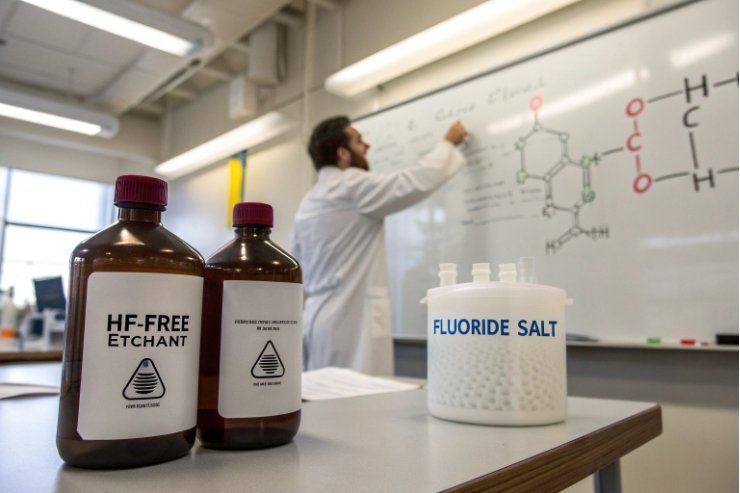
The hard truth about etching glass
To etch silica-based glass, the process must attack silicon dioxide. In practice, that is why hydrofluoric acid (HF) 5 and HF-containing solutions are historically used. Many products marketed as “HF-free etching cream” rely on ammonium bifluoride or other fluoride salts that release HF in solution. So the label can be misleading, even if the handling profile is different.
Food-contact safety is about residues and migration, not only the process name
The finished etched surface is still glass. The risk comes from residues, incomplete rinsing, or contamination trapped in rough textures. For food-contact bottles, the control plan should focus on:
- neutralization and rinsing validation,
- water quality and conductivity checks after rinse,
- visual checks for stains or residue film,
- and a process audit that prevents cross-contamination with non-food chemicals.
If a matte coating is used, the coating system becomes part of the food-contact evaluation. That includes curing completeness and any contact-zone restrictions (for example, keeping coatings off the sealing land and internal contact areas).
Viable “no fluoride” paths that still look frosted
When a brand wants “no fluoride,” these options usually work better than chasing a marketing term:
- Sandblasting or micro-abrasive finishing with controlled strength margins
- Molded texture (built-in matte look)
- Matte coatings designed and qualified for the intended use
- Sleeves/films that create a frosted look without changing the glass surface
| Goal | Best approach | Why it works | What must be controlled |
|---|---|---|---|
| “No fluoride” process | Sandblast or mold texture | No chemical etch residues | Strength margin, scuff control |
| Highest premium satin | Acid-etch (fluoride chemistry) | Most refined haze | Rinse, waste handling, uniformity |
| Fast scale + tight look | Matte coating | Visual control | Abrasion, adhesion, cleaning behavior |
| Decorative patterns | Sandblast + masking | Sharp edges and depth | Media wear, edge protection |
A premium bottle should feel intentional. Too smooth can feel like “cheap mist.” Too rough can feel like “chalk” and can ruin labels. Roughness targets keep everyone aligned: factory, decorator, and brand team.
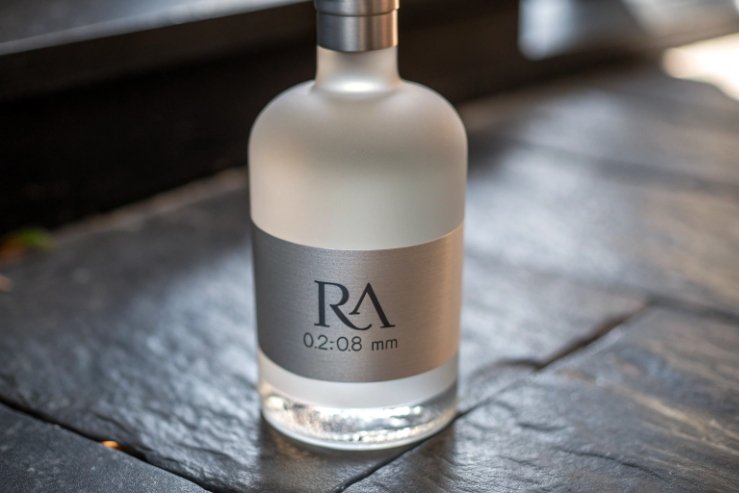
For premium bottles, a satin “luxury frost” often sits in a moderate Ra band, while tactile sandblast sits higher. The best Ra target is the one that keeps haze consistent, labels stable, and cleaning reasonable under real handling.
Think in bands, not a single number
The surface roughness parameter Ra 6 depends on measurement method, cutoff length, and where it is measured. A single number without a method creates disputes. A better approach is:
- define Ra range,
- define instrument and cutoff,
- define sampling locations (label panel, shoulder, near seam),
- and define visual acceptance (haze/gloss reference).
In many bottle programs, these bands work as a starting point:
- Satin premium feel: Ra around 0.2–0.8 μm (clean wipe, elegant diffusion)
- Tactile matte feel: Ra around 0.8–1.6 μm (strong grip, higher scatter)
- Heavy frost: Ra above 1.6 μm (bold white look, higher dirt retention risk)
These are not universal laws. They are practical “conversation starters” that help match finish to performance.
Why the best Ra is tied to ΔE, haze, and gloss
A bottle can hit the same Ra and still look different if the texture shape changes. That is why premium control often pairs:
- Ra (roughness)
- haze or gloss (optical behavior)
- and ΔE or whiteness index (appearance drift)
Build edge protection into the spec
Partial frosting needs a clean boundary. A roughness spec should also include edge rules:
- no sharp “tooth” edges where frosting stops,
- no chips on masked borders,
- and no heavy roughness near sealing lands or high-stress corners.
| Finish goal | Suggested Ra band | Optical cue | Label risk | Cleaning risk |
|---|---|---|---|---|
| Luxury satin | 0.2–0.8 μm | soft diffusion | low to medium | low |
| Tactile matte | 0.8–1.6 μm | whiter scatter | medium | medium |
| Bold heavy frost | 1.6+ μm | chalky/opaque | higher | higher |
Do matte coatings affect label adhesion or cleaning?
A coated matte bottle can look perfect on day one, then scuff during packing, or shed labels in cold rooms. These issues rarely come from “bad labels.” They come from surface-energy mismatch and abrasion reality.
Yes. Matte coatings can change surface energy and micro-slip, which can hurt pressure-sensitive label adhesion if adhesives are not matched. Coatings can also be easier to wipe than rough blasting, but they may scuff or stain if the coating hardness and cure are not tuned.
Label adhesion: surface energy and “silvering”
Pressure-sensitive labels need intimate contact, and adhesion on low-surface-energy substrates 7 is where many matte bottles fail first. If a matte coating is low-energy (more hydrophobic), adhesives may wet out poorly. That can cause edge lift, bubbles, or “silvering” where trapped air looks shiny under the label. A coating can also contain slip additives that reduce friction, which is great for conveyors but bad for labels if the adhesive was designed for bare glass.
The fix is not guessing. The fix is testing:
- 24-hour peel strength
- cold-room aging
- ice-bucket or condensation exposure (for spirits)
- and rub tests where labels scrape dividers and cartons
Cleaning: easy wipe vs coating sensitivity
Many matte coatings wipe clean because the surface is smoother than heavy sandblast. Still, coatings can be sensitive to:
- alcohol wipes
- citrus oils
- sanitizer overspray in bars
- and abrasion from repeated handling
If the bottle is a “bar rail” product, the coating must be chosen for chemical resistance and not only for appearance.
Where coatings scale beautifully
Coatings can deliver:
- tight color consistency,
- controlled haze and gloss,
- and patterned effects without deep texture.
That makes coatings attractive when the program needs tight batch-to-batch appearance.
QA checks that prevent bad surprises
A serious QA plan for coated matte bottles includes:
- coating thickness checks
- cure verification (time/temperature profile)
- abrasion/rub testing against the chosen carton or tray
- contact angle or dyne testing for label compatibility
- and edge checks for chipping at transitions
| Topic | Coated matte behavior | What to test | Pass/Fail sign |
|---|---|---|---|
| Label adhesion | depends on coating energy | peel + aging + wet exposure | no lift, no silvering |
| Scuff resistance | depends on hardness/cure | rub vs divider, transit sim | no burnish tracks |
| Cleaning | often easy wipe | alcohol/soap wipe test | no whitening, no stains |
| Shelf look | very consistent | ΔE + gloss/haze | low drift across lots |
Conclusion
Frosted glass is a toolbox: acid-etch for satin luxury, sandblast for tactile depth, and coatings for scalable visual control. The best choice is the one that protects strength, labels, and real-world cleanliness.
Footnotes
-
Learn how glass etching creates uniform satin frosting and what variables affect the finish. ↩ ↩
-
Overview of abrasive blasting basics, media, and how it changes surface texture. ↩ ↩
-
Explains UV curing fundamentals for coatings and why cure conditions impact durability. ↩ ↩
-
Shows how ceramic inks are fired onto glass for durable matte graphics and patterns. ↩ ↩
-
Key facts on hydrofluoric acid and why it’s used to etch silica-based glass. ↩ ↩
-
Defines Ra roughness and how measurement settings influence reported values. ↩ ↩
-
Practical guidance on substrate selection and surface energy factors that affect pressure-sensitive adhesion. ↩ ↩






