
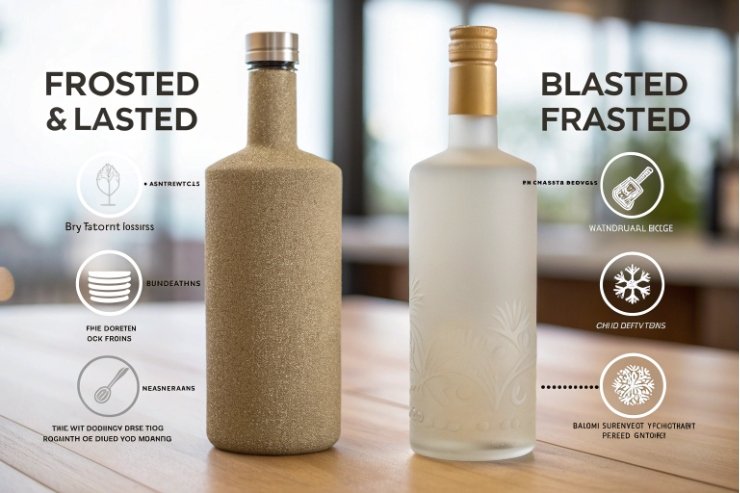
A matte bottle can look premium, then arrive scratched, smudged, or rejected. Most problems start with choosing the wrong frosting method for the job.
Frosted bottles usually use chemical etching or a sprayed frost coat for a smooth, even haze. Sand-blasted bottles use abrasives for a deeper, rougher texture that grips inks but needs more strength control.
The finish is not only “how it looks.” It changes strength, cleaning behavior, label adhesion, and how easy it is to keep tight consistency across mass production. The best choice depends on how the bottle will be filled, labeled, shipped, and handled on a bar.
Do acid-etch vs abrasive methods yield different matte textures?
Two bottles can both look matte, yet feel totally different in hand. That difference comes from how the surface is broken up and how deep the micro-texture goes.
Acid-etch frosting creates fine, uniform micro-roughness that scatters light smoothly. Sand-blasting cuts larger pits and peaks, so the finish feels grippier and can look whiter or more “chalky.”
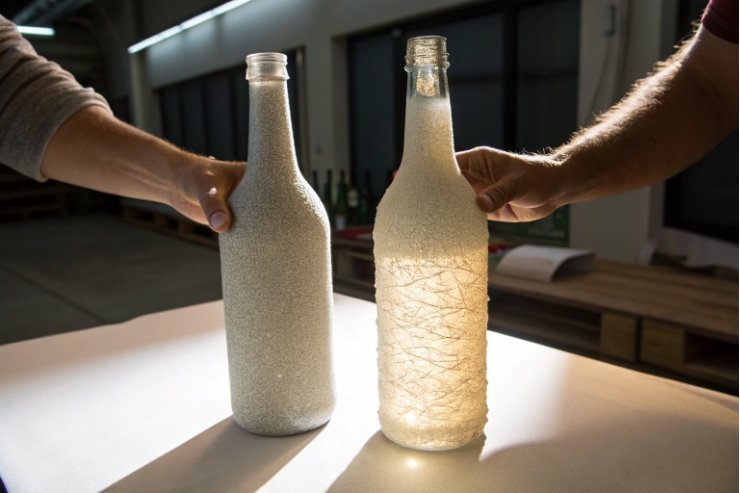
Acid-etch frosting: “dissolve the peaks” for a satin haze
Acid-etch frosting is a controlled chemical attack on the glass surface. In many finishing lines, this is done via hydrofluoric acid etching 1 to remove a very thin layer of glass and replace “clear shine” with micro-roughness that scatters light. When the chemistry and time are stable, the haze looks even and soft. The touch often feels satin, not gritty.
For premium spirits, this matters because the surface reads elegant under shelf lights. It also pairs well with high-contrast decoration like hot stamping, screen printing, and embossing. Another advantage is edge softness. When masking is done well, etched borders can look clean without sharp “tooth marks.”
Still, acid-etch is not one single look. A light etch gives a gentle mist. A heavier etch can become more opaque. If the bath is tired or the exposure is uneven, the bottle can show bands, clouding, or patchy zones.
Sand-blasting: “cut the valleys” for a tactile, higher-relief finish
Sand-blasting (or abrasive blasting 2) is mechanical erosion. Abrasive media hits the glass at speed and knocks away tiny fragments. The surface roughness is usually higher than acid-etch. The feel is more tactile. It can hide small scuffs because the texture is already strong.
This method is also great for localized graphics. With good masking, sand-blasting can produce crisp patterns, deep logos, and strong contrast between clear and matte zones. Many craft brands like it because it feels handmade and bold.
The trade is variability. Nozzles wear. Media breaks down. Pressure drifts. Distance and angle change. All of these can shift roughness and whiteness, especially across multiple cavities and long runs.
Spray-frost (coating) often gets called “frosted,” but it behaves differently
Some “frosted” bottles are not etched at all. They use a sprayed matte coating. Coatings can be very uniform in color and appearance, and they can scale fast. But they add a film layer that can scuff, chip, or react with solvents if the coating system is not matched to the supply chain.
For liquor bottles that get handled a lot, a true etched or blasted surface often feels more “glass-authentic,” while coatings can feel like paint unless the system is premium.
| Attribute | Acid-etch frosting | Sand-blasting | Spray-frost coating |
|---|---|---|---|
| Typical feel | Satin, smooth-matte | Tactile, rough-matte | Depends on coating, can feel “film-like” |
| Visual haze | Soft and even | Whiter, stronger scatter | Very controllable, can be very opaque |
| Pattern capability | Good with masking, softer edges | Excellent with masking, crisp relief | Excellent via screen masks, sharp edges |
| Main variability source | Chemistry, time, rinse quality | Media, pressure, nozzle wear | Film thickness, curing, handling damage |
How do strength, cleanability, and label adhesion compare?
A matte finish should not weaken the bottle or make it hard to clean. Yet many brands only learn this after scuffs, stains, or breakage show up in the field.
Sand-blasting can reduce strength if it creates deep surface flaws, while controlled acid-etch is often gentler on strength. Frosted surfaces wipe cleaner; rough blasting keys inks and labels better but can trap dirt and oils.
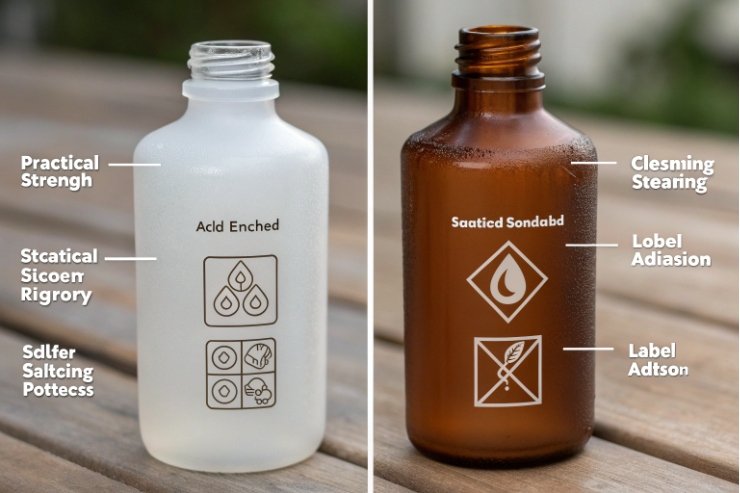
Strength: glass fails from surface flaws, not from “glass thickness alone”
Glass strength is dominated by surface flaws and crack-tip sharpness 3. Any process that deepens scratches or pits can lower impact resistance. Sand-blasting is more likely to introduce deeper micro-notches. That can reduce strength, especially near corners, heels, and shoulder transitions where stress is already higher.
Acid-etch can go either way. If the surface already has fine damage from forming or handling, a light etch can sometimes “round off” the sharpest micro-cracks. But if the etch is aggressive or uneven, it can create a rough surface that also becomes a crack starter. The practical message is simple: sand-blast needs tighter mechanical control and often needs stronger bottle design margins.
Cleanability: smooth matte wipes easier than rough matte
Bars are tough environments. Hands are oily. Syrups splash. Labels shed glue. A smoother etched frost usually wipes down faster because there are fewer deep valleys to hold grime. Sand-blasted textures can look clean at first, then start to hold fingerprints and dust in the roughness. This does not mean sand-blast is “dirty.” It means cleaning takes more effort, and the brand must expect more handling marks in real life.
If the bottle is likely to be reused for home infusions or bar refills, the cleaning difference becomes more obvious.
Label adhesion and decoration: roughness helps, but too much roughness can backfire
Adhesion has two main parts: chemical bonding (adhesive chemistry) and mechanical keying (surface texture). Sand-blasted surfaces usually provide better mechanical keying for inks, coatings, and some label adhesives. That is why sand-blast is popular when screen printing needs to survive ice buckets and wet hands.
But high roughness can also trap air and reduce contact area for pressure-sensitive labels. Labels can silver, wrinkle, or lift at edges if the surface peaks are too high. Acid-etched frosting is smoother, so labels can lay flatter, but some adhesives need a primer or special formulation to hold reliably on matte glass.
| Topic | Acid-etch frosting | Sand-blasting | Practical guidance |
|---|---|---|---|
| Strength risk | Medium (depends on etch depth) | Higher (deeper flaws possible) | Keep corner radii and heel strong, set limits on roughness |
| Cleanability | Better | Harder | Match finish to “bar touch” reality and cleaning habits |
| PSL label adhesion | Often good with the right adhesive | Can be mixed if too rough | Test peel + aging on real roughness, not on samples only |
| Screen print durability | Good | Very good | For heavy handling, sand-blast + durable ink system works well |
Which process scales better with tight ΔE and roughness control?
Premium spirits live and die by consistency. A small haze shift can make one batch look “off,” especially under store LEDs and in social media photos.
Acid-etch often scales better for tight, repeatable haze and roughness when chemistry is controlled. Sand-blasting scales well for patterned graphics, but roughness and whiteness drift with media and nozzle wear unless tightly managed.
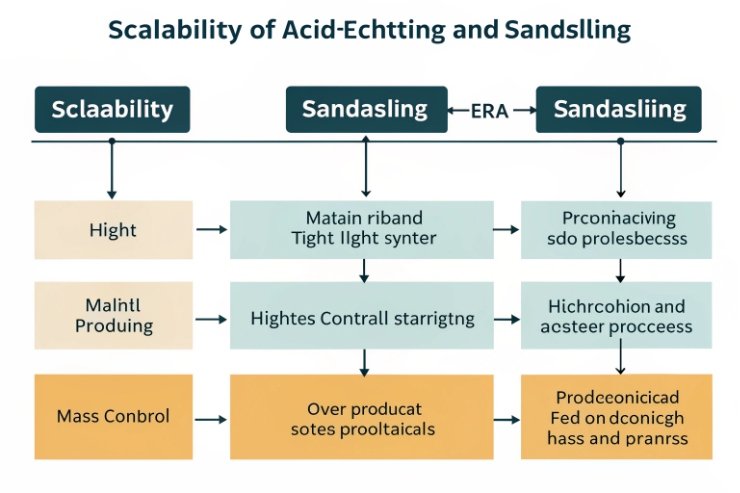
What “tight ΔE” really means for matte glass
For matte finishes, the customer sees changes in haze, whiteness, and perceived opacity. Those changes can be tracked with ΔE (color difference) and with haze or gloss measurements. If the goal is “same look across every production week,” the process must control:
- exposure or blast energy,
- surface roughness (Ra/Rz),
- and rinsing/cleaning quality (for etch).
Acid-etch: strong at uniform full-surface effects
Acid-etch can run like a recipe. Concentration, temperature, dwell time, agitation, and rinse steps can be kept stable. When those controls are in place, full-surface frosting is very repeatable. That helps brands that need a consistent “velvet haze” across multiple bottle sizes and multiple molds.
The weakness is chemical management. If rinse water is poor, residue can cause stains. If bath chemistry drifts, the finish shifts. Waste handling and safety controls also become part of the scale plan.
Sand-blast: strong at patterns and localized graphics, weaker at long-run uniformity
Sand-blast is excellent when the brand wants a logo or window with sharp edges and tactile relief. It is also flexible for small-to-medium batches. But for very tight roughness and ΔE, blasting needs strict standardization:
- media type and size distribution,
- media refresh schedule,
- nozzle type and change interval,
- pressure, distance, and angle control,
- and fixture repeatability by bottle position.
Without this discipline, a run can start smooth and end rough, or start bright and end gray.
Spray-frost coating: fastest to scale, but it shifts the risk to abrasion and chemical resistance
Coatings can produce very tight appearance specs if thickness and curing are controlled. That can be great for brand color consistency. The trade is durability and scratch/scuff behavior through packing and shipping. If the bottle will rub in cartons or trays, the coating system must be proven with abrasion testing and packaging rub trials.
| Scaling goal | Best fit | Why | Common failure mode |
|---|---|---|---|
| Tight full-surface haze (ΔE + gloss) | Acid-etch | Chemistry can be recipe-controlled | Bath drift, rinse stains, patchiness |
| Crisp logo patterns and relief | Sand-blast | Masking + depth control gives sharp graphics | Nozzle/media drift, roughness variation |
| High-volume appearance consistency | Spray-frost coating | Film thickness can be controlled | Scuffing, chipping, solvent sensitivity |
What QA checks verify uniformity and edge protection?
If the finish looks uneven under bar lighting, the customer will notice. QA must catch haze bands, sharp edges, and weak adhesion before bottles leave the factory.
Uniformity needs measured haze/ΔE and roughness, not only human eyes. Edge protection needs checks on masked borders, abrasion tests, and packaging rub trials so frosted zones do not chip or flake.
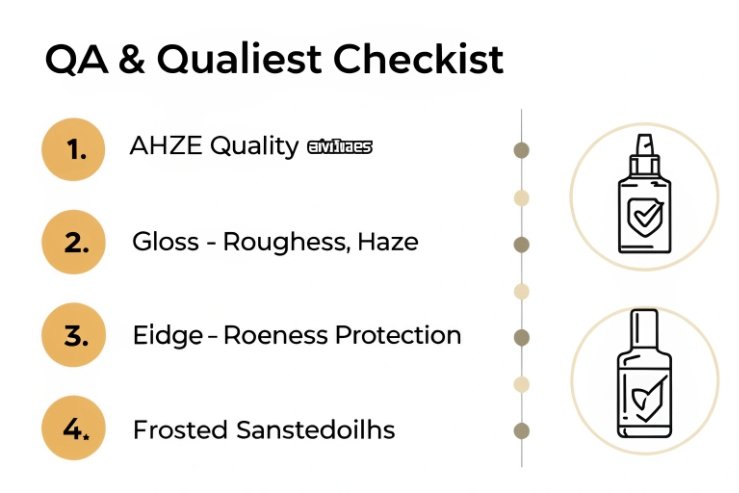
Visual control: standard light, standard angle, standard decision rules
Human inspection is still useful, but it must be standardized. Matte defects hide in soft light and show up under hard point light. The inspection station should use consistent lighting and consistent viewing angles. Inspectors should be trained to look for:
- banding (process non-uniformity),
- cloud spots (rinse or residue),
- edge fuzziness (mask failure),
- and local “shine” (under-processed areas).
A simple habit that helps is rotating bottles under the same light and using a go/no-go reference sample.
Measured uniformity: ΔE, haze, gloss, and roughness
For tight premium specs, measurement is the backbone:
- Spectrophotometer for ΔE and whiteness shifts.
- Haze meters that follow wide-angle scattering haze definitions 4.
- Gloss meter for surface reflectivity control.
- Profilometer (contact or optical) using ISO 4287 roughness parameters 5 to keep Ra/Rz inside limits.
These numbers should be tracked by cavity, by shift, and by bath/media age. When drift is mapped early, scrap drops fast.
Adhesion and durability: label tests, ink tests, and abrasion
For labels and prints, “looks good today” is not enough. QA should include:
- cross-hatch + tape pull using the ASTM D3359 tape test 6 (when applicable),
- peel strength for pressure-sensitive labels on real frosted surfaces,
- wet/ice-bucket exposure for bar conditions,
- and abrasion tests aligned with the ASTM D4060 Taber Abraser 7 approach to predict shipping scuff.
Edge protection matters most for partial frosting and patterned blasting. The transition edge can become a weak zone where chipping starts or where coatings lift. Good QA checks:
- microscope or loupe inspection on edges,
- fingertip check for sharpness (with a defined rule, not guesswork),
- drop and impact screening on worst-case corners,
- and packaging rub simulation with the chosen divider or tray film.
| QA item | What it detects | How it is checked | Why it matters for premium bottles |
|---|---|---|---|
| Standardized visual station | Banding, patchiness, edge defects | Fixed lighting + reference samples | Prevents “random look” complaints |
| ΔE and haze control | Appearance drift | Spectro + haze readings by shift | Keeps shelf look consistent |
| Roughness Ra/Rz | Over/under processing | Profilometer sampling plan | Protects adhesion and cleanability |
| Label/ink adhesion | Lift, silvering, wash-off | Peel + tape pull + wet aging | Stops label failures in the field |
| Abrasion + rub test | Scuffing and matte burnish | Controlled rub vs real packaging | Reduces cosmetic claims |
| Edge inspection | Chips, sharp transitions | Magnification + impact screening | Protects hands, avoids chipping at borders |
Conclusion
Frosted (acid-etched) finishes suit smooth, elegant haze and easier cleaning. Sand-blasted finishes suit tactile grip and sharp patterns, but need tighter strength and roughness control plus serious QA.
Footnotes
-
Explains how HF-based etching creates uniform frosted glass and how it differs from other “frosted” methods. ↩︎ ↩
-
Background on abrasive blasting mechanics and how blasting parameters influence roughness and surface removal. ↩︎ ↩
-
Clear overview of why crack-like surface flaws dominate glass strength and how flaw geometry changes failure risk. ↩︎ ↩
-
Practical explanation of haze measurement (wide-angle scattering) used to control matte and translucent appearance. ↩︎ ↩
-
Reference guide to ISO roughness parameters (e.g., Ra/Rz) used for controlling matte texture limits. ↩︎ ↩
-
Official ASTM description of the tape adhesion test used to qualify ink/coating/label systems on finished surfaces. ↩︎ ↩
-
Official ASTM overview of Taber abrasion testing used to benchmark scuff and wear resistance of coatings. ↩︎ ↩






