
Broken glass is not only a cost problem. It is a reputation problem. One bad shipment can cancel a distributor, delay a launch, and create painful photos on WhatsApp.
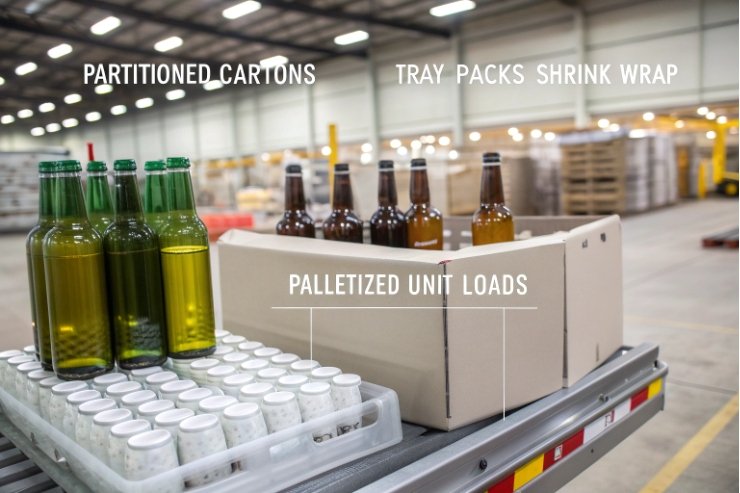
Most glass-bottle shipments rely on three core pack styles: partitioned cartons, shrink-wrapped tray packs, and palletized unit loads. The best choice depends on value, route risk, and how the bottles will be handled.
The simple truth is that packaging is a system. The “case” is only one layer. Real protection comes from how bottles are separated, how the pallet is stabilized, and how the load behaves under drops, vibration, and compression in real freight.
Do cartons with dividers, trays with shrink, and bulk pallets cover most needs?
When buyers ask for “standard packing,” they often mean different things. One customer wants perfect cosmetics-grade surfaces. Another wants the cheapest safe pack for a long ocean route.
Yes. Partitioned cartons, tray-and-shrink bundles, and palletized unit loads cover most glass-bottle needs. Extra options like molded inserts or returnable crates are upgrades for special risk or premium appearance.
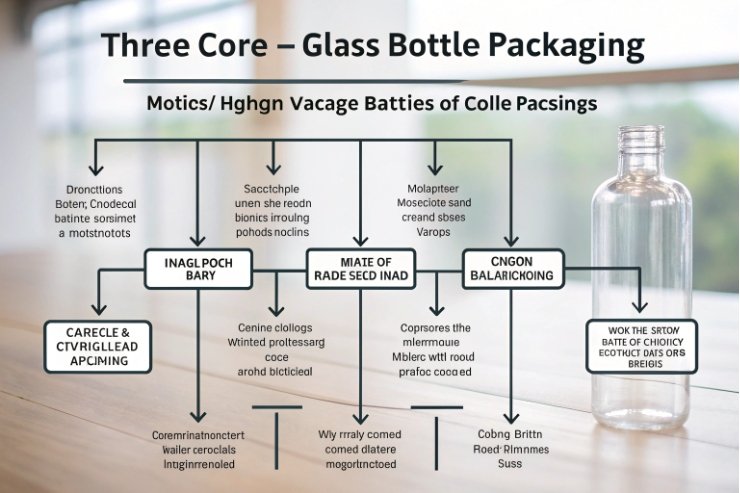
Partitioned corrugated cartons (cell dividers)
This is the workhorse for B2B glass bottles. Each bottle sits in its own cell so there is no glass-to-glass contact. The case resists side impacts, and the dividers control lateral movement. This method suits most export routes, most bottle shapes, and most filling plants. It also supports decoration. When a bottle is frosted, painted, or screen printed, separation is a must. Otherwise, rub marks will appear even if nothing breaks.
If you need a shared reference for specs and terminology, aligning on corrugated dividers and partitions 1{#fnref1} helps teams reduce “standard packing” misunderstandings.
Tray packs with shrink or stretch film
Trays with shrink film are common in beverage lines and retail-ready formats. Bottles sit on a corrugated or plastic tray, then film wraps the group. This is fast and cost-effective on high-speed lines. It also looks clean on pallets and can go directly to shelf in some channels. The risk is that bottles can touch each other if there is no spacing feature. For round bottles, contact points are predictable. For square or decorated bottles, the scuff risk can rise quickly unless the tray design and film tension are well controlled.
If you are choosing between formats, a simple overview of shrink wrap tray packs 2{#fnref2} can clarify what trays do well (and what they do not).
Palletized unit loads (bulk pallets)
A “bulk pallet” usually means cases or trays stacked in layers, then stabilized with stretch wrap and edge protection. Sometimes it also means bottles in returnable crates. Either way, the pallet is the true shipping unit. For long-distance freight, pallet quality decides whether the load arrives straight or arrives leaning. Even the best case pack can fail if the pallet is soft, the wrap is weak, or the load slides layer-to-layer.
If you want the fundamentals behind why pallets fail (and how to stop it), the concept of unitizing goods on pallets and slipsheets 3{#fnref3} is a useful baseline.
Where the “other” methods fit
Individually bagged bottles, bubble sleeves, foam inserts, molded pulp, and air-column packs are real tools. They are just not the top three for normal container-level B2B shipments. These methods shine for high-value bottles, fragile decorations, sample shipments, or irregular shapes that cannot be controlled with standard dividers.
| Method | Best for | Main protection mechanism | Common weakness | Typical use case |
|---|---|---|---|---|
| Partitioned cartons | Export, premium, decorated | Cell separation + box strength | Higher material cost | Spirits, cosmetics, pharma |
| Tray + shrink | High-speed lines, retail | Group restraint + tray support | Scuffing and contact risk | Beer, RTD, water, juices |
| Palletized unit load | Long routes, warehouses | Load stabilization across layers | Pallet/wrap failure | Full-container shipments |
| Inserts/sleeves | High-value, irregular shapes | Immobilization + cushioning | Labor and cost | Samples, limited editions |
Which method best balances cost and breakage risk?
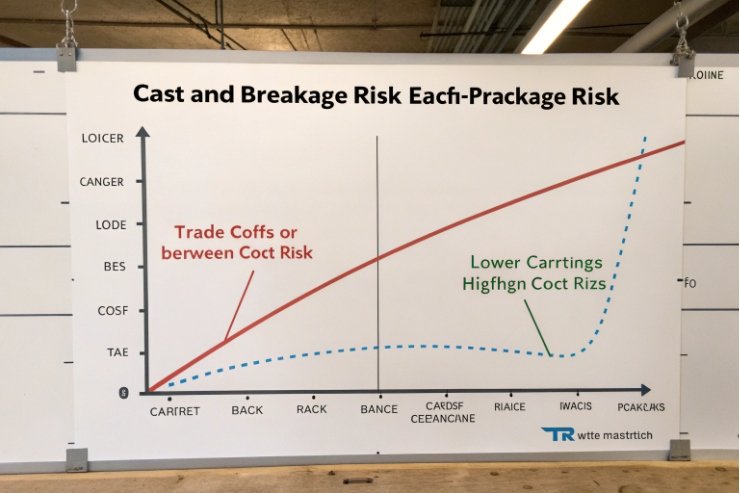
Everyone wants “lowest cost with zero breakage.” That goal is not realistic. The smart goal is low total cost, including claims, delays, and rework.
For most B2B shipments, partitioned cartons on a well-built pallet give the best balance of cost and breakage risk. Tray-and-shrink wins on speed and material cost, but needs tight control to avoid scuffs and leaning pallets.
Think in total delivered cost, not box price
A tray-and-shrink pack can be cheaper per bottle. It uses less corrugate and fewer divider parts. It also runs fast on filling lines. But if bottles scuff, the “cheap” pack becomes expensive. A scratched perfume bottle or a rubbed metallic ink can turn into a full rejection, even if the glass is intact.
Partitioned cartons cost more in paper and sometimes in packing labor. Still, they reduce glass contact, reduce motion, and reduce cosmetic damage. For export routes with port handling, transloading, and mixed trucking conditions, that reduction often pays back fast.
What drives breakage in real transport
Glass breaks from impact and stress. Impact comes from drops, knocks, and shifting pallets. Stress comes from compression and vibration over time. Partitioned cartons reduce impact transfer between bottles. They also reduce micro-impacts from vibration because bottles do not chatter against neighbors.
Trays with shrink can be safe when the tray has good geometry and the film tension is consistent. Problems show up when film is loose, when tray edges deform under compression, or when pallets are wrapped with low containment force. Then the group can move as a block, and bottles can strike each other inside the film pocket.
A practical “default” recommendation
When the shipment is full pallets or full containers, and the product is not ultra-low-cost, the safest standard is:
- Partitioned corrugated cartons (or die-cut dividers for shoulder control)
- Strong export-grade corrugate when route risk is high
- Pallet layering with anti-slip sheets
- Corner boards with strong stretch wrap containment
This setup is simple, scalable, and accepted by most warehouses.
| Priority | Best choice | Why it works | When it is not ideal |
|---|---|---|---|
| Lowest breakage | Partitioned cartons + stabilized pallet | No glass contact, strong system | Very low-cost products |
| Lowest material cost | Tray + shrink | Minimal corrugate, fast packing | Premium decoration, long routes |
| Fastest line speed | Tray + shrink | High-speed wrapping | Irregular shapes, heavy glass |
| Best cosmetic protection | Partitioned cartons + sleeves (optional) | Stops rub marks | Adds labor and cost |
| Best for mixed channels | Cartons + pallet standards | Works across 3PL and export | Needs carton sizing discipline |
How do corner boards and anti-slip sheets help?
Many packaging failures are not “broken bottles.” They are “broken pallets.” A load that leans is a load that drops later.
Corner boards protect edges, increase vertical stacking strength, and help stretch wrap hold the load. Anti-slip sheets increase friction between layers, reducing slide and pallet creep during vibration and braking.
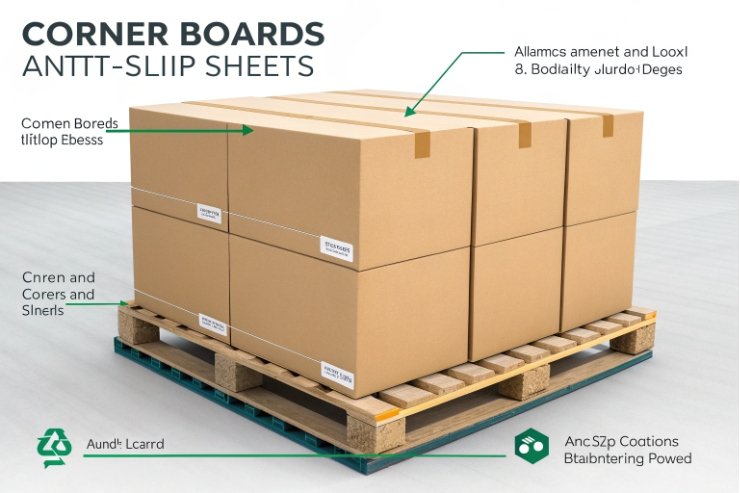
Corner boards: edge armor and load columns
Corner boards (also called angle boards) sit on the pallet corners and sometimes run full height. They protect cartons from strap and wrap damage. They also spread compression loads down the edges, where cartons are strongest. For tall pallets, corner boards act like simple columns. This reduces the chance of the top layers crushing the bottom layers during warehouse stacking or container racking.
If you need a clear definition and why they work, edge and angle board protectors 4{#fnref4} are a solid reference point.
Corner boards also improve wrap performance. Stretch film holds best when it has a clean edge to bite against. Without corner boards, film can cut into soft corrugate corners, lose tension, and then the load shifts.
Anti-slip sheets: friction that prevents “layer skating”
Anti-slip sheets go between layers of cartons or trays. Their job is simple. They increase friction. When a truck brakes or a container vibrates, each layer wants to slide. If layers slide, corners crush and bottles see more shock. Anti-slip sheets reduce that motion. They also help during pallet build and forklift handling, because the stack behaves like one unit.
If you want the basic “how it prevents sliding” logic, this explainer on anti-slip sheets between pallet layers 5{#fnref5} is a practical read.
Containment force is the quiet variable that decides success
Even with good trays and dividers, a pallet can still fail if the wrap does not apply enough holding force. That is why many teams measure and standardize stretch film containment force 6{#fnref6} instead of relying on “looks tight enough.”
Where they matter most
Corner boards and anti-slip sheets matter most in these situations:
- Long road routes with frequent braking and lane changes
- Hot or humid routes where corrugate softens
- Heavy bottles (spirits, thick base wine bottles)
- Tall pallets that approach container height limits
- Mixed SKU pallets where uniformity is weak
| Add-on | What it prevents | How it works | Best used when | Cost impact |
|---|---|---|---|---|
| Corner boards | Corner crush, wrap cut-in, pallet lean | Reinforces edges and improves wrap grip | Tall pallets, heavy loads | Low to medium |
| Anti-slip sheets | Layer sliding, “pallet creep” | Adds friction between layers | Long haul, high vibration | Low |
| Top cap sheet | Top damage, dust, strap cut | Shields top layer | Warehousing and export | Low |
| Strapping (PET/steel) | Load spread, wrap failure | Adds mechanical restraint | Very heavy loads | Medium |
| Slip sheet (no pallet) | Pallet cost, container cube | Forklift push/pull handling | High-volume export | Medium |
What ISTA tests validate the chosen pack?
A pack design is only a guess until it survives a repeatable test. Without testing, the first “real test” is a customer claim.
ISTA test protocols validate glass-bottle packs through controlled drops, vibration, compression, and conditioning. ISTA 1-series is basic integrity, ISTA 2-series adds partial simulation, and ISTA 3-series is general distribution simulation for stronger confidence.
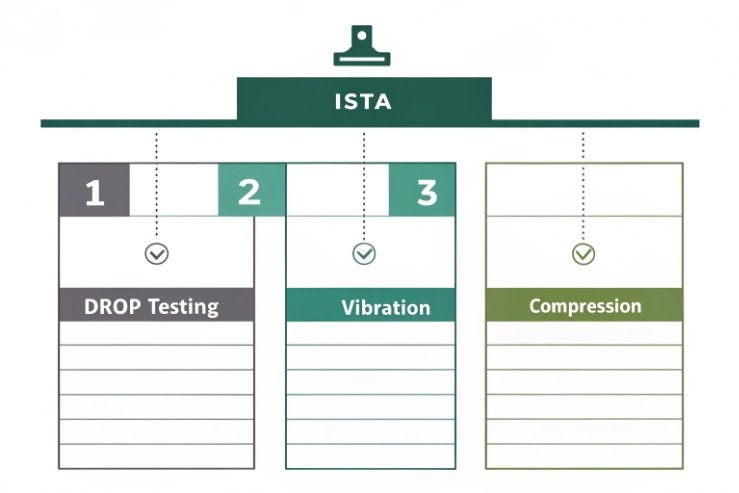
Choose a test level that matches the route
If bottles ship to a nearby customer with stable handling, a basic integrity test may be enough. If bottles ship export with multiple handoffs, simulation testing is safer. A common mistake is over-testing a weak pack and then ignoring the failure. The better approach is to select a target test level, redesign fast, then repeat until the result is stable.
If you need the official map of families and protocols, start with ISTA test procedures 7{#fnref7} and then match the procedure to your distribution reality.
What the tests actually prove
ISTA-style testing stresses the packaging system in a repeatable way:
- Drop testing checks shock and divider performance.
- Vibration testing checks long-duration rubbing, chattering, and pallet creep.
- Compression testing checks stacking strength and carton buckling.
- Conditioning checks how humidity and temperature weaken corrugate and adhesives.
For glass bottles, the most important observation is not only “did it break.” It is also “did it scuff, rub, or shift.” Cosmetic damage is a real failure for premium packaging.
Build a clean validation plan
A strong plan tests at least these variables:
- Full bottle vs empty bottle (weight changes everything)
- Worst-case decoration (frosting, screen print, metallic inks)
- Maximum pallet height and maximum stack load
- Route conditioning (dry, humid, hot)
Test results should be tracked by defect type. One cracked base points to impact. A cluster of shoulder chips points to divider fit. A wide spread of rub marks points to vibration and contact control.
Typical ISTA-style checkpoints for glass bottles
The exact selection depends on your channel and customer rules, but the structure below covers most needs.
| Test element | What it stresses | Glass-bottle failure mode | Pack tweak that often fixes it |
|---|---|---|---|
| Drop / shock | Handling drops and edge impacts | Chips, cracks, divider collapse | Stronger dividers, better headspace control |
| Random vibration | Truck and container vibration | Rub marks, chatter chips, loosening | Tighter cells, sleeves, anti-slip layers |
| Compression | Warehouse stacking and clamp loads | Carton buckling, bottle-to-bottle contact | Higher ECT/BCT, corner boards, better pallet pattern |
| Incline impact | Sudden horizontal shock | Pallet shift, corner crush | Corner boards, stronger wrap containment |
| Conditioning | Humidity/temperature exposure | Soft cartons, glue failure | Coated board, better tape, wrap strategy |
Conclusion
Three pack systems cover most glass-bottle shipping. Partitioned cartons on a stabilized pallet usually win on total cost, while corner boards, anti-slip sheets, and ISTA-style testing turn a “pack idea” into a proven standard.
Footnotes
-
Clarifies divider/partition styles and how interior forms reduce glass-to-glass contact. ↩ ↩
-
Explains tray + film multipacks and why tray geometry matters for alignment and stability. ↩ ↩
-
Practical fundamentals of building stable unit loads for handling, shipping, and storage. ↩ ↩
-
Defines edge/angle board functions for corner protection, stacking strength, and load stabilization. ↩ ↩
-
Shows how anti-slip layers reduce sliding and pallet lean during vibration and braking. ↩ ↩
-
Helps quantify containment force so stretch wrap actually restrains loads without crushing cartons. ↩ ↩
-
Official starting point to select ISTA procedures by shipment type and required test rigor. ↩ ↩






