
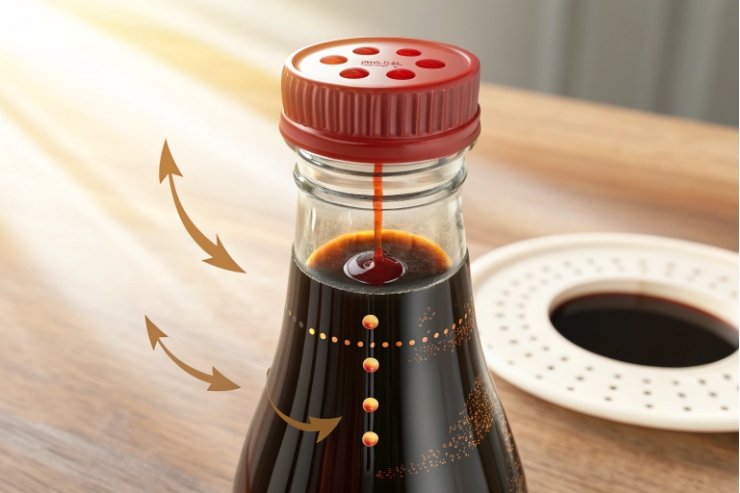
A tiny cap with two holes does not look special, but it completely changes how soy sauce behaves on the table. The bottle becomes a precision tool, not just a container.
Soy-sauce caps use two holes, tuned spout geometry, and durable liners to control flow, resist salt and acids, and keep the product safe, clean, and easy to pour.
Once you see how the design works, you cannot unsee it. Air, liquid, viscosity, materials, and even tamper bands work together. The iconic 1961 soy sauce dispenser design 1 {#fnref1} made this “table bottle” behavior feel effortless.
Do dual ports balance airflow for a controlled pour?
Everyone knows the “glug glug” of a badly designed bottle. With soy sauce, that glug is a disaster, because one surge can ruin a dish.
Yes. One hole lets soy sauce out while the second hole lets air in, so the flow stays smooth, quiet, and easy to control with a fingertip.
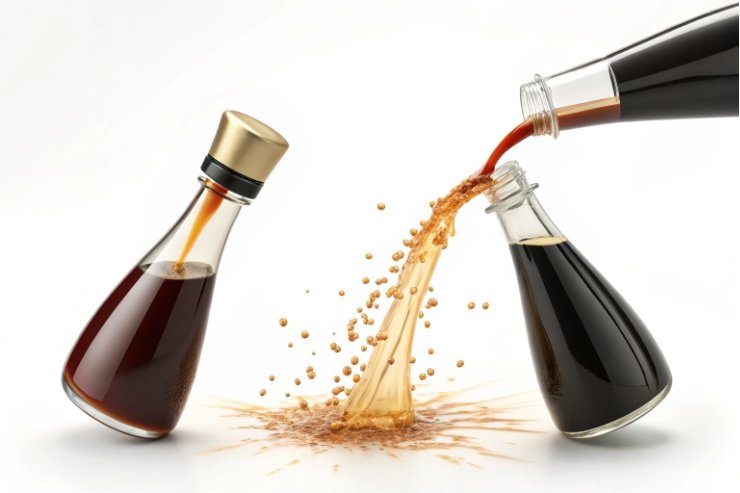
How two holes tame the flow
Inside the bottle, soy sauce competes with air for space. If there is only one hole, liquid tries to leave while air tries to enter through the same path. That creates:
- A partial vacuum inside the bottle
- Jerky “glugging” as air bubbles fight their way in
- Sudden surges and splashes at the spout
This is the same basic mechanism described in the physics of gurgling 2 {#fnref2}. When the cap has two small ports, the physics change:
- One side acts as the pour hole.
- The other side acts as the air vent.
- Air replaces the volume of sauce almost continuously.
So pressure stays closer to normal, and you get a thin, steady stream instead of bursts.
Finger control and ambidextrous use
The two holes also create a simple “manual valve”:
- Cover one hole with a finger to start or stop flow.
- Adjust angle and finger pressure to speed up or slow down.
- This works for right- and left-handed users, because you can choose which side to cover.
It is a clever user interface:
| Feature | Effect on use |
|---|---|
| Two small, equal holes | Balanced flow and airflow |
| Opposing positions | Easy finger control from any angle |
| Narrow opening diameter | Fine drizzle rather than a flood |
| Rigid neck on glass bottle | Stable geometry over the whole shelf life |
This is why people quickly “learn” how to drive a soy-sauce bottle without instructions. The cap itself teaches you.
How does viscosity shape spout geometry and drip-free use?
Soy sauce is not as thick as syrup, but it is also not as thin as water. That in-between viscosity is why generic bottle mouths do not work well.
Spout geometry is tuned around soy sauce’s viscosity: narrow, rounded ports and the right angle give a stable stream, less splashing, and fewer drips down the side of the bottle.
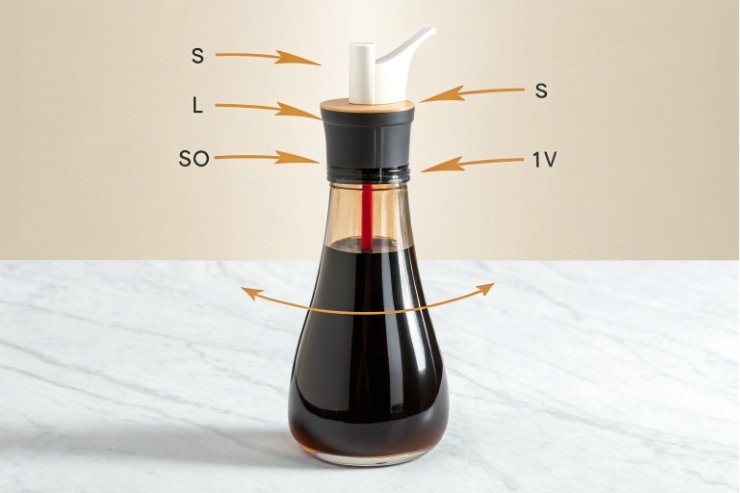
Designing around soy sauce, not water
For water, a wide and simple spout is fine. For soy sauce, the design needs to respect three things:
- Higher viscosity than water
- High surface tension that can cause hanging drops
- High salt that can crystallize at edges over time
If you want a baseline number, typical soy sauce viscosity values 3 {#fnref3} show why it pours “sticky” compared with water.
So the cap and neck often use:
- Small-diameter outlets so the stream stays thin and slow.
- Rounded lips that encourage the last drop to fall into the dish, not back along the bottle wall.
- Short overhangs so dried crystals do not block the port.
If the outlet is too wide, soy sauce races out and spreads on the food. Too narrow and the stream feels slow and sticky. The classic two-hole caps sit in a comfortable middle range.
Drip control and clean tables
A well-designed soy-sauce cap does three things at the end of the pour:
- Breaks the stream cleanly.
- Pulls the last drop inward, away from the outer wall.
- Keeps the neck clean so it does not attract dust, crumbs, or bacteria.
This is why many caps:
- Use a small internal cone to shape the stream.
- Have a micro-ridge or edge to cut the flow.
- Sit on a precision glass neck that does not warp.
From a packaging perspective, the glass bottle helps here:
| Aspect | Glass bottle + plastic cap combo |
|---|---|
| Neck roundness | Very stable, keeps both holes aligned |
| Thread accuracy | Repeatable torque, cap stays at right angle |
| Surface for sealing | Smooth land, reduces leaks at the interface |
| Long-term shape | No creep, so spout geometry stays consistent |
Viscosity also means you do not want users to shake hard. The dual-hole design reduces that impulse, because flow is already predictable. Less shaking means fewer bubbles and less foaming inside the sauce.
Which liners resist salt and acids over time?
Soy sauce is beautiful in a bowl, but it is a harsh environment for packaging. It is salty, often slightly acidic, and stored for months. Closure materials must handle that without failing.
Caps need liners and resins that resist salt, mild acids, and long contact times. The right liner keeps the seal tight, prevents corrosion, and blocks oxygen from creeping in.
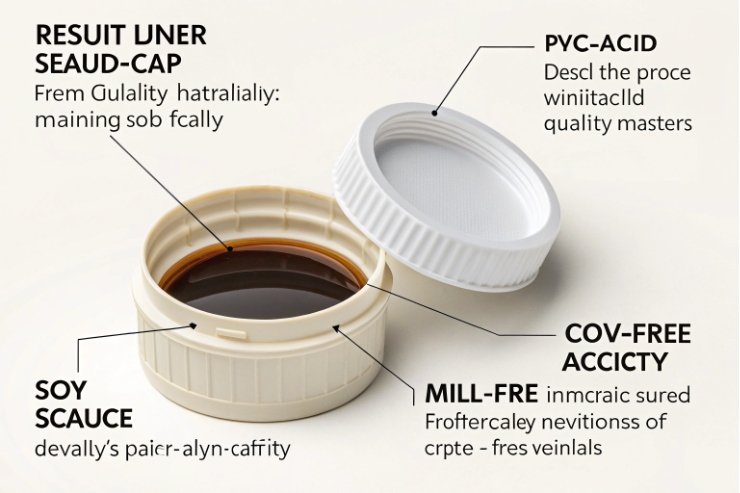
What soy sauce does to weak materials
Typical brewed soy sauce contains:
- High salt concentration
- Organic acids from fermentation
- Colorants and aroma compounds that can stain or migrate
If the closure system is not designed for this, you may see:
- Corrosion on metal caps from trapped liquid at the crimp or thread.
- Swelling or cracking of low-grade plastics.
- Loss of elasticity in cheap liners, leading to leaks or oxygen ingress.
- Flavor taint if plasticizers or monomers migrate into the sauce.
So the cap and liner must use food-grade, soy-compatible materials and a geometry that does not trap liquid at the wrong points.
Common liner choices and what they solve
For glass soy-sauce bottles with plastic or metal caps, you often see liner types summarized in cap materials and liner descriptions 4 {#fnref4}, including options designed to handle mild acids in food products.
A simplified liner comparison:
| Liner type | Pros for soy sauce | Watch-outs |
|---|---|---|
| Foamed PE disc | Good seal, low cost, salt-resistant | Needs correct torque to avoid leaks |
| Induction seal + backing | Strong tamper evidence, great O₂ barrier | Must match glass finish and cap design |
| Coextruded multi-layer | Tuned barrier and elasticity | Higher cost, needs stable specs |
For long shelf life and export, a strong oxygen barrier in the liner is important. Glass already blocks gas through the wall. The closure becomes the main path. A good liner keeps flavor stable and slows oxidation of the sauce.
From a glass supplier perspective, this means:
- The finish must be smooth and within tight tolerances so the liner seats correctly.
- The sealing land must be flat so the liner can compress evenly.
- The neck design and thread must match the cap standard you choose.
Glass and cap design are a system, not two separate choices.
Are tamper-evident features required for safety?
Soy sauce looks simple, but it is a long-shelf-life, high-usage food product. Customers expect clear proof that the bottle is new and untouched. Many markets also require this by law.
Most soy-sauce caps now include tamper-evident features—breakaway rings, tear bands, induction seals, or shrink sleeves—to show if the bottle has been opened before.
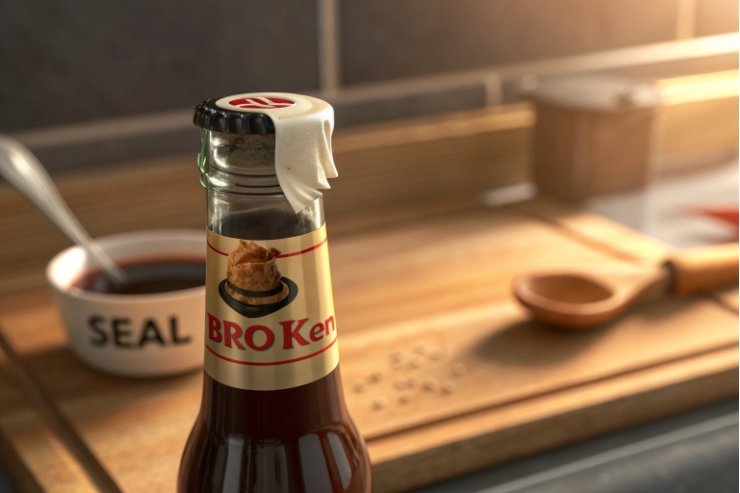
Why tamper evidence matters so much
Without a visible indication, it is hard to know if:
- The bottle was opened on shelf and sampled.
- The closure was damaged in transport.
- Someone refilled or diluted the contents.
Soy sauce is often used at room temperature and shared at the table, so confidence in hygiene is critical. A simple, visible break point reassures both restaurants and home users.
Common tamper systems on soy-sauce bottles
Typical options include:
-
Breakaway ring on a screw cap
- When you twist the cap for the first time, small bridges snap.
- The ring stays on the neck as a signal that the bottle is now “in use”.
-
Induction seal under the cap
- A foil or laminate membrane is bonded to the glass rim.
- You must peel or puncture it before pouring.
- This also improves oxygen barrier performance.
-
Shrink band or sleeve
- A perforated band or full sleeve covers the cap–neck joint.
- You tear it away along a printed line to open the product.
For a quick overview of options and trade-offs, see types of tamper-evident packaging 5 {#fnref5}.
Each system has trade-offs:
| Tamper feature | Strengths | Considerations |
|---|---|---|
| Breakaway ring | Simple, cheap, easy for users | Needs tight control of neck and thread specs |
| Induction seal | Strong barrier, clear safety signal | Requires induction equipment and good glass land |
| Shrink band / sleeve | High visibility, room for branding | Extra material and application step |
Linking tamper evidence to glass design
Induction seals are also a freshness tool, because the hermetic seal can reduce oxygen and contamination pathways—see why induction sealing supports food safety 6 {#fnref6}.
For a glass bottle, tamper systems rely on:
- Clean, repeatable finish for induction seals and rings.
- Correct shoulder and neck shape for shrink sleeves and bands.
- Enough vertical real estate for both functional and branded elements.
As a packaging partner, the goal is to give the brand:
- Reliable tamper evidence that survives transport.
- Easy, intuitive first opening for the consumer.
- A look that still fits the aesthetic of a refined table sauce.
When all of that is correct, the result is simple: a glass soy-sauce bottle that pours smoothly, keeps its flavor, and tells the user at a glance that it is safe to use. For compliance and material choices, it also helps to understand FDA guidance on food-contact substances 7. {#fnref7}
Conclusion
The famous two-hole soy-sauce cap is not an accident. It is a small engineering system: airflow, viscosity, liners, and tamper evidence all tuned so a strong, salty product pours gently, stays clean, and keeps its flavor from the factory to the last drop on the plate.
Footnotes
-
Museum entry on the iconic 1961 dispenser—useful for design history, materials, and context. ↩ ↩
-
Explains why single-opening bottles “glug” and how airflow restores smooth pouring. ↩ ↩
-
Reference table showing soy sauce viscosity—helps explain why spout geometry must be tuned. ↩ ↩
-
Quick guide to cap liners and materials, including options suited for mild-acid food products. ↩ ↩
-
Practical list of tamper-evident methods (bands, sleeves, seals) and how they signal first opening. ↩ ↩
-
Shows how induction seals create a hermetic barrier against oxygen, moisture, and contaminants. ↩ ↩
-
Explains how FDA evaluates and authorizes substances used in contact with food. ↩ ↩






