
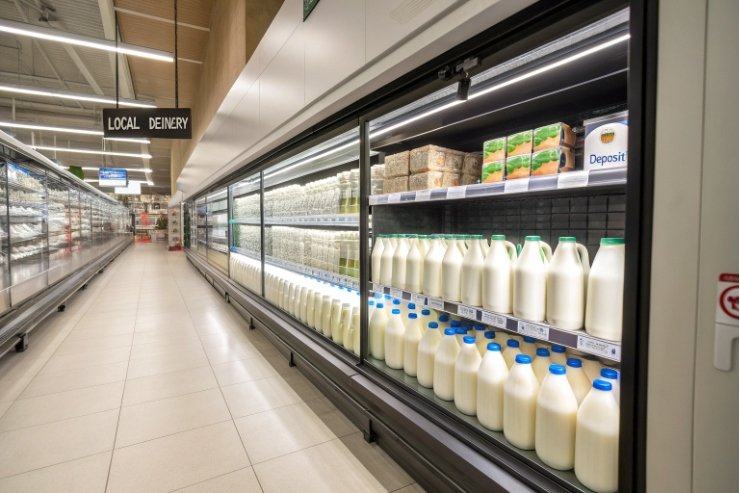
Supermarkets are full of plastic jugs and cartons, yet glass milk bottles keep coming back in farm shops, doorstep delivery, and premium aisles. They should be “old tech”, but they are not.
Glass milk bottles survive because they combine flavor purity, reuse economics, strong sustainability stories, and very visible brand value in a way that cartons and plastic struggle to match in local dairy systems.
When dairies run short, efficient distribution loops and treat the glass as a long-life asset, the bottle becomes much more than a container. It turns into a moving billboard, a return ticket, and a taste-protection device.
Do flavor purity and reuse cycles beat cartons and plastic?
People often think “milk is milk” no matter the package, until they taste them side by side. Many can tell which one came from glass without seeing the bottle.
Glass is inert, non-porous, and easy to sterilize, so it protects flavor and aroma. At the same time, its long reuse life spreads cost and footprint over many cycles, often beating single-use plastic and cartons in local loops.
Why glass tastes “cleaner”
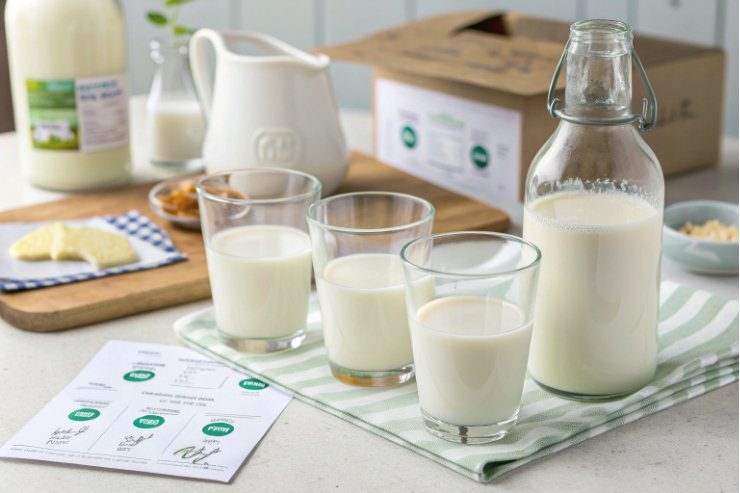
Glass has one very simple advantage: glass is nonporous and impermeable 1. It does not absorb fat or odor. It does not leach additives. It does not carry printing inks in contact with the product. As a tasteless and odourless material 2, it stays neutral across repeated reuse cycles.
Plastic and cartons tell a different story:
- HDPE jugs can pick up fridge odors and sometimes give a faint “plastic” note, especially to sensitive drinkers.
- Cartons use paper with inner plastic or foil layers. Over time, some people notice a slight “pack” taste, especially when the milk is near the shelf-life limit.
A peer-reviewed study on the role of packaging on the flavor of fluid milk 3 helps explain why these differences can show up in side-by-side tasting.
In glass, milk keeps the taste it had in the tank. This matters most for:
- Non-homogenized or organic milk, where the cream line and subtle flavors are part of the appeal.
- Low-temperature pasteurized milk sold fresh and local.
- Customers who buy on taste and are willing to pay a bit more.
Reuse cycles and cost per fill
At first glance, glass seems expensive: more material, more weight, more breakage risk. The trick is to stop thinking in “per bottle” terms and think in “per fill”.
A single glass bottle may run through many cycles:
- Fill → sell → return → wash → refill
- Repeat 20, 30, even 40 times in a well-run system
When you divide the bottle’s manufacturing cost and embodied carbon by all those cycles, numbers look very different.
Rough illustration:
| Packaging type | Typical use pattern | Container cost per use (conceptual) |
|---|---|---|
| Single-use plastic jug | 1 trip, then recycle or landfill | High (100% of cost in one use) |
| Single-use carton | 1 trip | High (multi-layer, no reuse) |
| Refillable glass milk bottle | 20–30+ trips in local loop | Much lower, cost spread over cycles |
This is why many small dairies can afford sturdy, nice-looking glass even without giant volumes. The bottle becomes a durable asset, not a disposable cost.
Cleaning, hygiene, and shelf life
Modern washers use controlled cycles:
- Pre-rinse to remove product residue.
- Hot caustic wash to remove fat and biofilm.
- Fresh water rinse and sometimes final disinfectant or steam.
Because glass tolerates high temperatures and harsh cleaners, dairies can achieve very strong hygiene levels. That supports:
- Consistent shelf life
- Low off-flavor risk
- Regulatory compliance under frameworks like the Grade “A” Pasteurized Milk Ordinance (PMO) 4 even in strict markets
Cartons and plastic never see this reuse cycle. They depend instead on one-time sterility and later recycling, which is fine at scale, but it does not deliver the same closed-loop reuse story.
In short, when the loop is short and the return rate is high, flavor purity plus reuse cycles push glass ahead of alternatives in both taste and long-term economics.
How do deposit and return systems maintain economics?
Without deposits, many glass bottles would vanish in kitchen cupboards, recycling bins, or garden projects. That would kill the economics instantly.
Deposit and return systems keep glass milk bottles financially viable by turning each bottle into a small “loan” that comes back, funding reuse and reducing loss rates to an acceptable level.
How deposits work in practice
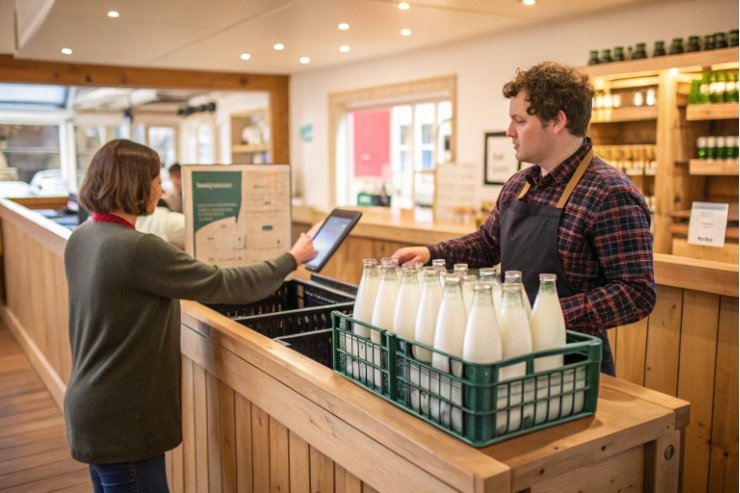
The basic model mirrors broader deposit refund schemes 5:
- The dairy sells milk in glass with a separate bottle deposit.
- The customer returns the empty when buying again.
- The deposit is refunded or credited against the next purchase.
This small extra payment:
- Gives customers a clear reason to bring bottles back.
- Reduces the number of bottles that disappear each cycle.
- Creates a visible loop in the customer’s mind: bottle out, bottle back.
For doorstep delivery and farm shops, the loop is even simpler. Customers leave empties on the doorstep or drop them in a crate, and the driver or clerk handles the rest.
Economics of a reusable asset
From the dairy’s perspective, each bottle is like a small piece of equipment. It has:
- A purchase price.
- A useful life measured in cycles.
- An expected loss rate from breakage and non-returns.
The goal is to keep the total cost per cycle lower than the cost of continuous single-use packaging.
Simple cost logic:
| Factor | Single-use plastic/carton | Refillable glass bottle |
|---|---|---|
| Unit packaging cost | Paid every fill | Paid once, amortized over many fills |
| Transport cost | Lower per trip (lighter) | Higher per trip (heavier) |
| Return logistics | None | Extra route organization |
| Washing cost | None | Ongoing (water, energy, detergent) |
| Brand value per unit | Limited | High (bottle as permanent brand asset) |
Well-designed deposit systems help keep:
- Loss rates low
- Bottle pool size stable
- Capital tied up in glass at a manageable level
Without deposits, the bottle pool would constantly shrink, and the dairy would spend much more on new glass.
Routes and distance: where glass works best
Heavy, reusable glass works best in short, dense loops—often where distribution distances stay local 6:
- Local dairies delivering within a defined region.
- Farm shops and regional supermarkets that return crates on full truck runs.
- Urban doorstep services that hit many customers per route.
Over long distances, the transport penalty of glass starts to hurt. This is why national brands often prefer lightweight plastic or cartons, while local brands lean into refillable glass.
From my own discussions with dairies, the breakeven point often appears when:
- The dairy controls its own routes.
- The same trucks handle delivery and collection.
- Bottles move quickly between fill, sale, return, and wash without sitting idle.
In those conditions, deposit and return become a stable, predictable system, not a romantic dream.
Are transparency and nostalgia key brand assets?
Even if many people cannot explain the technical benefits, they react strongly to a row of glass milk bottles. It feels fresh, honest, and a bit like childhood.
Yes. Transparency and nostalgia are powerful assets: glass lets shoppers literally see freshness, while the “old-school milkman” image helps local dairies charge a small premium and stand out from anonymous mass-market packs.
Seeing what you buy
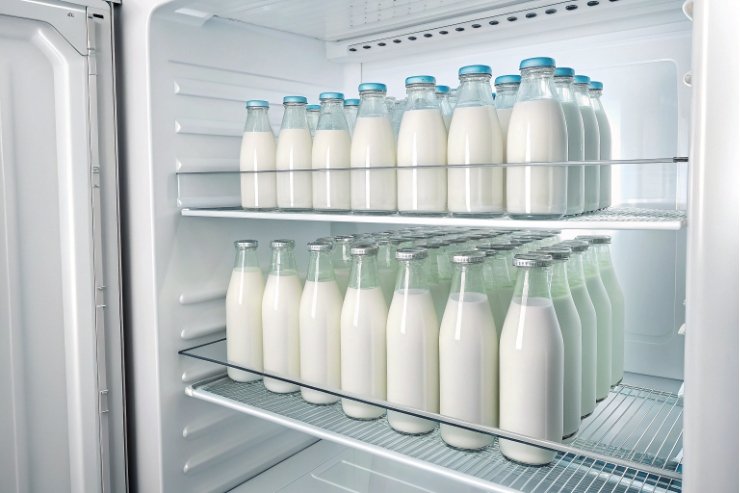
Clear glass gives customers instant information:
- Color and opacity of the milk
- Cream line on non-homogenized products
- Any separation or sediment
This visible honesty supports claims like “nothing added” or “minimally processed”. Cartons and opaque jugs cannot do this. They ask customers to trust printed words only.
In chillers and farm shops, transparent bottles also:
- Catch light and stand out against cardboard and plastic.
- Create tidy, uniform blocks of white that read as fresh.
- Help staff spot low stock and rotation issues at a glance.
For premium or organic milk, that visual difference matters. It turns a basic commodity into something more like a specialty product.
Nostalgia as a real business tool
The image of clinking bottles on a doorstep or in a wire basket has real emotional weight. Brands use it to:
- Signal local farming and shorter supply chains.
- Tap into memories of “simpler” food systems.
- Distance themselves from anonymous industrial packaging.
On social media, glass bottles photograph very well. They show reflections, condensation, cream lines, and branding in a single frame. Many small dairies use this for free marketing: customers happily share photos of their deliveries.
In practice, this emotional connection can support:
- Slightly higher pricing vs plastic competitors.
- Stronger loyalty from customers who want to “support local”.
- Easier introductions of new products (cream, flavored milk, yogurt drinks) in the same bottle family.
Brand signaling across packaging types
If we strip away emotion and just list what each pack “says”, we get something like this:
| Package | Typical signal in shopper’s mind |
|---|---|
| Plastic jug | Cheap, everyday, mass-market |
| Carton | Practical, large brand, long shelf life |
| Glass bottle | Fresh, local, premium, nostalgic |
Glass is not automatically better, but it definitely speaks a different language. For dairies who want that language, transparency and nostalgia are not side effects. They are core brand tools.
Which closures guarantee hygiene and no-leak delivery?
Heavy glass and great milk are worthless if the bottle leaks in the crate or fails hygiene checks. Closures are the last, quiet piece that holds the whole system together.
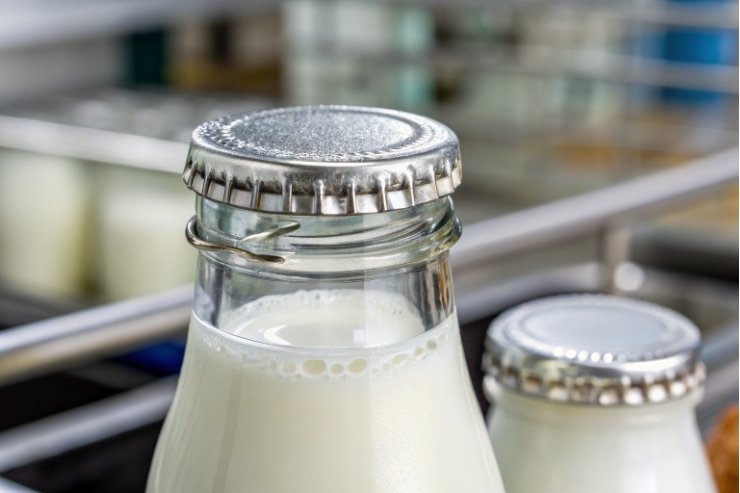
Modern glass milk bottles rely on tight-tolerance neck finishes plus either crimped foil caps or snap-on / screw plastic caps with liners, which together guarantee hygiene, tamper evidence, and leak-free transport.
Classic foil caps
Traditional glass milk bottles used (and still use) crimped foil discs:
- The foil sits on a small land inside or at the top of the neck.
- A machine crimps the edge of the foil around the rim.
- The disc must be torn or pierced to access the milk, giving clear tamper evidence.
Advantages:
- Simple, low material use.
- Easy visual check of integrity.
- Fully removable before washing (no complex disassembly).
Foil alone is more common in shorter-distance or doorstep models, where the bottle stays upright and handling is gentle.
Snap and screw caps
Many modern dairies combine foil with a plastic closure, or skip foil in favor of a more advanced cap. Common options:
- Snap-on LDPE or HDPE caps that fit over a neck bead.
- Tamper-evident screw caps with a breakable band.
These closures often include:
- An inner plug or liner that seats on the glass land.
- Designed venting behavior if there is pressure from mild temperature changes.
- Enough grip for customers to open and reclose the bottle easily.
They improve:
- Leak resistance during transport and handling.
- Hygiene, by giving a deeper mechanical barrier.
- Consumer convenience, especially when the bottle is stored on its side in a fridge.
Neck finishes and standards
To make these closures work, the bottle needs:
- Consistent outer diameter on the finish for snap or screw engagement.
- A smooth, flat sealing land for foil and liners.
- Controlled height so capping machines can apply proper force and torque.
Specs like Pasteurized Milk Containers, Closures and Packaging (IMS #22) 7 exist because these details make or break real-world hygiene and leak performance.
In engineering terms, tolerances on these dimensions matter as much as wall thickness in the body. Poor finishes show up as:
- Seepage rings under caps.
- Spoilage from micro-leaks and loss of cold chain.
- Damaged caps during application.
Hygiene controls and testing
Closures also drive the hygiene protocol:
- Caps and foils arrive pre-cleaned and sometimes pre-sterilized.
- Capping happens immediately after filling, usually in a controlled environment.
- Bottles are checked via leak tests, visual inspection, and sometimes torque checks for screw caps.
In refill systems, dairies often:
- Remove any remaining cap and foil before washing.
- Wash bottles completely open.
- Apply new closures only after the fresh fill.
This keeps no hidden “dead zones” where old milk or bacteria could hide between cycles.
A simple overview:
| Closure type | Seal quality | Tamper evidence | Typical use |
|---|---|---|---|
| Foil disc only | Good | Very clear | Short loops, doorstep delivery |
| Snap-on plastic cap | Very good | Sometimes yes | Reusable bottles, fridge storage |
| Screw cap with band | Excellent | Built-in band | Retail channels, longer transport |
Together, these systems ensure that glass milk bottles are not just charming, but also robust and safe in modern distribution.
Conclusion
Glass milk bottles keep their place because they do three jobs at once: they protect taste, make reuse economics work in local loops, and give dairies a visible, nostalgic brand asset that cheaper packs cannot copy.
Footnotes
-
Explains why glass packaging stays inert and flavor-neutral for foods and beverages. ↩ ↩
-
Details how glass preserves taste by being tasteless and odourless. ↩ ↩
-
Peer-reviewed study comparing milk flavor in glass, HDPE, cartons, and other packages. ↩ ↩
-
Reference for U.S. Grade “A” milk sanitation rules covering packaging, equipment, and handling. ↩ ↩
-
Clear overview of how deposits incentivize returns for reuse or recycling. ↩ ↩
-
Review showing when reusable bottles perform best, especially in short-distance local distribution loops. ↩ ↩
-
Specs for milk containers and closures, including tolerances and rinse tests used in dairy quality control. ↩ ↩






