
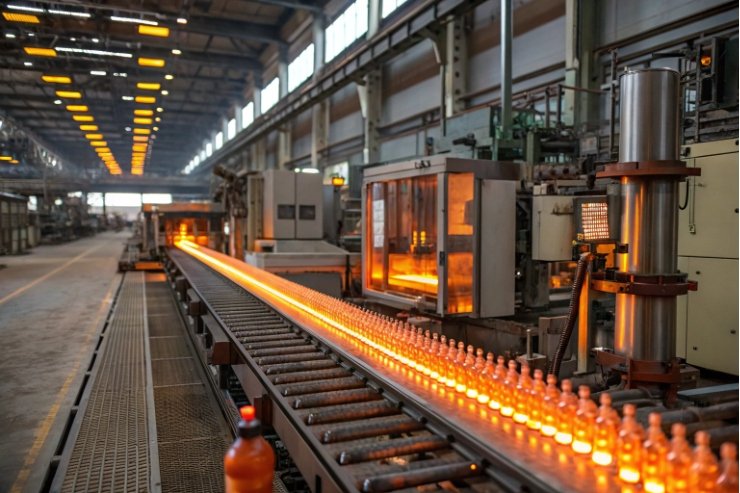
Most people see the finished bottle on the shelf and think “design.” In reality, it is the end of a very strict industrial process.
Glass perfume bottles start as molten gobs, become parisons in blow-blow or NNPB molds, pass annealing and hot-/cold-end coatings, then receive décor and rigorous QA before any fragrance touches them.
When you understand each step, you can talk to factories with confidence, ask the right questions, and design bottles that are both beautiful and easy to produce at scale.
How do blow-blow and NNPB shape parisons into perfume bottles?
If the gob is wrong or the parison is bad, no decoration will ever save the bottle.
Blow-blow and NNPB both turn molten gobs into parisons, then into final bottles, but they control wall thickness differently and limit what shapes and weights are realistic for your perfume project.
From raw glass to gob: getting the starting point right
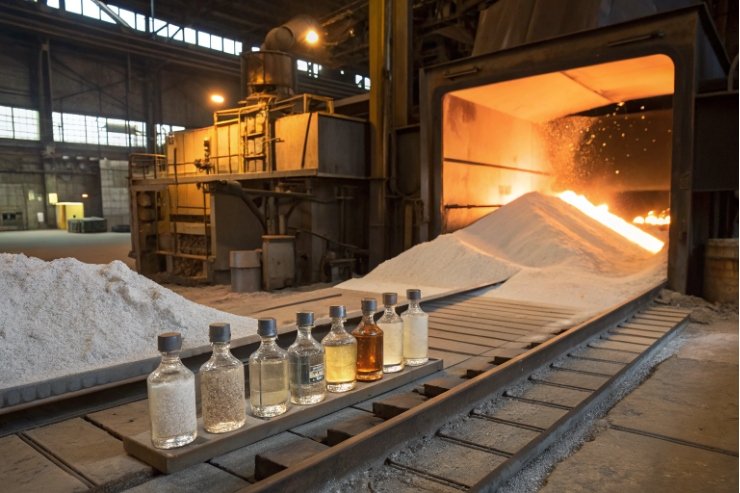
Behind every “luxury” bottle there is a very simple recipe:
- sand, soda ash, limestone and cullet 1 for the base glass.
- Cullet (recycled glass) to improve melt efficiency and cut energy.
This batch melts in a furnace at high temperature until it becomes a uniform molten pool. From there, feeders cut it into gobs of very precise weight. For perfume, that weight might be surprisingly high compared to the small volume, because thick bases and faces are part of the luxury look.
The gob is the first real spec you feel as a brand owner: it fixes bottle weight, cost, and energy per piece. If your design asks for a heavy base or thick shoulder, you are really asking for a heavier gob.
Blow-blow: classic method with robust forming
Most perfume bottles are formed on an Individual Section (IS) machine 2, where each section repeats the same forming cycle at high speed.
In blow-blow, the gob drops into a blank mold:
- A small “settle blow” or counterblow pushes glass into the corners, forms the neck, and creates the parison cavity.
- The parison is then transferred to the blow mold.
- Final air blow expands it into the finished shape.
For perfume:
- Blow-blow handles many narrow finishes and simple shapes well.
- It works for thick, chunky bottles where weight matters more than extreme wall control.
- But fine edges, sharp facets, or extreme lightweighting are harder to control.
Wall distribution in blow-blow is mainly driven by gob temperature, gravity, and timing. This can create thicker zones in the shoulder or base, which might be fine or even desired in a heavy, sculptural perfume bottle.
NNPB: narrow-neck press-and-blow for better wall control
NNPB (narrow-neck press-and-blow) is more precise, and is designed to improve glass distribution in narrow finishes—see this overview of the narrow neck press and blow (NNPB) process 3.
- The gob drops into the blank mold.
- A plunger presses glass into the blank, shaping the internal bore and pushing glass into key areas.
- The parison transfers to the blow mold for final blowing.
For perfume and cosmetics, this brings clear benefits:
- Better wall uniformity, especially around shoulders and corners.
- Reduced glass weight for the same performance.
- More repeatable thickness for complex shapes.
Many high-end perfume bottles, especially those with strongly defined corners or long, slim necks, lean toward press-and-blow or NNPB style forming, because design relies heavily on sharp details and controlled reflection.
Where custom molds change the game
No matter which forming route you choose, the mold set is what turns a gob into “your” bottle:
- Engraved shoulders and faces for facets.
- Embossed or debossed logos.
- Custom punts and base engravings.
The mold design must respect the rules of glass flow. Very sharp corners, deep pockets, and aggressive undercuts can cause thin spots or trapped air. Good engineers gently “soften” these areas inside the mold while keeping the outer silhouette as close to your design as possible.
For custom perfume projects, this step is often where expectations and reality first meet. Once you see how the parison is formed, you understand why some extreme 3D ideas are risky, and which shapes will run all year without headaches.
How do annealing and hot-/cold-end coatings prevent checks and scuff?
Fresh bottles look strong, but inside the glass they are full of tension. Add rough handling and you get checks and breakage long before filling.
Annealing removes internal stress, while hot-end oxide and cold-end lubricity coatings protect the surface from micro-cracks and scuff, so perfume bottles survive decoration, filling, and shipping.
Annealing: slow cooling so glass can relax
Right after forming, bottles are very hot on the surface and cooler inside. If we let them cool in open air, the outside would shrink faster than the inside and lock in high stress. That stress later shows as:
- Checks (small cracks) around the neck and heel.
- Sudden shattering from a small knock or thermal shock.
- Breakage during decorating ovens or hot-filling.
To avoid this, bottles pass through an annealing lehr 4:
- They reheat to a controlled “soak” zone where stress can relax.
- Then they cool down in a slow, controlled curve.
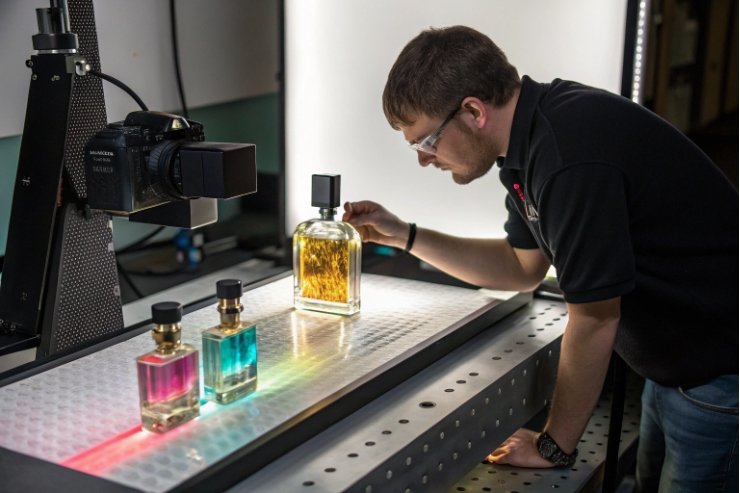
This process lowers internal stress to safe levels. Many factories check this with a polariscope, which shows stress patterns as bright colors. Smooth, balanced colors mean a healthy, stable bottle.
Hot-end coatings: thin oxide armor
Just after forming, while the glass is still very hot, bottles pass through hot-end coating hoods. A vapor of tin or titanium compound hits the surface and forms a very thin oxide layer.
This helps by:
- Increasing surface strength and resistance to scratching.
- Providing a better base for cold-end polymer and later decoration.
- Reducing damage when bottles touch molds and each other early in the process.
You never see this layer with the naked eye, but it is a big reason why modern bottles carry heavy decoration, labeling, and travel without turning cloudy from tiny scratches.
Cold-end coatings: controlling friction and scuff
After annealing, bottles go through a cold-end coating station. Here, a fine mist of polymer—often polyethylene or stearate-based—is applied.
This layer:
- Reduces glass-to-glass friction on conveyors and in cartons.
- Limits scuff marks on shoulders, edges, and label panels.
- Helps bottles pass through high-speed filling and packing lines without cosmetic damage.
Because these surface treatments work as a system, it helps to review how hot-end and cold-end coatings 5 interact across forming, lehr exit, and downstream handling.
Coatings vs decoration
The coating system also affects how later decorations behave:
- Screen printing, spray lacquers, and foils need a clean, predictable surface.
- In some lines, parts of the cold-end layer are removed or activated (flame, plasma) before decoration to get better adhesion.
The balance is simple: enough coating for protection, but not so much that labels or inks peel. When that balance is right, checks and scuff stay rare, even after the full decoration and filling journey.
Which decorations come last: ceramic inks, lacquers, foils, plating?
The forming and annealing steps create the “raw” bottle. Decoration is where the brand personality appears.
Decoration comes after forming and annealing and often after coatings: options like ceramic inks, spray lacquers, hot stamping foils, and metallization build tiers of effect, each with different cost, durability, and recycling impact.
Core glass and permanent embossing
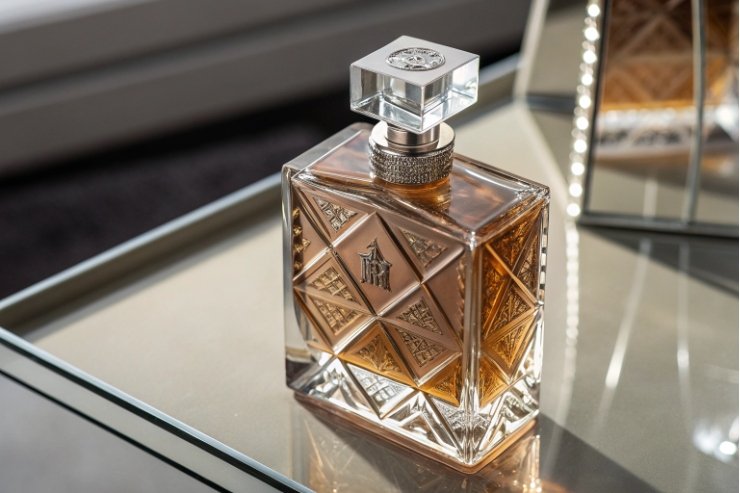
The most durable identity is built into the glass itself:
- Embossed or debossed logos on shoulders, faces, or the base.
- Unique silhouettes and base profiles.
These elements survive long after labels and paints are gone. They do not peel and they stay readable through the bottle’s whole life, including possible reuse.
Ceramic inks and enamel
Ceramic screen printing (ACL) uses inks with glass frits—often described as Applied Ceramic Labeling (ACL) 6:
- Inks are printed directly onto the bottle.
- Bottles go through a furnace where the frit softens and fuses with the glass surface.
Result:
- Very high chemical and abrasion resistance.
- Ideal for small logos, legal text, or long-life branding on refillable packs.
Colors tend to be solid and slightly more “enamel-like” than ultra-bright neon, but for many perfume brands, this matches the luxury image.
Spray lacquers and special effects
Spray coatings allow:
- Full-body color, soft gradients, or partial fades.
- Matte, satin, or high-gloss finishes.
- Soft-touch or velvet-like feelings.
Process outline:
- Bottles are pre-cleaned and often flame- or plasma-treated.
- Color lacquer is sprayed in a controlled booth.
- Bottles pass through a drying or curing oven (thermal, IR, or UV).
These coats add strong visual impact, but must be compatible with:
- The hot-/cold-end system.
- Any later printing or foil.
- The thermal limits of the glass and previous coatings.
Hot stamping, foils, and metallization
For metallic elements:
- Hot stamping transfers metallic foil into selected areas (logos, borders) with heat and pressure.
- Metallization (for example vacuum-deposited aluminum) can coat the whole bottle or defined zones, then sometimes overcoated with clear lacquer.
These methods give strong “jewelry” effects:
- Gold, rose gold, chrome, and many metallic shades.
- Mirror looks or gradient metallic.
They are usually among the last steps in decoration, because they can be damaged by later oven cycles or contact.
Decoration sequence in a typical project
A common order looks like:
- Forming and annealing.
- Hot-end and cold-end coatings.
- Surface prep (washing, activation).
- Ceramic print or screen inks if used.
- Spray lacquer / color coats and cure.
- Hot stamping and selected foils.
- Final inspection and packing.
You can change the order in special cases, but every change needs tests. Each decorative layer must survive the next process without yellowing, cracking, or losing adhesion.
For perfume, it helps to decide early which decoration becomes “core” (always on every SKU) and which becomes “seasonal” or limited. That decision drives both cost and process design.
What QA tests sign off the perfume bottle output?
Even the most beautiful design must pass mundane checks before factories trust it with expensive fragrance.
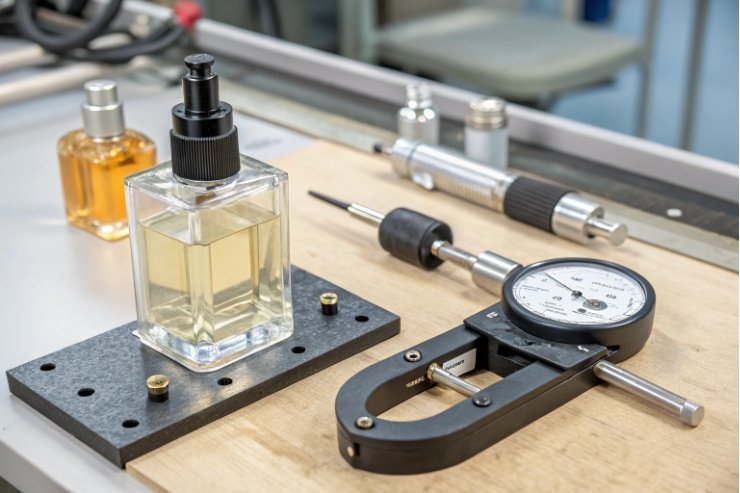
Quality assurance for perfume bottles covers dimensions, visual defects, impact and pressure tests, and thermal shock (ΔT), plus fit checks with pumps and collars, all under defined AQL plans.
Dimensional checks and finish control
First, QA verifies that bottles match the agreed drawing:
- Height, diameter, and body ovality so labels fit and cartoning works.
- Finish dimensions: thread diameter, bore, sealing land, and neck height.
- Brimful volume and overflow volume, especially for regulated sizes.
These are measured with gauges, calipers, and sometimes automatic measuring stations. For perfume, finish accuracy is critical; a few tenths of a millimeter can mean:
- Leaks under transport vibration.
- Pumps not seating correctly.
- Collars sitting crooked.
Visual inspection and AQL
Every batch is checked for cosmetic defects:
- Stones, blisters, long cords.
- Heavy seams, misaligned halves.
- Scratches, scuffs, or dull patches.
- Poorly formed embossing or deformed silhouettes.
Factories use both automatic inspection machines and human inspectors. Results are judged under AQL (Acceptable Quality Level) rules, often implemented via ANSI/ASQ Z1.4 7:
- Critical defects: usually zero allowed.
- Major defects: very low AQL (for example 0.4–0.65).
- Minor defects: slightly higher, within agreed limits.
Brands can tune these levels by price tier. A niche luxury line will often push for stricter cosmetic AQLs than a mass-market item.
Mechanical and performance tests
To confirm safe handling and transport, QA runs mechanical tests on sample bottles:
- Vertical load / top-load: simulated stacking pressure.
- Impact or drop tests: to estimate how the bottle behaves under shocks.
- Internal pressure tests if needed (less common for classic perfume, more for pressurized packs).
While perfumes are not carbonated, some brands still use tougher bottles so they can survive:
- Air shipping and handling.
- Retail mishandling and falls from low shelves.
Thermal shock (ΔT) tests
Perfume bottles face temperature changes:
- From cold storage or shipping to warm retail.
- From room temperature to ice-bucket, in some gifting or display cases.
Thermal shock tests expose bottles to a sudden temperature difference (ΔT). For example:
- Hot water, then cold water.
- Or the reverse, depending on the use case.
If the bottle breaks or checks under the planned ΔT, the design or thickness profile might need to be adjusted.
Pump, collar, and leakage tests
Finally, bottles are tested as a pack system:
- Pumps or sprayers are fitted with production torque or crimp profiles.
- Bottles are stored upright and on their side at different temperatures.
- Sprays are tested for consistency and feel.
This is less about the glass alone and more about the whole set: bottle + pump + collar + décor. Any leak, weep, or stain on coatings is a sign something in that system needs tuning.
A compressed QA table:
| QA area | Typical checks | Why it matters |
|---|---|---|
| Dimensions | Height, diameter, finish, volume | Line fit, closure compatibility |
| Visual | Scratches, stones, seams, color | Brand perception, luxury image |
| Mechanical | Top-load, impact, pressure (if needed) | Handling and shipping safety |
| Thermal shock | ΔT hot–cold transitions | Real-world temperature swings |
| System fit | Pump fit, leaks, spray pattern | Consumer experience, product loss |
When a batch passes these tests and meets the agreed AQL plan, the factory can release it to the filler with confidence.
Conclusion
Glass perfume bottles are not just “pretty containers”; they are engineered objects shaped by forming, annealing, coatings, decoration, and strict QA so your fragrance arrives intact and on-brand.
Footnotes
-
Explains standard container-glass ingredients and why cullet matters for efficient melting. ↩︎ ↩
-
Overview of IS machines that automate bottle forming from gobs in multiple sections. ↩︎ ↩
-
Details how the NNPB process improves glass distribution and enables lightweight narrow-neck bottles. ↩︎ ↩
-
Shows why controlled cooling in a lehr relieves stress and reduces cracking in formed glass. ↩︎ ↩
-
Explains how hot-end and cold-end coatings work together to reduce scuffing and improve handling. ↩︎ ↩
-
Explains how ceramic inks fuse into glass during firing, creating durable graphics that resist chemicals and abrasion. ↩︎ ↩
-
Defines the Z1.4 sampling system and how AQL plans set accept/reject rules for inspection. ↩︎ ↩






