
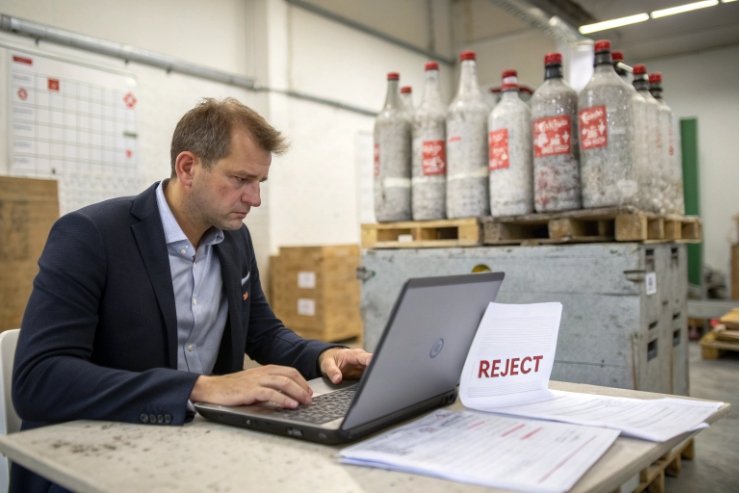
Choosing a glass bottle factory just on price looks easy, but one wrong choice can break bottles, delay launches, and hurt your brand for years.
To choose the best glass bottle manufacturer, check hard evidence: certifications, performance tests, custom-mold and closure support, realistic MOQs and lead times, plus audit results and real customer references.
When these pieces line up, you do not just buy glass. You lock in a packaging partner who grows with your products. Let us break the decision into four clear questions you can use as a checklist on any factory.
Which certifications and test reports prove quality?
Many suppliers say “high quality” and “food-grade.” Those words mean nothing until you see the documents behind them.
Look for ISO and food-safety systems, plus real test reports for drop, burst pressure, and thermal shock, all linked to the exact bottle design and color you plan to buy.
System certifications: proof the factory can repeat good work
A good bottle design is only the start. You also need the same quality every week.
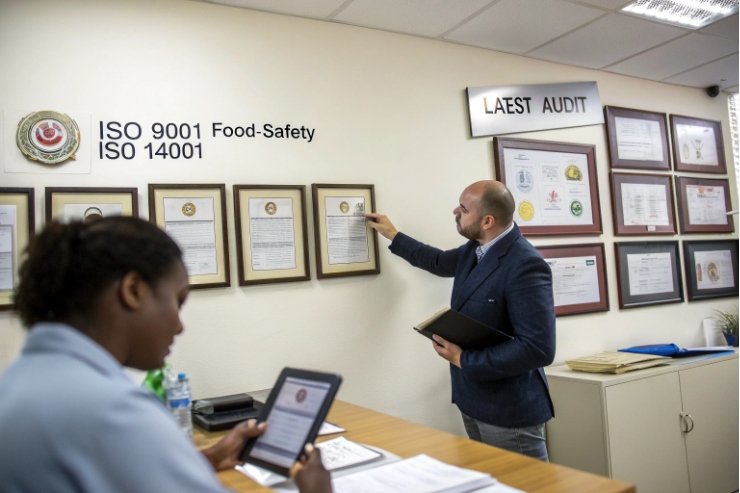
The best sign is a certified management system. At minimum, ask for:
- ISO 9001 for quality management (verify against the ISO 9001:2015 quality management systems standard 1).
- Food safety schemes such as FSSC 22000, BRCGS, or similar when bottles will touch food, beverages, or supplements (review the FSSC 22000 certification scheme 2).
- Environmental standards like ISO 14001 are a plus if your brand pushes sustainability.
Then look at compliance for direct contact:
- US: FDA food-contact compliance and heavy-metal limits.
- EU: EU Regulation (EC) No 1935/2004 for food contact materials 3 and related rules, including migration and lead/cadmium limits.
Ask for recent certificates, not ones that expired years ago. Check if the certification body is a well-known third party, not a local unknown name.
Performance tests: how strong and stable is the glass?
Real glass quality lives in numbers. At FuSenglass, we run these tests on every new bottle program, and you should expect the same from any serious manufacturer:
- Vertical top-load: how much stacking force the bottle can take on the filling line and in pallets.
- Internal pressure / burst test: critical for carbonated drinks, beer, sparkling wine, and some sauces (ask if they follow the ISO 7458 internal pressure resistance test 4).
- Thermal shock (ΔT): how much temperature difference the bottle survives between hot product and cooler environment or rinsing water (align to the ASTM C149 thermal shock resistance method 5).
- Impact / drop tests: simulate real handling and transport knocks.
- Annealing / strain check with a polariscope: shows if internal stress is under control after the lehr.
You want written test reports and clearly defined acceptance levels, not just a quick email that says “OK.”
Documents you should collect from every serious factory
| Document type | What it proves | What you check first |
|---|---|---|
| ISO / food-safety certificates | Stable management system | Valid dates and certifying body |
| Food-contact / heavy-metal reports | Safe for food, drink, cosmetics | Test lab, limits, and test methods |
| Burst / pressure test reports | Safe for carbonation or internal pressure | Minimum value vs your filling conditions |
| Thermal shock (ΔT) reports | Safe for hot-fill or rapid cooling | ΔT capacity vs your process temperatures |
| Top-load and impact test records | Safe for handling, pallets, and conveyors | Values vs line design and pallet pattern |
Do they offer custom molds, decoration, and closure sourcing?
Standard bottles are fine for some products. For brands that want a stronger shelf presence, the bottle shape, color, and closure become part of the story.
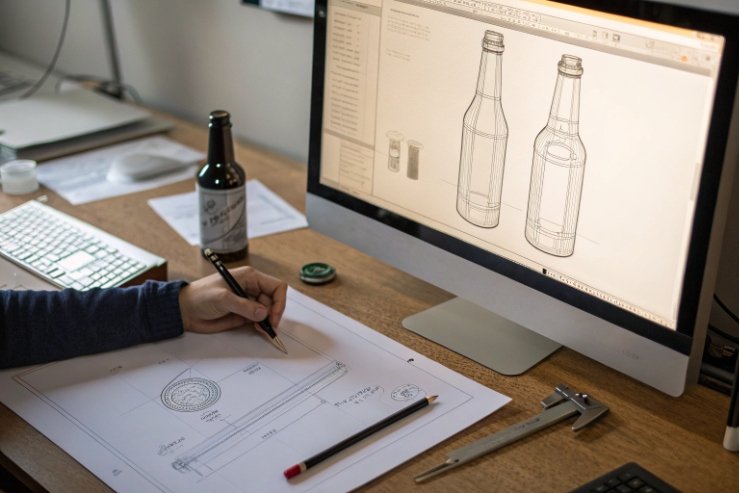
A good manufacturer can take a sketch to a custom mold, control decoration and label panel tolerances, and help you source matching closures that seal and look right.
Custom molds: from idea to stable production tool
Custom molds are where costs and delays often appear. So the process must be clear.
A mature factory will:
- Start with 2D drawings and 3D models, with exact capacity, brimful, height, and finish drawings.
- Share section views so you see glass thickness in shoulder, heel, and base.
- Offer rapid samples (pilot molds or 3D-printed mockups) before full set tooling.
- Discuss cavity count and which line will run your mold.
Clarify who owns the molds. In many projects, the customer owns the mold set, but the factory keeps it on site and handles maintenance. Set rules for:
- How often molds are cleaned and repaired.
- Who pays when a worn cavity needs replacement.
- How design changes are handled and what they cost.
This avoids surprise tooling invoices one year later.
Decoration and label-panel control
Decoration is only beautiful when the glass below is consistent.
Ask which decoration methods they support in-house:
- ACL / ceramic screen printing for long-lasting, dishwasher-safe prints.
- UV screen printing for fine detail and small runs.
- Hot stamping, decals, transfers for metallic or complex artwork.
- Spray coating, frosting, electroplating for color and surface effects.
- Embossing and debossing in the mold, for logos and text.
Decoration quality depends on good control of ovality and label panel runout. If the body is too oval or twisted, labels wrinkle, and artwork misaligns. Ask for typical tolerances and see real decorated samples, not only catalog photos.
Closure compatibility and sourcing support
The closure must fit the finish standard, or you will chase leaks and line stoppages.
Confirm:
- Finish standard: GPI / GCMI, ROPP, crown, cork, or special thread (use a shared reference for GPI / GCMI finish standards 6).
- Thread profile and dimensions on detailed finish drawings.
- Liner type: foam, plastisol, TPE, cork, or others.
- Tamper-evident features: bands, perforations, or shrink bands.
The best manufacturers help you run filling trials with your actual closures on your actual line. You can then measure:
- Application and removal torque.
- Seal integrity after hot-fill or pasteurization.
- Liner compression and any leakage.
Here a manufacturer with its own cap plant, or strong closure partners, saves you time. At FuSenglass, for example, many clients take bottle + closure + decoration as one package, to avoid “blame games” between different suppliers.
| Area | What to ask | Red flag |
|---|---|---|
| Custom molds | Ownership, maintenance, cavity count | Vague answers on who owns and repairs molds |
| Decoration | Methods, max colors, oven temp | No data on ovality or label-panel runout |
| Closures | Finish drawing, trial support, partners | “Any cap will fit this bottle” style claims |
What MOQs, tooling fees, and lead times fit your launch?
A factory can look perfect on paper but still kill your project with huge minimums or slow deliveries.
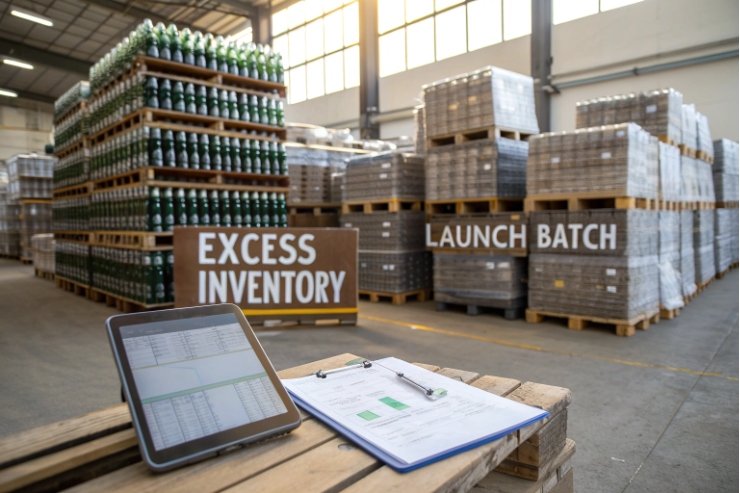
Match the manufacturer’s furnace capacity, MOQs, tooling fees, and typical lead times against your forecast so you do not overbuy or miss your launch window.
Align furnace capacity and MOQs with your volume
Glass is a continuous process. Furnaces and IS lines run nonstop. So factories need a minimum economic run for each design and color.
Key questions:
- Furnace tonnage per day and number of lines.
- Which lines run your bottle size and color.
- Minimum order quantity per run and per year.
- How often they can schedule your color (flint, amber, green, extra flint).
For a new brand, very high MOQs are risky. You do not want to sit on years of glass. Look for options like:
- Shared molds on standard shapes with custom decoration.
- Partial runs during color campaigns.
- Mixed-container loading if you need several sizes.
We often start small brands on standard flint or amber families, then move to full custom once sales data is stable.
Tooling and development costs: understand the full picture
Tooling fees are more than just “mold cost.”
You should clarify:
- Cost for full mold set (blank and blow molds, baffles, plungers).
- Any cost for design engineering and 3D modeling.
- Extra charge for engraved logos or cavity numbers.
- Fees and timing for design revisions after first trials.
Also agree on:
- Who holds the original drawings and CAD files.
- How many cavities must be active for you to hit your volume and AQL.
- Service level for mold repair if quality drifts.
All this should sit in a short tooling agreement. This protects both you and the factory and prevents arguments when you need a quick change for a new label claim or award logo.
Lead times, seasonality, and logistics
Lead time has three layers:
- Development: design, drawing approval, 3D model, and sampling.
- Tooling: making the molds, setting them up, and trial runs.
- Production and shipping: full run, packing, and transport.
Ask for typical weeks for each step, and then add safety for:
- Peak seasons (for example, Q2–Q3 for many beverage projects).
- National holidays in the producer country.
- Sea freight or rail schedules if you import.
For repeat orders, ask for:
- Standard lead time from purchase order to shipment.
- Emergency capacity rules.
- Stock options close to your market if you need fast call-offs.
A simple planning table helps line up your launch:
| Stage | Typical range (example) | What you should confirm |
|---|---|---|
| Concept to final drawing | 1–3 weeks | Number of design rounds included |
| Sample molds and first parts | 3–6 weeks | Number of sample iterations and shipping method |
| Full mold build | 4–8 weeks | Tooling lead time in busy season |
| First mass run | 1–2 weeks | Minimum run size and line speed |
| Ocean freight + customs | 4–8 weeks | Incoterms, port, and buffer stock plan |
How do audit results and references confirm reliability?
Many buyers stop at price lists and samples. The real test is how the factory runs on a normal day when nobody is watching.
Use audits, trial runs, and customer references to test if a manufacturer keeps promises on quality, delivery, and problem-solving, not just in the first order but over years.
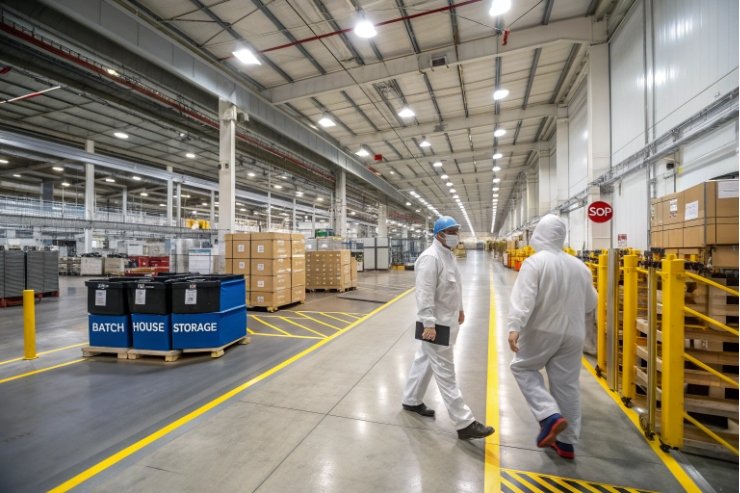
Factory audits: what you should see on the ground
If you can visit, even once, it gives you a clear picture.
Walk through:
- Batch house and raw material storage. Are materials dry, labeled, and tracked?
- Furnace and forehearth area. Is there clear control of temperature and color?
- Forming area. Are operators trained, with clear work instructions at each line?
- Annealing lehrs. Is there recorded temperature control and belt speed logs?
- Cold-end inspection. Do they use 100% automatic vision inspection for critical defects like cracks, blisters, and stones?
- QC lab. Do you see real testing gear for top-load, burst, ΔT, and dimensional checks?
You do not need to be an engineer to spot big issues. Dirty floors, poor lighting, and random piles of pallets are strong early warning signs.
If a visit is not possible, ask for a remote audit with photos, videos, and document review. Many of our overseas clients start this way.
First-article approval and ongoing quality data
Before full production, insist on a first-article inspection (FAI) or PPAP-style package:
- Full dimensional report vs drawing.
- Top-load, burst, and ΔT results.
- Visual defect rate data with AQL levels.
- Polarscope pictures for strain.
For mass runs, ask what AQL they use for critical, major, and minor defects. Also ask if they monitor key features (like finish diameter, weight, and height) with SPC and talk about Cp/Cpk—use a shared reference like Cp/Cpk process capability 7. If they can speak about capability in simple terms, it shows they watch trends, not only reject after the fact.
References and reliability history
Finally, ask for references from customers in a similar segment:
- For example, a craft spirits brand if you are launching a new whiskey.
- A cosmetic brand if you buy for skincare.
- A food brand if you pack sauces or honey.
Good questions for references:
- How often do you see quality issues, and how fast are they fixed?
- How is on-time delivery performance?
- How did the manufacturer handle the biggest problem you had together?
Also listen for what they do not say. If a reference hesitates, or refuses to talk about current volumes, there may be a reason.
From our side as a manufacturer, we always invite new clients to start with a smaller project, review the first run together, and only then scale up. That way both sides see how we work under real pressure.
| Evidence type | What it tells you | Warning sign |
|---|---|---|
| Audit report | Process control and housekeeping level | Many open nonconformities, no deadlines |
| FAI / PPAP pack | Real performance vs drawing and specs | Only visual approval, no test data |
| Long-term customer | Stability and problem-solving over years | Only very new or very small references |
Conclusion
Choose a glass bottle manufacturer with strong certifications, proven test data, custom and closure support, realistic MOQs and lead times, plus clear audits and references that prove long-term reliability.
Footnotes
-
Official ISO page describing ISO 9001 requirements, scope, and certification relevance for repeatable quality. (↩︎) ↩
-
Explains what FSSC 22000 covers and how it aligns with GFSI-recognized food safety management. (↩︎) ↩
-
Primary EU regulation outlining rules for materials intended to contact food, including compliance responsibilities. (↩︎) ↩
-
Defines test methods for internal pressure resistance of glass containers used for carbonated beverages. (↩︎) ↩
-
Standard method for thermal shock testing of bottles/jars to match hot-fill, washing, and chilling. (↩︎) ↩
-
Practical guide to neck finish terms so closures and bottles match without leaks or cross-threading. (↩︎) ↩
-
Quick reference on Cp/Cpk capability metrics to judge whether a factory can hold tolerances over time. (↩︎) ↩






