
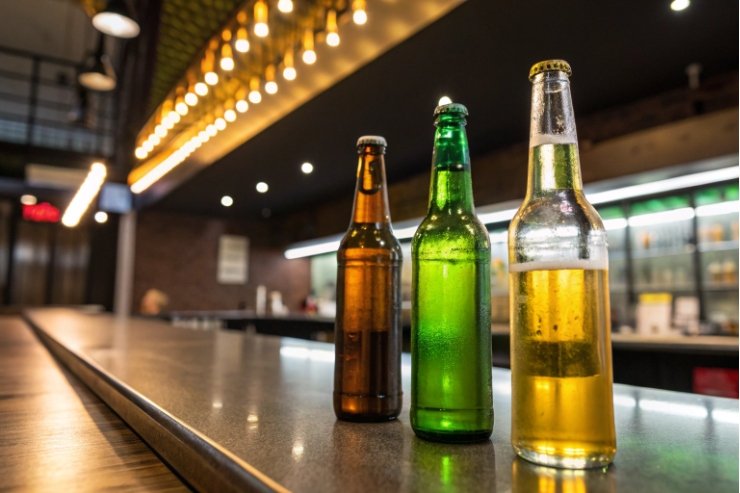
A perfect beer can turn “skunky” just from sitting in the wrong bottle under bright lights. That smell costs you flavor, money, and your customer’s trust.
Beer bottles are made from green or brown glass because dark glass blocks the UV and blue light that skunks beer, keeps hop flavor stable, supports reuse and recycling systems, and has strong branding value by style and region.
Color is not just a branding choice. It is a quiet piece of brewing equipment that keeps flavor safe from light. Once we see amber and green as part of the process, not decoration, the trade-offs become clear.
How much UV do amber and green beer bottles block between 300–450 nm?
Light-struck beer happens faster than most drinkers expect. A few minutes in strong light can twist hop aroma into a skunky smell.
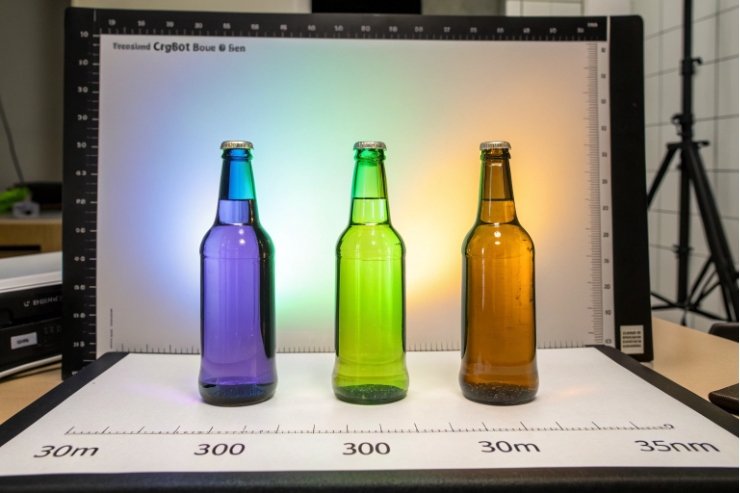
Across roughly 300–450 nm, amber glass blocks most UV and much of the blue band, while typical green glass blocks only part of it, so amber gives clearly stronger real-world protection than green.
Why wavelength matters for beer
The “skunk” problem is a wavelength problem: the lightstruck skunky off-flavour of beers exposed to light 1 is driven by UV and short-wave visible light energy.
UV and blue light in the 300–450 nm region carry enough energy to break hop bitterness molecules (iso-alpha acids). When these fragments meet sulfur compounds, they form 3-methyl-2-butene-1-thiol (MBT) 2, the classic light-struck culprit.
Below 300 nm, most light is already absorbed by air and glass. Above roughly 450 nm, energy drops and the risk of this specific reaction falls. So the key band is about 300–450 nm, with a big focus around UV-A and violet/blue.
If a bottle lets a lot of this light pass, the beer inside is on a short timer near a sunny window, glass-door fridge, or strong store lighting. If the bottle blocks most of it, the same beer can sit there much longer with almost no light damage.
Amber vs green: practical protection
No two glass recipes are identical, but there are useful patterns. Typical amber beer glass is very dense in the UV and blue range and can block most UV light below 450 nm 3. In practice, that means very low light-strike risk from normal shop and bar exposure.
Green beer glass helps, but not at the same level. It cuts a good share of UV, but more blue and some violet light still pass compared with amber. So the MBT reaction can still happen, just slower than in clear bottles.
You can picture it like this:
| Wavelength band | Clear flint glass (qualitative) | Green beer glass (qualitative) | Amber beer glass (qualitative) |
|---|---|---|---|
| 300–350 nm (UV-A) | Very high transmission | Strongly reduced, but not minimal | Very low transmission |
| 350–400 nm (near UV) | High transmission | Medium to low | Very low |
| 400–450 nm (violet/blue) | High transmission | Medium | Low |
So when someone asks, “Does brown glass really matter?” the answer is yes. It removes most of the light energy that would trigger MBT. Green takes the edge off, but it does not shut the door in the same way. That is why amber is the default choice for many hop-forward and long-shelf beers, while green often needs extra help from recipe choices or packaging rules.
What history and supply factors shaped green and brown bottle traditions by market?
If amber protects beer better, why do so many lagers still wear green bottles and still sell well?
Brown glass won on protection, but early raw materials and later shortages pushed some brands into green. Over time, markets learned to read green as “import premium” and brown as “fresh craft” or “classic local.”
Early glassmaking and “accidental” green
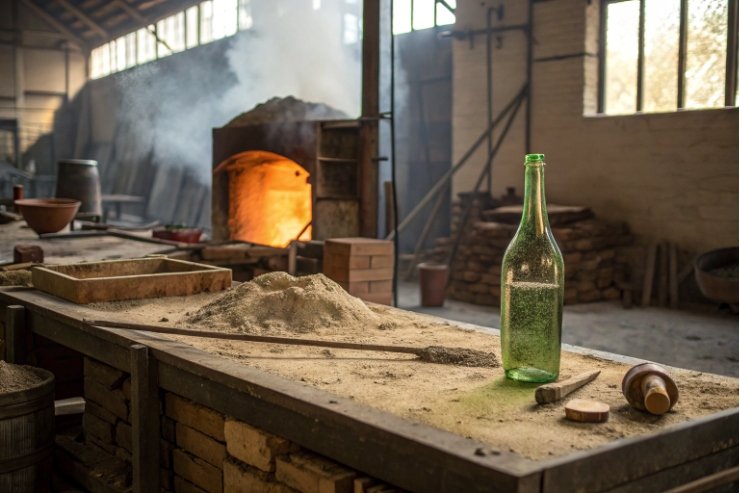
In early industrial glassmaking, perfect clear glass was hard. Bottles made from basic ingredients often came out green because of iron impurities in the sand 4. To reach flint-clear glass, factories needed better raw materials and decolorizers. To reach amber, they needed controlled colorants and more careful recipes.
So green was often the easy baseline. It tolerated more mixed cullet and raw material variation. That made it attractive in regions where glass plants focused on volume and cost. Brown (amber) needed more precise control, so it sometimes came with capacity limits or higher cost.
As brewing industrialized, both green and brown were in use, but brown slowly gained ground because brewers saw better flavor stability. When science later explained light-strike and MBT, it only confirmed what many had already seen in practice.
War, shortages, and “import green”
During major wars, especially around World War II, glass supply and furnace space were tight. In some regions, amber glass capacity was limited or redirected. Certain breweries that had once used brown glass shifted to green simply because that was what they could get at reliable volume.
Famous brands carried those green bottles out of the war years and into export markets. When drinkers in other countries first met these beers, the green bottle became part of the identity. In places like North America, “green bottle” began to mean “European import lager” in people’s minds.
At the same time, many domestic beers in the US moved into brown glass. Later, the craft beer wave also leaned heavily on amber bottles, because they protected hop flavor and fit the story of freshness and care.
Over time, these patterns solidified:
| Market / segment | Typical color reading |
|---|---|
| European “heritage” lager | Green = historic brand, continental style |
| North American craft | Brown = fresh, flavour-care, local |
| Mainstream domestic lager | Mix of brown and clear, brand-driven |
There is also a supply side. Some regions have strong green cullet streams from wine and other products. Using green beer bottles can absorb that cullet efficiently. In one-way systems, using more recycled glass (and more cullet to reduce furnace energy 5) is often the fastest lever to cut footprint. In returnable pools, the “best” option depends on how many trips you can reliably achieve—exactly why life cycle assessments of reusable glass bottles 6 focus so much on reuse rate and transport distance.
So today’s color traditions are part science, part supply, part path dependence. Brewers inherit these stories as much as they choose them.
When should brewers choose amber over green for better protection?
A brewer might love the look of green glass, but one angry review about “skunky” flavor can undo a lot of marketing.
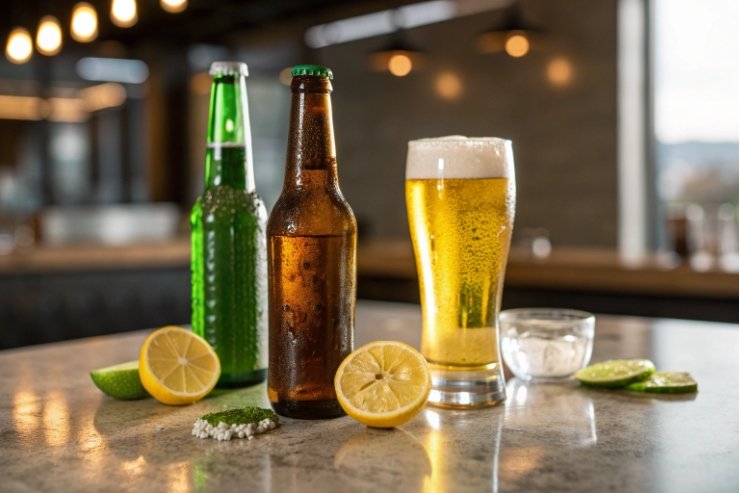
Brewers should choose amber when hop aroma or shelf time are priorities, when display lighting is strong, or when they do not use light-stable hop extracts. Green is a style and branding choice that needs extra protection.
Match color to beer style and route to market
The first question is style. Hop-forward beers and delicate aromatics are more vulnerable to light-strike. That includes:
- Pilsners and pale lagers with bright hop notes
- IPAs and dry-hopped ales
- Bottle-conditioned beers with long time in glass
For these, amber glass is the safe default. It lets the brewer focus on recipe and oxygen control, without fighting constant light damage in exposed shelves.
Green glass can still work for lighter, less hop-driven lagers, especially when bitterness is low and aroma is subtle. But even then, the route to market matters. A beer that goes into dark crates and cool cellars is different from one that lives in glass-door fridges and bright supermarket aisles.
We often walk brewers through a simple set of questions:
| Question | If answer is “yes” most of the time… | Packaging advice |
|---|---|---|
| Is the beer hop-forward or aromatic? | Yes | Favor amber |
| Will it sit months in mixed retail? | Yes | Favor amber or cans |
| Will it face bright, warm conditions? | Yes | Amber plus cartons, or cans |
| Is green part of brand history? | Yes | Consider green + recipe and pack tweaks |
If most answers point to risk, amber or cans are the clean answer. Green becomes a deliberate compromise, not an accident.
Recipe tweaks and extra protection when using green
Some big brands choose green so strongly that they redesign the beer around it. They use light-stable hop extracts 7 that avoid forming MBT under light. The result is a more light-proof beer that can tolerate less protective glass.
That approach works, but it changes the brewing toolkit. Not all breweries want or need to move into heavy extract use. Smaller brewers may prefer classic hopping and rely on amber to do the heavy lifting on light protection.
Extra secondary packaging also helps. Cartons, display cases, and shrink-wrapped packs can shield bottles from direct light until the final step. This works especially well for export, where sea containers and warehouses can add months to the journey.
So the rule we tend to follow is simple: if flavor and shelf life matter more than green glass branding, choose amber. If green is non-negotiable for identity, then adjust hops, packaging, and display rules so the bottle color does not keep hurting the beer.
Can sleeves or coatings really substitute for dark glass?
Many designers want clear glass for color and transparency, but brewers worry about skunking. Sleeves and coatings look like a way to have both.
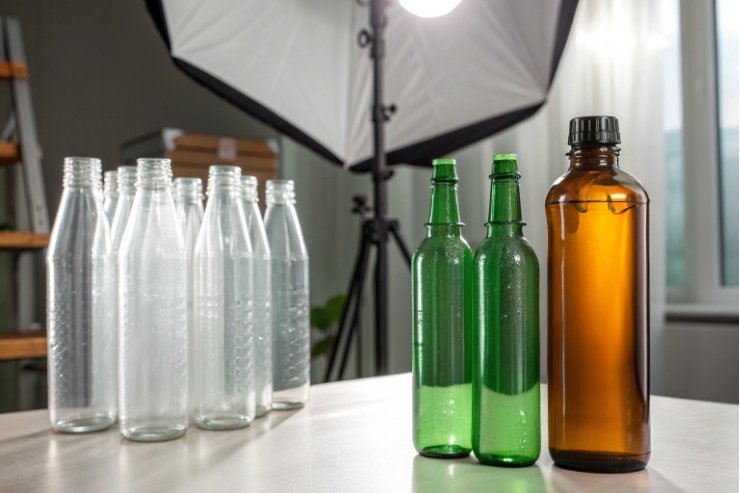
Full, opaque sleeves and high-coverage coatings can give strong light protection on clear or green glass, but they must be truly blocking, well-applied, and compatible with recycling and branding.
What sleeves and coatings actually do
Shrink sleeves, painted coatings, and printed films all sit outside the glass. They absorb or reflect light before it reaches the beer. If the artwork is dense and dark enough, they can cut UV and blue light to levels similar to amber glass.
But not all sleeves are equal. A mostly clear sleeve with some printed logos still lets a lot of light in. Metallic inks and opaque whites or blacks protect more. Multi-layer films with UV-absorbing layers protect even more, but they can be harder to recycle.
Coatings work the same way. A full-body opaque spray on a flint bottle can behave almost like a colored glass wall. A soft matte frost improves the look and diffuses light, but it does not guarantee deep UV blocking. In that case, you still rely on the base glass color.
| Solution | Light protection potential | Key watchpoints |
|---|---|---|
| Clear flint + transparent sleeve | Low to medium | Still high light-strike risk |
| Flint + dense printed sleeve | Medium to high | Coverage gaps, recyclability, cost |
| Flint + opaque spray coating | High | Coating quality, chip resistance, decoration cost |
| Amber glass + sleeve coating | Very high | Over-engineering unless brand needs full opacity |
When sleeves and coatings are “good enough”
In my work with brands, sleeves and coatings make most sense when:
- The marketing team really needs a specific solid color or pattern
- The beer style is somewhat sensitive, but not extreme
- Retail lighting is strong, and clear glass would be too risky
- The brand can justify the extra cost and think about recycling impact
For very light-sensitive, hop-driven beers, I still see amber glass as the cleanest starting point. A sleeve or coating on amber can create a dramatic effect and almost complete light blocking, but at that point we are adding protection on top of protection.
There is also a customer side. Many drinkers like seeing the beer color through at least part of the package. Full opaque sleeves remove that cue. Some brands solve this with “windows” in the design, but every window is also a light entry point. So there is always a trade-off.
So yes, sleeves and coatings can substitute for dark glass in many cases, if they are designed as true light shields and not just decoration. But if pure technical protection and simple recycling are the first goals, amber glass still does the job with less complexity.
Conclusion
Green and brown glass are quiet tools of brewing: they guard against light, support reuse and recycling, and help each beer look and taste the way the brewer intended.
Footnotes
-
Explains how UV/visible wavelengths trigger lightstruck reactions and off-flavors in beer. ↩︎ ↩
-
Peer-reviewed evidence identifying MBT as the key compound behind “skunky” light-struck beer aroma. ↩︎ ↩
-
Reference on amber glass filtering UV/blue light up to ~450 nm, improving protection for light-sensitive contents. ↩︎ ↩
-
Historical reference explaining why natural glass often appears green due to iron impurities in raw materials. ↩︎ ↩
-
Explains how using recycled glass cullet lowers melting energy and emissions in new glass production. ↩︎ ↩
-
LCA comparing returnable and one-way glass under different reuse rates and logistics assumptions. ↩︎ ↩
-
Overview of producing light-stable hop extracts and how they reduce skunking risk in greener or clearer packaging. ↩︎ ↩






