
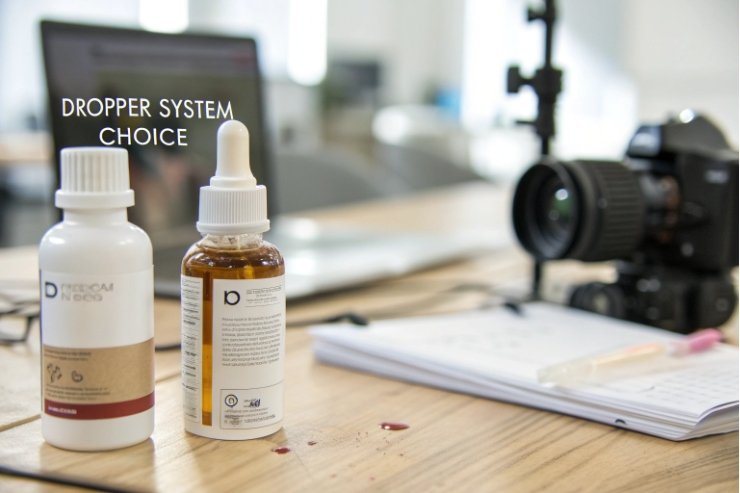
The wrong dropper can turn a perfect formula into a messy, leaky, one-star review machine.
To choose the right dropper system, match elastomers to your formula, size the pipette to the bottle and dose, lock the correct neck finish + liner for sealing, then add CR/TE features that fit your market.
Dropper selection is not “just a cap.” It’s a dosing device + a seal + a brand touchpoint. If any one of those fails, customers notice immediately.
1) Which bulb material is most compatible with your formula?
A beautiful bottle does not matter if the bulb swells, cracks, or develops off-odors.
Choose bulb material by compatibility first, then by feel: silicone for broad chemical resistance, TPE for mild formulas and cost, nitrile (NBR) for extra oil resistance and grip.
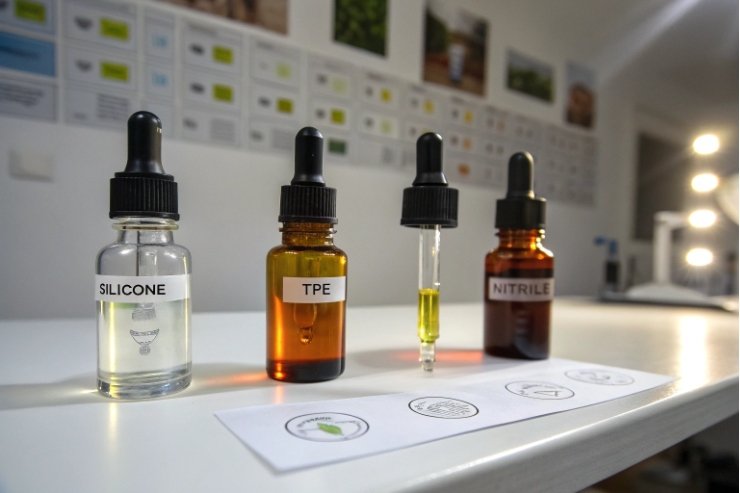
Practical compatibility guidance (what usually works)
-
Silicone
- Strong overall resistance to many essential oils and actives.
- Stays flexible across temperature swings.
- Watchouts: some solvent-heavy systems can still cause swelling; always run a soak test.
-
TPE (thermoplastic elastomer)
- Great soft-touch feel and cost balance.
- Best for water-based serums, glycerin blends, and mild oil blends.
- Watchouts: terpene-rich essential oils and some solvents can soften or stress it (different thermoplastic elastomer (TPE) grades 1 behave very differently).
-
Nitrile (NBR)
- Common choice where oil resistance is needed.
- Durable, good grip, “technical” vibe.
- Watchouts: not universal for all aggressive terpenes/solvents; verify with your exact formula (see nitrile rubber (NBR) properties 2).
Avoid natural rubber for terpene-rich oils whenever possible. It’s a frequent source of stickiness, swelling, and odor transfer.
Quick decision table:
| Bulb material | Biggest advantage | Biggest risk | Best fit |
|---|---|---|---|
| Silicone | Broad chemical resistance | Can feel slick; higher cost | EO blends, actives, demanding systems |
| TPE | Soft feel + cost | Grade-dependent compatibility | Mild serums, gentle blends |
| NBR | Oil resistance + toughness | Less “cosmetic” feel | Oil-heavy / functional products |
Minimum test to require: 2–4 week compatibility soak (ambient + warm), then check swelling, hardness change, odor, discoloration, and suction performance.
If you need a reference framework, base your protocol on ISO 1817 liquid-immersion testing 3.
2) How should pipette length, tip shape, and bore be matched to bottle and dose?
If the pipette is wrong, users waste product or stop believing your “X drops” guidance.
Size length so the tip reaches near the bottom without contacting it, select bore size for viscosity and target dose, and choose a tip shape that matches how the product is applied.
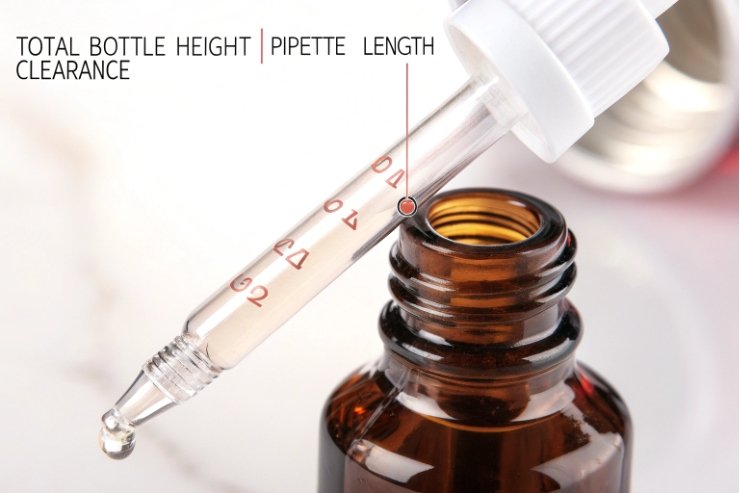
Length (avoid waste and breakage)
Target 1–3 mm clearance above the bottle bottom when fully closed:
- Too short → can’t pull a full draw as the bottle empties; visible “waste pool.”
- Too long → bottom contact, chipping risk, bent pipette, inconsistent draw.
Bore size (controls “feel” and dosing stability)
- Low viscosity (water-like): smaller bore to prevent sudden gushes.
- Medium oils: medium bore is usually comfortable and controllable.
- Thicker oils: larger bore (or users squeeze harder and over-dose).
If your product is “drop-counted,” don’t rely on generic rules. Validate by gravimetric dosing using a gravimetric analysis approach 4:
- Dispense 30–50 drops the way users will.
- Weigh, calculate average per drop.
- Confirm variation stays acceptable across temperature.
Tip shape (controls placement and hygiene)
- Fine tip: spot treatments, scalp, precise areas.
- Rounded tip: gentler for face/under-eye.
- Cut/flat end: better for dispensing into bowls, diffusers, or spoons.
Simple mapping:
| Product type | Viscosity | Dose style | Typical pipette choice |
|---|---|---|---|
| Water serum | Low | 0.2–0.5 ml draws | Small bore, rounded/fine tip |
| Face oil / EO blend | Medium | drops or partial draws | Medium bore, fine/standard tip |
| Hair/body oil | Med–High | 0.5–1.0 ml draws | Larger bore, rounded/cut tip |
| Tincture-style dosing | Low–Med | exact drops or 1 ml draw | Small–med bore, fine tip (graduations if needed) |
3) Which neck finishes and liners ensure a leak-tight seal?
The neck finish is the hidden interface that decides whether you fight leaks forever.
Pick one neck standard (DIN-18, 18/415, or 20/410) and buy droppers/liners designed for that exact finish—then control torque and validate with leak tests.
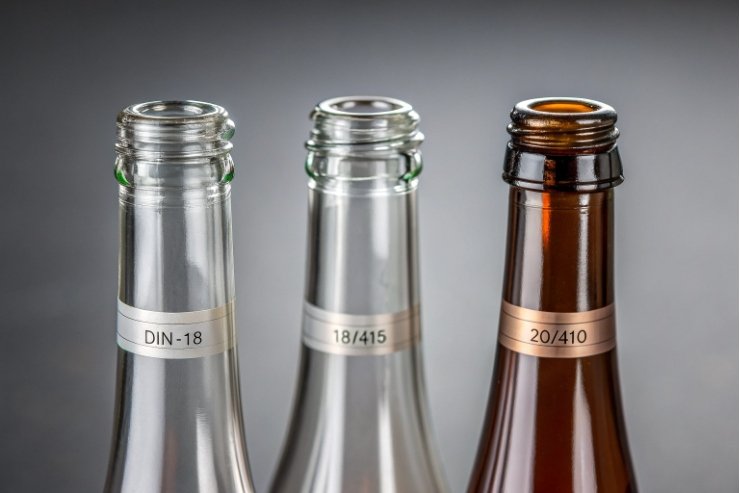
Don’t mix “almost compatible” parts
Even if a cap seems to thread on, mismatched finishes often create:
- weak thread engagement
- inconsistent liner compression
- micro-leaks during vibration/temperature cycling
DIN finishes trace back to standardized geometry work by DIN (Deutsches Institut für Normung) 5, which is why “close enough” parts often fail in real shipping.
Liner selection (small part, big consequences)
Common liner families:
- Foam / PE liners: economical, fine for many mild systems.
- Polycone / cone liners: strong sealing; great for leakage control.
- PTFE-faced / laminated liners: best chemical resistance for demanding oils/solvents.
Rule of thumb: the more aggressive the formula (terpenes/solvents), the more you should lean toward polycone or PTFE-faced designs—after confirming compatibility.
Torque + leak testing (non-negotiable)
Set a torque window and confirm it stays stable:
- Too low → caps back off, evaporation and weeping.
- Too high → liner deformation, neck chipping, poor open feel.
For a repeatable method, align your SOP with cap closure and removal torque testing 6.
Basic leak protocol:
- Upright + side + inverted (24–48h)
- Ambient + warm condition (e.g., 40°C exposure for stress)
- Inspect for ring marks, damp cartons, odor loss
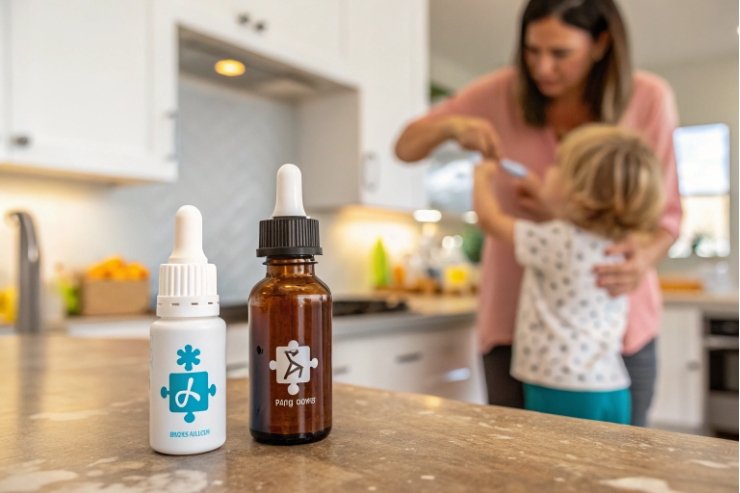
4) Do you need child-resistant or tamper-evident features?
Safety features change cost, tooling, UX, and sometimes channel access.
Decide early whether CR (child-resistant) and TE (tamper-evident) are required or strategically useful—then design the whole system around it.
When CR/TE matters most
- Home-use products with ingestion risk (supplements, tinctures, potent oils)
- Markets/retailers that expect stronger safety signaling
- Products that ship widely via e-commerce (tamper trust matters)
In the U.S., many child-resistant expectations connect back to the Poison Prevention Packaging Act (PPPA) 7.
CR typically adds:
- higher unit cost, more parts/complexity
- tighter tolerances and more QC points
- additional certification/testing requirements (varies by market)
TE options include:
- break rings, tear bands, shrink bands/sleeves, or TE euro-dropper systems
A fast “specifier” decision path
1) What is the formula? (solvents/terpenes/pH/viscosity)
2) How will users dose? (drops, partial draw, full 1 ml draw)
3) What neck standard is your family? (DIN-18 vs 18/415 vs 20/410)
4) What seal system is safest? (liner type + torque window)
5) Do you need CR/TE? (channel + risk + region)
6) Validate with tests (compatibility soak + leak + cycle life + transit)
Supplier/QC checklist you can copy-paste
- Elastomer: material + grade, hardness (durometer), and compatibility notes
- Pipette: length, bore ID, tip finish, and breakage protection in packing
- Neck finish: drawing reference + critical dimensions + tolerance control
- Liner: material stack (e.g., PE, TPE, PTFE-faced), compression behavior
- Torque window: target + test method + retention check after aging
- Tests: compatibility soak, leak (all orientations), cycle life (squeeze count), hot/cold stress, transit simulation
Conclusion
The “right” dropper system is the one that survives your formula, delivers the intended dose, seals reliably through shipping, and matches your safety and brand requirements—without surprises at month three.
Footnotes
-
Overview of TPE structure and properties to understand why grades differ in solvent and oil resistance. ↩ ↩
-
Quick reference on NBR composition and oil resistance traits for selecting dropper bulbs. ↩ ↩
-
Standard method for rubber/liquid immersion testing; useful for designing compatibility soak protocols. ↩ ↩
-
Explains gravimetric analysis principles—useful for weighing dispensed drops and calculating average dose per drop. ↩ ↩
-
Background on DIN and its standards work; helpful for understanding DIN-18 terminology and cross-supplier compatibility. ↩ ↩
-
Practical guidance on measuring application and removal torque to set a repeatable torque window and prevent leaks. ↩ ↩
-
U.S. regulatory foundation for many child-resistant packaging expectations; useful when deciding if CR is required. ↩ ↩






