
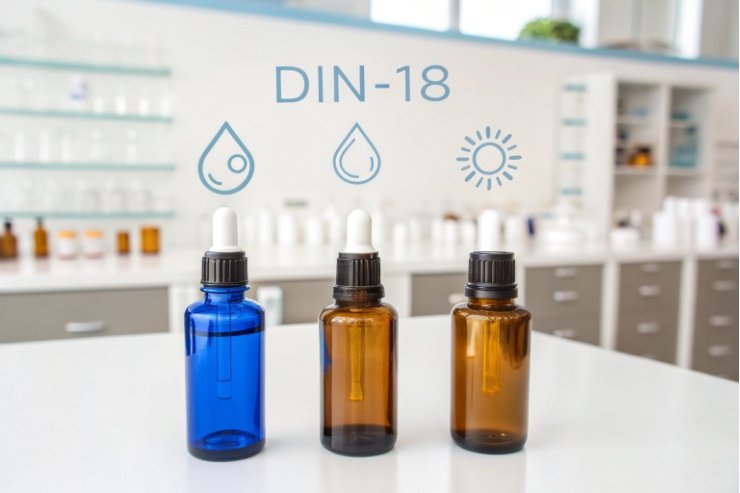
Most essential oils do not “go bad” overnight. They slowly flatten, oxidize, and discolor in the wrong bottle, and you only notice after customers start complaining.
Amber and UV-protective glass offer the strongest light protection for essential oils; cobalt is more about branding. For real shelf life, combine dark glass with small volumes, tight closures, and cool, dark storage.
Color is not the only protection layer. It works together with glass thickness, bottle size, DIN-18 droppers, labels, and the storage plan. Once these pieces align, your oils age slower, smell cleaner, and survive transport and retail light much better.
Amber vs. cobalt: which blocks more UV to protect terpenes and aromatics?
Many brands pick cobalt blue first because it looks pretty on Instagram. Then citrus and top-note blends start turning dull under shop lights.
Amber glass blocks more UV and short blue light than cobalt, so it protects terpenes, color, and top notes better, especially for long storage and high-natural or citrus-heavy blends.
What light actually does to essential oils
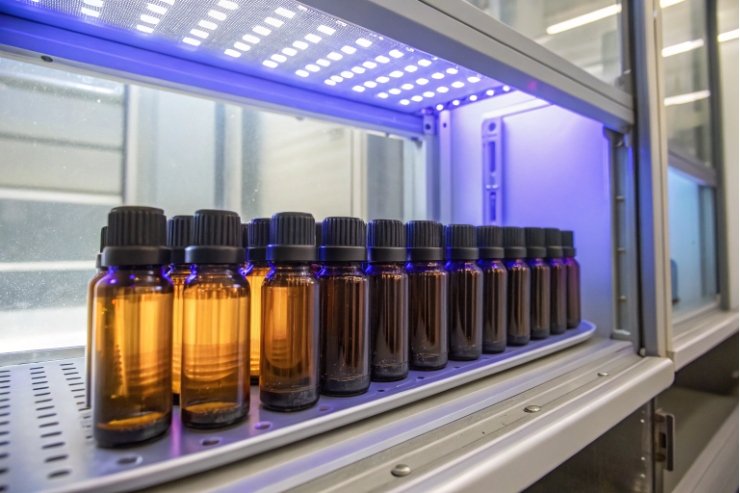
Essential oils and aromatic blends carry many delicate molecules: limonene, linalool, pinene, and more. Under UV and strong blue light, these can:
- Break into smaller fragments
- Oxidize into harsher, “old” smelling notes
- Form sensitizing oxidation products 1 that raise irritation risk
So the goal is simple: reduce short-wavelength light reaching the liquid.
Why amber wins on protection
Amber glass is loaded with iron and sulfur colorants that absorb UV and part of the visible spectrum. If you want a practical reference point for why amber packaging is widely used for light-sensitive contents, review this amber-bottle light-transmission datasheet 2. In practice:
- It blocks most UV-B and UV-A
- It cuts a lot of blue and violet visible light
- It still lets enough light through so you can see fill level and rough color
Cobalt glass uses cobalt oxide. It looks strong, but it behaves differently:
- It absorbs some UV and red, but its blue transmission can stay high
- It often lets more total energy through than amber at the same thickness
- So it protects better than clear or green, but less than amber in many cases
A simple way to think:
| Glass color | UV / blue protection | Typical role |
|---|---|---|
| Clear flint | Very low | Only safe in full boxes or tins |
| Green | Low–medium | Short-term or decorative use |
| Cobalt | Medium | Good look, moderate protection |
| Amber | High | Default for serious EO protection |
For light-sensitive oils (citrus, conifer, fresh herb), amber is the safe default, especially for export and long shelf-life targets.
Using cobalt without sacrificing stability
If a line is already known for cobalt, you do not need to abandon it. You can reduce risk by:
- Keeping stock and backroom units in cartons, not on open shelf
- Using large, opaque labels or sleeves to cover most of the body
- Reserving cobalt for faster-moving blends, not niche slow sellers
This way you still enjoy the branding power of cobalt, but most of the oil’s life still happens in the dark.
Does opaque (black/white) sprayed glass outperform tinted glass for light-sensitive EOs?
When you see “black UV glass” or fully sprayed bottles, it feels like the strongest possible shield. The question is what you gain and what you give up.
Opaque and UV-coated glass can beat standard tints on light protection, especially for very sensitive or premium oils, but they may cost more, hide fill level, and complicate recycling in some regions.
Opaque vs. tinted: what changes in practice
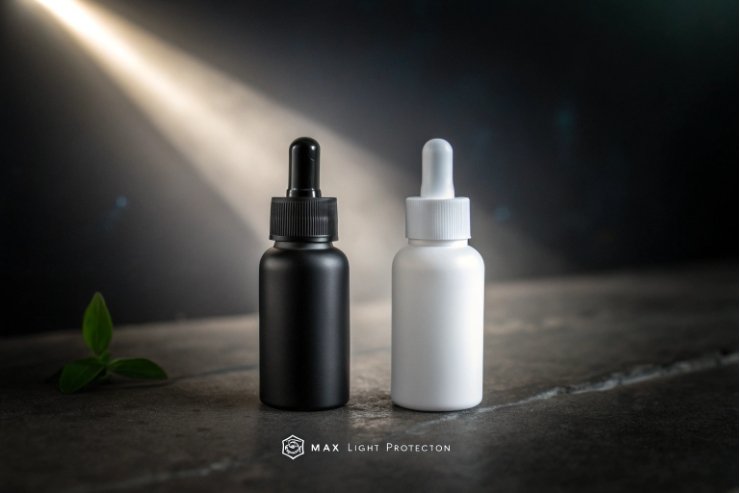
A fully opaque bottle (black or white) or a special UV glass has one big advantage: almost no light reaches the oil from normal directions.
This is useful when:
- You sell high-value, high-natural blends that sit long on shelf
- The market has intense store lighting or long shipping chains
- You want to promise longer shelf life without heavy storage rules
Compared with standard amber:
- Opaque bottles can cut more total light (including some that amber still passes)
- There is less risk of slow discoloration of pale juices
- You can hide minor color variations in PCR glass or high-herb blends
But you also lose some things:
- Customers cannot see fill level or natural juice color
- Staff cannot check sediment or clouding at a glance
- Some black/violet coatings can confuse optical sorters, and colour separation in glass recycling 3 becomes more important for high-quality cullet streams
So opaque is not an automatic “upgrade.” It is a specific tool.
When sprayed or coated glass makes sense
There are a few clear cases where opaque or high-UV glass makes sense:
- Photolabile blends with high citrus or conifer top notes that must stay bright
- Small-batch, high-price oils where any color shift feels unacceptable
- Markets with strong sunlight at retail, where even amber struggles over time
You can also use partial coatings:
- Gradient sprays that leave a clear “window” near the base
- High-coverage prints or sleeves that still keep at least a small view slot
- Inner coatings that tint the inside but keep the outside printable
This gives strong protection on most of the surface while keeping a bit of visual honesty.
Recyclability and cost trade-offs
Dark and opaque glass can be harder to sort in some recycling systems. Near-infrared (NIR) scanners may misread very dark or heavily coated bottles. That can:
- Lower effective recycling rates in some regions
- Clash with “easy to recycle” or “eco” claims if you are not careful
For design choices that keep luxury decoration compatible with real-world recycling, see this overview of recyclability in cosmetic glass packaging design 4.
On cost, opaque or special UV bottles often:
- Use more complex colorants or coatings
- Need extra QC for coating defects and scuffs
- Sit at a higher unit cost than standard amber
So the decision is about risk level vs positioning. For most core essential oils, good amber plus cartons is enough. For “hero” SKUs or very unstable blends, opaque or UV glass can be a smart premium move.
Which color balances shelf life with visibility and regulatory labeling needs?
It is nice to protect the oil, but a bottle that hides everything can slow sales and complicate labeling. You still need a front panel that reads well and looks trustworthy.
Amber glass usually gives the best compromise: strong light protection, acceptable visibility of fill and color, good contrast for labels, and strong acceptance in recycling streams.
What you must show on the bottle
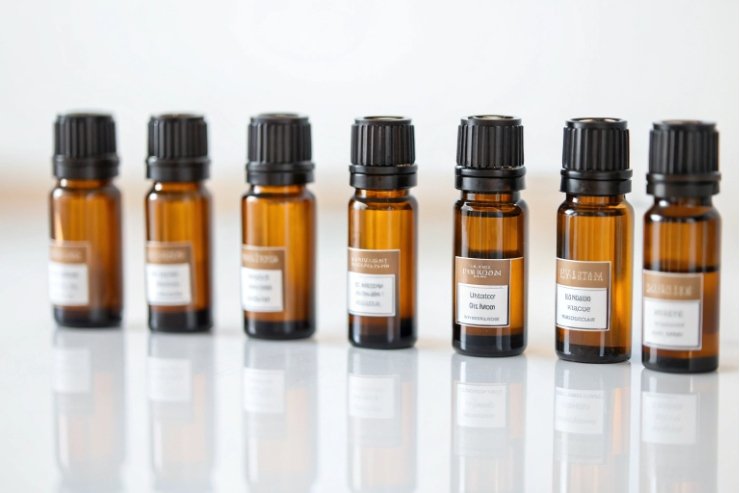
Regulations and retailers expect:
- Brand and product name
- Ingredients or INCI, usage and safety warnings
- Net volume, batch or lot, sometimes origin and allergen notes
To keep this readable, you need:
- Enough flat label area
- Background and ink colors that contrast well
- Space for local language requirements if you export
Amber works well because:
- White or light ink sits clearly on it
- You can use cream, kraft, or pastel labels and still read black text
- Many small EO bottles already follow this visual code, so customers understand them fast
Balancing visibility and protection
Some visibility is not only marketing. It also supports quality:
- You can check fill height quickly at filling and during QC
- Customers can see if there is sediment or cloudiness
- Distributors can notice if the oil has darkened far beyond normal
Here is how different colors balance things:
| Glass color / finish | Protection | Visibility | Label contrast & space |
|---|---|---|---|
| Clear flint | Very low | Very high | Easy labels, but weak protection |
| Cobalt | Medium | High | Great look, OK protection |
| Amber | High | Medium | Strong labels and decent visibility |
| Opaque black | Very high | None | Labels only, need strong contrast |
| Opaque white | Very high | None | Good label contrast, clinical feel |
For most EO ranges, a simple rule works:
- Core oils and blends → amber
- Premium or very sensitive → amber or UV/opaque with a window
- Branding specials → cobalt or other tints, but only with strong secondary packs and fast turnover
Color and category expectations
Many buyers already read:
- Amber bottles as serious, natural, and pharmacy-adjacent
- Cobalt as spa, boutique, or more decorative aromatherapy
- Clear as DIY, short-life, or multi-purpose containers
If you want to signal professional quality and care, amber gives you that story almost for free, plus the technical benefits.
Should I pair dark glass with DIN-18 orifice reducers/droppers, and which sizes (5–30 ml) work best?
Even the best glass fails if the closure is wrong. Every leak, overdose, or dried-out reducer cancels part of the benefit of careful color choice.
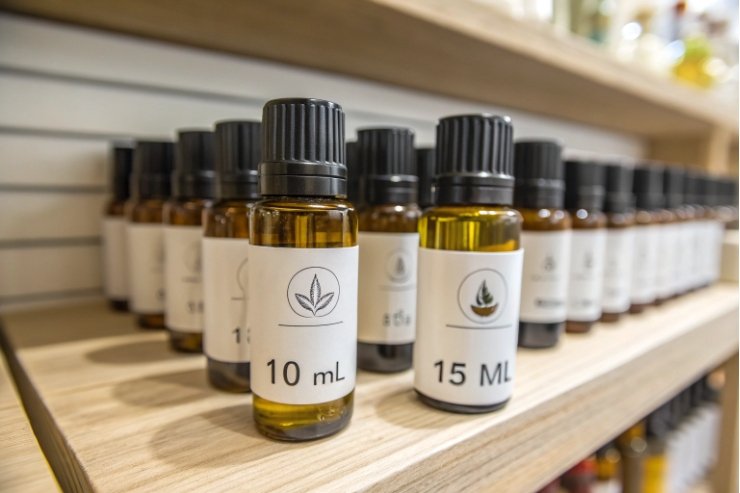
Dark glass works best when paired with DIN-18 (GL18) necks and euro-dropper or orifice-reducer systems, especially in 5–30 ml sizes that limit headspace and make dosing safe and familiar for essential oils.
Why DIN-18 + reducers is the “standard language” for EOs
“DIN” refers to Deutsches Institut für Normung (DIN) 5, the German standards body behind many industrial norms. In packaging practice, DIN-18 / GL18 is the common dropper neck standard for small EO bottles. If you need a quick reference drawing, review these DIN-18 / GL18 thread dimensions 6. It supports:
- Plug-in orifice reducers (“euro-droppers”) with air vents
- Tamper-evident and child-resistant caps (align to PPPA child-resistant packaging requirements 7)
- Interchangeable closures across 5–30+ ml bottles
For essential oils, this system gives:
- Controlled drop dosing without direct contact
- Lower air exchange than leaving a pipette in the bottle
- Tight seals when paired with good liners and torque
Choosing bottle sizes: 5–30 ml
Color and closure are only part of shelf life. Headspace is just as important. The more air above the oil, the faster it oxidizes.
Most EO lines work well with:
- 5 ml for rare, expensive, or powerful oils
- 10–15 ml for popular single notes and blends
- 30 ml for base oils, frequent-use blends, or professional users
| Size | Best use case | Shelf-life benefit |
|---|---|---|
| 5 ml | Potent or costly oils, trial sets | Low headspace, faster turnover |
| 10 ml | Main retail size for most EOs | Good balance of price and protection |
| 15 ml | US-style standard for aromatherapy | Slightly more usage, still manageable |
| 30 ml | High-use blends, massage, pro back-bar | Use only if rotation is fast |
Orifice reducers vs pipette droppers
Dark glass plus a euro-dropper and cap usually gives the best long-term barrier:
- Oil stays in contact with glass and a small piece of chemical-resistant plastic
- The cap liner sits on a clean sealing land
- The dropper insert reduces the “chimney” of air down into the bottle
Pipette droppers feel premium and convenient, but they bring risks:
- Rubber bulbs can harden or get sticky with terpene-rich oils
- Users often leave the pipette in, which increases air contact
- Glass pipettes add a breakage risk and more complex assembly
A practical compromise:
- Ship the bottle with reducer + cap as the default
- Offer pipette droppers as separate accessories for blending or short-term use
A simple “safe default” spec
For a robust EO bottle system, a simple spec might look like:
- Glass: thick-walled amber or UV-protective glass, 5–30 ml range
- Neck: DIN-18 / GL18 with TE ring
- Closure: tamper-evident cap with EO-compatible liner + euro-dropper insert
- Storage: all bottles shipped in cartons; retail displays avoid direct sun
Conclusion
For essential oils, amber or UV-protective dark glass plus small DIN-18 bottles and good droppers gives the best balance of protection, usability, and honest, long-lived aroma.
Footnotes
-
Explains why oxidized terpenes (linalool/limonene) can increase contact allergy risk. ↩ ↩
-
Quick reference on how amber packaging reduces light exposure for sensitive contents. ↩ ↩
-
Explains why color-separated cullet improves recycling quality for flint/amber/green glass streams. ↩ ↩
-
Practical guidance on designing cosmetic glass packs that recycle well, even with decoration choices. ↩ ↩
-
Official background on DIN as the standards body behind many industrial specifications. ↩ ↩
-
Dimension reference to sanity-check DIN-18/GL18 compatibility across bottle and closure suppliers. ↩ ↩
-
Clarifies U.S. PPPA expectations for child-resistant packaging used with hazardous household substances. ↩ ↩






