
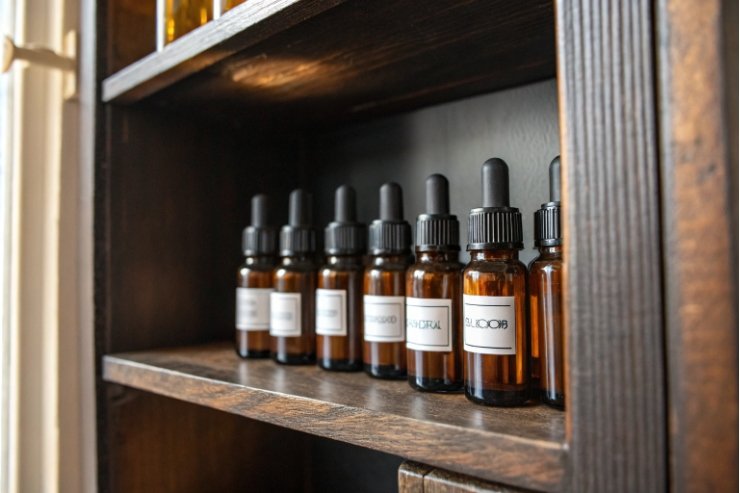
When an essential oil turns dull or harsh too soon, it is usually the bottle, not the plant, that failed to protect it.
To protect essential oils, choose dark, inert glass bottles with euro-dropper closures or orifice reducers, solvent-resistant caps and liners, small bottle sizes, and cool, dark storage. This setup keeps light, oxygen, and reactive materials away from the oil.
From the packaging side, the goal is simple. Keep the oil away from light, air, and reactive materials for as long as possible. Color, neck finish, closure, liner, and storage plan are just different tools to reach that goal. When these choices work together, even sensitive citrus or conifer oils stay closer to their fresh state for much longer.
Amber, cobalt, or opaque: which glass color best protects EOs from UV degradation?
Many oils start bright and green, then slowly turn flat or yellow in clear bottles. Light, not age alone, often sits behind that change.
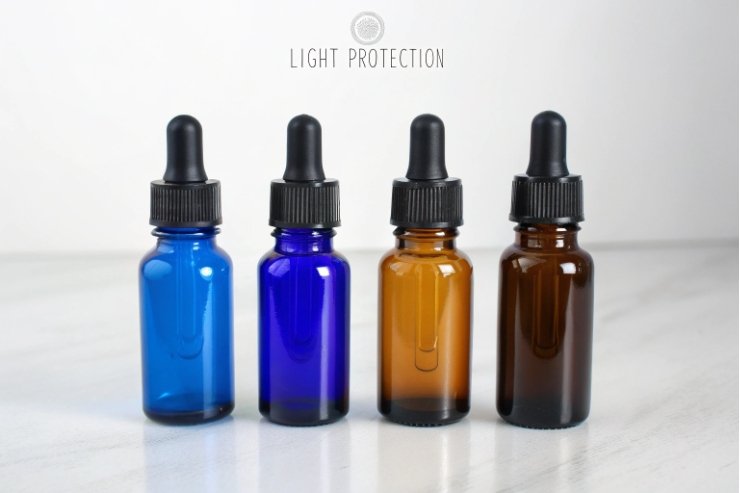
Amber and UV-protective violet or black glass give the strongest light barrier, cobalt offers medium protection, and clear glass is only safe when you add strong secondary shielding and careful storage.
How light damages essential oils
Light does two jobs at once. It fades color and it breaks molecules.
Essential oils hold many light-sensitive compounds. Citrus top notes, some herb oils, and many absolutes react to UV and short-wave blue light. When these wavelengths hit the bottle:
- Some molecules break apart.
- Some oxidize into sharper, sometimes irritating products.
- The oil can darken, even if the smell still seems “fine” at first.
So light protection is not only about color. It is also part of safety, because oxidized terpenes 1 are more likely to act as skin sensitizers.
Glass color options in simple terms
Different glass colors filter light in different ways:
| Glass color / type | UV / light protection level | Typical use for EOs | Main pros | Main trade-off |
|---|---|---|---|---|
| Clear flint | Very low | Short-term use or full box / tin | Juice fully visible | Needs strong outer shielding |
| Cobalt blue | Medium | Aromatherapy retail with good storage | Strong shelf impact | Less UV block than amber |
| Amber / brown 2 | High | Standard for neat essential oils | Excellent UV block, easy to source | Color may not fit every brand story |
| Opaque violet / black UV | Very high | Sensitive or premium EO lines | Maximum light protection | Cannot see fill level without opening |
For most projects, amber is the safest default. It blocks a very high share of UV, is widely available in DIN-18 necks, and still allows basic visibility of the fill level.
Violet or black UV glass is a next step for very sensitive products or very long routes. It shields better, especially on open shelves. The cost is higher, and you lose a clear view of the oil.
When cobalt and clear glass still make sense
Cobalt and clear bottles are not “wrong.” They just need help.
- With cobalt, pair the bottle with full-height labels or carton boxes, and keep stock out of strong store light.
- With clear glass, treat the bottle as an inner vial that always lives inside an opaque box or tin.
If a brand insists on clear or light tints on open shelves, I usually suggest faster rotation, shorter shelf-life dates, or using these only for blends where color and top-note stability matter less.
Dropper vs. orifice reducer: which closure and DIN-18/20 neck ensure precise, leak-free dosing?
Even the best glass fails if every second bottle drips from the neck or doses double the intended drops.
For neat essential oils, pair a DIN-18 (or GL18/18-415) bottle with a euro-dropper or orifice reducer and a tight screw cap; avoid long-term storage in rubber-bulb pipette droppers.
DIN necks and thread matching
The neck finish 3 is the “language” your bottle and cap use. If they do not speak the same code, the seal is never perfect.
For essential oils, the most common are:
- DIN-18 / GL18 / 18-415 for classic 5–30 ml euro bottles.
- DIN-20 in some larger or special formats.
What matters is that the bottle neck and cap share the same standard. A 18-415 cap on a GL18 bottle may seem “almost right,” but even small differences in thread height or land width can break the seal.
A simple rule on drawings and quotes: always lock both bottle and closure to the same neck code.
Euro-droppers vs pipette droppers
Now look at how the user gets the oil.
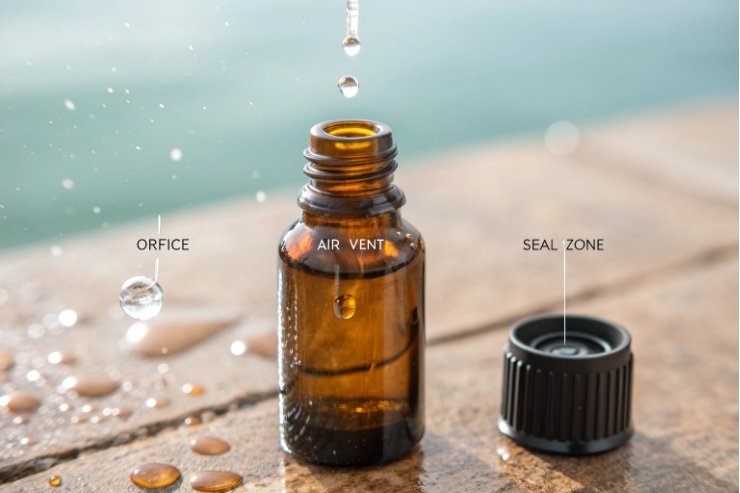
Euro-dropper / orifice reducer system
- A small plastic insert snaps into the neck.
- It has a central outlet and a tiny air vent.
- The user tilts the bottle and counts drops.
This system is ideal for:
- Neat essential oils and strong blends.
- Retail products that must be safe during transport.
- Long-term storage, because the glass is closed with a solid cap between uses.
Pipette dropper with rubber bulb
- Glass pipette reaches into the oil.
- Bulb sits outside and moves air in and out.
- Many users leave the pipette in the bottle all the time.
This system is good for:
- Short-term use in blending or lab environments.
- Carrier oils and bases with low EO load.
It is much less ideal for long-term storage of neat essential oils. The bulb is often natural rubber, which can absorb and degrade with terpenes. It can turn sticky or crack, and the pipette leaves a long “chimney” of air down into the oil.
Building a precise and leak-free dosing system
For daily use bottles, I usually suggest:
- Bottle: 5–30 ml amber DIN-18, thicker wall, flat base.
- Insert: euro-dropper or orifice reducer tuned to medium drop size.
- Cap: tamper-evident PP cap with a good inner liner.
This combination:
- Gives repeatable drops when the user tilts properly.
- Keeps the oil in contact with glass, PP, and a short piece of PE.
- Closes the system tightly between uses, which limits evaporation and leaks in transit.
You can still offer glass pipette droppers as an accessory for blending. But for storage and shipping, the euro-dropper style closure 4 wins almost every time.
Which cap liners and materials (PP, phenolic, TPE, silicone) resist terpene attack over time?
Essential oils are friendly to skin in the right dilution, but they are tough on packaging. Terpenes behave like solvents and can attack soft plastics and rubber.
Use PP or phenolic caps with PE, TPE, or PTFE-faced liners, and silicone or nitrile elastomers where needed; avoid long-term contact between neat essential oils and natural rubber or unknown foams.
What is happening at the cap over months
Every time you close a bottle, a small cushion of air remains at the top. Over weeks and months, volatile components move into this headspace. Some of them reach the underside of the cap and the liner.
If that liner or seal is made from a weak or poorly chosen material, several things can happen:
- The material swells, softens, or cracks.
- Plasticizers migrate into the oil.
- The cap loses torque and the seal loosens.
So cap and liner are not small details. They are a critical barrier for oxidation, leakage, and contamination.
Common cap and liner materials for EOs
A simple map helps:
| Component | Better choices for EOs | Choices to avoid for neat EOs | Notes |
|---|---|---|---|
| Cap body | PP (polypropylene), phenolic | Low-grade mixed plastics | Phenolic is very strong and heat resistant |
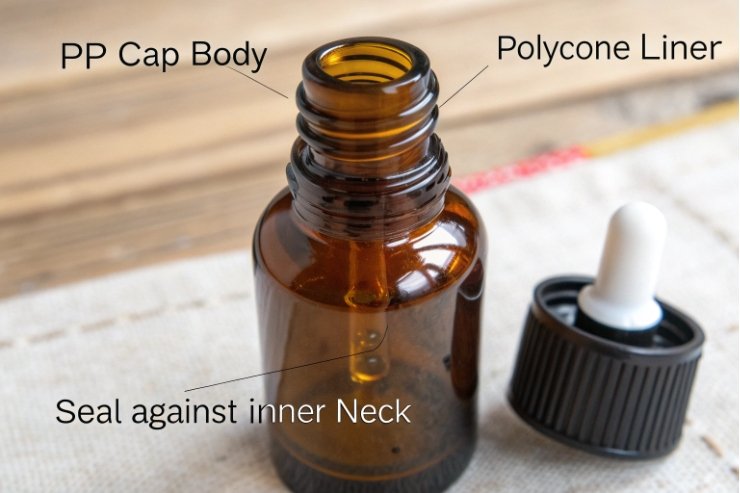
| Liner | PE, TPE, polycone liners 5, PTFE-faced liners 6 | Basic foam, cardboard + unknown adhesives | Polycone phenolic caps seal very tightly |
| Elastomer parts | Silicone, some nitrile grades | Natural rubber in long-term contact | Rubber bulbs often fail with citrus oils |
| Dropper insert | PP, PE blends designed for EO contact | Unspecified PVC | Ask for EO compatibility from supplier |
Phenolic caps with polycone liners create a cone that deforms to the inner neck. This gives a vapor-tight seal and is excellent for stock storage, bulk oils, or long-term archives.
For everyday retail bottles, tamper-evident PP caps with built-in TPE or PE liners are a good balance. They seal well, cost less, and are easy for customers to open and close.
Designing for long-term terpene resistance
To keep caps safe over time:
- Keep the contact area small. Good orifice reducers limit how much oil touches the liner and threads.
- Choose silicone or nitrile instead of natural rubber when an elastomer is needed. This matters in dropper bulbs and some gasket designs.
- For very aggressive oils or highly concentrated blends, consider PTFE-faced liners in bulk or storage bottles.
If a brand wants rubber-bulb droppers for look and feel, I suggest:
- Use them on diluted blends or carrier oils, not neat EOs.
- Treat them as short-life accessories, not as the main long-term closure.
For pure essential oils that must sit stable for two or three years, a hard cap with a strong liner will always be safer than a soft bulb.
What bottle size, headspace, and storage conditions keep oxidation and volatilization to a minimum?
Even with perfect glass and caps, essential oils age fast in half-empty, warm, bright bottles.
Use the smallest practical bottle size, keep headspace low, and store filled bottles cool and dark in secondary cartons or tins; this combination slows both oxidation and evaporation.
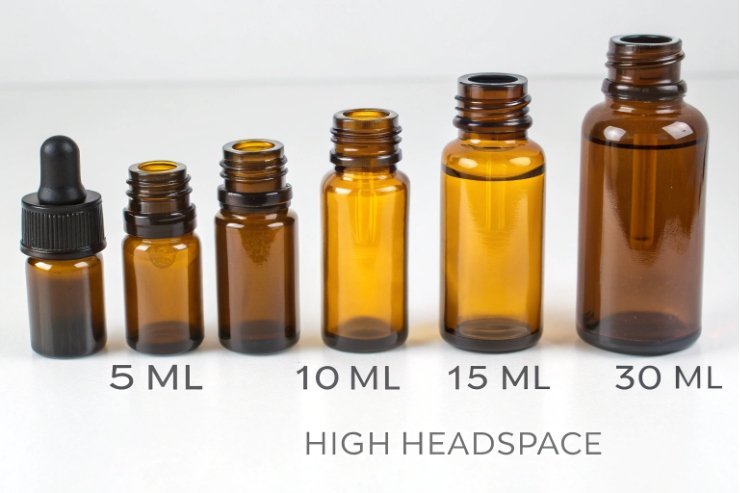
Why bottle size and headspace matter
Oxidation needs oxygen. The more air you leave above the oil, the more oxygen sits ready to react.
Two stages matter:
-
At filling
A properly designed 5, 10, or 15 ml bottle fills close to the shoulder. Only a small air pocket remains. -
During use
Each time a drop leaves, air enters. Once the bottle is below half full, the headspace becomes large.
This is why I usually recommend smaller bottles for neat EOs:
- 5–15 ml for single notes and strong blends.
- 30 ml only when you know the oil will move fast.
Less volume in the wrong bottle can be worse than more volume in the right one. A 50 ml bottle sitting half full for a year holds much more oxygen over the oil than a fresh 10 ml bottle with minimal headspace.
How storage conditions change the aging speed
Two simple rules cover most of the risk:
- Cool: lower temperatures slow chemical reactions.
- Dark: less light means fewer photo reactions.
Practical habits that help:
- Keep stock in closed cartons or tins, even if you use amber bottles.
- Avoid storage over heaters, near windows, or next to hot equipment.
- Try to keep warehouse and store rooms near a stable, moderate temperature.
For very sensitive oils or important archives, a dedicated cool cabinet or fridge 7 (with tight caps and slow temperature changes) gives the longest life. The bottles must warm to room temperature before opening, so water does not condense inside.
When and how to “rescue” half-full bottles
Once a bottle is far below half, the headspace is large and oxidation speeds up. A simple way to slow this is to re-bottle:
- Move the remaining oil from a half-full 30 ml bottle into a fresh 10 or 15 ml amber bottle.
- Use a clean glass funnel and do it in a low-light, low-heat area.
- Close tightly at once and return to the dark.
This small step often adds months of good life to slow-moving oils. It also lets you use thick-walled, more impact-resistant small bottles for daily handling, while the larger bulk bottle stays in more controlled storage.
Conclusion
A well-chosen essential oil bottle is a small system: dark, strong glass, EO-safe closures and liners, small headspace, and cool, dark storage working together to protect the oil’s natural integrity.
Footnotes
-
Study on limonene/linalool oxidation products and contact allergy risk in real patients. ↩ ↩
-
Why amber pharmaceutical glass is used to block UV and protect light-sensitive contents. ↩ ↩
-
Practical guide to neck finishes and thread matching to prevent leaks from mismatched closures. ↩ ↩
-
Example of euro dropper bottles using an orifice insert for controlled, transport-safe drop dispensing. ↩ ↩
-
Quick primer on how polycone liners create a tighter, oil-resistant seal for liquid products. ↩ ↩
-
Compare PTFE and other liner materials for chemical resistance and low extractables in closures. ↩ ↩
-
Storage guidance on keeping essential oils cool to slow oxidation and preserve aroma longer. ↩ ↩






