
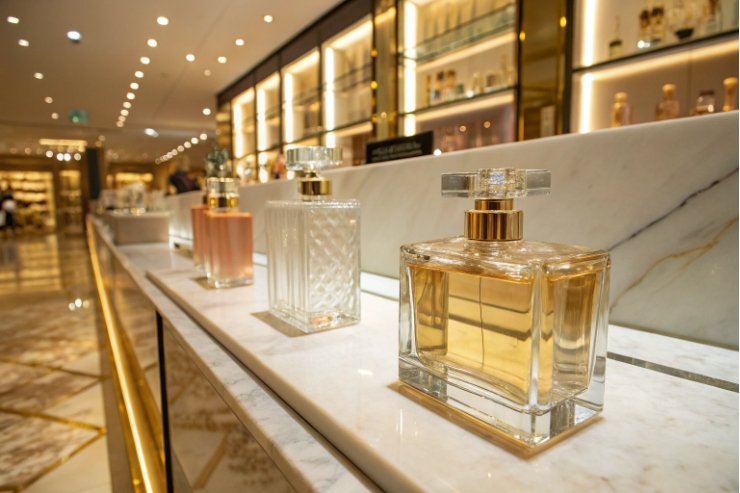
Your perfume formula can be perfect, but the wrong bottle slowly flattens the top notes and cheapens the whole experience at first touch.
Glass perfume bottles are best because they are chemically inert, protect from light when tinted or coated, elevate the feeling of luxury, and support true recyclability and refill programs without damaging the fragrance.
Once a fragrance leaves the lab, the primary glass bottle becomes its “second formula.” Material, shape, and finish all decide how well the scent survives transport, storage, and the customer’s daily routine. When brand owners compare glass with plastic or metal at each of these points, glass usually wins on both performance and perception.
Is glass more chemically inert and aroma-safe than plastics for alcohol-based fragrances?
Perfume is not just water with a little scent. It is a mix of high-proof alcohol, fragrance oils, and often colorants or UV filters that can attack weaker packaging materials.
Glass is far more chemically inert than most plastics, so it does not react with alcohol-based fragrances, does not leach additives, and does not absorb precious aroma molecules from your perfume.
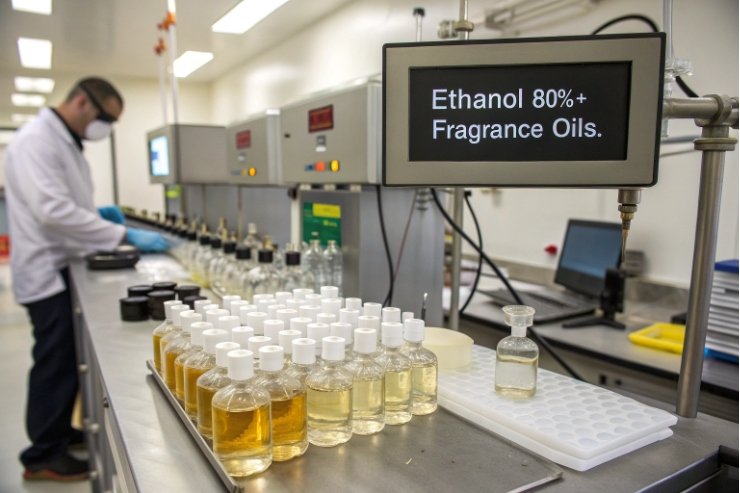
Why perfumes are demanding on packaging
Alcohol-based fragrances usually sit around 70–90% ethanol, plus a complex mix of aroma chemicals and natural essential oils. This combination behaves like a powerful solvent. In many plastics, such solvents can:
- Extract plasticizers and stabilizers.
- Cause swelling or cracking.
- Slowly “steal” scent molecules into the plastic wall.
If you want a quick reference for why perfume behaves like a solvent, review the physical data behind high-proof ethanol (NIST Chemistry WebBook entry) 1.
Glass behaves very differently. It is an inorganic, non-porous network with practically zero migration in normal cosmetic use. Many container-glass technical summaries describe glass as one of the most inert packaging materials (FEVE overview on glass and health) 2. That means:
- No foreign molecules move from the bottle into the perfume.
- No fragrance components diffuse into the bottle wall and “disappear.”
- No slow yellowing or stress cracking because of alcohol attack.
This is why regulations and technical guidelines tend to show glass as the safest default for complex cosmetics and fragrances, especially when high solvent levels or essential oils are involved.
How glass preserves the top notes
Top notes are often the most fragile part of a fragrance. Citrus, herbal, and green notes evaporate and oxidize easily. If packaging interacts with them, the first thing a customer loses is that bright opening mist.
Comparing material behavior:
| Property / risk | Typical plastics (general) | Perfume glass bottle |
|---|---|---|
| Reaction with ethanol | Possible swelling, stress cracking over time | No reaction in normal cosmetic conditions |
| Additive migration | Plasticizers, stabilizers may leach | No additives needed for basic glass matrix |
| Aroma absorption | Fragrance can be partly absorbed into wall | Non-porous, no aroma loss into container |
| Regulatory perception | Must prove “no migration” case by case | Often seen as “inert reference material” |
In real projects, this difference shows up as simple facts: glass-stored perfumes keep their original profile longer, especially when the bottle stays tightly sealed. Plastic housings are still useful for travel minis and secondary packs, but most brands trust glass for the main container that must protect both smell and brand image.
Do tinted or coated glass bottles reduce UV exposure and extend scent longevity?
Even a chemically stable perfume changes if sunlight and harsh store lighting hit it for months. Light does two kinds of damage: it fades dyes and it triggers chemical breakdown of aroma components.
Tinted and coated glass bottles reduce UV and short-wavelength visible light, slowing photo-oxidation and color fading so the fragrance stays closer to the perfumer’s original accord.
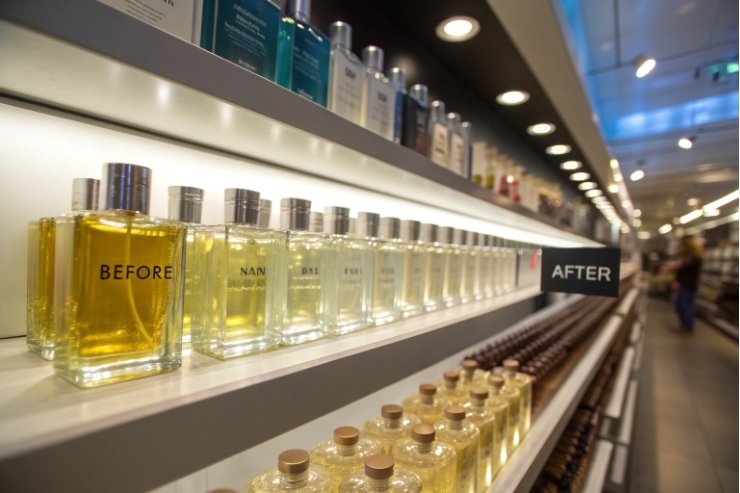
How light degrades fragrance in clear bottles
Inside a perfume, many natural extracts and aroma molecules are light sensitive. When they absorb UV or strong blue light, they can:
- Break apart into smaller molecules.
- Oxidize into less pleasant notes.
- Change color from clear to yellow or brown.
If you need a structured, widely used framework for evaluating light-driven degradation, see the photostability testing guidance used in regulated stability work (FDA guidance: ICH Q1B Photostability Testing) 3. While written for pharmaceuticals, it clarifies why light exposure can change complex formulas over time.
What tinted and coated glass actually do
Tinted or coated glass adds a passive shield between the liquid and the light. Different options offer different levels of protection:
| Glass type | Light protection level | Typical use in fragrance |
|---|---|---|
| Clear flint | Almost no UV protection | Short display times, strong outer box |
| Light tint (smoke, blue) | Some UV reduction, brand aesthetic | Mid-shelf perfumes with cartons |
| Amber or deep tint | Strong UV and blue-light blocking | Natural, essential-oil-heavy, niche perfumes |
| UV-blocking / coated | Very high UV and visible light barrier | High-value or very sensitive compositions |
Besides pure color, modern coatings can add:
- Inner or outer spray layers that double as design and UV filter.
- Frosted or matte finishes that scatter light and hide slight discoloration over time.
- Combinations of tint plus coating for both performance and branding.
If you are aligning specs with lab language, it helps to think in terms of UV-A and UV-B wavelengths (ultraviolet spectrum overview) 4—because those higher-energy bands are often where instability accelerates first.
Balancing visibility and protection
Perfume brands often want the juice color visible, because it is part of the story. A golden amber or soft pink tone sells the idea as much as the logo. So there is always a balance:
- High protection: darker glass or UV-blocking coatings, less visible juice.
- High visibility: clearer glass with stronger reliance on cartons and storage rules.
One practical compromise is clear glass with a high-coverage, printed, or gradient coating that leaves only a small “window” of juice visible. That way, the bottle still tells the color story, while most of the liquid sits in the shade.
How do weight, clarity, and custom shaping in glass elevate luxury branding?
Fragrance is emotional and aspirational. The first impression comes from the bottle in the hand, sometimes long before the customer reads any note list.
Glass offers natural heft, high clarity, and almost limitless shaping, embossing, and decoration options, so a perfume bottle can look and feel like a luxury object before it is even sprayed.
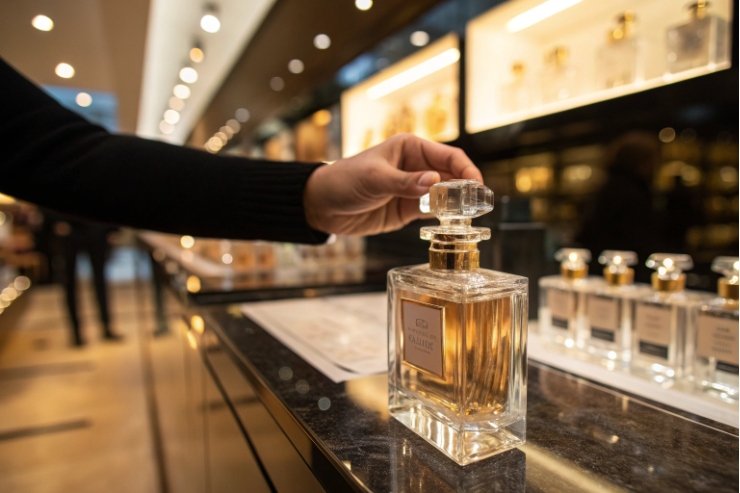
Why weight and clarity matter so much
When someone picks up a perfume tester, they subconsciously judge:
- How heavy it feels in the hand.
- How stable it feels when pressed back onto the counter.
- How the light plays through the juice and the glass.
Glass does three important things for this experience:
-
Weight
Even with lightweighted designs, glass still carries more mass than plastic. A solid base gives a strong, stable feel that says “premium” without any words. -
Clarity
High-quality flint or extra-flint glass gives sharp transparency. Color purity of the juice shows clearly. This clarity is hard to copy with plastics, which often look softer or slightly cloudy. -
Surface quality
Glass can hold polished planes, smooth curves, and crisp edges that catch light in a precise way. Combined with fine decoration, it communicates care and craftsmanship.
Custom shapes as a branding language
Luxury brands treat the perfume bottle as a small sculpture. A good glass partner can offer:
- Unique body shapes (pillars, curves, asymmetrical forms).
- Embossed or debossed logos in the glass itself.
- Heavy bases and thick walls for a “crystal” feel.
- Custom shoulders and necks that pair perfectly with metal or fancy caps.
These elements support visual storytelling:
| Design element | Brand message it can support | Example use |
|---|---|---|
| Heavy solid base | Serious, enduring, “object to keep” | Heritage or couture fragrance lines |
| Thin, tall silhouette | Modern, elegant, light | Contemporary urban unisex scents |
| Soft rounded shoulders | Comfort, sensuality, warmth | Gourmand or skin-scent perfumes |
| Sharp facets and edges | Precision, power, confidence | Masculine or “statement” fragrances |
| Deep or colored glass | Mystery, intensity, night-time usage | Intense or limited editions |
In many projects, a custom glass form does more for brand recall than any secondary packaging. People remember “the little heavy bottle with the rounded shoulders” long after they forget the exact carton design.
Decoration as the final layer of luxury
Because glass is heat resistant and stable, it accepts many decorations:
- Silk-screen printing for logos and text.
- Hot stamping in gold or other metallic tones.
- Acid-etch or sandblast for permanent matte areas.
- Spray or gradient coatings in custom colors.
- Partial metallization or inner-lacquer effects.
A single bottle design can become a whole collection by combining the same glass shape with different coatings and decos. This is a powerful tool when building flankers, limited editions, or seasonal lines without new tooling every time.
Are glass bottles easier to recycle and integrate into refill programs than alternatives?
Customers now look at the whole footprint of a perfume, not only the scent. They ask what happens to the bottle when it is empty and whether refills are possible.
Glass bottles are widely recyclable, compatible with high-heat cleaning, and strong enough to use in refill systems, which makes them more future-proof for sustainable fragrance concepts than most plastic alternatives.
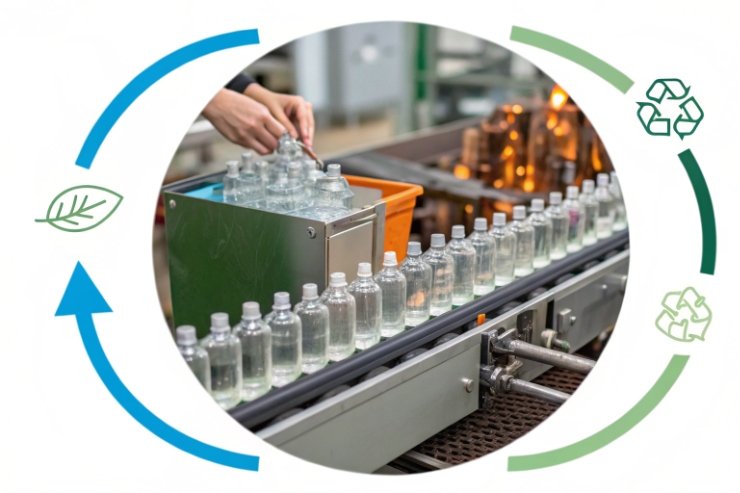
Recycling and closed-loop potential
Glass is one of the few materials that can be recycled over and over without losing quality. For a simple explainer you can share internally, see how the glass recycling stream works in practice (glass recycling overview) 5:
- It can be crushed (cullet), cleaned, and fed back into new glass batches.
- It keeps its basic properties; there is no “downcycling” into a weaker class of material.
- It helps lower furnace energy use when cullet ratios are high.
When your sustainability story includes recycled inputs, it also helps teams align on terminology like post-consumer recycled cullet (cullet definition and context) 6.
Plastics, by contrast, often degrade in quality with each cycle. Many complex cosmetic packs mix polymers, colors, and decorative layers that make true recycling difficult. Glass, even when decorated, stays closer to a “pure” material stream.
Refillable systems and glass performance
Refillable fragrance is moving from niche to mainstream. Here, glass works well because it can:
- Handle repeated cleaning, including hot washing and sterilization where needed.
- Keep mechanical strength across many refill cycles if designed with good wall thickness and protected bases.
- Maintain clarity and surface quality longer than most alternatives.
Refill programs usually fall into two models:
| Refill model | How glass fits | Design focus |
|---|---|---|
| At-home refills | Customer buys separate refill pouch or bottle | Easy-open spray units, leak-safe refill necks |
| In-store / boutique refills | Bottles cleaned and refilled at point of sale | Strong glass, robust decoration, traceability |
In both cases, the core glass bottle becomes a long-lived object rather than single-use waste. Caps, pumps, and decorative collars may still be replaced, but the heavy glass base stays.
Lightweight glass and transport impact
A common worry is that glass is heavy and raises transport emissions. This is true for very thick, “overbuilt” designs. Modern lightweighted perfume bottles address this by:
- Optimizing wall thickness while keeping a solid base feel.
- Using better forming control to keep strength but remove unnecessary mass.
- Reducing overall glass weight per bottle without losing the luxury cue.
This approach is often framed as source reduction and reuse in packaging strategy (EPA basics on reducing and reusing) 7. For global launches where millions of bottles cross oceans, this balance is important.
Conclusion
Glass perfume bottles protect the formula, project luxury, and support real recycling and refill stories, which is why they remain the strongest long-term choice for fragrance packaging.
Footnotes
-
NIST WebBook data explains ethanol properties and why it behaves as a strong solvent. ↩ ↩
-
FEVE summarizes why glass is inert and forms a strong barrier against contamination and interaction. ↩ ↩
-
FDA’s ICH Q1B guidance explains standard approaches to assess light-driven degradation and photostability. ↩ ↩
-
Quick reference for UV band definitions to align “UV” language across marketing, R&D, and packaging teams. ↩ ↩
-
Overview of how collected glass is processed into cullet and recycled into new glass products. ↩ ↩
-
Definition of cullet and why recycled glass feedstock matters for manufacturing and sustainability claims. ↩ ↩
-
EPA guidance on reducing material use and extending product life—useful framing for lightweight and refill packaging decisions. ↩ ↩






