
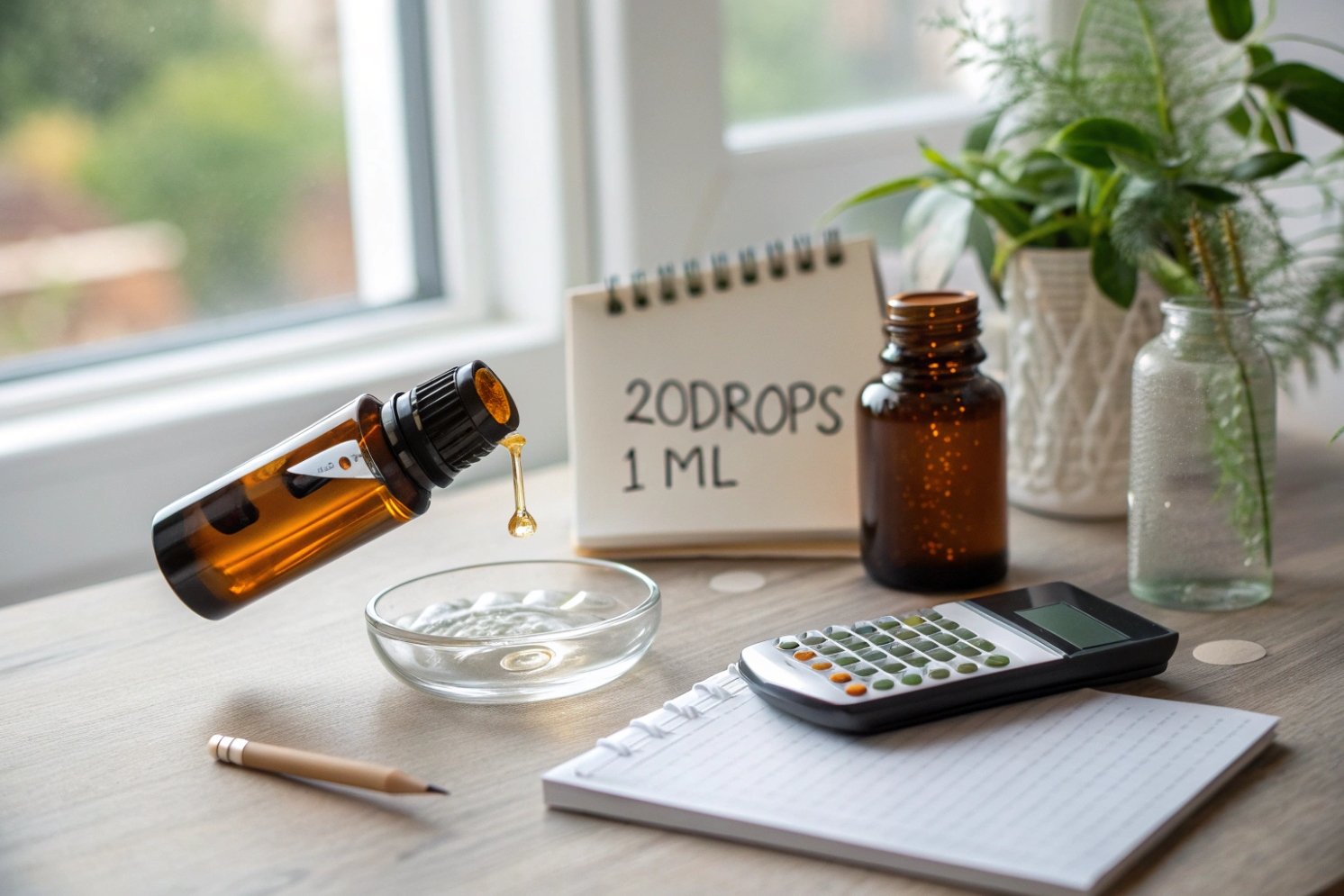
Every recipe speaks in drops, but bottles are labeled in milliliters. Without a simple system, dilution charts, safety, and cost calculations get messy fast.
To estimate drops in an essential oil bottle, use the standard 20 drops per ml formula (1 drop ≈ 0.05 ml), then refine it by testing your own bottle, oil, and dropper in real use.
The 20-drops rule is only a starting point. Real drop size shifts with oil viscosity, room temperature, and the design of the DIN-18 euro dropper or orifice reducer. So the best way is to start with the formula, then calibrate your own packaging.
What is the ml-to-drops formula for essential oils (gtt/ml)?
Most aromatherapy charts assume a simple, fixed conversion. This is useful for planning blends and label claims, even if reality is not perfect.
The common working formula is 1 ml ≈ 20 drops. So drops in a bottle ≈ bottle volume (ml) × 20, as long as you accept a small margin of error.
The basic 20 drops per ml rule
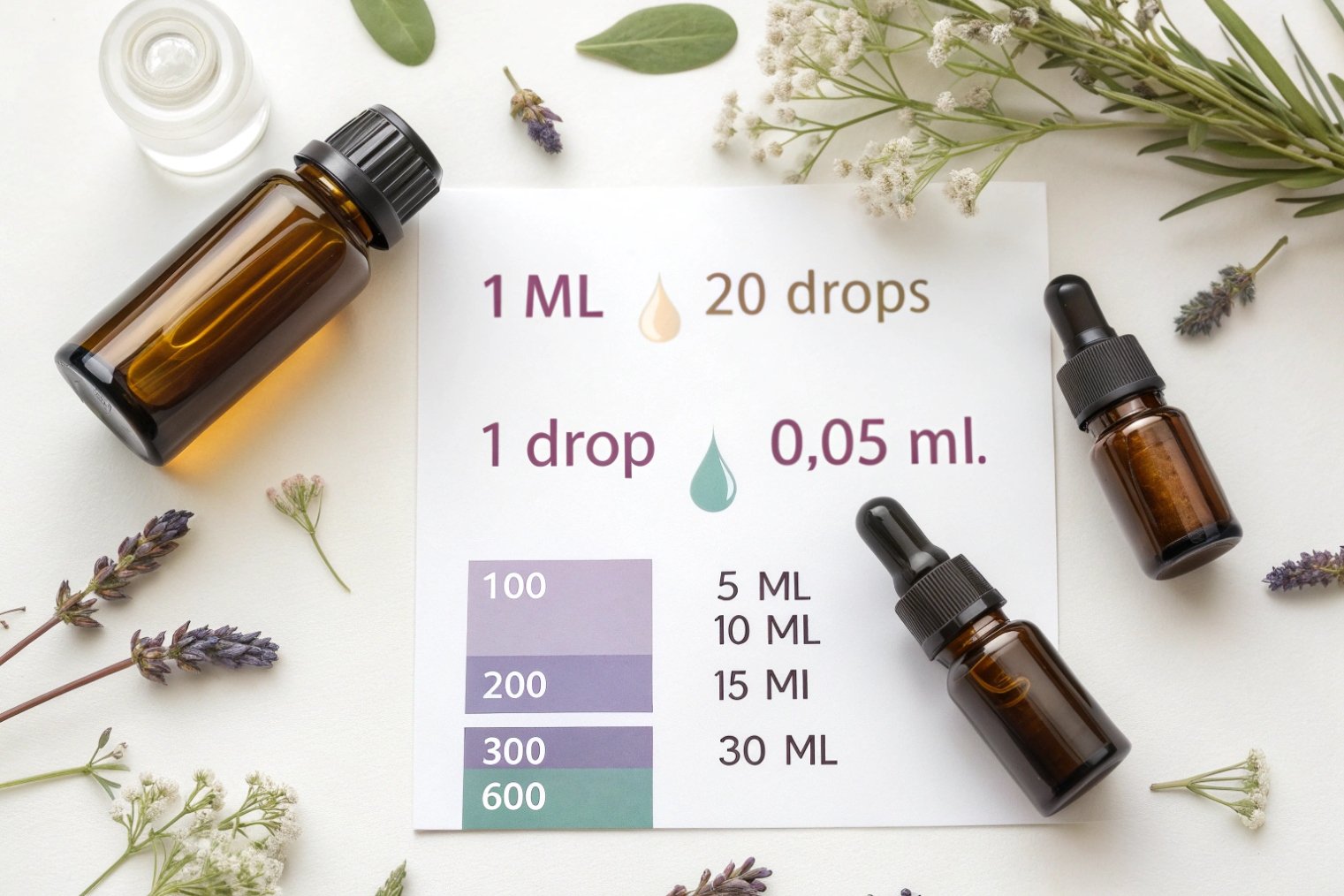
The easiest way to calculate drops is to treat one drop as 0.05 ml. This gives a neat conversion:
- 1 ml ≈ 20 drops
- 5 ml ≈ 100 drops
- 10 ml ≈ 200 drops
- 15 ml ≈ 300 drops
- 30 ml ≈ 600 drops
In practice, this matches many common essential oils with standard aromatherapy droppers well enough for day-to-day blending and label guidance. It also lines up with medical and lab practice, where a drop (unit) 1 is often treated as a practical (device-dependent) volume.
The simple formula looks like this:
Number of drops ≈ bottle volume (ml) × 20
So a 10 ml bottle:
10 ml × 20 drops/ml = 200 drops (approx.)
How to use the formula in daily work
For planning, this rule has three big benefits:
- It is easy to remember.
- It works for quick mental math when planning recipes or label guidance.
- It gives a consistent baseline for team discussions and marketing copy.
For example, if a 10 ml bottle has around 200 drops, and a customer uses 4 drops per day, then one bottle lasts about 50 days. You can use this to write “lasts around 6–7 weeks with normal use” in simple language.
This same baseline also helps when you cost formulas. If you know raw material cost per kilogram, density, and approximate drop count, you can estimate cost per customer dose in a simple spreadsheet.
When the rule stops being accurate
The 20-drops rule is still a simplification. Real life moves around it. Some key limits:
- Thin oils may give more than 20 drops per ml, sometimes closer to 25–30.
- Thick oils may give fewer drops per ml, sometimes close to 15–18.
- Different dropper designs change the drop size even with the same oil.
- Temperature changes viscosity, so warm oil often gives more drops per ml.
So the rule is best seen as a planning tool, not a regulatory guarantee. For safety-critical work or clinical aromatherapy, it is better to measure your own device and record the real drops per ml that your customer will get.
How do viscosity, temperature, and orifice size affect drop count?
Two bottles can both say “10 ml” on the label but give very different numbers of drops. The oil and the hardware both play a role.
Thinner oils and warmer temperatures give smaller drops (more drops per ml), while thicker oils, cooler rooms, and larger orifices give bigger drops (fewer drops per ml).
Why drop size is not a fixed unit
A “drop” is not a natural unit like a gram. It is what falls from a specific opening under gravity. So three things matter:
- The liquid properties (fluid viscosity and surface tension).
- The orifice diameter and shape.
- The angle and speed with which the user tilts and taps the bottle.
Thin, mobile liquids detach sooner from the opening and form smaller drops. Thick, sticky liquids hang longer before they fall and form larger ones. A narrow orifice tends to form smaller drops. A wide opening tends to form larger ones.
This is why medical devices define their own “gtt/ml” rate. One drip set might be 10 drops per ml, another 20, another 60. The hardware decides, not magic.
Viscosity and temperature
Viscosity of a liquid 2 describes how “thick” a liquid feels. It changes with both oil type and temperature.
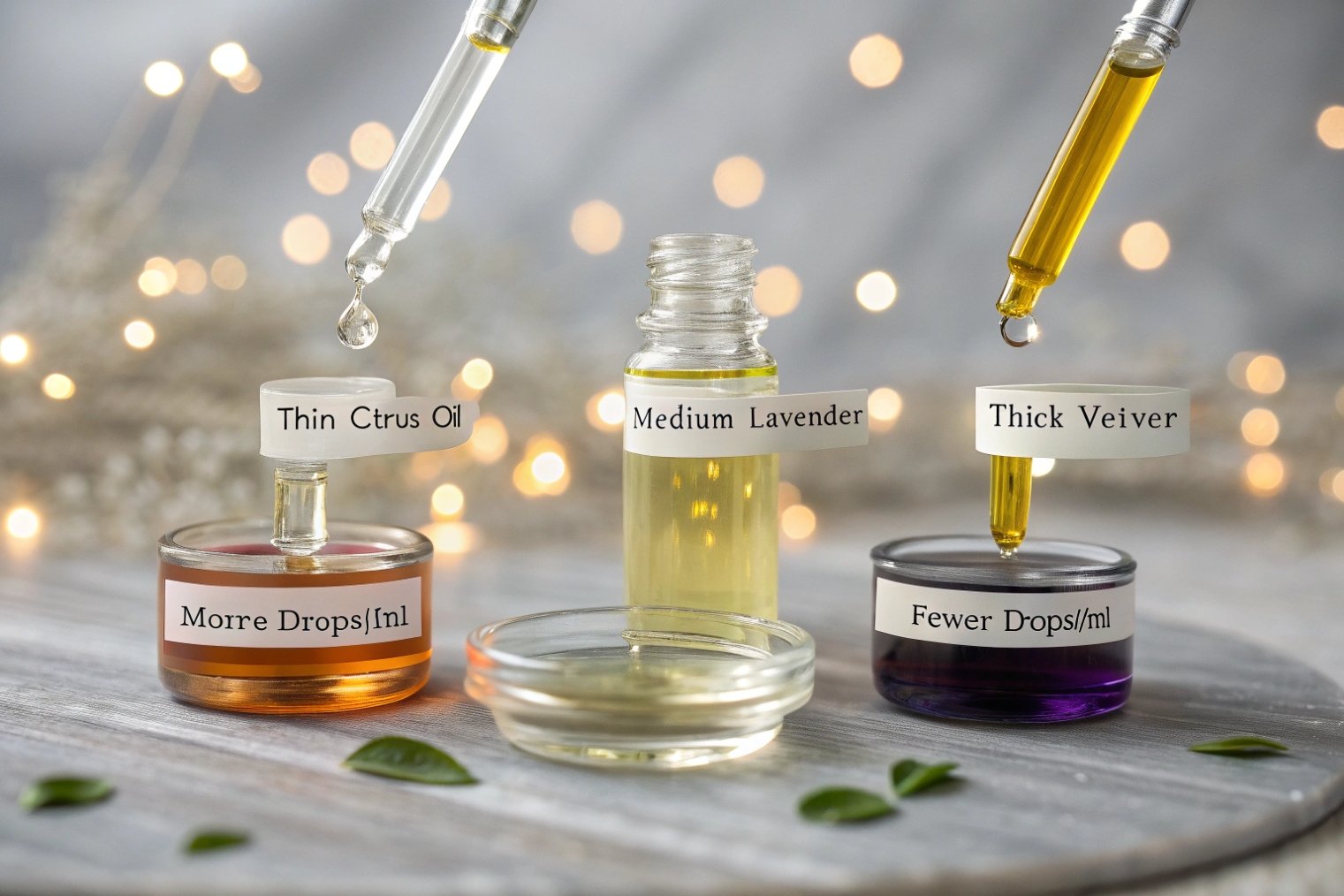
- Thin essential oils (like many citrus top notes) flow fast and give smaller drops. It is common to see 25–30 drops per ml from some of these oils in practical tests.
- Medium oils (like many herb or flower oils) often sit near the classic 20 drops per ml in normal room conditions.
- Thick or resinous oils (like vetiver or patchouli) flow slowly and give larger drops. You may see only 15–18 drops per ml.
When the room is warm, almost all oils become slightly thinner. So drop count per ml goes up. In a cool room, oils become thicker and drop count goes down. The difference is not huge, but it matters when you want more exact blends.
Orifice size and dropper design
The second big factor is the device. Two common options in essential oil packaging are:
- Euro dropper bottles with insert-style restrictors.
- Orifice reducers that push into the neck of a standard bottle.
Each has its own internal geometry. The orifice diameter, the air vent path, and the surface finish inside the insert all change how a drop forms. This is why one supplier’s 10 ml bottle might give 200 drops of lavender, and another’s 10 ml bottle might give 250 drops with the same oil.
A simple summary:
| Factor | Change | Effect on drops per ml |
|---|---|---|
| Oil viscosity | Thinner oil | More, smaller drops |
| Thicker oil | Fewer, larger drops | |
| Temperature | Warmer | Oil thins → more drops |
| Cooler | Oil thickens → fewer drops | |
| Orifice size | Smaller opening | Smaller drops → more per ml |
| Larger opening | Larger drops → fewer per ml |
So the only honest answer is: the same 10 ml volume can easily give 150–300 drops depending on oil and device. The 20-drops rule is the center of this range, not the full story.
How do I calibrate my own bottle—DIN-18 dropper vs. orifice reducer?
Instead of arguing about the “true” drop count, it is easier to measure what your own bottle actually does.
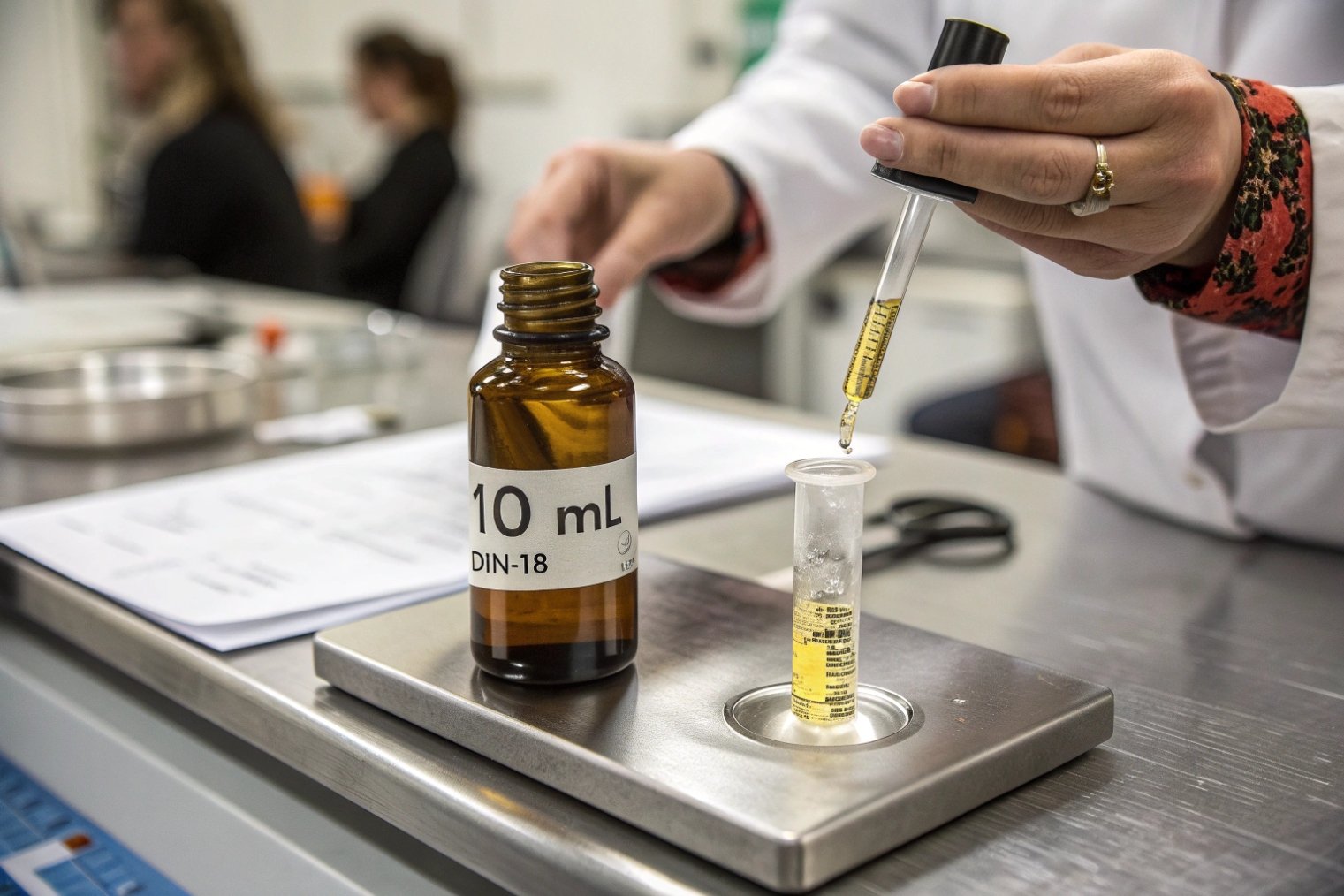
To calibrate, count how many drops from your DIN-18 dropper or orifice reducer fill 1 ml, then use that drops/ml value for all future recipes and labels.
Step 1: Choose your device and oil
First pick the exact setup you care about:
- The bottle size and neck (for example, 10 ml, DIN-18 amber).
- The dropper type (euro dropper insert or push-in orifice reducer).
- One typical oil or blend you use often.
For a brand, it makes sense to calibrate with a mid-viscosity “average” oil, like a common blend or a popular single note that many customers will use as directed. You can then repeat with very thin and very thick oils later for more detail.
Step 2: Measure drops per ml
Then run a simple test:
- Place a small measuring device on a flat surface. A 1 ml syringe or a 1–2 ml graduated cylinder 3 works well.
- Fill your bottle with the test oil and fit the dropper insert or orifice reducer.
- Hold the bottle at the angle you would normally use (usually about 45 degrees).
- Count how many drops it takes to reach exactly 1 ml.
- Repeat this two or three times and average the result.
If you get, for example, 24, 23, and 25 drops to fill 1 ml, you can assume about 24 drops per ml with that oil and that dropper at that temperature.
Step 3: Convert bottle volume to total drops
Once you know drops per ml, you can scale up:
Total drops ≈ bottle volume (ml) × measured drops per ml
So if your DIN-18 dropper gives 24 drops per ml:
- 5 ml ≈ 5 × 24 = 120 drops
- 10 ml ≈ 10 × 24 = 240 drops
- 30 ml ≈ 30 × 24 = 720 drops
You can now write more realistic usage guidance like “10 ml bottle contains about 240 drops with this dropper.”
Step 4: Record differences between inserts
If you use both DIN-18 euro droppers and simple orifice reducers, repeat the test for each. You might find:
- DIN-18 dropper: 22 drops per ml with a given oil.
- Orifice reducer: 27 drops per ml with the same oil.
That gap matters when you write recipes. A statement like “Use 2% by 10 drops in 10 ml” only makes sense if you know what “10 drops” means in your own packaging. After calibration, you will not have to guess. You can base all your future charts, labels, and training on the real drops per ml for your chosen bottle and closure.
For reference, the common container style for this workflow is the dropper bottle 4, where the dispensing hardware strongly influences drop formation.
How many drops are in 5 ml, 10 ml, and 30 ml bottles for common essential oils?
Customers often ask simple questions: “How long will this bottle last?” or “How many baths can I make?” They need clear ballpark answers, not lab reports.
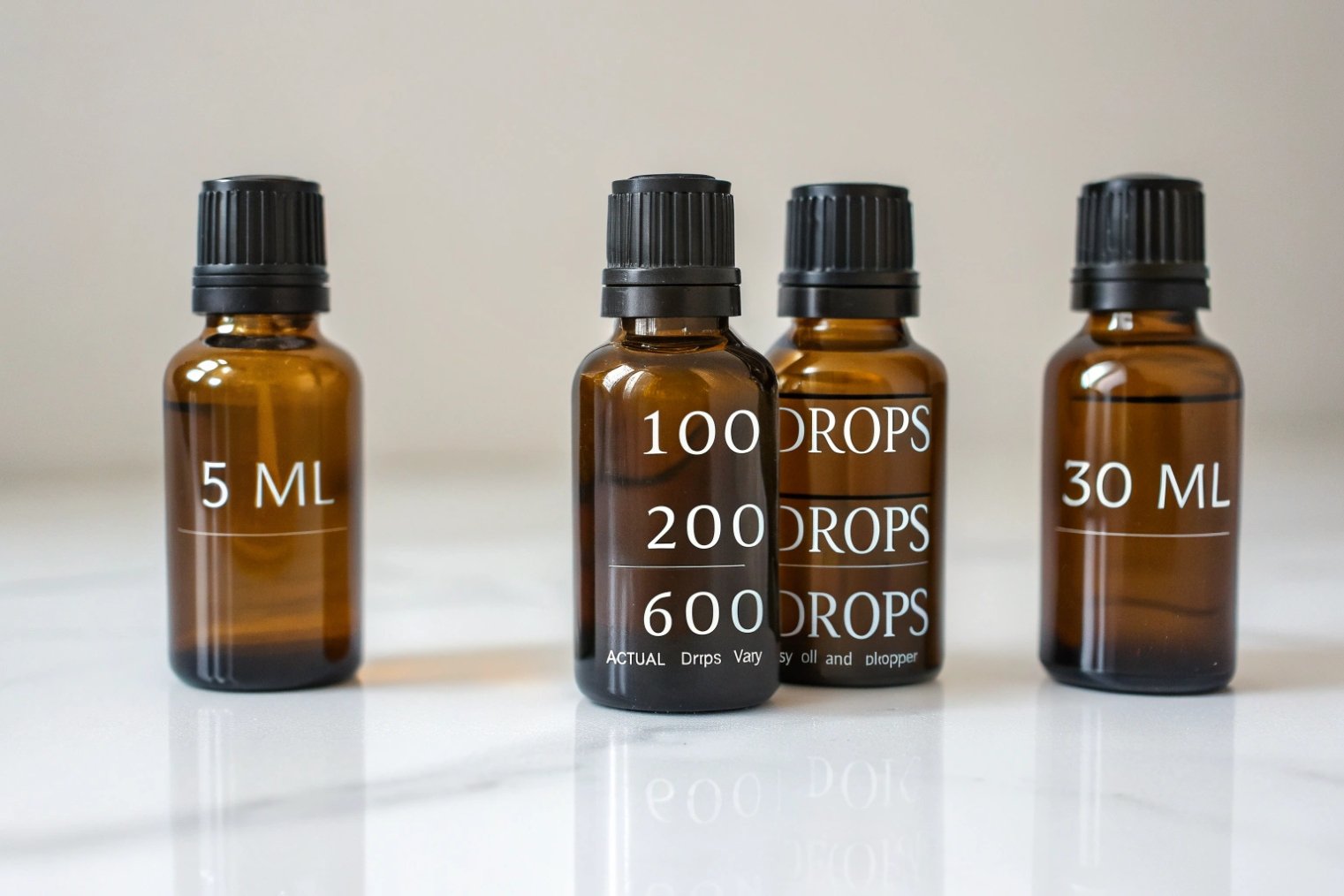
Using the 20-drops rule, 5 ml has ~100 drops, 10 ml ~200, and 30 ml ~600, but real counts shift with oil thickness and dropper design.
Standard estimates with the 20-drops rule
If you accept the 1 ml ≈ 20 drops assumption, the math stays very simple:
| Bottle volume | Approx. drops (20 drops/ml) |
|---|---|
| 5 ml | 100 drops |
| 10 ml | 200 drops |
| 15 ml | 300 drops |
| 30 ml | 600 drops |
From this, you can give fast guidance:
- A 5 ml bottle gives about 20 uses at 5 drops each.
- A 10 ml bottle gives about 40 uses at 5 drops each.
- A 30 ml bottle gives about 120 such uses.
This is often “good enough” for retail communication and internal planning.
Realistic ranges for different oil types
Now add real-world variation. Many suppliers and practitioners report broad ranges like:
- 10 ml ≈ 150–300 drops, depending on oil and dropper.
- 15 ml ≈ 225–450 drops, on the same logic.
We can narrow this by oil type:
| Bottle size | Thin citrus oil (≈25–30 drops/ml) | Medium oil (≈20 drops/ml) | Thick oil (≈15–18 drops/ml) |
|---|---|---|---|
| 5 ml | 125–150 drops | ~100 drops | 75–90 drops |
| 10 ml | 250–300 drops | ~200 drops | 150–180 drops |
| 30 ml | 750–900 drops | ~600 drops | 450–540 drops |
These are still estimates, but they show why two users can count very different numbers from “the same” 10 ml bottle. One may use a thin citrus in a warm room with a tight orifice; the other may use a thick base note in a cool room with a wide insert.
How to present this to customers
From a brand view, a simple approach works best:
- Use the 20-drops rule as your default for basic statements (“about 200 drops in a 10 ml bottle”).
- Add a short note that actual drops vary with oil and dropper.
- For professional users, share your calibrated drops/ml, for example in a tech sheet.
Inside the company, keep a simple table with tested drops per ml for your standard DIN-18 droppers and reducers. Use this table when you design new blends, plan dosing charts, or write safety guidelines. This keeps your whole team aligned and saves long arguments about what “10 drops” really means.
Conclusion
Treat 20 drops per ml as a starting point, then measure your own bottles and oils so every formula, label, and usage guide rests on your real, tested drop count.
If you convert drops into mass-based guidance, use the density of the oil 5 so “mg per drop” stays consistent across different materials and batches.
Also remember that both light and oxygen can change oils over time via photo-oxidation reactions 6, so storage habits can change real-world dosing consistency.
Footnotes
-
Clarifies what a “drop” unit means and why drops-per-ml depends on device design. ↩ ↩
-
Explains viscosity and temperature effects that directly change drop size and drops-per-ml. ↩ ↩
-
Shows what a graduated cylinder is and why it helps measure 1 ml consistently during calibration. ↩ ↩
-
Overview of dropper bottle structures (pipettes/inserts) that influence dosing behavior. ↩ ↩
-
Helps convert volume-per-drop into mass-per-drop using density for more precise dosing and costing. ↩ ↩
-
Explains photo-oxidation—why light exposure can shift aroma and stability in essential oils. ↩ ↩






