
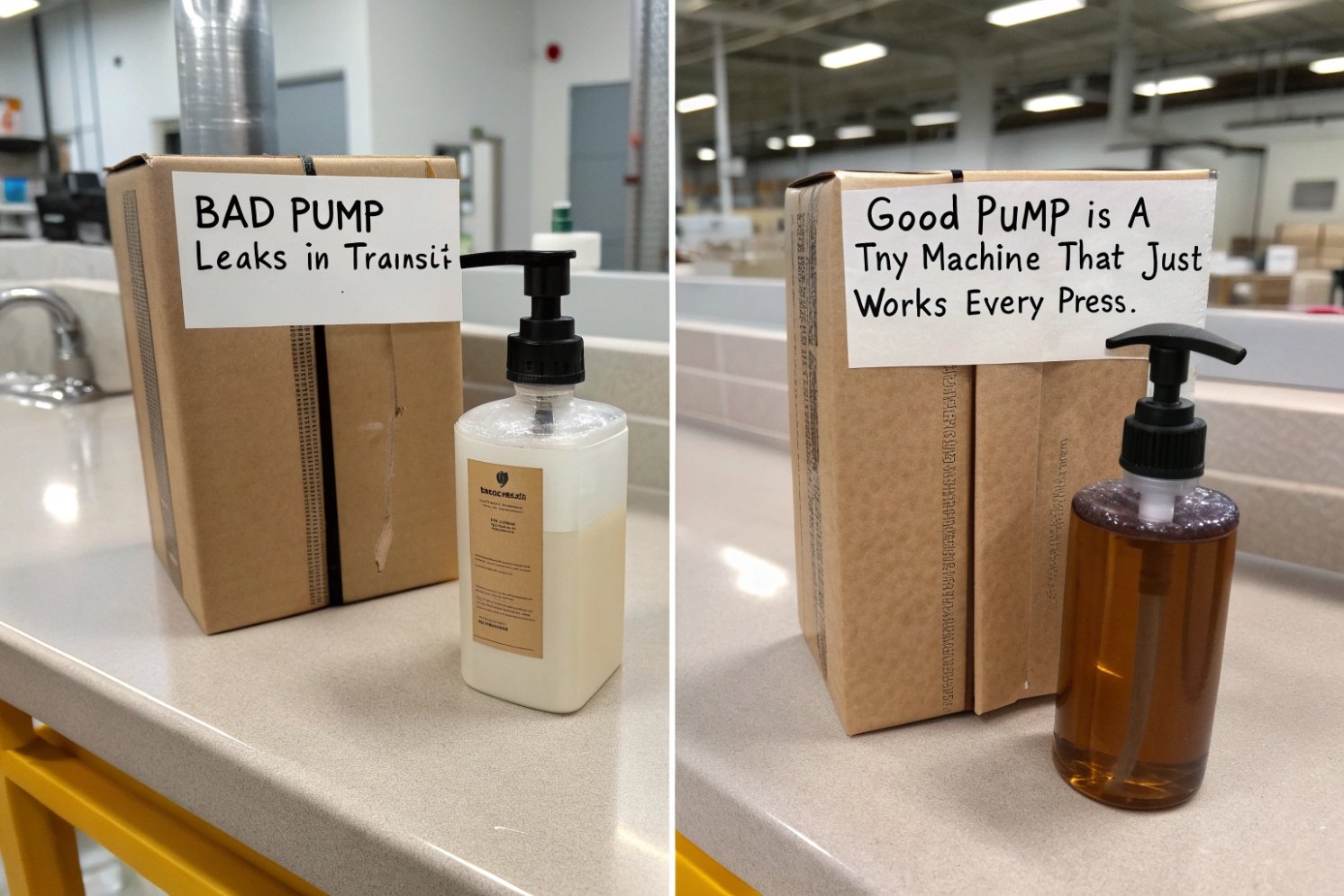
A lotion pump looks simple, but one weak part can cause leaks, messy shipments, and bad reviews. In bulk orders, tiny defects become big losses.
A lotion pump is a small piston pump with a spring and one-way valves. Each press pushes a measured dose out, and each release pulls new product up the dip tube without backflow.
The basic idea behind every lotion pump
A lotion pump is a controlled “push and pull” system built on a piston pump mechanism 1{#fnref1}. The pump has a sealed chamber. Inside that chamber, a piston moves up and down. A spring resets the piston after each press. One-way valves guide the flow, so the product moves in one direction only.
On the downstroke, the actuator is pressed. The stem pushes the piston down. Pressure rises in the chamber. The inlet valve closes, so product does not go back into the bottle. At the same time, the outlet path opens and product exits through the nozzle.
On the upstroke, the hand releases the actuator. The spring pushes the piston back up. The chamber volume increases. Pressure drops. The outlet valve closes, so air does not pull back from the nozzle. The inlet valve opens, so product is pulled up through the dip tube to refill the chamber.
New pumps often need priming. The first few strokes move air, not product. Once the chamber fills, the output becomes stable. Larger chambers often need more priming strokes.
This mechanism matters because it connects packaging to user experience. A smooth pump feels premium. A dripping pump feels cheap. A pump that needs 15 strokes to prime feels broken, even if it is not.
Below is a simple sourcing view of what makes pumps “work well” in the real world.
| What the user wants | What the pump must control | What the buyer must specify |
|---|---|---|
| Clean dispensing | Valve seal + suck-back | Valve type, nozzle design |
| Stable dose | Chamber volume + piston fit | Output per stroke, tolerance |
| No leaks in transit | Gasket + lock feature | Gasket material, lock style |
| Works with thick formulas | Flow path + spring force | Viscosity range, orifice size |
A pump is not only a closure. It is a system. The bottle neck finish, gasket, formula, and shipping method all matter.
The next part breaks down the internal parts, because knowing each part makes supplier conversations faster and more accurate.
What are the key internal parts of a lotion pump and what does each do?
Many buyers call it “a pump,” but the factory sees a small machine. Each part has a job. If one job fails, the whole pump feels wrong.
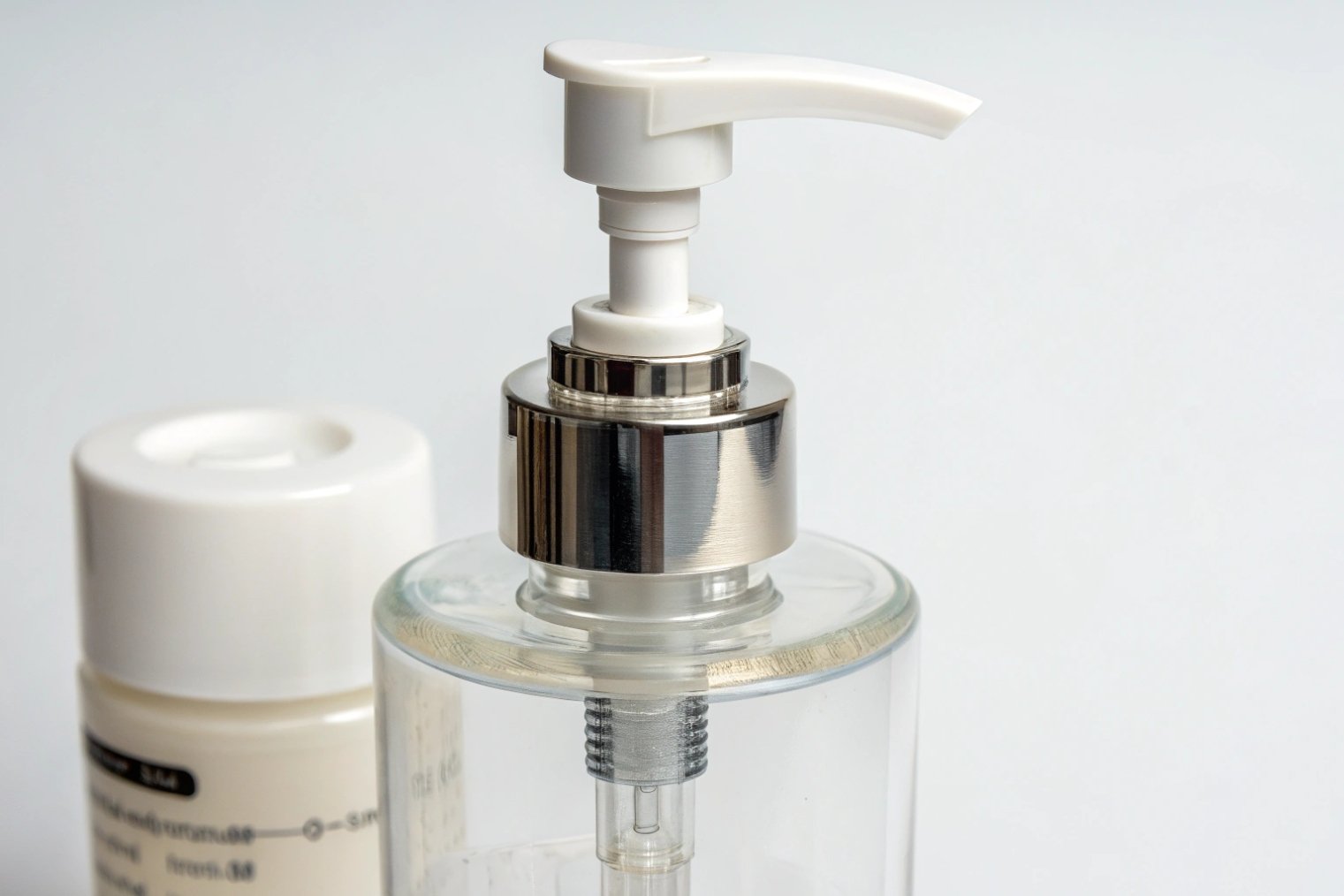
The key parts are the actuator, collar/closure, gasket, housing, piston and stem, spring, one-way valve (often a ball), and the dip tube. Each part controls dose, sealing, and flow direction.
The parts that customers touch and see
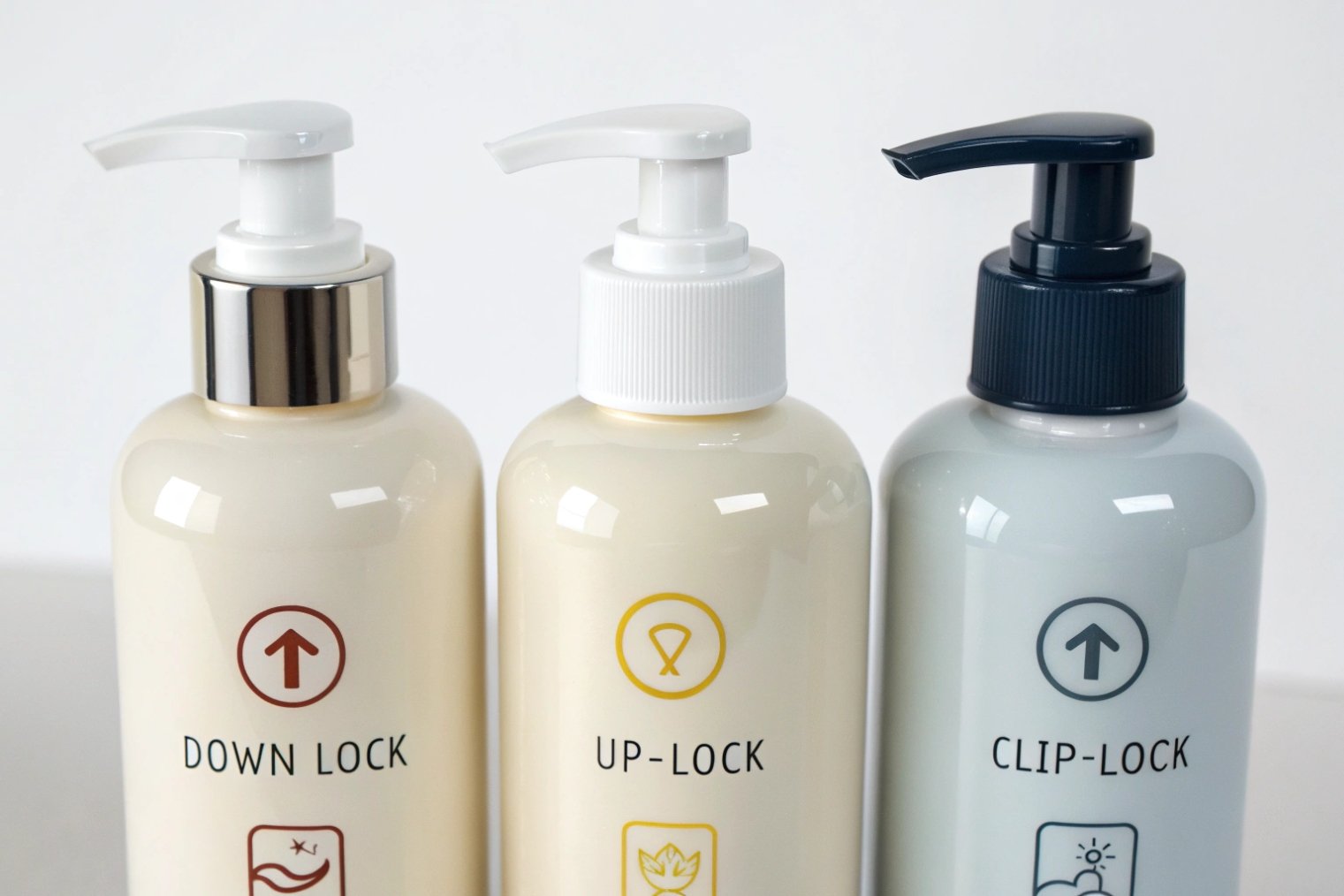
The actuator is the top head. It shapes the stream and controls the feel of the press. Many actuators include a lock feature like twist-to-lock or down-lock. The collar or closure is the threaded part that fixes the pump to the bottle neck.
The parts that do the pumping
Inside the housing, a piston slides in a chamber. The spring pushes the piston back up after each press. The stem connects the actuator to the piston and also forms the product path to the nozzle.
The parts that stop backflow
Most lotion pumps use at least one check valve. The common inlet check valve is a small ball that seats and unseats with pressure changes. Some designs also use an outlet valve. These valves make the pump one-way, which is the core job of one-way check valves 2{#fnref2}.
The parts that prevent leaks
The gasket and other seals create a tight seal at the neck finish and inside the pump. Seal material choice is not a detail. It decides chemical resistance. For example, EPDM rubber gasket materials 3{#fnref3} often handle many chemicals well but can struggle with some oil-heavy formulas. FKM is often used when oils or solvents raise compatibility risk, and FKM fluoroelastomer seals 4{#fnref4} are often chosen for tougher chemical exposure.
A practical “parts map” for sourcing
This table helps when asking a supplier for drawings, BOM, and material specs.
| Part | Main job | Common materials | What to watch in bulk |
|---|---|---|---|
| Actuator/nozzle | User feel + spray/stream shape | PP, sometimes ABS | Cracks, flash, rough edges |
| Closure/collar | Fit to neck finish | PP | Thread mismatch, torque issues |
| Gasket/seal | Stop leaks at the neck | PE, TPE, EPDM, FKM | Swell, shrink, stress cracks |
| Housing/chamber | Holds piston and valves | PP/PE | Warping, poor sealing surfaces |
| Stem | Transfers force + flow path | PP/PE | Poor fit causes dose drift |
| Piston | Creates pressure and suction | PE/TPE | Wear, inconsistent dose |
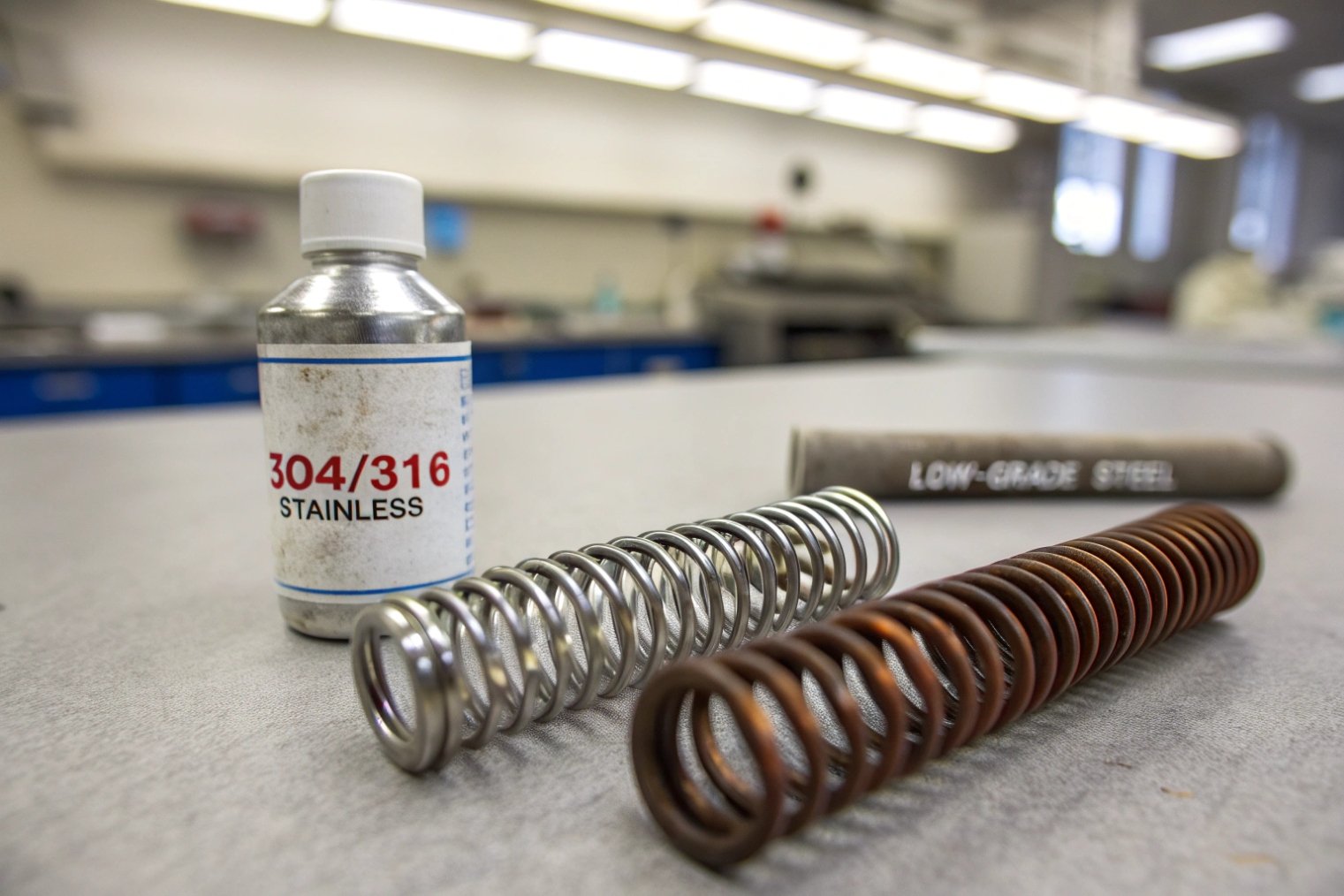
| Spring | Returns piston | Stainless steel, or external-spring designs | Corrosion, force variation |
| Check valve (ball) | One-way inlet flow | Glass, stainless, plastic | Poor seating causes backflow |
| Dip tube | Pulls product from bottle | PE | Wrong length, tube kinks |
A clear parts list makes it easier to prevent “silent substitutions.” In large orders, small material changes can appear if control is weak. The best suppliers lock the BOM and run change control.
Next, the flow control story matters most: how the pump stops leaking and backflow while still feeling smooth.
How does a lotion pump prevent backflow and leaking while still dispensing smoothly?
Backflow and leaking usually show up after shipping, temperature swings, or rough handling. Many teams blame the pump factory, but the real cause can be a mismatch between pump, bottle, and formula.
A lotion pump prevents backflow with one-way valves and prevents leaks with tight seals and controlled venting. Smooth dispensing comes from the right spring force, piston fit, and nozzle design.
One-way valves: the “traffic lights” of the pump
The inlet valve opens only when suction is created on the upstroke. On the downstroke, pressure pushes the valve closed. This stops product from draining back into the bottle. Many designs use a ball valve at the bottom of the chamber for this job.
Some pumps also include an outlet valve to control what happens near the nozzle. This helps avoid dripping and helps keep air from being pulled backward through the nozzle during the return stroke.
Seals and venting: stop leaks without locking the bottle
A pump must allow air to enter the bottle as product leaves. Without venting, a vacuum forms and dispensing becomes hard. Many pumps have a vent path that lets air in while keeping product in. This vent path must work with the bottle and the gasket design.
Leaks often come from:
- A gasket that does not match the neck finish
- Wrong torque during assembly
- Seal material swelling in the formula
- A cracked housing from stress or impact
Suck-back: the anti-drip trick
Some pumps use a “suck-back” feature. After dispensing, a small negative pressure pulls leftover product back into the nozzle. This reduces drips and keeps the tip cleaner. It also helps in e-commerce because product does not smear on the cap area.
What to look for in designs that claim “no leak”
Marketing words are cheap. A buyer should connect each claim to a real feature.
| Problem seen in the market | Real mechanical cause | Design feature that helps | Buyer note |
|---|---|---|---|
| Dripping nozzle | Residual product at tip | Suck-back / outlet valve | Test after 10 strokes |
| Product drains back | Inlet valve not sealing | Better ball seat fit | Check valve material |
| Leaks at neck | Poor gasket seal | Correct gasket + torque | Match neck finish spec |
| Hard to press | Vacuum or thick formula | Vent path + stronger spring | Test at cold temp |
| Foamy spurts | Air in chamber | Better priming + valve seal | Count prime strokes |
A smooth pump is not only “soft.” It is consistent. Consistency comes from stable spring force and tight piston-to-chamber tolerance.
Next, matching pump output, viscosity range, and dip tube length is where many projects win or lose.
How do you match pump output (dosage), viscosity range, and dip tube length to different bottle sizes and formulas?
When pump output is wrong, customers either waste product or get annoyed. When viscosity is wrong, the pump either jams or spits. When dip tube length is wrong, the bottle looks fine but cannot empty well.
Match output by choosing chamber size and stroke design, match viscosity by choosing the right flow path and spring force, and match dip tube length by cutting to bottle height with the right tube angle and diameter.
Output per stroke: set the “dose promise”
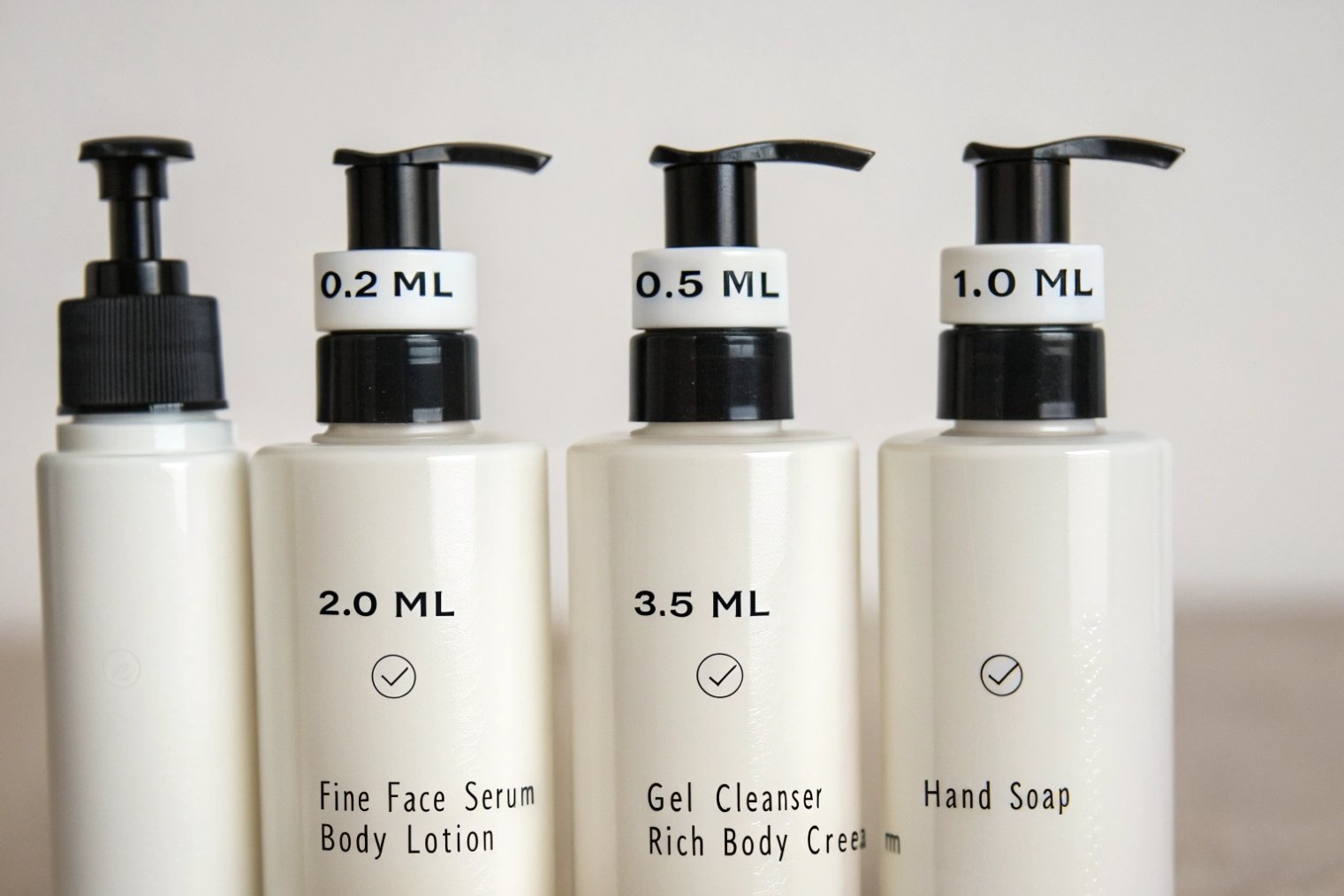
Output is commonly stated as mL (cc) per stroke. Many lotion pumps sit around sub-1 mL to a few mL per press, depending on the chamber. A hand soap pump may need a bigger dose than a face serum pump.
Output should match how users apply the product:
- Face lotion often feels right around smaller doses
- Body lotion often needs higher doses
- Hair conditioner often needs high-output pumps
Output must also match viscosity. A high-output pump on a very thick cream can feel heavy and may not recover well.
Viscosity range: test with the real formula
Suppliers may list a viscosity range, but the best proof is a fill test with the real formula at real temperatures. A formula that pumps fine at 25°C can become slow at 10°C. Thick products also need a wider flow path and sometimes a larger nozzle orifice. If teams need a shared reference, start with viscosity fundamentals 5{#fnref5} so “thin vs thick” becomes measurable.
Also, watch compatibility:
- Oil-rich formulas can swell some gasket materials
- Solvents and fragrances can stress plastic parts
- Metal springs in the product path can raise concerns for some formulas
Some designs keep the spring out of the product path to reduce contamination risk, but they often cost more.
Dip tube length and cut: the simple detail that ruins fit
The dip tube must reach near the bottom without bending or blocking. If it is too short, product stays unused. If it is too long, the pump may not seat or the tube may curl and restrict flow. An angled or V-notched cut at the tube end helps prevent the tube from sealing flat against the bottle base.
| Bottle size | Typical user behavior | Common output target | Dip tube notes |
|---|---|---|---|
| 30–50 ml | Controlled use | Low output | Tight length tolerance matters |
| 100–200 ml | Daily routine | Medium output | Use angled cut for better evacuation |
| 250–500 ml | Body care/soap | Medium-high output | Strong lock for shipping helps |
| 1 L+ | Salon/cleaning | High output | Tube ID may need to be larger |
A good match process is simple:
1) Lock the bottle neck finish and shoulder design.
2) Choose a pump family with a realistic output range.
3) Run viscosity and temperature tests with the real formula.
4) Cut dip tubes to spec and verify seating torque.
Next, bulk problems and test plans decide whether the project scales smoothly.
What common lotion pump failures happen in bulk orders, and how can you test pumps before mass production?
A sample can be perfect and a bulk order can fail. This is common in dispensing components because tolerance stacks up across many small parts.
Common failures include leaking, dose inconsistency, poor priming, cracked actuators, valve sticking, and compatibility issues. Strong pre-production testing checks sealing, output, cycle life, shipping stress, and formula compatibility.
The failures that show up most often
In bulk orders, these problems appear again and again:
- Leaks at the neck after transit
- Dripping nozzles that smear cartons
- Pumps that need too many priming strokes
- Output that varies from unit to unit
- Actuators that crack or locks that fail
- Dip tubes that pop off or kink
- Valves that stick, causing “no pump” complaints
- Seal swelling or stress cracks after weeks in contact with the formula
These failures often come from one of three roots: part tolerance drift, material substitution, or weak assembly control.
A simple test plan that catches most risks
A buyer does not need an expensive lab to catch most problems. A practical test plan combines quick checks and a few longer tests.
| Test | What it checks | How to run it | What “pass” looks like |
|---|---|---|---|
| Incoming visual + dimensions | Mold quality and fit | Sampling inspection | No cracks, stable key sizes |
| Torque test on bottle | Neck seal and threads | Apply target torque | No leaks, no thread slip |
| Leak test (upright + inverted) | Gasket and valve seal | Time-based hold | No wetness at collar/nozzle |
| Prime stroke count | User experience | Count strokes to first dose | Stable within set limit |
| Output per stroke | Dose control | Weigh 10 strokes, average | Within tolerance window |
| Cycle test | Wear and valve stability | 1,000–5,000 strokes | No output drop, no failure |
| Temperature test | Cold/hot performance | Store then test output | Still pumps smoothly |
| Compatibility soak | Seal/material resistance | Weeks in formula | No swell, cracks, discolor |
| Transit simulation | E-com robustness | Drop/shake with locks | No leaks, lock stays closed |
For e-commerce, lock performance is a big deal. A pump that unlocks in transit can ruin a whole carton. For export, temperature swings matter. A hot container can soften parts and change sealing. A cold warehouse can raise viscosity and make pumping hard.
Supplier documents that protect the buyer
Before mass production, these documents help control risk:
- Assembly drawing and exploded view
- BOM with material grades (actuator, housing, gasket, spring, ball)
- Output spec with tolerance
- Dip tube length and cut spec
- QC plan and AQL acceptance sampling plan 6{#fnref6}
- Change-control promise for material and mold changes
If your channel includes parcel shipping, require a transit method aligned to ISTA 3A package testing 7{#fnref7} so leaks and breakage show up before bulk.
When these tests and documents are in place, the pump becomes predictable. Predictable packaging is what keeps brands calm when orders scale.
Conclusion
A lotion pump is a piston, spring, seals, and one-way valves working as a system. Clear specs, compatibility checks, and realistic testing prevent leaks, dose drift, and bulk-order surprises.
Footnotes
-
Learn how piston pumps meter fluid via a moving piston, matching lotion pump core mechanics. ↩ ↩
-
Understand check valves and how they stop backflow in small dispensing systems. ↩ ↩
-
EPDM rubber properties for seals; helps judge compatibility with water-based formulas. ↩ ↩
-
FKM fluoroelastomer overview for oil/solvent resistance when formulas swell standard gaskets. ↩ ↩
-
Viscosity basics to align pump selection with formula thickness and temperature changes. ↩ ↩
-
AQL sampling explanation to set measurable accept/reject rules for pump and bottle QC. ↩ ↩
-
ISTA 3A overview for parcel-shipping hazards used to validate leak prevention and packaging durability. ↩ ↩






