
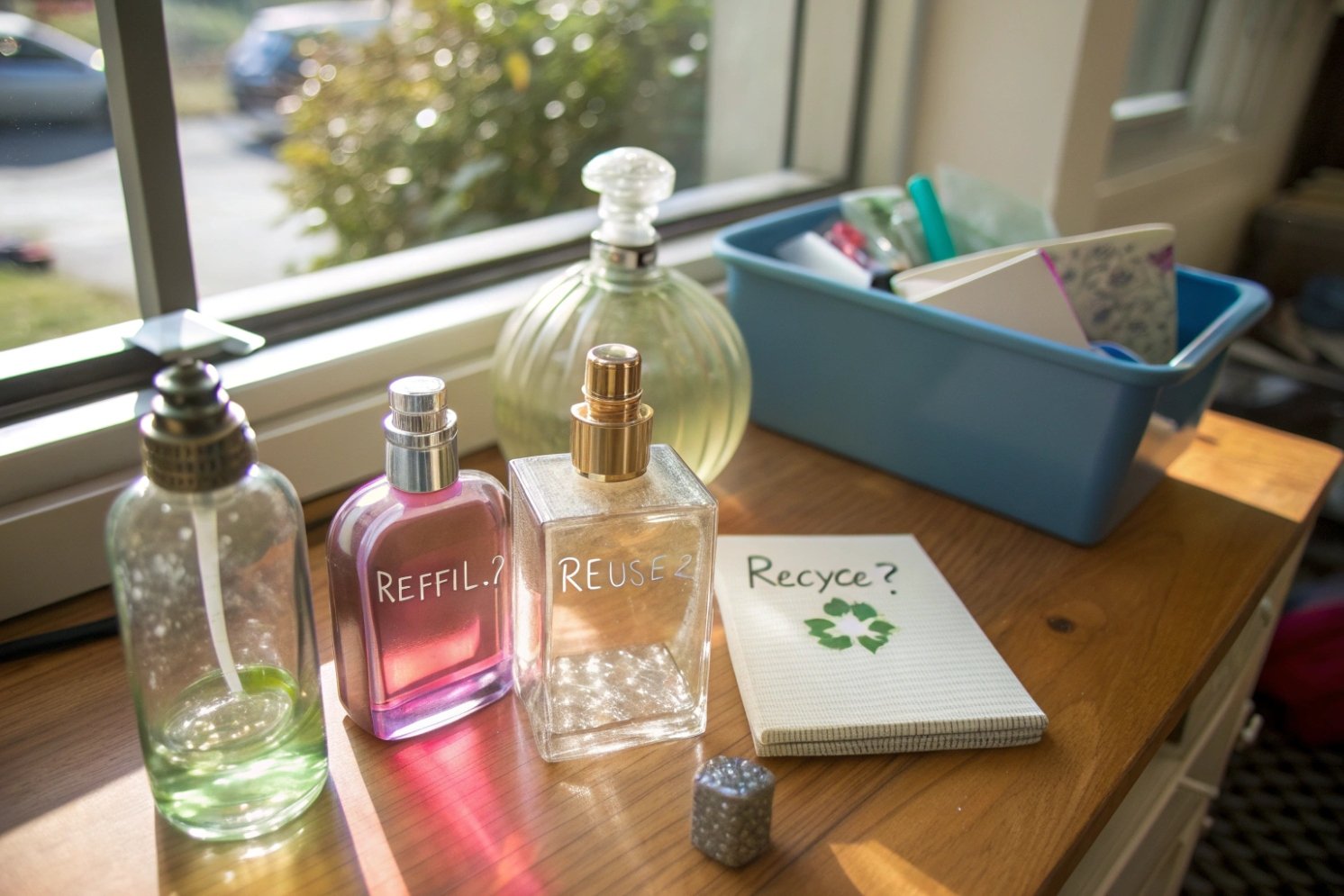
Empty perfume bottles look too beautiful to throw away, yet there is real confusion about safety, refilling, and what brands actually support.
Perfume bottles can be safely reused when cleaning, materials, and sealing are handled correctly, and when reuse stays within cosmetic/home-fragrance applications—not food, drink, or high-risk DIY experiments.
In practice, reuse is not one simple yes or no. It depends on how the bottle was sealed, what lived inside it, which components you change, and what you plan to put back in. For brands and retailers, the question is bigger: which refill, returnable packaging systems 1, or take-back model makes sense commercially, and how do we protect product quality while telling a strong sustainability story.
When is sanitizing and refilling safe—and when isn’t it?
Many people rinse a bottle, pour in a new perfume, and only later realize the scent smells “muddy” or the pump has started to leak.
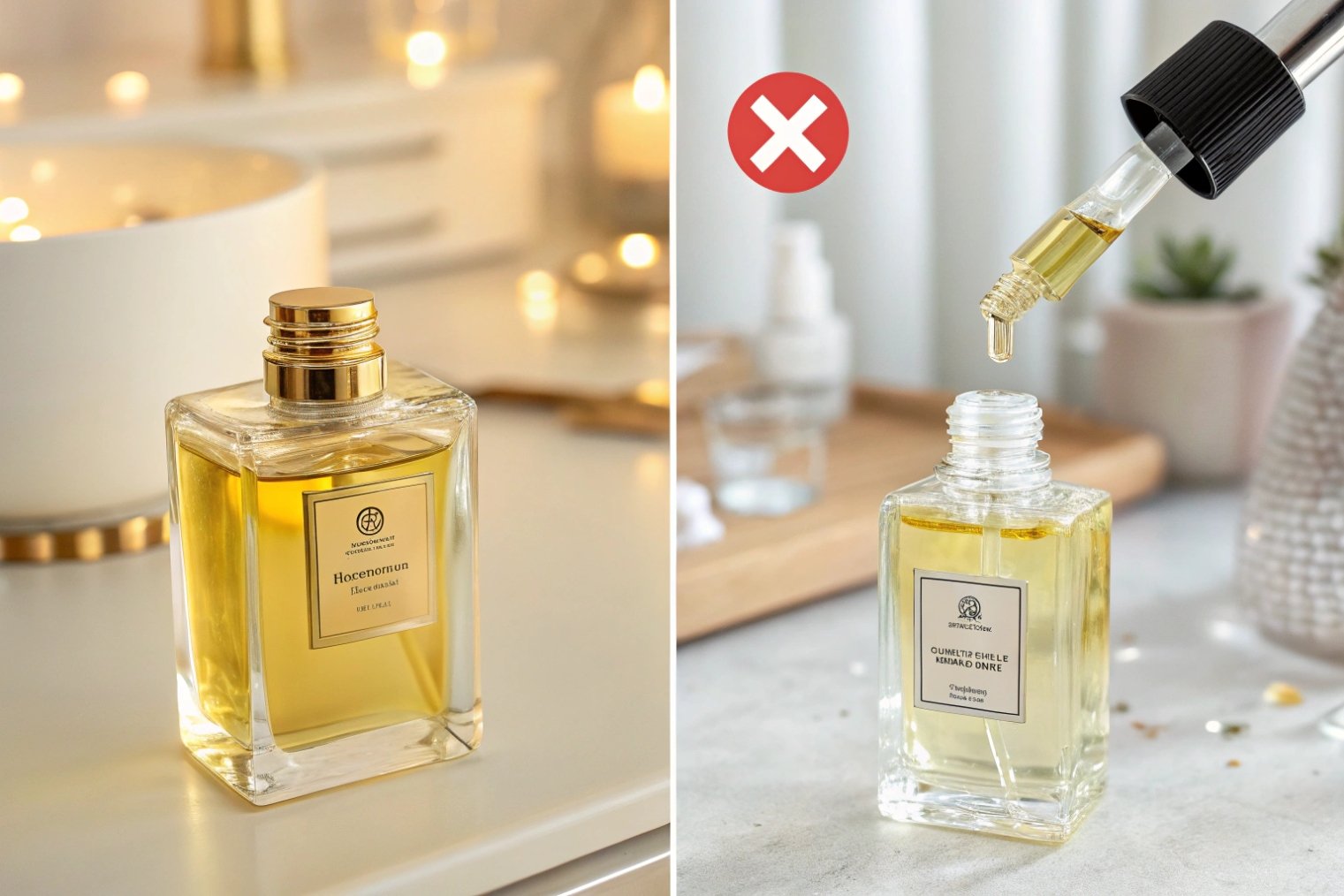
Sanitizing and refilling is generally safe when the bottle stays in the same category (perfume or home fragrance), is cleaned well, and is not reused for food, drink, or untested skin-contact products.
Safe scenarios for refilling
It helps to start from the original intent. Perfume bottles are designed for alcohol-based fragrances. The glass is usually fine for repeated use with similar formulas. The main questions are hygiene, material compatibility, and sealing. When the bottle holds the same perfume again, or a very similar style of fragrance, risk is low if cleaning is careful. This applies both to full-size bottles and to travel atomizers.
Some brands now sell official refills. In that case, the safest path is to follow their instructions: clean only as directed, refill only with the specified product, and keep the bottle within its original use. If the bottle has a removable screw pump, the process can be simple. If it has a crimped pump, refilling usually happens via a dedicated refill port or by using a bottom-fill travel atomizer that taps the spray head, instead of forcing the main bottle open.
When refilling is not a good idea
There are clear red lines. Perfume bottles should not be reused for anything that might be eaten, drunk, or used in direct contact with the mouth. Food-contact packaging requirements 2 follow different testing and regulatory routes. Old fragrance and solvent residues may stay trapped in joints or coatings even after a good clean.
High-risk uses also include eye products, nasal sprays, or medical-style solutions. The pump and bottle were not designed for that. Even switching from one perfume family to another can be a problem if cleaning is rushed. For anything intended for skin, reputable brands typically formulate within safety frameworks like the IFRA Standards 3, plus applicable cosmetic regulations.
The sealing method matters too. Many commercial bottles are crimp-sealed perfume pumps 4 and never designed to be opened and closed again. De-crimping and re-crimping requires specialist tools and skill. An imperfect reseal can leak, weep, or let in air faster than intended, which affects both safety and shelf life.
A simple overview:
| Scenario | Reuse Status | Comment |
|---|---|---|
| Same perfume, official brand refill | Generally safe | Follow brand’s cleaning and refill instructions |
| Similar alcohol-based fragrance, same owner | Usually safe | Deep clean, keep for personal use only |
| Home-fragrance oil (reed diffuser, room spray) | Often safe | Stay in home-fragrance category |
| Food or drink (oil, vinegar, spirits, water) | Not safe | Bottle is not tested for food-contact |
| Eye or medical-style liquids | Not safe | Design and testing do not cover this use |
| Random mix of leftover perfumes | Technically possible, risky | Often smells muddy and wastes product |
When there is doubt, it is better to send the bottle into a proper recycling or return program than to push it into a use it was never meant to handle.
What gasket, pump, and cap replacements are necessary?
Even when the glass looks perfect, an old or damaged pump can leak, dribble, or spray in a harsh jet that ruins the experience.
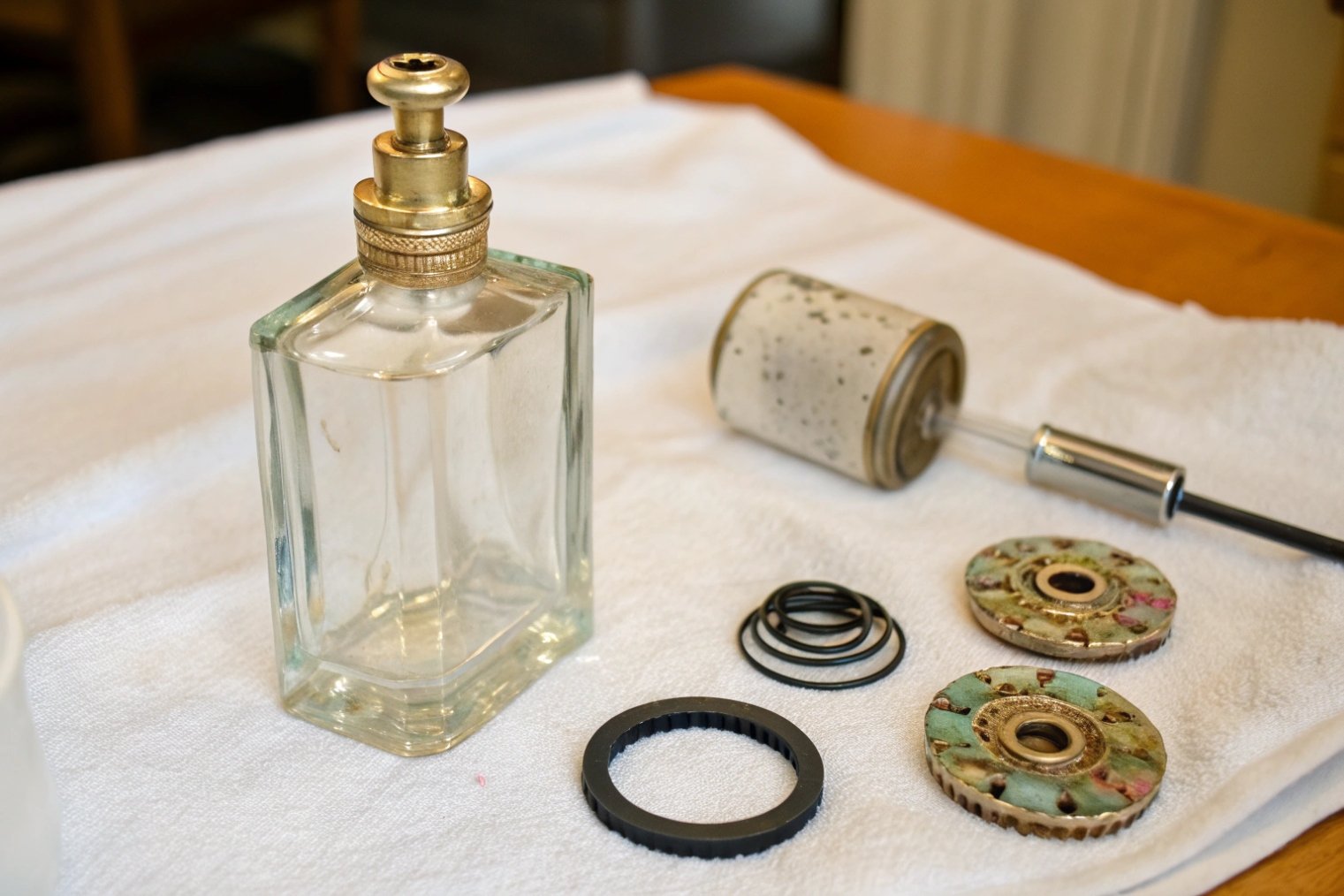
For serious reuse, it is usually best to keep the glass only and replace the pump, gaskets, and sometimes the cap with fresh, fragrance-compatible components that match the neck finish.
Why components age faster than glass
Glass is very stable. It does not change shape or absorb perfume. Pumps and gaskets behave differently. Springs, valves, and elastomer seals cycle with every spray. Over time, they can wear, harden, or swell. Alcohol and fragrance oils are also tough on some plastics and rubbers, especially if the material choice was more about cost than long-term reuse.
If the pump starts to leak at the base, sticks when pressed, or sprays in an uneven fan, it is sending a clear signal. For a refillable project, reusing that worn pump would be a false economy. The same is true for gaskets. A tired or cracked gasket around the neck can let in air and let out scent, even if the pump still works.
Crimp vs screw: what can be replaced
Crimped pumps are locked to the neck with a metal ferrule. They are hard to remove without denting the ferrule or chipping the glass. In factory settings, there are de-crimping tools, but even then perfect reseals are not guaranteed. This is one reason many refill concepts now use deliberately refillable architectures, like screw pumps or dedicated refill ports, instead of standard crimp-only designs.
Screw pumps and screw caps are much easier to refresh. You can unscrew the whole assembly, discard the old pump, and fit a new one with a fresh gasket. As long as the thread standard is known (for example, a common FEA or DIN neck), replacement is straightforward.
A simple component guide:
| Component | Reuse in Simple Upcycling | Reuse in Serious Refilling | Best Practice |
|---|---|---|---|
| Glass body | Yes, if undamaged | Yes | Inspect for cracks, chips, coatings |
| Crimp pump | Maybe, for short-term decanting | Not ideal for multiple refill cycles | Prefer new pump or purpose-built design |
| Screw pump | Yes, for same perfume | Replace for long-term reuse | Use new gasket and matching thread |
| Gasket | Avoid reusing if cracked or hard | Replace | Choose alcohol-resistant material |
| Decorative cap | Yes, if it still fits well | Yes | Check grip and align with new pump |
For brands planning refillable systems from day one, it makes sense to standardize on neck finishes and pump families that are easy to source and replace. This keeps the refill program scalable instead of custom for each bottle.
How do you remove residual scent to avoid cross-contamination?
Nothing kills the excitement of a new fragrance faster than discovering it still smells like the last one that lived in the same bottle.
Removing residual scent means combining mechanical cleaning (soap, hot water, agitation) with a strong solvent rinse and enough time to dry and air out, and accepting that some bottles will never be fully neutral.
Mechanical cleaning: soap, water, and agitation
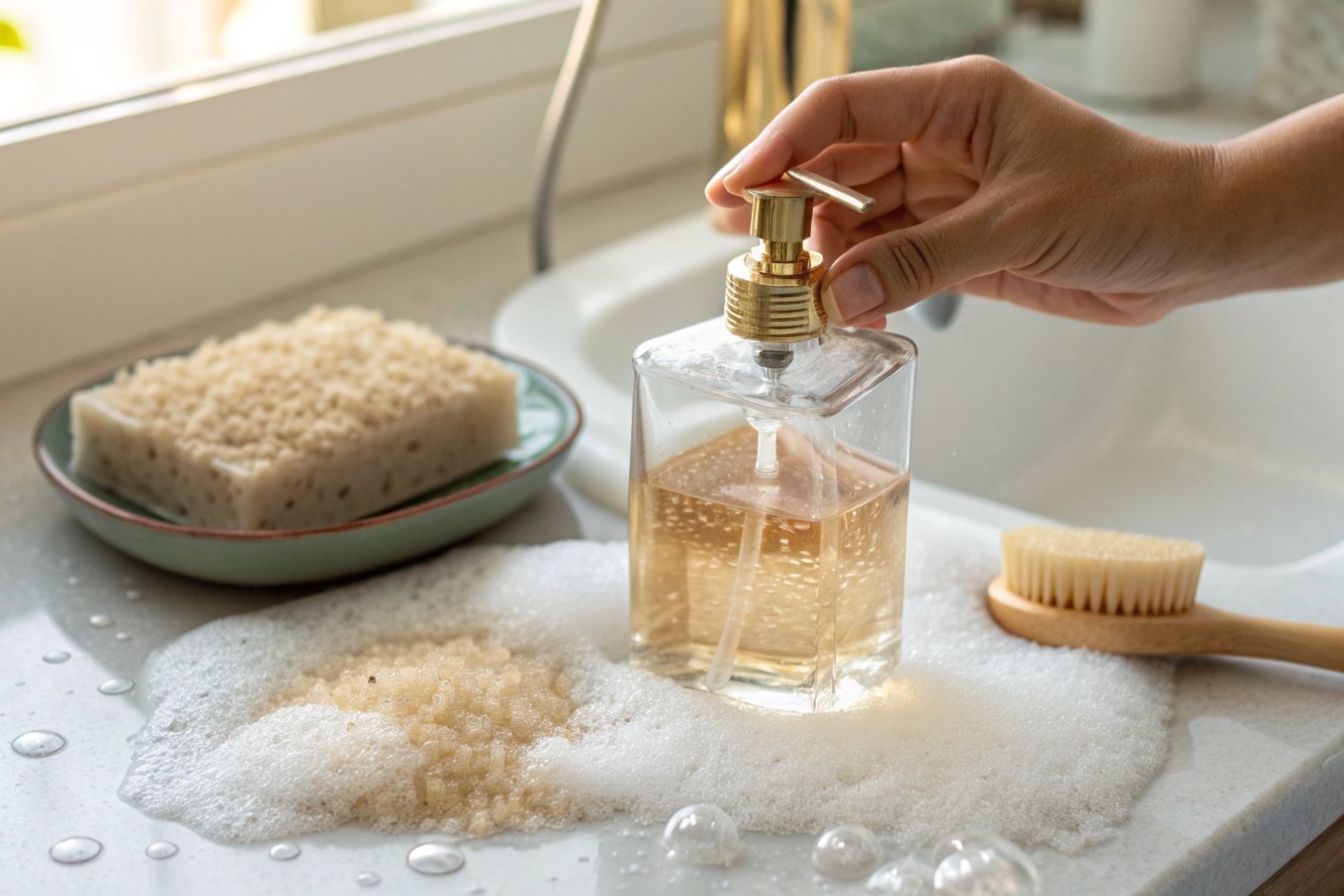
The first goal is to remove visible and oily residues. Warm water and a small amount of unscented dish soap work well for this. Fill the bottle, shake, and let it soak. A soft bottle brush helps reach corners and the shoulder where oil can cling. For stubborn rings at the base, a spoonful of uncooked rice can act as a gentle abrasive. Shake the bottle with rice and soapy water to scrub the surfaces.
If the pump will be reused for the same perfume, pumping soapy water through the system can clear internal passages. For cross-use with a new scent, this is less reliable, since some internal parts may still hold perfume in pores and seals.
Solvent rinse: alcohol as a scent stripper
Mechanical cleaning often leaves a faint smell. A high-proof solvent rinse is the next step. Cosmetic-grade ethanol or isopropyl alcohol is the usual choice. If you are using isopropyl alcohol, review a Safety Data Sheet for isopropyl alcohol 5 and follow safe ventilation and flammability precautions. Pour a small amount into the bottle, swirl to wet all inner surfaces, and let it sit briefly. If the pump will stay, a few sprays of this alcohol through the sprayer can push old scent out of the internals.
Afterwards, drain the alcohol and either follow with a quick rinse of clean water or go straight to drying, depending on use. Be aware that both perfume and cleaning alcohol are flammable. Work away from open flames or hot surfaces, and allow enough ventilation for vapors to disperse.
Drying, airing, and deciding when to stop
Drying is just as important as washing. Any leftover moisture will dilute the next perfume and can introduce off-odors later. Let the bottle dry upside down on a rack for at least 24 hours. If there is time, leave it open for longer so the last traces of smell can escape.
In reality, some deeply scented bottles never become fully neutral. Heavy resins, gourmands, and oud-forward fragrances can anchor themselves in seal materials or internal coatings. For those, a practical compromise is to keep the bottle for a similar scent family or for decorative reuse instead of trying to host a very different fragrance.
A quick method comparison:
| Method | Best Use | Pros | Limits |
|---|---|---|---|
| Warm soapy water + brush | First clean for most bottles | Simple, low cost | Often leaves light residual scent |
| Rice agitation | Stubborn base and shoulder deposits | Gentle scrubbing inside the bottle | Not useful for pump internals |
| Alcohol rinse | Removing light residual odors | Strong solvent, fast drying | Flammable, may not clear very heavy scents |
| Long air drying | Final step before refill or décor | No chemicals, safe | Needs time and dust-free environment |
For brand-level refill programs, it is often safer to avoid full scent removal on returned bottles altogether and instead design systems where the fragrance never changes inside the same container, or where the refill is an insert rather than a direct re-use of the original interior.
Which refill or take-back models work for brands and retailers?
Consumers ask for less waste and more reuse, but brands and retailers still need clean operations, strong margins, and a clear quality story.
The refill and take-back models that work best are simple to explain, easy to run at scale, and keep sensitive fragrance handling inside controlled systems, not random DIY experiments at the counter.
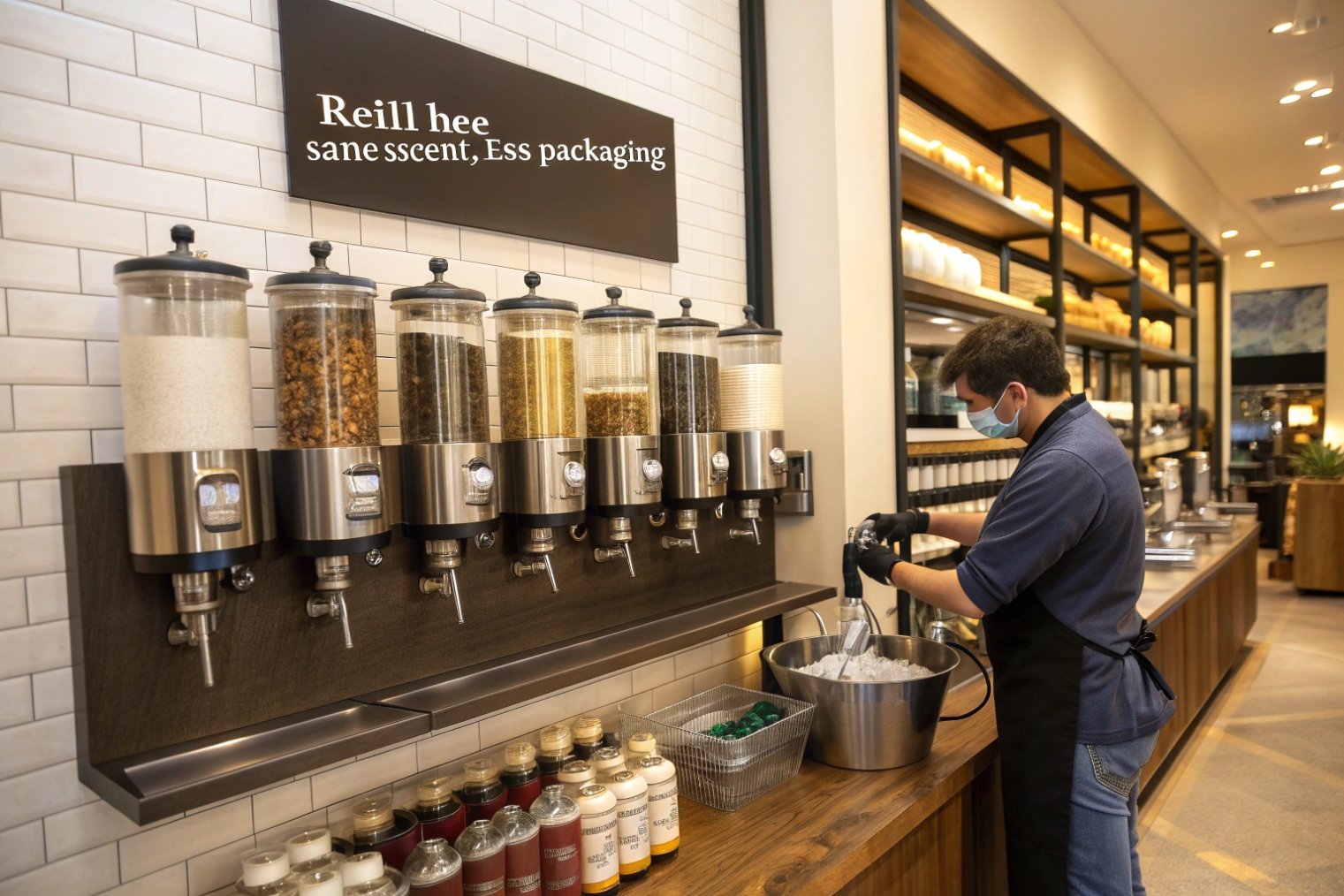
In-store refills in controlled systems
One path is in-store refilling. Here, customers bring back their branded bottle and refill from a bulk container or a dedicated refill fountain. Staff control the process: check the bottle, clean the neck if needed, and refill with a closed hose or valve. This model works best when:
- The bottle design is refill-friendly (screw pump, wide opening, or dedicated port).
- The store has space and training for safe handling of alcohol-based liquids.
- There is a clear visual and price incentive for customers to engage.
This system keeps fragrance quality inside brand control and reduces packaging per refill. It does require investment in equipment and hygiene protocols.
Factory-based refills and branded returns
Another model is factory-based refill or re-manufacture. Customers return empty bottles through stores or mail. The brand then sorts, cleans, and refills them in a controlled industrial process. This is closer to how some beverage refill systems work. It can support strong sustainability messaging, but it needs robust reverse logistics 6, inspection, and washing lines.
Not every bottle is a candidate here. Very complex decorations, delicate coatings, or fragile attachments may not survive industrial washing. In those cases, it may be better to focus on recycling the glass and upcycling some special pieces for displays or limited editions.
Pre-filled refills and inserts
A more modular route uses pre-filled refills: inner glass bottles, cartridges, or pouches that drop into a long-life outer bottle. The consumer keeps the decorative outer shell and swaps the inner container when it is empty. This has several advantages:
- The perfume always sits in a known, clean inner vessel.
- The outer glass can be heavier and more sculptural.
- Retailers handle sealed units instead of bulk liquid.
The trade-off is that more components are produced overall. So the design needs to keep materials simple, compatible with recycling, and as mono-material as possible.
Take-back for recycling and upcycling
Take-back programs that focus on recycling rather than refilling are also useful. Customers drop off empties at counters or collection points. Brands partner with recyclers who can handle pumps, caps, and decorated glass correctly, and route material back into a credible glass recycling stream 7. Some programs also upcycle special shapes into displays, art pieces, or limited-edition runs.
A simple comparison of models:
| Model | Main Benefit | Best Fit |
|---|---|---|
| In-store liquid refill | Strong waste reduction, visible action | Flagship stores, brand boutiques |
| Factory refill / return | Tight quality control | Larger brands with strong logistics |
| Pre-filled refill inserts | Easy for retail, long-life outers | Premium ranges, giftable bottles |
| Take-back for recycling | Simple for consumers and staff | Multi-brand retailers, malls, airports |
For glass suppliers and fragrance houses, the most successful solutions usually start at the design stage. Neck finishes, pump choice, decorations, and glass weight all need to align with the chosen refill or take-back model. Doing this early turns “Can this be reused?” from a worry into a built-in feature of the bottle’s story.
Conclusion
Perfume bottles can be reused safely and profitably when cleaning, components, and program design respect what the glass was built for and keep reuse within well-defined, low-risk applications.
Footnotes
-
Learn how scaled reuse systems work and what design choices make returns and washing viable. ↩ ↩
-
Understand why food-contact containers require different compliance and safety pathways than fragrance packaging. ↩ ↩
-
See recognized fragrance safety standards used to guide skin-contact fragrance formulation and risk management. ↩ ↩
-
Learn what “crimping” is and why crimp seals are difficult to reopen and reseal reliably. ↩ ↩
-
Review handling hazards and flammability precautions before using isopropyl alcohol as a cleaning solvent. ↩ ↩
-
Understand the basics of returns flows that make take-back, sorting, and refurbishment programs workable. ↩ ↩
-
Learn how glass is collected and recycled, and why clean separation of components improves recycling outcomes. ↩ ↩






