
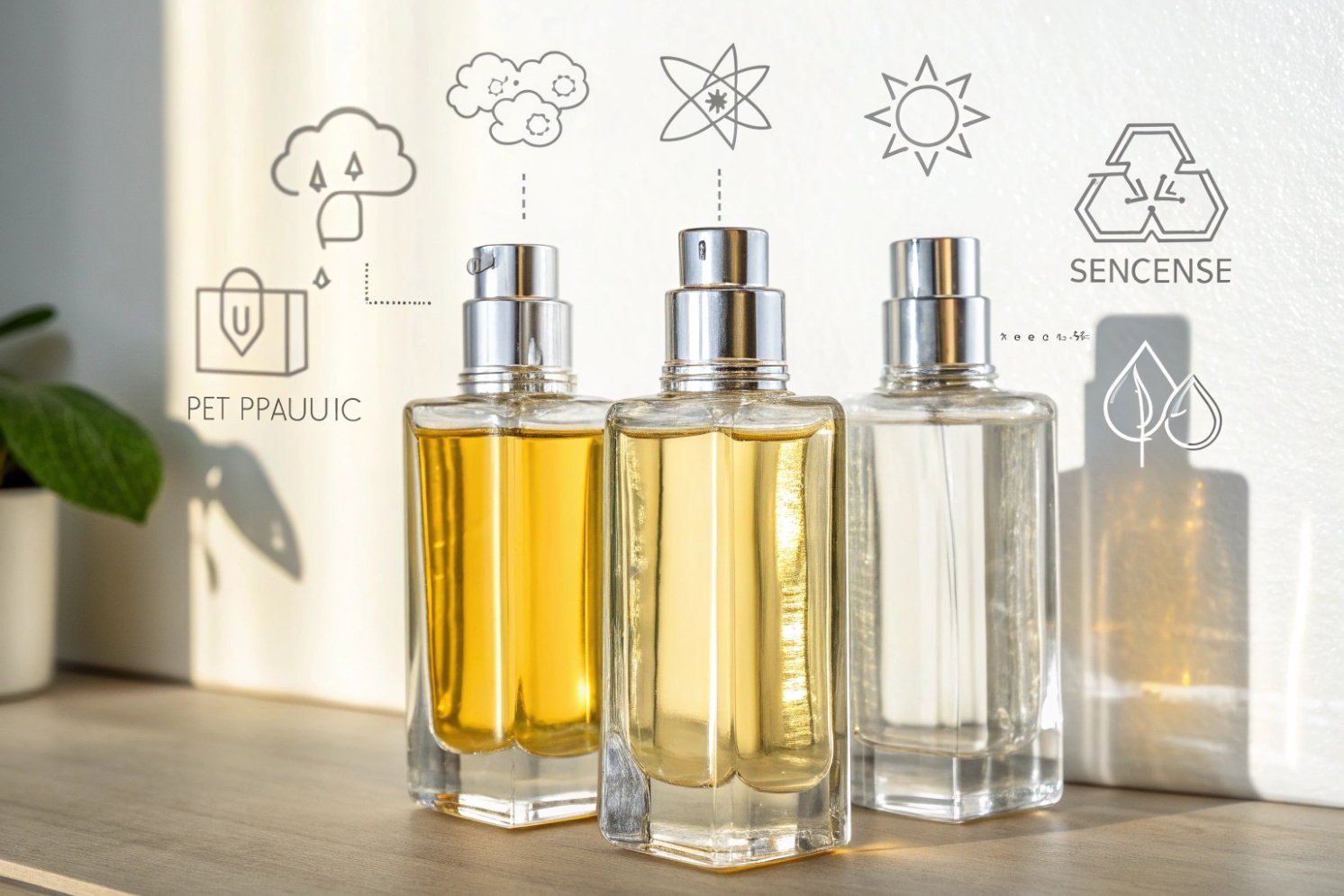
Bottle material is not only about weight and look. It also decides how fast a perfume fades, discolors, or picks up strange off-notes over time.
Glass, plastics, metals, tints, and inner coatings all change how much light, oxygen, and chemistry a perfume sees, so smart material choices are key to long-term scent stability.
When talking with fragrance brands, this topic comes up again and again. Someone spends months on a formula, then a year later the top note is flat or the juice has browned. Very often, the problem starts with the wrong material or the wrong combination of materials around the fragrance.
Does soda-lime vs. borosilicate glass change scent stability?
Many people assume “better glass” will give a longer-lasting perfume, so borosilicate sounds like an obvious upgrade.
For most fine fragrances, both soda-lime and borosilicate glass are chemically inert enough that scent stability is almost the same; light, oxygen, and closures matter far more than base glass type.
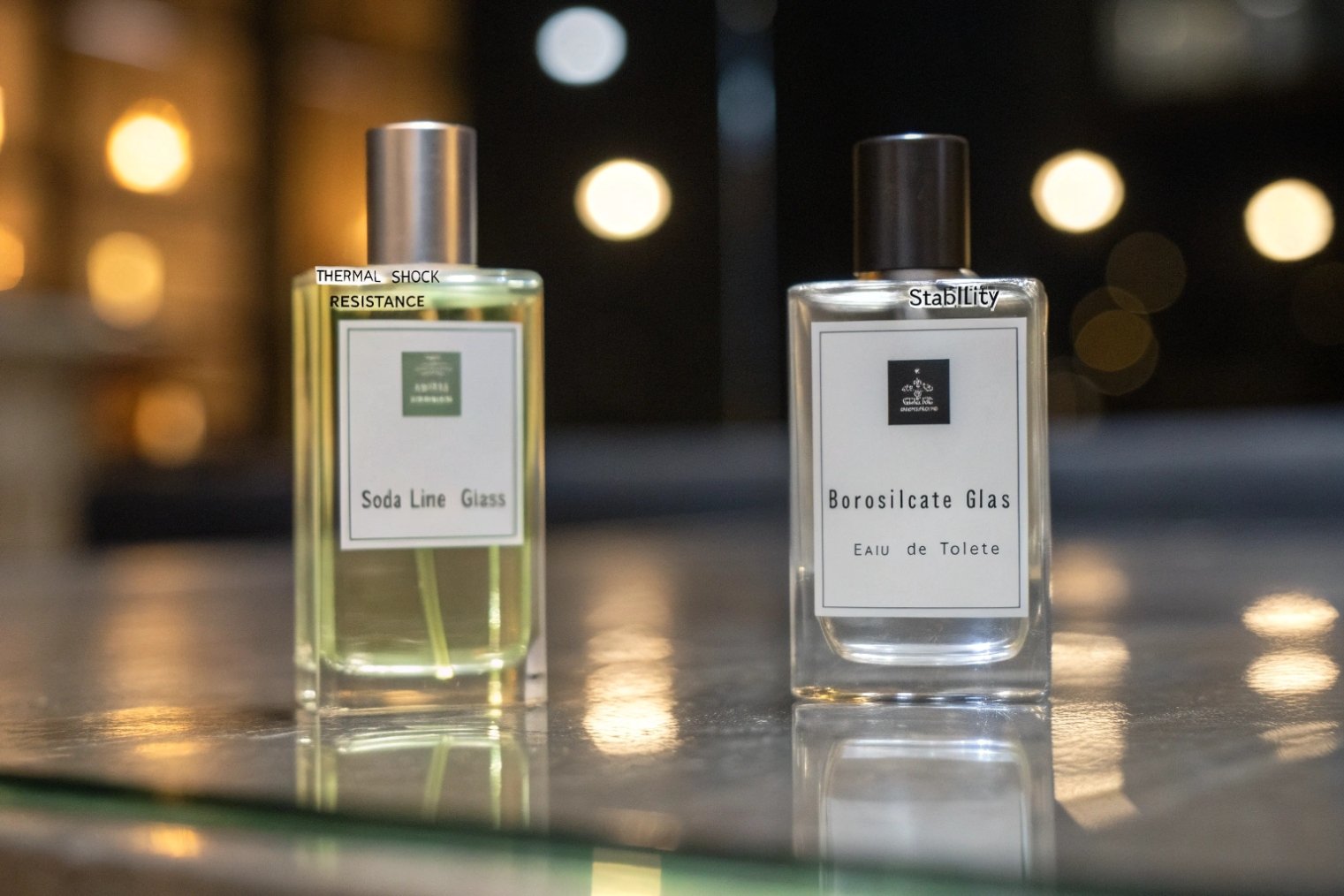
Glass types and their impact on perfume
Both soda-lime and borosilicate glasses are based on silica networks. The difference sits in modifiers:
- Soda-lime adds sodium, calcium, magnesium.
- Borosilicate adds boron and often a bit more alumina.
This change gives borosilicate a lower coefficient of thermal expansion 1{#fnref1} and better thermal shock resistance. That matters when glassware goes from oven to cold water. Perfume bottles never see that kind of abuse in normal life. They stay around room temperature, maybe a bit warmer in warehouses or bathrooms.
From a fragrance point of view, the key question is simple. Does the glass react with ethanol, water, and aroma chemicals? For both soda-lime and borosilicate, at perfume pH and alcohol levels, the answer is no in practical terms. Leaching is extremely low. There is no real “flavor scalping” from the glass itself.
A simple comparison:
| Property | Soda-lime glass | Borosilicate glass |
|---|---|---|
| Chemical inertness to EDT | Very high | Very high |
| Thermal shock resistance | Good enough for perfume use | Higher than needed |
| Cost and availability | Lower, widely used in bottles | Higher, more niche |
| Effect on scent profile | Negligible in normal use | Negligible in normal use |
When glass type can still matter
Even if the base glass is not a big factor for scent, some related points still matter:
- Surface quality and cleanliness: residues from forming, poor washing, or bad lubricants can sit on the inner wall, especially in cheaper bottles, and slowly taint a very delicate fragrance.
- Heavy metals: true lead crystal or old decorative decanters may leach lead into ethanol over time. This is a health and regulatory issue, and these pieces are not meant for long-term storage of perfume.
So for most perfume lines, well-made soda-lime glass is the right answer. Borosilicate is an option for special pieces or lab uses, but it does not suddenly make the scent more stable. Once glass meets a certain quality level, other parts of the pack become more important.
Can plastic or metal liners interact with essential oils or EDT bases?
Not every perfume lives in pure glass. Caps, dip tubes, pumps, and travel bottles often bring plastics and metals into the system.
Yes. Plastics and metals in contact with perfume can absorb, permeate, or react with fragrance components, so liner and pump material choice is critical, especially for citrus-heavy or high-natural formulas.
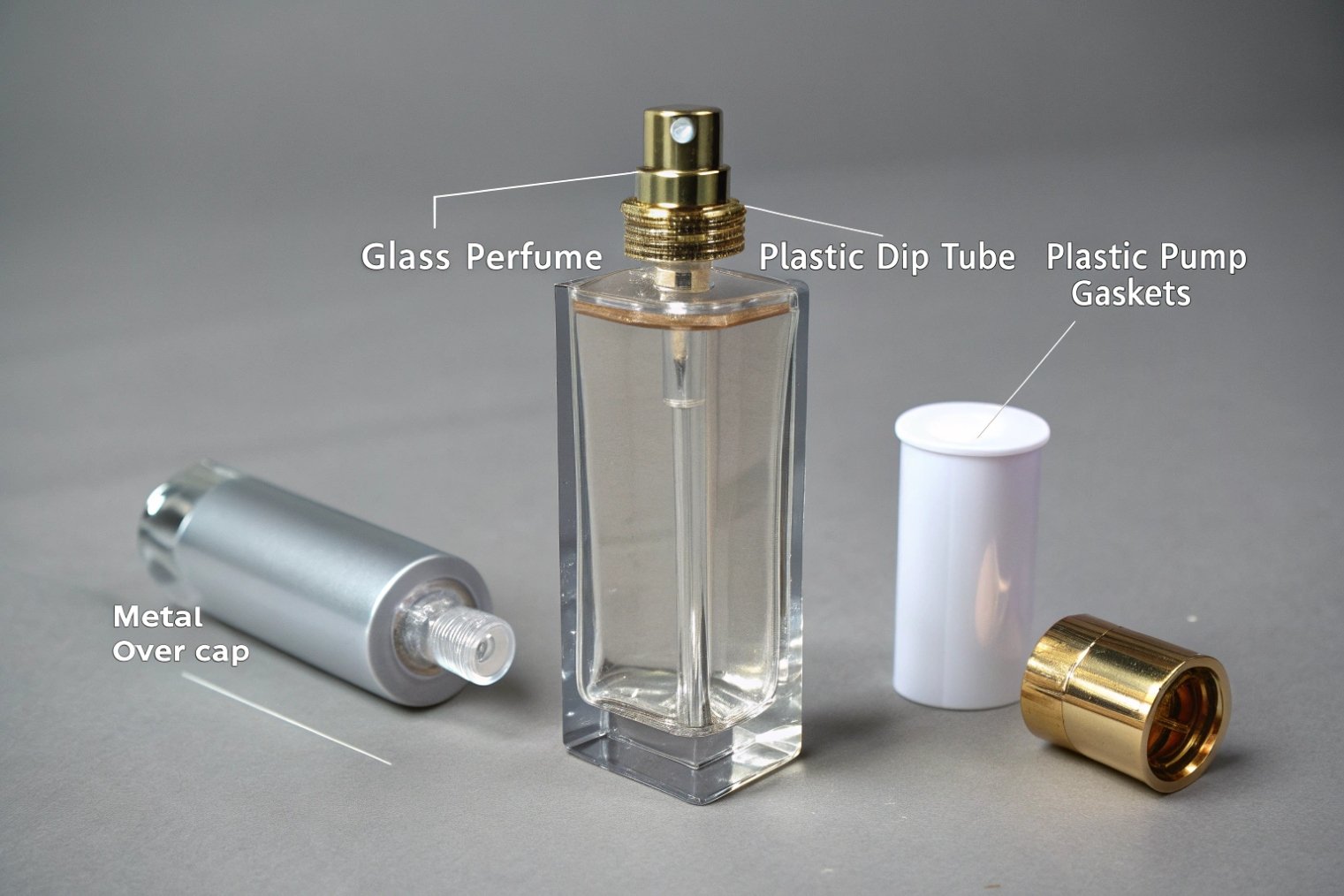
How plastics can change a scent
Different plastics behave very differently:
- HDPE and PP can absorb and release aroma molecules over time. This scent scalping 2{#fnref2} flattens the top notes and can make a bottle smell weak or blurred after months. They are also more permeable to oxygen.
- PET has better barrier properties than HDPE and PP, and is used in some body mists or mass fragrances. But it is still more permeable than glass and can slowly lose light top notes over long storage.
- Elastomers in gaskets or spray valves can leach faint rubbery or plastic smells into the headspace of a bottle, especially if not carefully chosen for alcohol and essential oils.
For short-life products or samples, this may be acceptable. For niche perfume or high-value essential oil blends, this kind of slow change is not welcome.
For teams comparing options, research on the oxygen barrier performance of glass vs PET and HDPE 3{#fnref3} is a useful starting point for why plastics can age differently in storage.
A quick overview:
| Material | Main risk in perfume use |
|---|---|
| HDPE / PP | Aroma absorption, oxygen ingress |
| PET | Better barrier, still some loss over time |
| PVC (not advised) | Plasticizer migration, strong taint risk |
| Silicone / TPE | Odor transfer if not carefully formulated |
Metals and liners
Bare metals bring other issues:
- Aluminum or tinplate without a proper liner can react with acidic or sulfur-containing components, common in many naturals and citrus notes. This may cause discoloration or metallic off-notes.
- Food-grade liners (often epoxy, polyester, or acrylic systems) are used to separate metal from perfume. They must be chosen to resist ethanol and fragrance oils, and not soften or crack under them.
- Stainless steel is more inert and works well in decant sprayers or roller balls. It is not common for full perfume bottles due to cost and weight, but it can work very well in small formats.
Key idea: metal can work, but only with the right liner. Glass needs no liner at all; that is one reason it remains the main choice.
Contact time and surface area
Contact risk grows with:
- Larger surface area of plastic or metal touching the juice.
- Longer storage time.
- Higher temperature along the supply chain.
This is why a small plastic dip tube in a glass bottle is usually fine, while a full plastic inner bag or a bare metal flask needs much more care. For long-term storage and high-value juice, the less reactive surface in contact with the perfume, the better.
How much UV protection do tinted bottles provide for perfume longevity?
Color is not only about brand mood. It also changes how much light reaches the juice.
Tinted bottles, especially amber, green, or deep colors, cut UV and part of visible light, slowing down photodegradation and discoloration, but they usually work best together with cartons and good storage.
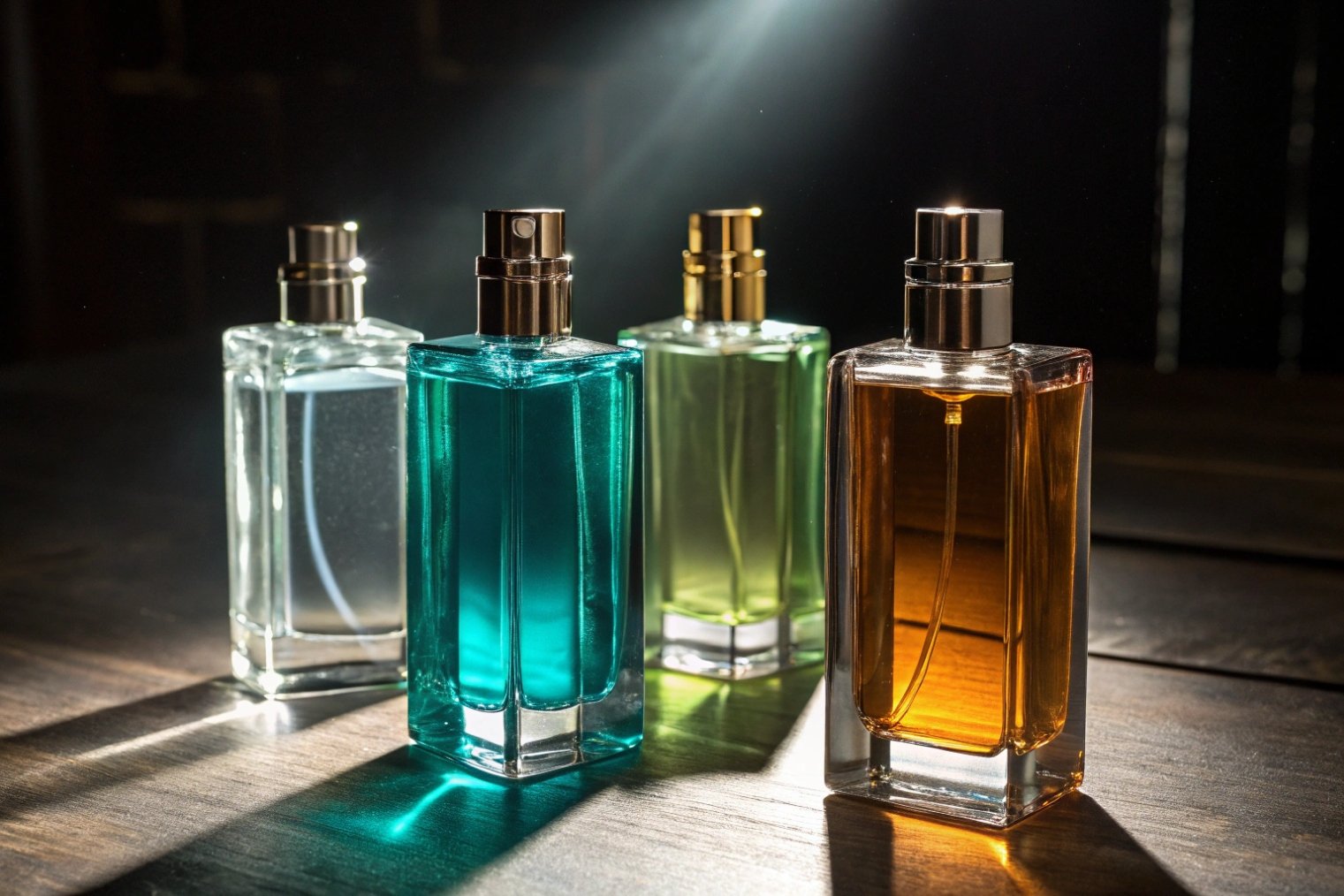
Light and fragrance breakdown
Many fragrance ingredients, especially citrus oils, some natural extracts, and certain colorants, are sensitive to light. UV and parts of visible light can:
- Break double bonds in aroma molecules.
- Change their oxidation state.
- Slowly drive the juice toward yellow or brown.
This shows up as:
- Brighter top notes fading faster than expected.
- A “stale” or flat opening.
- Color drift in the bottle, especially near the glass wall.
What tinted glass actually blocks
Tinted glass acts as a built-in filter. The exact protection depends on color and thickness:
| Glass color | Approximate effect on light (simple view) |
|---|---|
| Clear flint | High UV and visible transmission |
| Light tint | Modest UV and visible reduction |
| Green | Good cut in parts of UV and blue |
| Amber / brown | Strong UV and blue-light attenuation |
| Opaque / coated | Near total light block (depends on coating) |
When brands need proof beyond “darker is better,” spectral transmission testing 4{#fnref4} is a clear way to compare how much light actually gets through container walls.
Even with amber glass, light can still enter through the neck and any clear parts. So for long-term stability, especially in retail stores with strong lighting, a carton remains important.
Balancing design and protection
In real projects, there is always a trade-off between showing the juice and protecting it.
- Designer brands often accept clear or lightly tinted bottles and rely on outer cartons and customer habits.
- “Apothecary” or “clinical” brands lean on amber or dark glass to show a more functional, protective image and support active-rich formulas.
- For very photosensitive juices, opaque or full-coated glass is common, sometimes with a small window for fill-level check.
A helpful way to decide:
| Formula sensitivity | Recommended bottle strategy |
|---|---|
| Low | Clear or light tint + standard carton |
| Medium (citrus, naturals) | Tinted glass + carton, avoid long light exposure |
| High (very fragile actives) | Amber/opaque glass + carton, careful storage |
Tinted glass on its own is a good step, but for maximum longevity it should sit inside a broader light-protection plan.
Which inner coatings or lacquers are safe for alcohol-based fragrances?
Internal lacquers can add color, gradient effects, or a “floating juice” look, but they bring one big question: will the coating survive years of contact with ethanol and fragrance oils?
Only coatings and inner lacquers specifically rated for alcohol and fragrance contact should be used inside perfume bottles; wrong systems can soften, cloud, or peel, tainting the scent and creating flakes.
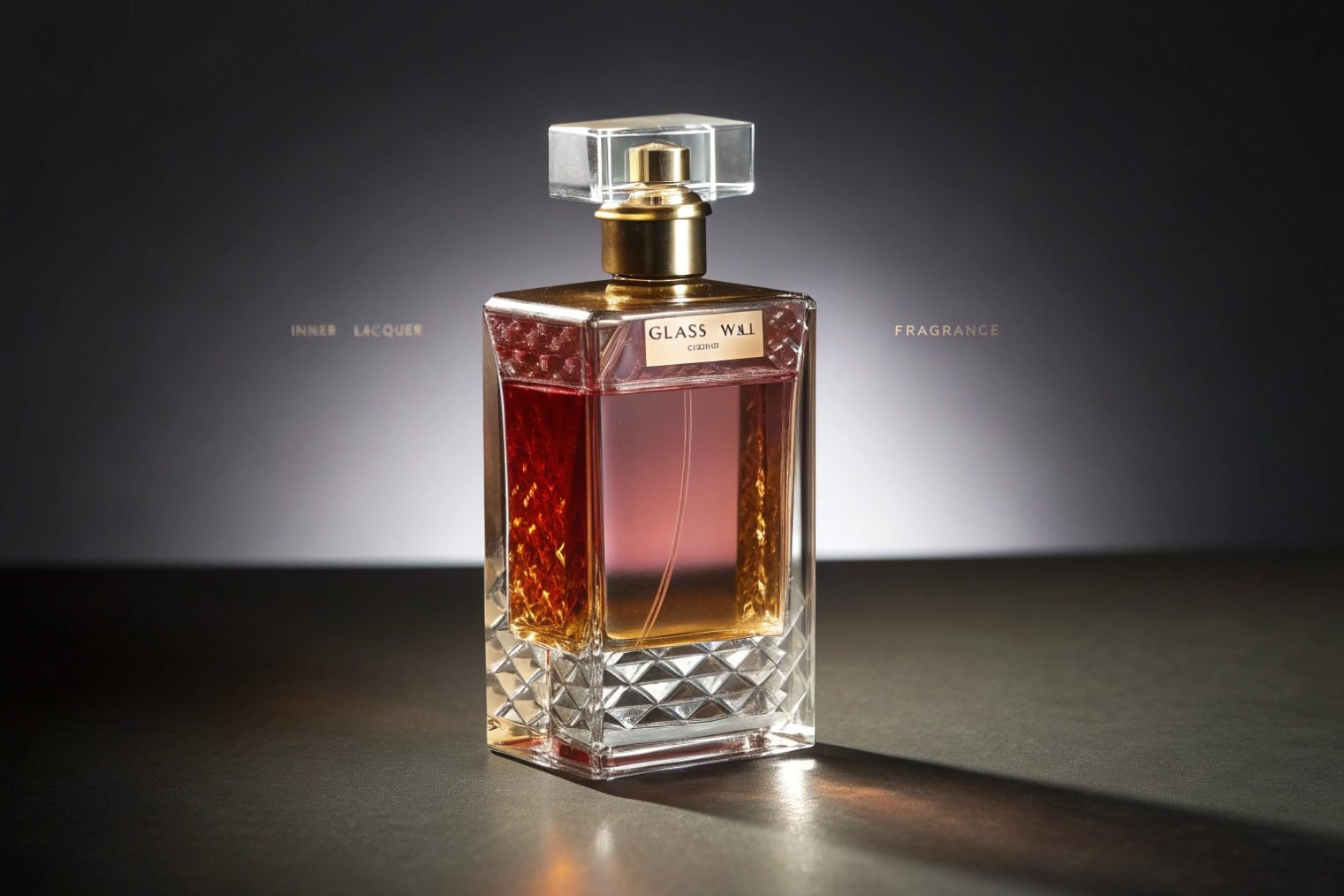
What inner lacquers do to the pack
Internal coatings can:
- Add full color while keeping the outer wall smooth and glossy.
- Create gradients or partial transparency.
- Increase light protection without tinted base glass.
Visually, this is very attractive. But the coating now sits in full, constant contact with ethanol, water, and oils. Fragrance bases are strong solvents. Many decorative paints that are fine on the outside of a bottle will not survive inside.
If you are considering an internal finish, look specifically at supplier data for inner lacquering in direct contact with alcohol-containing products 5{#fnref5} rather than relying on generic “decorative coating” claims.
Typical failure modes:
- Haze or whitening in the lacquer layer.
- Sticky or “soft” inner walls after some months.
- Small flakes or filaments floating in the juice.
- A faint “paint” or plastic note polluting the top notes.
What “safe” systems look like
Safe inner coatings for alcohol fragrances share a few traits:
- High crosslink density and chemical resistance to ethanol and common perfume solvents.
- Low extractables so they do not leach odor or taste into the headspace.
- Good adhesion to glass even under thermal cycling and transport vibration.
In practice, this means:
- Working with suppliers who state perfume compatibility, not only “cosmetic contact”.
- Running soak tests where real or surrogate juice stays inside coated bottles at elevated temperature for weeks.
- Checking both visual and olfactory changes after these tests.
A quick checklist:
| Question to ask a coating supplier | Why it matters |
|---|---|
| Is this system certified for alcohol-based fragrances? | Simple compatibility filter |
| What solvents was it tested against? | Check match to your base (ethanol, IPM, etc.) |
| How long and at what temperature were tests run? | Shows depth of testing |
| Any known issues with naturals or high citrus levels? | Some oils are more aggressive |
When an inner coating is not the best answer
Sometimes it is easier and safer to:
- Use tinted or opaque glass as the base.
- Apply color or effects on the outside with robust coatings or inks.
- Keep the inner surface bare glass, which we already know behaves very well with perfume.
This approach avoids the risk of long-term contact between solvents and paints. For high volume and long shelf life, this is often the most robust path.
Conclusion
Bottle material does far more than hold the juice; it quietly sets the rules for light, oxygen, and chemistry around a fragrance, so smart choices in glass, liners, tints, and coatings are part of the formula’s real-world performance.
For finished products, material choices also sit inside safety frameworks like the IFRA Standards 6{#fnref6}, which help brands manage ingredient limits and reduce avoidable stability and compliance surprises.
Material basics also matter: understanding how soda–lime glasses 7{#fnref7} are formulated can clarify why “standard perfume glass” already performs extremely well in most cases.
Footnotes
-
Background on borosilicate properties; useful for explaining why thermal shock resistance rarely drives perfume stability. ↩ ↩
-
Explains aroma “scalping” into packaging materials, helping teams predict top-note flattening in plastic-contact systems. ↩ ↩
-
Research comparing oxygen barriers of glass and common plastics; supports decisions about oxidation risk over long storage. ↩ ↩
-
Shows a practical method to quantify light transmission, useful when choosing tinted glass for photostability. ↩ ↩
-
Manufacturer overview of inner lacquering for alcohol contact; helps screen coatings that won’t haze, peel, or taint. ↩ ↩
-
Official standard reference for safe fragrance ingredient use; helps align formulation and packaging choices with industry expectations. ↩ ↩
-
Clear explanation of soda–lime glass composition and modifiers; helpful for communicating why standard container glass is usually sufficient. ↩ ↩






