
Premium beverage brands need more than “any” glass bottle. If the bottle fails tests or looks cheap next to competitors, the brand pays the price, not the factory.
Premium beverage glass must be food-contact compliant, dimensionally precise, optically clean for decoration, secure against tampering and fakes, and backed by test reports that pass retailer onboarding without drama.

When these pieces work together, the result feels obvious: the bottle looks heavy, closes with a clean “snap,” carries fine decoration with no defects, and comes with a document pack that lets your quality team and your retailer sleep at night.
Which dimensional tolerances and wall thicknesses signal “luxury”?
Most consumers cannot read a drawing, but they can feel a cheap bottle. Light weight, wobble on the table, or a cap that does not sit flat all tell them the brand cut corners.
Luxury glass usually means heavier walls and base, tighter tolerances on height, diameter, and finish, plus excellent verticality and weight control so every bottle feels the same in hand.
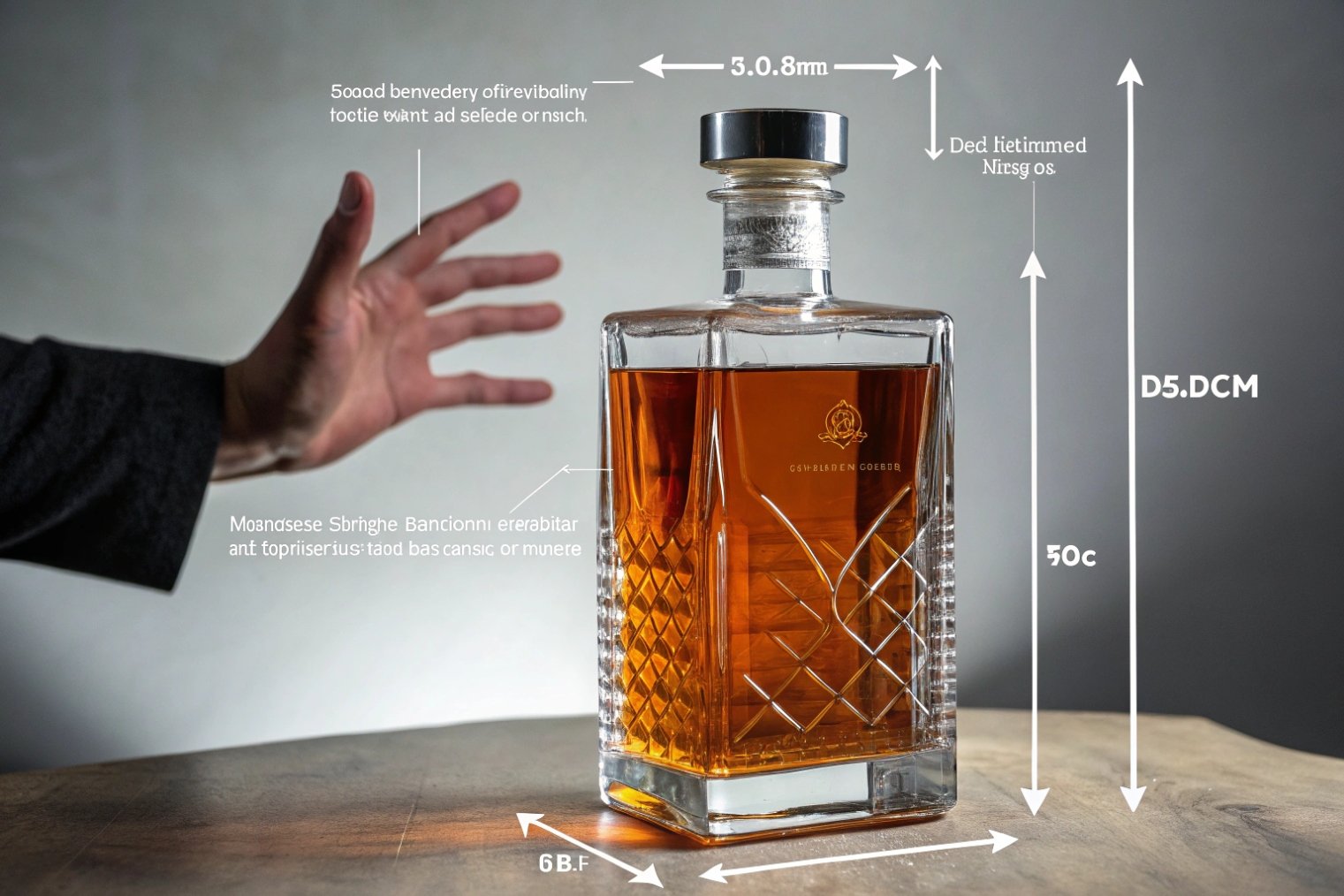
A good starting point is control on basic geometry. For a 500–750 ml premium spirits or wine bottle, we often work with:
- Wall thickness in the body generally around 3–4 mm, with a visibly thicker base for weight and stability.
- Height tolerances typically close to ±1.0–1.5 mm.
- Body diameter tolerances around ±0.7–1.0 mm to keep labels straight and consistent.
- Finish diameter and bore tolerances tighter again, often within tenths of a millimeter, to match high-end corks, stoppers, or screw closures.
For procurement and QA teams, it helps to anchor “tighter tolerances” to a recognized reference such as ISO 9058:2008 standard tolerances for bottles 1 {#fnref1}. Verticality and base flatness matter a lot. A premium bottle that leans or wobbles will be rejected by retailers and by consumers. In production, we measure lean, mouth–base parallelism, and base tilt constantly and correct the IS machine section when data starts to drift.
Weight is another signal. Luxury bottles usually carry extra glass in the base and shoulder. The key is not just “heavy,” but consistent. If one case feels lighter or one bottle in a line-up feels different, consumers notice. So we put narrow tolerances on nominal weight and track each cavity separately.
Inside the glass, wall distribution must be even. Thin spots in the shoulder or heel can fail pressure or impact tests, even if average thickness looks fine. For a premium project, we often do full sectional checks on pilot runs, then lock the gob weight and parison design before mass production.
When a buyer asks for “luxury feel,” these are the quiet engineering details that make that feeling real and repeatable, not just a design sketch.
What surface and optical criteria matter for flawless decoration?
A premium bottle is more than its shape. It is a canvas for screen printing, hot stamping, metallization, or complex labels. Any small surface or optical defect can ruin an expensive decoration step.
High-end decoration needs a smooth, low-defect surface with stable coatings, very low seed and blister levels, and tight control of color, haze, and stress marks so artwork looks clean on every bottle.
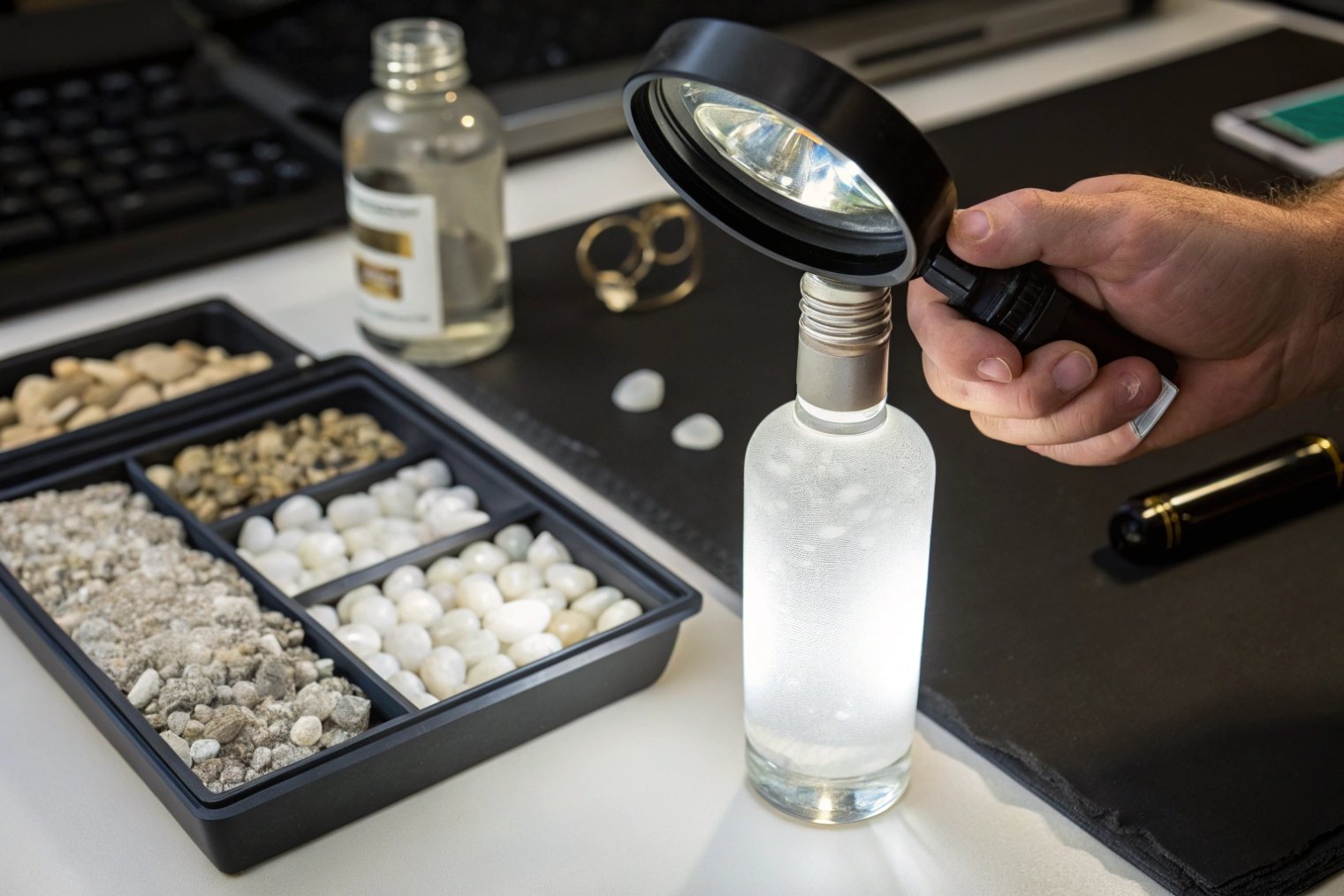
We think about the surface in three layers:
- The raw glass skin.
- The hot-end and cold-end coatings.
- Whatever decoration you apply later.
On the raw glass skin, premium quality means:
- Minimal seeds and blisters in the main viewing area.
- No stones, cords, or devitrified patches that catch light.
- No folds, wrinkles, or heavy “orange peel” that break reflections.
- Clean parting lines and well-finished engravings or embossing.
For extra-flint or super-flint, clarity is critical. Iron levels must stay low. Color has to be consistent from batch to batch, otherwise shelves will show different tones of “clear.” For dark glass (amber, antique green), color uniformity still matters. If some bottles look lighter or darker, printed branding and capsules will not align visually.
Coatings are another key part. A good hot-end tin oxide layer and cold-end lubricant make bottles run smoothly and reduce scuffing, but they also affect how paints and inks behave. We tune the cold-end coating so it is strong enough for transport yet not so waxy that inks or adhesives lose grip.
Before we approve a premium bottle for decoration, we test:
- Screen printing adhesion and cure.
- Foil and hot stamping adhesion and edge sharpness.
- UV or metallic inks, if the brand uses them.
- Label flatness and bubble risk on curved and embossed surfaces.
We also look at optical effects under different light sources. A bottle that looks fine in the factory may show stress bands or color waves under strong retail or bar lighting. Polariscopes and light boxes help us see these issues before they reach a decorator or a retailer.
In short, if you want flawless decoration, the bottle must be more than “no big defects.” It must have stable optics, predictable coatings, and a surface that behaves the same way for every print run.
How do tamper-evident and anti-counterfeit features integrate?
Premium beverage brands live with a constant risk of refilling, re-use of empties, or full counterfeit products. The bottle and closure are often the first line of defense.
Tamper-evident rings, tear-off capsules, and shrink seals show if a bottle was opened, while custom glass shapes, embossing, laser codes, and smart labels make counterfeiting harder and easier to trace.
True security starts in the glass design itself. We can build features into the bottle that are hard to copy at low cost:
- Custom shoulder profiles and base shapes with deep embossing.
- Unique engraving on the heel or punt with logo, codes, or symbols.
- Very specific glass color or gradient that is difficult to match exactly.
On the closure side, tamper-evident features must be linked to the neck finish design:
- For screw caps and roll-on pilfer-proof (ROPP) closures, the glass finish must match finish standards so the break-off ring works every time.
- For cork and capsule systems, tear-off or perforated capsules give a clear “first opening” signal.
- For some spirits and RTDs, we combine a crown or ring-pull with a printed or laser-marked top that is hard to replace.
On top of this, we layer anti-counterfeit elements:
- Mold codes and cavity numbers on the glass, so each bottle can be traced back to a production run.
- Laser-etched data or microcodes on the glass surface or closure, often readable only under certain light.
- Security inks, UV elements, or microtext on labels and capsules.
- Smart packaging features like QR codes linked to cloud authentication, or NFC tags in labels or medallions.
Integration is the key word. These features must not fight each other. The tamper band must break cleanly but not shed fragments into the product. Laser coding must not weaken the glass. Smart labels must still apply smoothly on curved, sometimes frosted, surfaces.
In practice, for a new premium project we put the glass maker, closure supplier, and label printer at the same table early. Then we agree on:
- Finish standard and tolerances.
- Tamper system details and test protocol.
- Space and surface requirements for anti-counterfeit features.
This takes more time at the design stage, but it pays off later in fewer recalls, fewer fakes on the market, and more trust from distributors and consumers.
Which certifications and test reports do retailers require at onboarding?
For many premium brands, the hardest part is not making a beautiful bottle. It is getting through retailer technical approval. Buyers want to see more than a nice sample on the desk.
Major retailers usually expect clear food-contact compliance (EU and/or FDA), a strong quality system such as ISO or BRCGS Packaging, and a package of mechanical, thermal, and migration test reports before the first order ships.
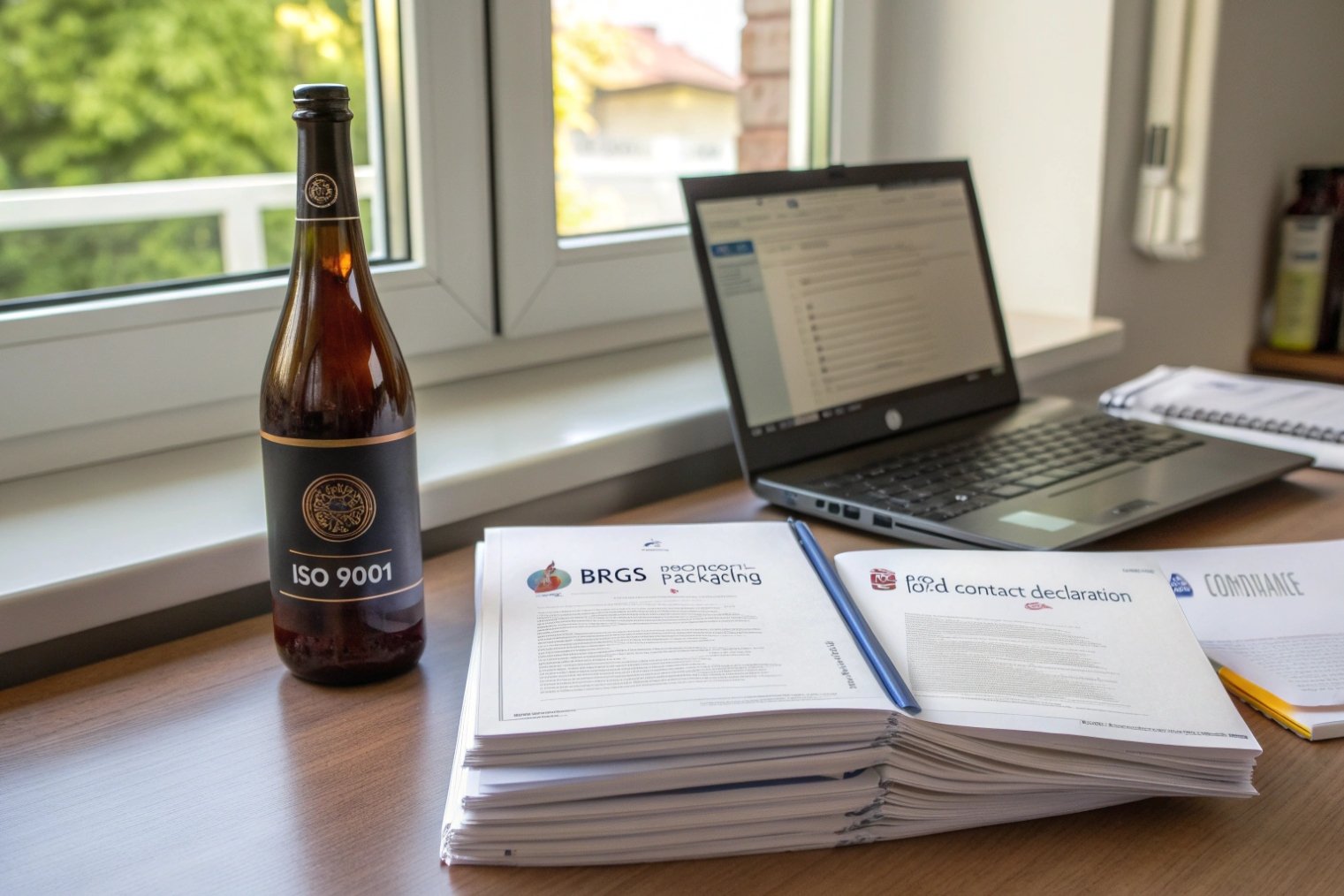
For the bottle itself, the key documents include:
- A declaration of compliance for food contact.
- Evidence that the bottle is made under good manufacturing practice.
- Migration or chemical durability tests that show no unsafe transfer into the beverage.
- Mechanical and thermal test reports that match the real filling and logistics conditions.
For the European market, we link the compliance statement to the EU Framework Regulation (EC) No 1935/2004 on food-contact materials 2 {#fnref2} and the Commission Regulation (EC) No 2023/2006 on good manufacturing practice 3 {#fnref3}. For the U.S., we typically reference the FDA’s Packaging & Food Contact Substances (FCS) program 4 {#fnref4}, especially when coatings, inks, or closure contact parts are involved.
Performance and safety tests should match the product reality. For carbonated beverages and pressure-containing formats, internal pressure testing is commonly structured around methods like the ASTM C147 internal pressure strength test 5 {#fnref5}, supported by impact, top-load, and (if applicable) thermal shock / pasteurization simulations.
Beyond the bottle itself, many large retailers prefer or require that the glass plant holds:
- A certified ISO 9001:2015 quality management system 6 {#fnref6}.
- A recognized packaging safety standard such as the BRCGS Packaging Materials Global Standard 7 {#fnref7}.
- In some cases, environmental and social certifications or audits.
When we support a new premium brand into a large retail chain, we normally prepare a full onboarding pack:
- Drawings and tolerances.
- Certificates and audit copies.
- Migration and heavy-metal test reports from accredited labs.
- Mechanical and thermal test data.
- Closure compatibility statement from the closure supplier.
This pack helps the brand pass internal QA reviews and retailer checks with minimum friction. Once it is approved, reorders and new SKUs are much easier to add, because the bottle supplier is already on the retailer’s system as a trusted source.
Conclusion
Premium beverage bottles are not only about glass weight and looks. They must meet strict safety, dimensional, optical, and security standards, and they must come with solid documentation so retailers can say “yes” with confidence.
Footnotes
-
Sets recognized dimensional tolerance limits for glass bottles to support consistent “luxury feel.” ↩ ↩
-
EU legal framework ensuring food-contact materials do not endanger health or change taste/odor. ↩ ↩
-
EU GMP rules requiring controlled manufacturing for food-contact materials and articles. ↩ ↩
-
FDA hub for U.S. food-contact substance pathways, guidance, and inventories for packaging components. ↩ ↩
-
Standardized internal pressure strength testing for glass containers used with carbonated or pressurized beverages. ↩ ↩
-
Global QMS standard often requested by retailers to prove consistent process control and corrective action. ↩ ↩
-
Retailer-recognized packaging standard covering safety, hygiene controls, and traceability expectations for packaging suppliers. ↩ ↩






