
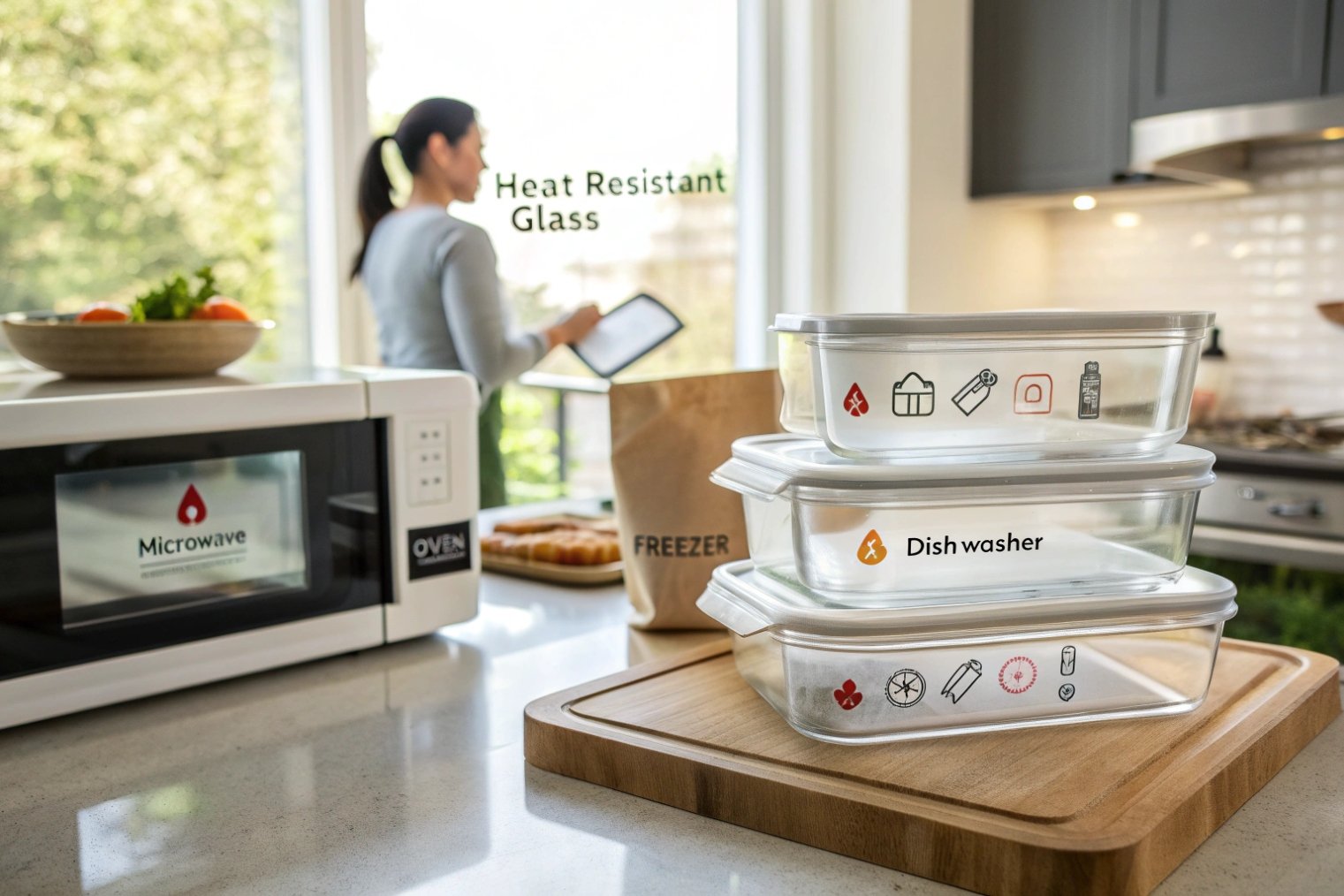
Customers love the promise of “heat-resistant” glass, but broken dishes and complaints still happen. Clear rules about borosilicate in microwaves and ovens can prevent cracks, burns, and returns.
High-borosilicate heat-resistant glass is generally safe for microwaves and household ovens when the specific item is labeled accordingly; real limits come from temperature ratings, thermal-shock guidance, and non-glass parts like plastic lids and silicone gaskets.

Every buyer now asks the same questions: “Can this go in the microwave? Can this go in the oven? What if I take it from the fridge?” When we design and supply high-borosilicate containers, we need answers that are simple for users but still anchored in real material limits.
What temperature range and thermal shock values should you verify?
Many buyers see “heat-resistant 400°C” on a spec sheet and assume anything goes. In reality, usable microwave and oven limits are lower and depend on thermal shock ratings.
For consumer products, it is safer to verify a working oven range around 220–230°C (about 425°F) plus a maximum temperature jump of roughly 100 K, even though borosilicate 3.3 lab glass can tolerate higher values.
Lab numbers vs kitchen reality
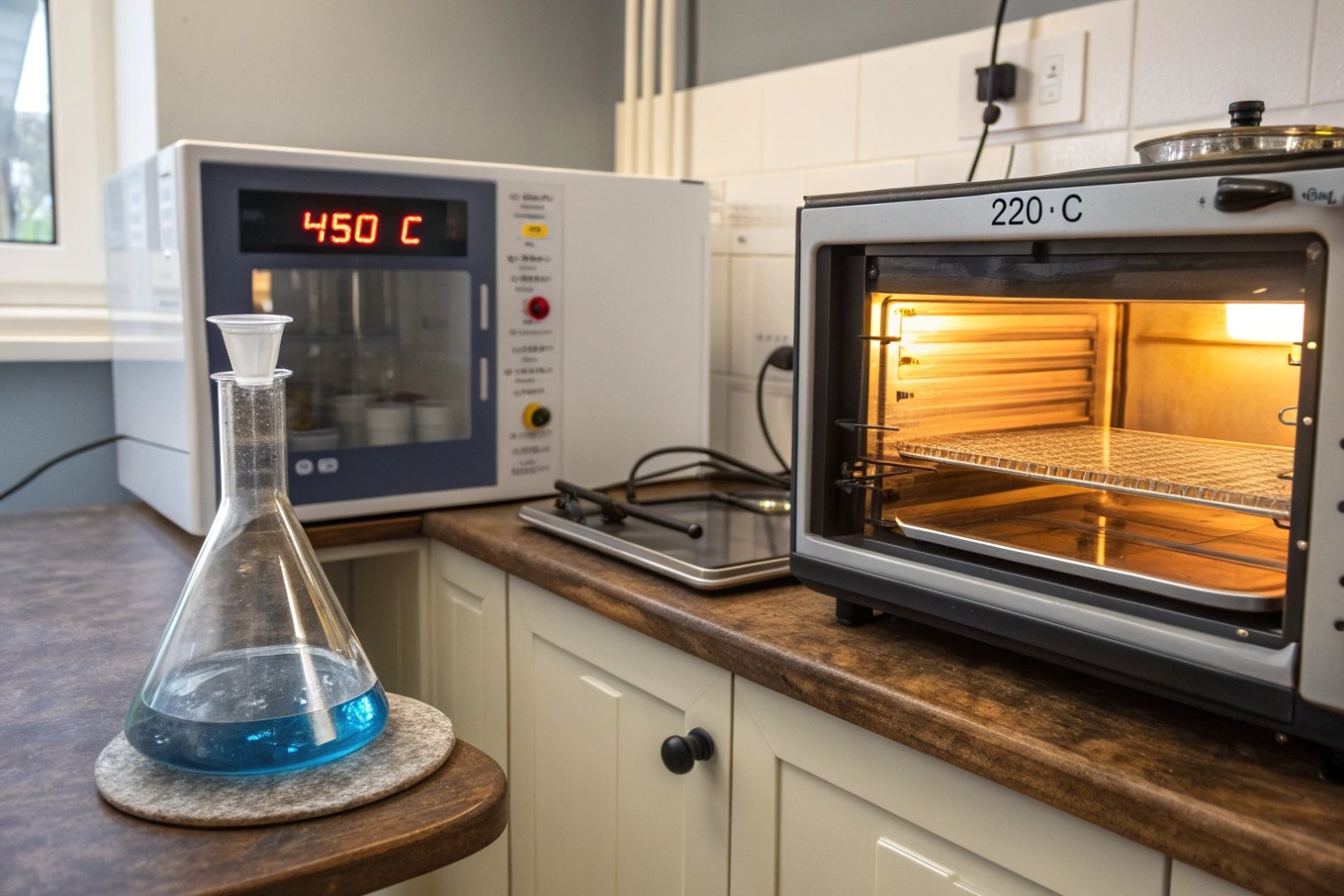
High-borosilicate 3.3 glass has impressive lab data, and the common definition of borosilicate glass 3.3 properties 1 helps align what “3.3” actually means across suppliers. In industrial datasheets you often see long-term working temperatures around 450°C, very low thermal expansion, and strong thermal shock resistance—values similar to what’s listed in a BOROFLOAT® 33 thermal properties datasheet 2. On paper, this looks almost “unbreakable” in a home oven.
Kitchen reality is different. Food containers have corners, thicker bottoms, logos, and sometimes uneven wall thickness. Real ovens also have hot spots and direct radiant heat from elements. Users place hot dishes on wet countertops, or take cold containers straight from the fridge into a fully preheated oven.
So when we create specs for consumer products, we usually “downrate” the glass:
| Parameter | Lab value for borosilicate 3.3 (typical) | Safer consumer spec target* |
|---|---|---|
| Long-term working temperature | Up to ~450°C | 220–230°C continuous oven use |
| Short-term temperature exposure | Higher, depending on design | 250°C short peaks, if design is validated |
| Recommended thermal shock (ΔT) | 100–180 K depending on standard | 100 K or less in user instructions |
| Low temperature operation | Down to -70°C or lower | -20 to -40°C for household freezer use |
*Always follow the actual glass supplier’s test data and your own product tests.
For marketing, it is tempting to print the highest lab number on the box. From experience, this creates more failures and more angry emails. A realistic 220–230°C rating still covers most baking and reheating recipes, but gives generous safety margin for uneven heating and user mistakes.
Why thermal shock matters more than maximum temperature
Most glass failures in ovens and microwaves come from thermal shock, meaning cracking from rapid temperature change—exactly what the Thermal Shock lesson (glass cracking basics) 3 explains in plain terms. The glass does not fail because it reaches 220°C; it fails because one part is at 220°C while another part is still cold.
Common risky moves include:
- Freezer-to-hot-oven jumps
- Placing hot glass on wet or very cold surfaces
- Adding cold liquid into a very hot dish
- Using a small amount of food in a large dish, so some areas overheat
For high-borosilicate containers, we want clear internal rules:
- Define a safe ΔT (temperature difference) for your product line, often 100 K or less.
- Build your user instructions around that limit.
- Test worst-case scenarios: full freezer load to hot oven, partial fill, corners, and bottom contact spots.
When the datasheet shows that the glass itself can handle more, we still keep the user guidance conservative. This protects the brand from edge cases, misuse, and the natural variation in real ovens.
Which lid and gasket components limit actual oven performance?
Many customers think “glass container” and forget the lid. In real life, lids, seals, and clips usually fail long before the borosilicate base gets close to its limits.
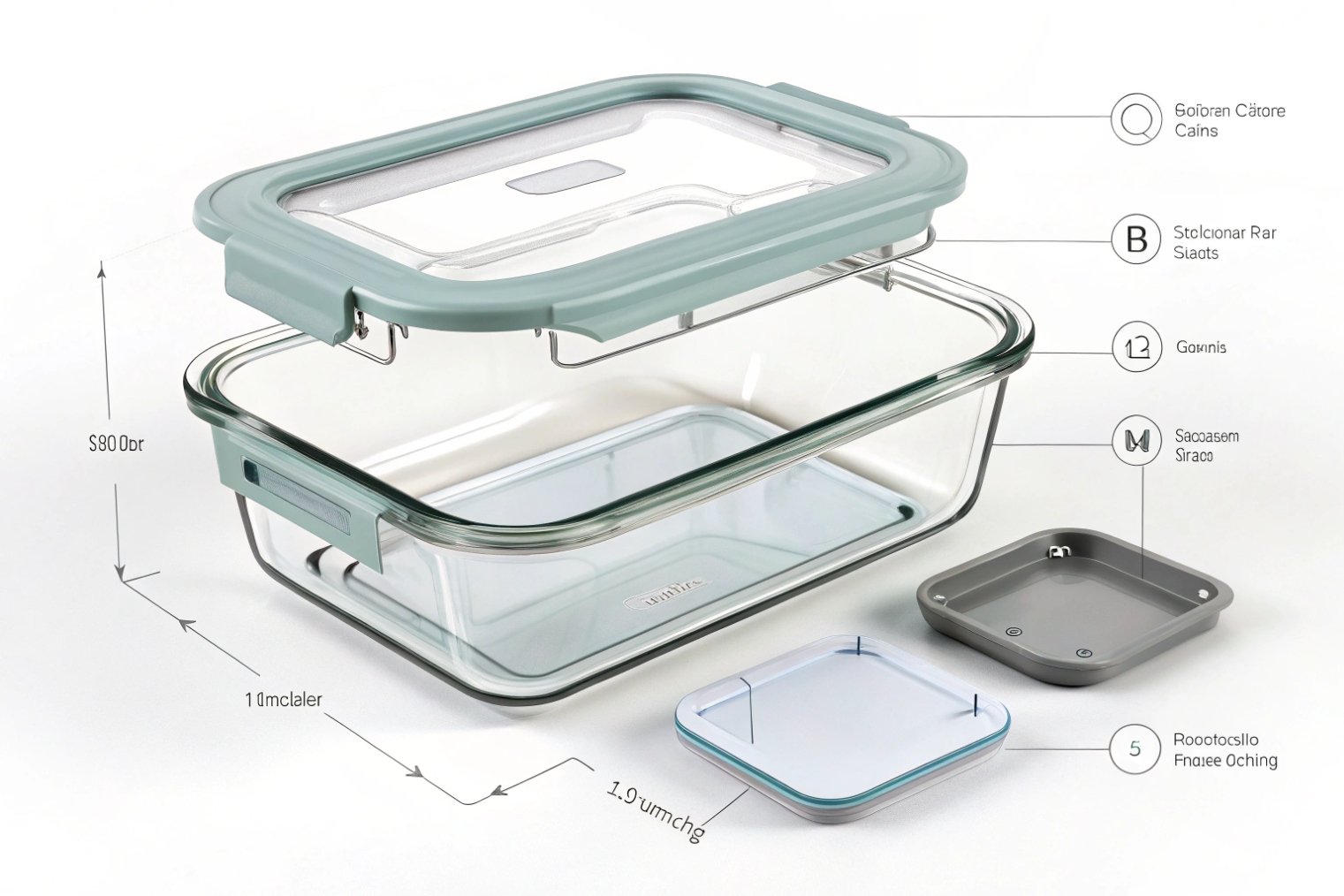
Plastic lids are rarely oven-safe, silicone gaskets have lower heat limits than glass, and any metal or decorated parts can change safe temperature ratings, so the weakest component always sets the real oven performance.
Plastic lids are usually microwave-only
Most food storage lids use PP, PE, or Tritan. These plastics are great for room temperature and refrigerator storage. They are also fine for short microwave use, as long as there is space for steam to escape.
In a conventional or convection oven, they are a problem. Materials soften, warp, or melt at temperatures well below typical baking ranges. Some brands offer special “oven-safe lids”, but these are the exception and need careful design and clear branding.
For a high-borosilicate line, a simple rule works well:
- Oven: glass base only, no plastic lid, unless a special oven-safe system is developed and clearly marked.
- Microwave: lid allowed, but vent open or lid offset, so steam can escape.
Silicone gaskets, clips, and decorative elements
Silicone seals are often rated to around 200–230°C; many suppliers publish similar ranges (for example, a recommended silicone elastomer service range up to 230°C 4). That sounds like enough for many recipes, but long exposure near the limit can cause hardening, loss of elasticity, or odor. Some designs also include plastic or metal clips that heat faster than the glass and can stress the gasket.
Decoration adds more limits:
- Painted or sprayed lids and rims can discolor or off-gas at high temperature.
- Printed logos or labels on lids may not be oven-stable.
- Metal rings, handles, or bands can create hot spots or arcing in microwaves.
So, when we set performance claims, we treat the complete set as a system, not just the glass base.
The “lowest-rated part wins” rule
For every SKU, it helps to build a simple internal table like this:
| Component | Common material choice | Typical safe use |
|---|---|---|
| Glass base | High-borosilicate 3.3 | Oven, microwave, freezer, dishwasher |
| Plastic lid | PP / Tritan | Fridge, freezer, microwave (not oven) |
| Silicone gasket | Food-grade silicone | Fridge, freezer, microwave; cautious in oven |
| Metal clips / rim | Stainless steel / coated | Oven OK if tested, never in microwave |
| Printed sleeve | Paper / cardboard | Packaging only, remove before oven or MW |
Then the external claim is simple: “Follow the lowest rated part.” If any part cannot tolerate the oven, the whole product is “glass base oven-safe only”. We put this in big text on packaging and in icon form near the lid area, where users actually look.
How do usage instructions reduce user breakage and warranty claims?
Even the best borosilicate glass cannot survive every kind of misuse. Many breakages come from unclear or missing instructions rather than bad material.
Plain, specific usage rules about temperature changes, liquids, and surfaces dramatically cut glass failures, reduce warranty claims, and turn potential complaints into five-star reviews.
Turn technical rules into simple kitchen language
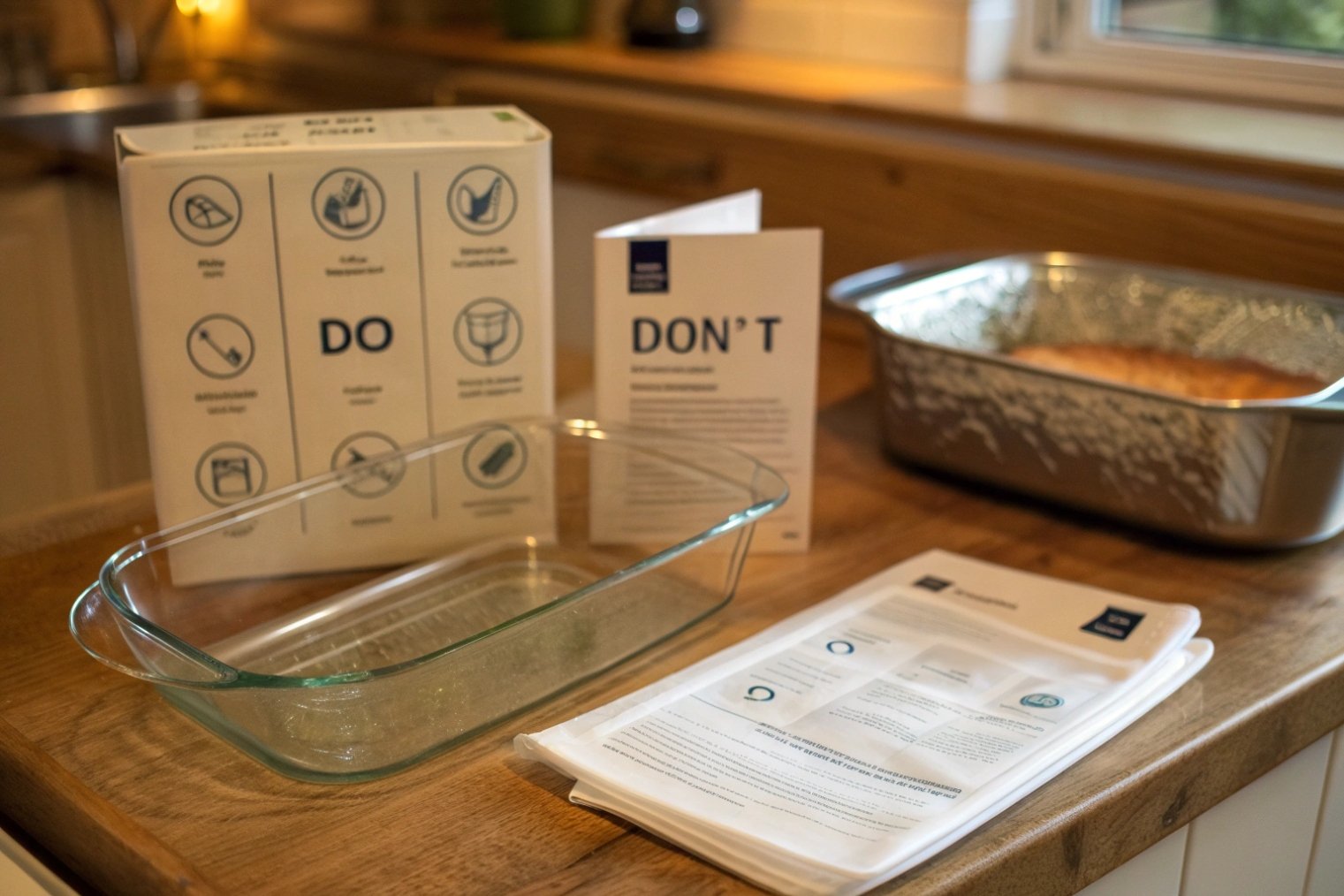
Material scientists talk about ΔT, heat flux, and expansion coefficients. Home cooks talk about fridge, freezer, hot oven, and cold water. Our job is to translate.
Typical lab rules might say: “Avoid temperature differences greater than 100 K.” For users, we turn this into clear sentences:
- Do not take the dish from the freezer directly into a hot oven.
- Let refrigerated glass rest at room temperature for 10–20 minutes before baking.
- Never add cold liquid to a very hot dish; let the glass cool first.
We repeat these instructions in the leaflet, on the box, and sometimes as a short line on the bottom of the product itself.
Key do’s and don’ts that prevent most failures
From field experience and big brands’ care sheets, a short checklist covers most risky situations—and clear consumer wording like the Pyrex® Glass Use & Care guide 5 shows how blunt “no stovetop / no broiler” language can be:
| Situation | Do this | Not this |
|---|---|---|
| From freezer to oven | Move freezer → fridge, then into moderate oven | Freezer container straight into very hot oven |
| Removing hot glass | Use dry mitts, place on dry cloth or wooden board | Put on wet, cold, or metal sink surface |
| Microwave heating | Heat with some food or liquid inside | Heat empty or almost empty glass |
| Damaged glass | Retire chipped, cracked, or deeply scratched pieces | Keep using “small” chips or cracked corners |
| Cooking methods | Use in standard oven, microwave, or air fryer basket | Use under broiler, on stovetop, or on open flame |
These points look very basic, but they cut failure rates a lot. Heating empty glass in a microwave, for example, can create local hot spots and stress; banning this in instructions is simple and effective. Advising against broiler and stovetop use is also critical, because direct, concentrated heat can exceed the safe thermal gradient even for high-borosilicate glass.
Why wording and layout matter for claims
Warranty claims and negative reviews often start with “The box said oven-safe” or “The symbol looked like it was okay for the broiler.” So we pay attention to wording and layout:
- Keep icons big and high-contrast, not tiny and hidden.
- Put oven and microwave rules near the lid illustration, not only on the bottom of the glass.
- Use strong verbs: “Do not use under broiler or on stovetop” instead of “Not recommended”.
- Add one short explanation: “Sudden extreme heat can crack glass” helps users accept the rule.
Good instructions do not scare users away. They build trust, because customers feel the brand is honest about risks and wants them to use the product for many years.
What markings and icons are required for compliance and safety?
Even if your testing is perfect, regulators and retailers still look at the markings. Consumers also rely on a few simple icons to decide if a dish is safe.
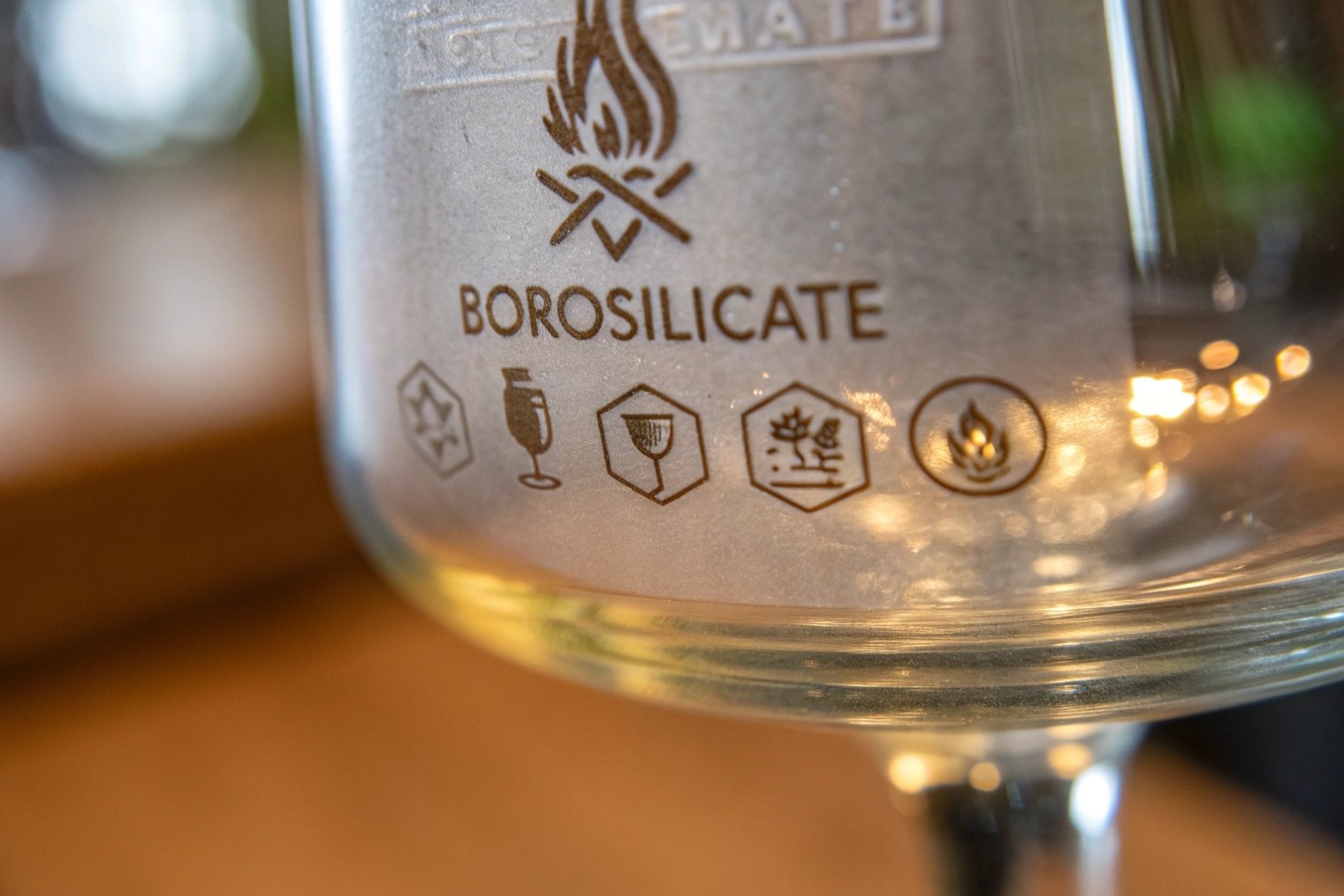
At minimum, high-borosilicate food containers need food-contact marking, clear microwave and oven icons, readable temperature ranges, and explicit “no flame / no broiler” warnings on either the product or its packaging.
Food-contact safety and glass identification
For food-contact items, many markets recognize the fork-and-wine-glass “food safe” symbol 6. This tells buyers that the material is suitable for food contact. In the EU, some kind of indication like this is required for certain products sold empty, and the underlying framework is the Regulation (EC) No 1935/2004 7.
For high-borosilicate products, it also helps to:
- Mark “BOROSILICATE GLASS” or “HIGH BOROSILICATE” on the bottom.
- Use batch or mold codes for traceability.
- Add recycling information, such as “GLASS – widely recyclable” and local symbols where needed.
This avoids confusion with soda-lime glass containers that may not share the same thermal shock resistance.
Appliance and temperature icons
Most users scan for three or four icons and one number. A clean set might include:
| Icon / text | Meaning in practice | Placement |
|---|---|---|
| Fork and glass | Food-contact safe material | Molded or printed on base |
| Wavy lines / microwave | Microwave-safe glass (and sometimes lid) | Base and lid, plus packaging |
| Oven symbol + °C/°F | Oven-safe glass, with max temperature listed | Base, instruction leaflet, box |
| Snowflake | Freezer-safe | Base and packaging |
| Dish + water jets | Dishwasher-safe | Base or leaflet |
| Flame crossed out | No stovetop, no direct flame, no hot plate | Base and near main product photo |
| Top heat crossed out | No broiler / grill | Box, leaflet, possibly base |
For borosilicate containers, adding the numerical limit beside the oven icon is very helpful: “Oven safe up to 230°C / 445°F (glass base only).” This avoids misunderstandings when users see glamorous social media content that might show extreme recipes.
Aligning markings, tests, and marketing
The final step is alignment. The icons, the text, the product photography, and lab tests must all tell the same story.
So we check:
- Lab tests cover at least the temperatures and thermal shocks we claim.
- Marketing photos do not show forbidden uses (no broiler flames, no stovetop scenes).
- Product pages online replicate the same icons and warnings as the box.
- Any eco or material claims, such as “BPA-free lid” or “LFGB-tested silicone gasket”, are backed by current test reports.
When this alignment is tight, retailers feel safer listing the product, consumers feel more confident using it in microwaves and ovens, and we see fewer product returns and warranty claims over the lifetime of the line.
Conclusion
High-borosilicate glass can perform very well in microwaves and ovens, as long as we respect real temperature and thermal shock limits, weaker lid components, and clear, honest user guidance.
Footnotes
-
ISO standard defining borosilicate glass 3.3 properties used for heat- and chemical-resistant glassware. ↩ ↩
-
SCHOTT BOROFLOAT® 33 datasheet with operating temperatures and thermal expansion values for borosilicate glass. ↩ ↩
-
Clear explanation of thermal shock and why rapid temperature changes can crack glass. ↩ ↩
-
Example silicone elastomer service-temperature range showing why gaskets can limit “oven-safe” claims. ↩ ↩
-
Practical consumer do/don’t rules for oven, broiler, stovetop, and microwave use of glassware. ↩ ↩
-
Overview of food contact compliance and the fork-and-glass symbol meaning for food-safe materials. ↩ ↩
-
Official legal text for EU framework rules on materials intended to come into contact with food. ↩ ↩






