
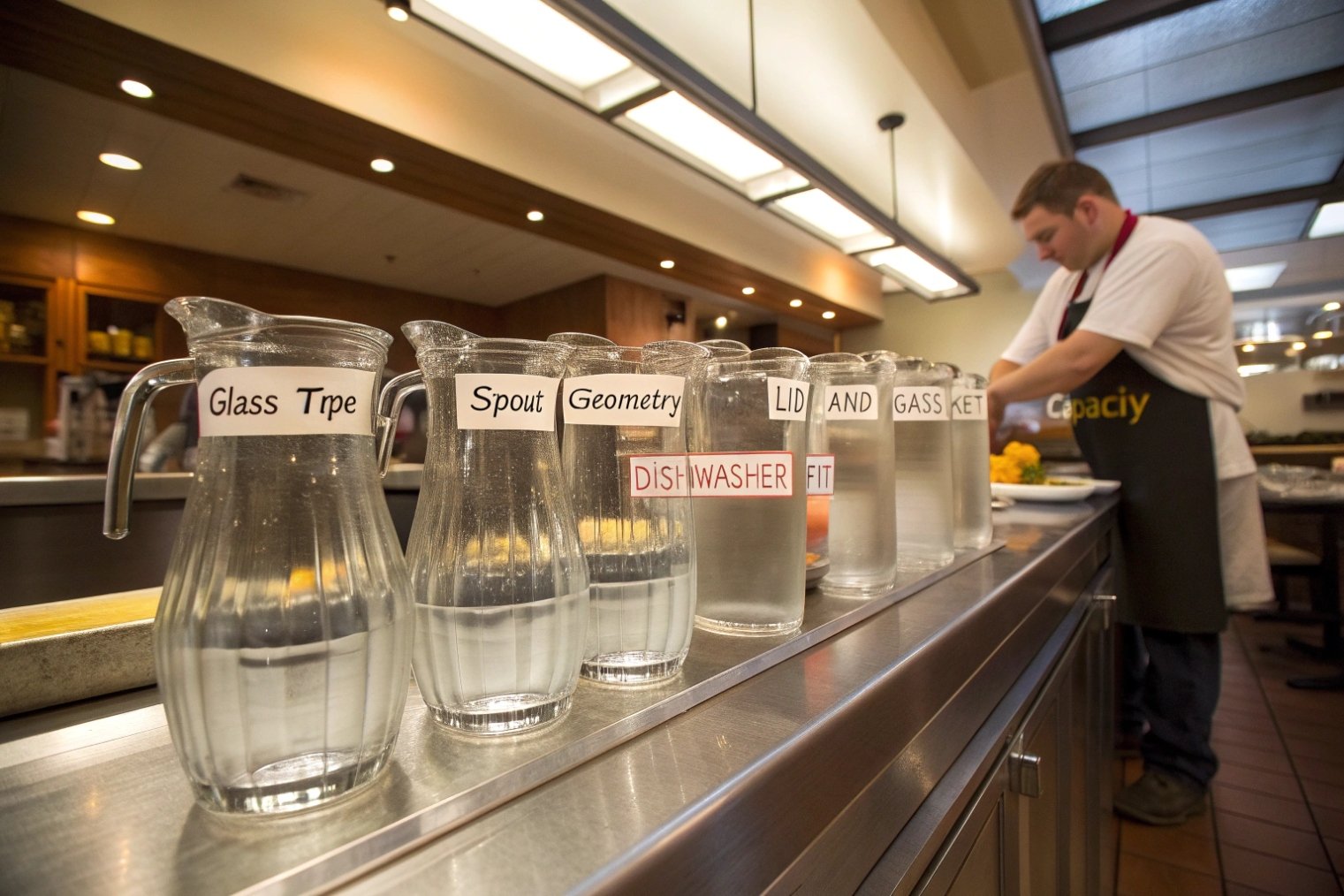
A pitcher that pours beautifully on day one but leaks, chips, or clouds after a month is not a good investment, especially in restaurants or busy homes.
To choose a durable, dishwasher-safe glass water pitcher, match glass type, spout and lid design, capacity, and handle geometry to your real usage: fridge-to-table cycles, dishwashers, and daily refills.
When I design and source pitchers with clients, I do not start from aesthetics. I start from how they will be washed, carried, refilled, and abused. Good ergonomics and leak control come first; the pretty silhouette comes later.
If you worry about “clouding,” it helps to know the root causes—many issues come from detergents, water chemistry, and surface etching described in Explanation of glass cloudiness & preventive measures 1.
Which spout, lid, and gasket designs actually prevent leaks and drips?
Every pitcher looks leak-proof in a catalog photo. The difference shows up during a busy dinner when someone pours quickly and wipes the table for the third time.
Choose a well-defined spout, a lid that locks or nests securely, and removable silicone gaskets that seal without warping, so the pitcher pours in a clean stream instead of dribbling down its own neck.
Spouts that pour cleanly
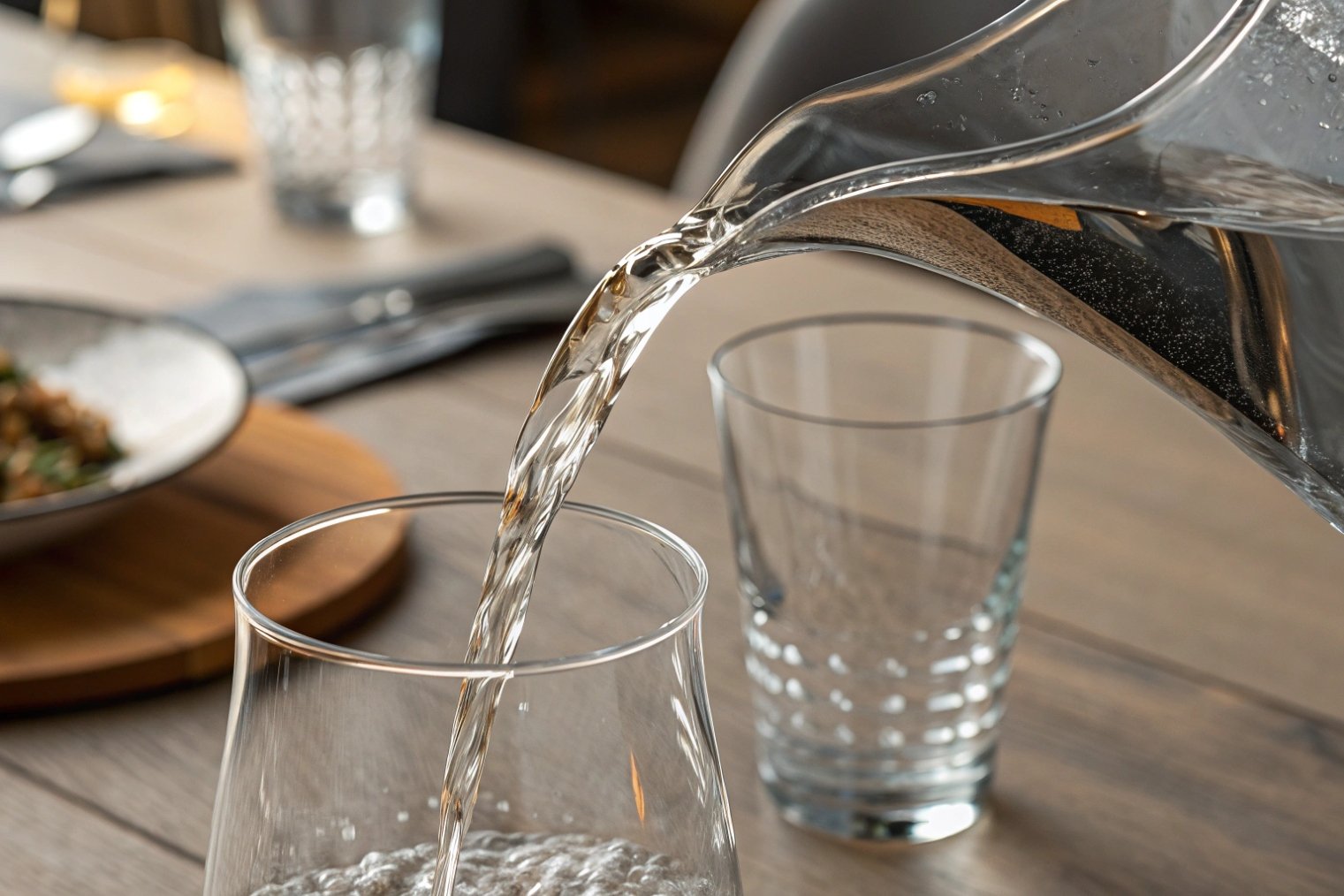
A good spout is like a good faucet: it controls the stream.
Key features I look for:
- Clear lip geometry: a neat V-shape or gently pinched beak that gathers liquid into a focused stream. Flat or blunt rims dribble more.
- Slight outward flare: helps the water break cleanly from the glass edge rather than curling back down.
- Enough height: a spout with a little “nose” above the rim gives better control when the pitcher is almost empty.
Compare two pitchers on the table: one with a crisp beak often leaves the tablecloth dry, while a flat-lipped design leaves a crescent-shaped water mark under the spout after every pour. That “curl back” behavior is exactly what surface tension and capillary action 2 do at poorly shaped edges.
Lids that stay put and behave
Lids work in two ways: they keep dust and ice inside, and they cooperate with the spout rather than fighting it.
Useful options:
- Push-in or twist-lock lids that cannot jump off if someone pours quickly.
- Rotating lids with different modes (open, strainer, closed) for water, ice, or fruit infusions.
- Weighted glass or stainless lids that self-seat when you tilt the pitcher.
I always check:
- Can the lid be lifted with one hand while holding the handle?
- Does the lid stay in place when the pitcher is full and poured at a normal angle?
- Are there small crevices that will trap pulp or limescale in the dishwasher?
Gaskets and seals
Silicone gaskets are the quiet heroes. They turn a loose-fitting lid into a leak-resistant system.
For daily use:
- Choose removable gaskets and specify FDA 21 CFR 177.2600 rubber articles intended for repeated use 3 for food-contact confidence.
- Make sure the gasket can be stripped, cleaned, and reinstalled easily.
- Avoid designs where the gasket sits in very deep grooves that never see fresh water.
A simple summary:
| Part | Good design cues | Warning signs |
|---|---|---|
| Spout | Defined beak, slight flare, raised lip | Flat rim, indistinct pouring edge |
| Lid | Twist or push fit, clear open/close positions | Loose cap that rattles or falls off when pouring |
| Gasket | Removable silicone ring, easy to wash and re-seat | Hard, non-removable ring, hidden crevices |
If the spout, lid, and gasket look over-complicated on the drawing, they will usually be harder to keep leak-free and clean in real life.
Does borosilicate glass really handle fridge-to-table temperature swings better?
Water pitchers live between fridge and table, and sometimes meet hot tea or freshly boiled water. The wrong glass here can give you a crack at the worst moment.
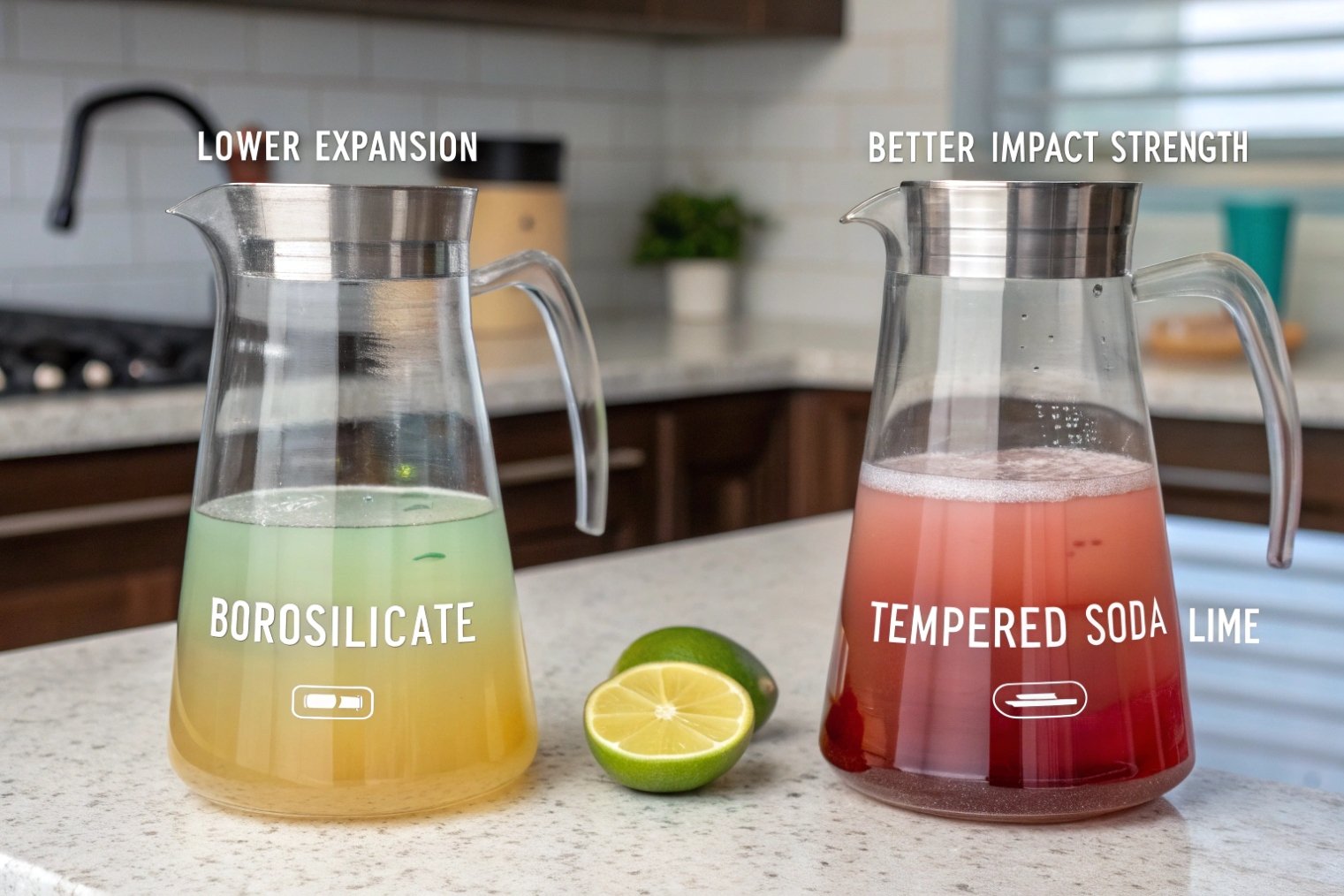
Borosilicate glass has lower thermal expansion than ordinary soda-lime, so it handles moderate fridge-to-table temperature swings better, but tempered soda-lime can be just as practical if you avoid extreme shocks and follow the maker’s limits.
What “thermal shock” looks like in daily use
Thermal shock is what happens when one part of the pitcher heats or cools much faster than the rest. The fast part tries to expand or shrink; the colder part resists. Stress builds. If it passes a limit, the glass cracks.
Typical risk moves:
- Pouring near-boiling water into a pitcher that just came from the fridge.
- Filling with very cold water and ice, then putting the pitcher straight into a hot dishwasher.
- Taking a hot, just-washed pitcher and immediately adding ice and cold water.
Borosilicate glass has a much lower coefficient of thermal expansion—if you want a concrete reference point, see the Corning® borosilicate 7740 material properties 4. That means lower internal stress and more safety margin for “normal” moves like:
- Chilled pitcher → room-temperature table → refill with cool tap water.
- Room-temperature pitcher → hot herbal tea (not straight from a rolling boil).
- Fridge → dishwasher, as long as the pitcher warms slightly in the air before the cycle.
Borosilicate vs tempered soda-lime in pitchers
For pitchers, I usually see two practical options:
| Feature / Risk | Borosilicate pitcher | Tempered soda-lime pitcher |
|---|---|---|
| Thermal shock | Excellent for moderate swings | Good, but less margin than boro |
| Impact / knock resistance | Good | Very good (tempering helps) |
| Typical weight | Often a bit lighter | Often slightly heavier |
| Feel and clarity | Very clear, “lab like” | Clear, sometimes with faint greenish tone |
| Price and availability | More “premium” and niche | More standard, widely used in foodservice |
Tempering works by building compressive stress at the surface—Britannica’s note on toughened (tempered) glass 5 is a quick primer on why it resists knocks so well.
For a home kitchen or café that wants to pour both iced water and hot tea from the same pitcher, a borosilicate design clearly marked for hot and cold is a safe choice. For restaurants that handle large volumes, constant dishwashing, and more mechanical abuse, tempered soda-lime can make more sense, as long as the workflow avoids extreme temperature jumps.
Whatever the material, I always follow simple habits:
- Let a pitcher rest a moment on the counter between fridge and hot liquids.
- Avoid adding boiling water directly; let it cool slightly first.
- Never shock hot glass with straight cold tap water or ice.
Thermal shock stories usually come from those extremes, not from normal fridge-to-table use.
What capacity and weight balance ergonomics for restaurants and busy homes?
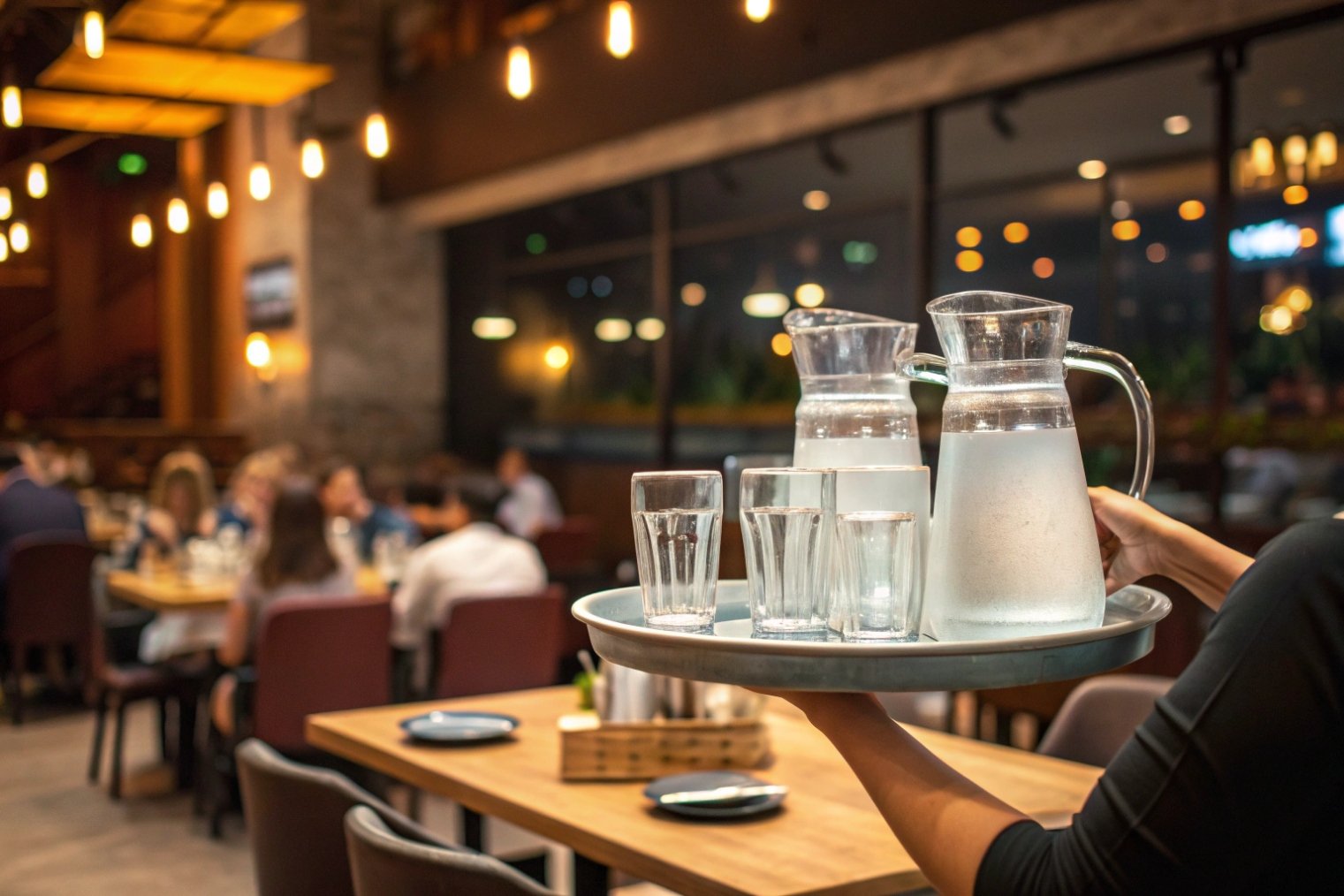
A 2-liter pitcher looks generous until a server carries three of them in one hand at lunch rush. Capacity and weight must work together.
For restaurants, a sweet spot is usually 1.0–1.5 L per pitcher with a broad base and comfortable handle; this keeps full weight manageable, reduces refill frequency, and still fits standard trays and table space.
Matching capacity to service style
Think first about how the pitcher will be used:
- Table water service: guests pour themselves; the pitcher should not be so heavy that a child or elderly guest struggles.
- Server-carried refills: staff hold the pitcher one-handed, sometimes several at once.
- Self-service stations: guests lift pitchers or use them only for refilling smaller carafes.
For table water with staff refilling:
- 1.0–1.3 L keeps full weight reasonable.
- 1.5 L can work if the handle is comfortable and the base is stable.
For buffets or self-service:
- Larger (1.5–2.0 L) can make sense, but only if the grip is safe and the mouth is large enough for easy refills with ice.
Weight and balance
Weight is not just about how thick the glass is. It is about how a full pitcher feels in the hand.
Practical tips:
- Aim for a full weight that a person can hold confidently at arm’s length. Very roughly, many servers are comfortable around 1.5–2.0 kg per full pitcher; above that, fatigue grows fast.
- Choose a wide, heavy base so the center of gravity stays low. Tall, slender pitchers tip more easily when a table is bumped.
- Ensure the handle position balances the mass; when the pitcher is full, it should not “pull forward” aggressively.
Here is a simple comparison:
| Capacity | Where it fits best | Notes |
|---|---|---|
| 0.8–1.0 L | Small tables, cafés, home use | Very easy to lift, more refills |
| 1.0–1.3 L | Standard restaurant table water | Good balance between weight and refills |
| 1.5–2.0 L | Buffets, large tables, family-style dining | Needs robust handle and base stability |
Handle ergonomics
Restaurants and busy homes push handles harder than occasional home use. I focus on:
- Width for three or four fingers, not just two.
- Enough clearance so knuckles do not hit the glass body.
- A shape that stays comfortable when the pitcher is heavy; sharp edges dig into fingers over time.
If the pitcher will be used many hours per day, a slightly thicker handle that spreads pressure is far better than a thin, elegant loop that hurts after ten minutes of service.
Which dishwasher rack clearances and handle widths really matter?
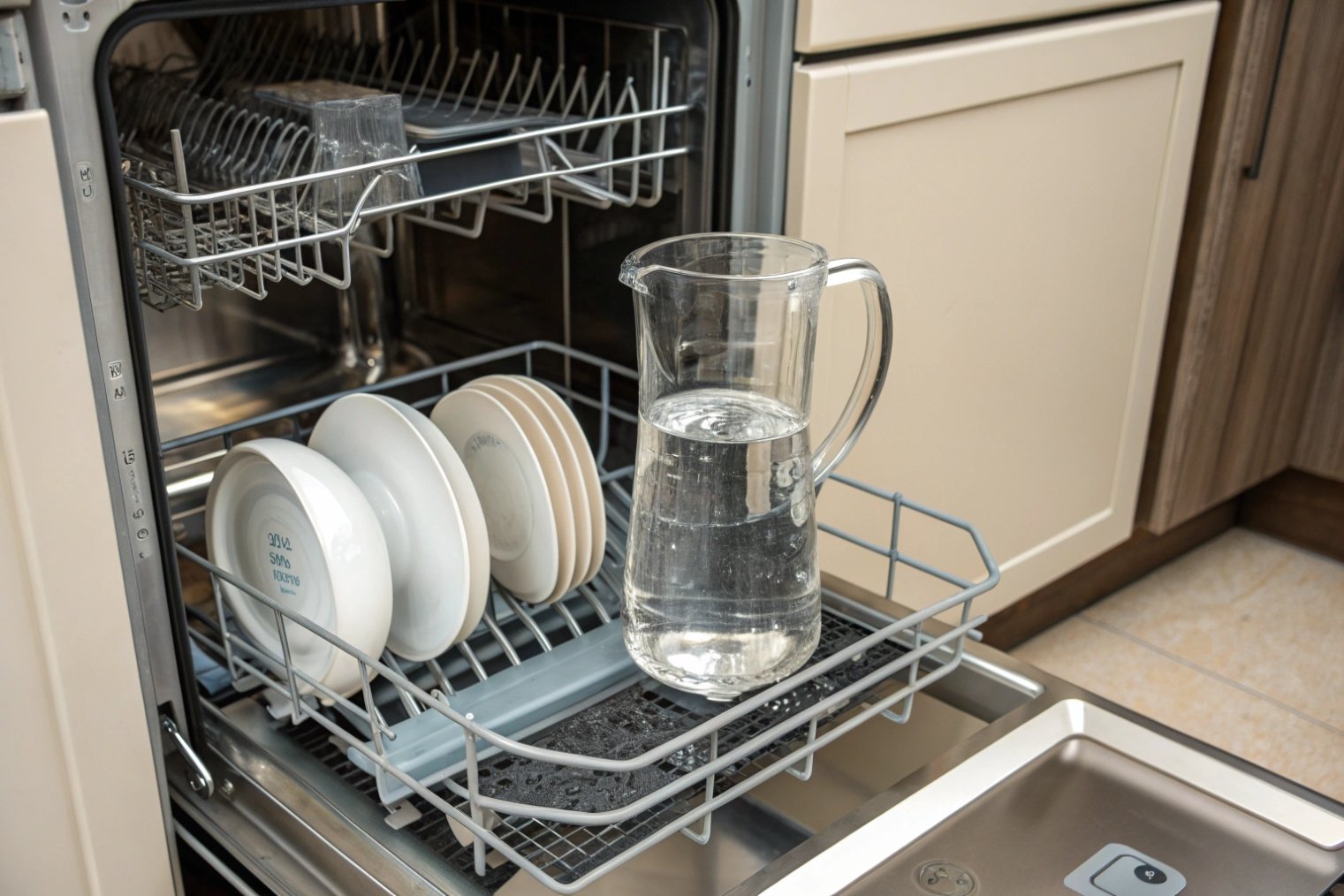
You can buy the nicest pitcher and then discover it has to lie on its side in the dishwasher, collecting half-washed puddles. Rack geometry is part of the spec, not an afterthought.
Measure the pitcher’s height and base diameter against your dishwasher racks, and choose handles and shapes that sit upright and stable between prongs so the pitcher can wash cleanly without banging into neighbors.
Height and clearance
For a pitcher to stand upright during washing:
- The total height (including lid) must be lower than the vertical clearance of the rack you want to use.
- In domestic dishwashers, the top rack is often adjustable; in many commercial machines, racks are open but height is still limited by the chamber.
Before buying in bulk, I like to:
- Measure from rack base to spray arm or top in the real machine.
- Compare that with the pitcher drawing or sample.
- Check second and third machines if we know the product will move between kitchens.
If a pitcher is slightly too tall, you will need to tilt it. That reduces cleaning effectiveness and increases the risk of breakage when it slides during the wash.
If you’re buying for restaurants, it’s also reasonable to ask for wash testing references like the EN 12875 Part 1 dishwasher resistance test method 6, especially for lidded designs.
Base footprint and handle width
Dishwasher racks expect a certain footprint.
- A round base that fits between standard prongs is the safest choice.
- Very wide or square bases may sit on top of prongs and wobble.
- Deep “belly” shapes that flare outwards can clash with neighboring items.
Handles should not be so wide that they occupy another entire lane in the rack. Ideally:
- The handle loop stays close to the body, without sticking out much wider than the base.
- When two pitchers sit side by side, their handles do not touch.
If you’re planning around commercial machines, a quick skim of a glass rack sizing guide 7 helps you sanity-check pitcher dimensions against rack realities.
A simple rack-friendly checklist:
| Feature | Good for dishwashers | Risky in dishwashers |
|---|---|---|
| Height | Fits upright under spray arm | Needs tilting or laying on its side |
| Base shape | Round, fits neatly between prongs | Very wide or odd shapes that bridge prongs |
| Handle width | Compact, close to body | Large, far-out handles that snag on racks |
| Mouth size | Wide enough for water jets to reach inside | Very narrow neck that traps residue |
A wide mouth helps too. It lets jets reach the interior and makes manual cleaning easier when something sticky dries inside. Complex internal baffles or tea inserts should be removable before washing; built-in complexity is the enemy of hygiene.
Conclusion
The “perfect” dishwasher-safe glass pitcher is the one that pours cleanly, survives your fridge-to-table routine, fits your racks and hands, and keeps doing all of that quietly for years.
Footnotes
-
Manufacturer guide to causes of dishwasher cloudiness and practical steps to reduce etching and deposits. ↩ ↩
-
Explains why liquids dribble from lips and how edge shape controls pouring. ↩ ↩
-
Official FDA regulation for rubber articles (including gaskets) intended for repeated food contact. ↩ ↩
-
Primary datasheet showing borosilicate 7740 thermal expansion and temperature behavior relevant to thermal shock. ↩ ↩
-
Overview of how tempering increases glass strength and changes break pattern in impact. ↩ ↩
-
Describes EN 12875-1 method for evaluating dishwashing resistance under chemical, thermal, and mechanical stress. ↩ ↩
-
Helps size pitchers for commercial racks and avoid breakage from poor rack fit. ↩ ↩






