
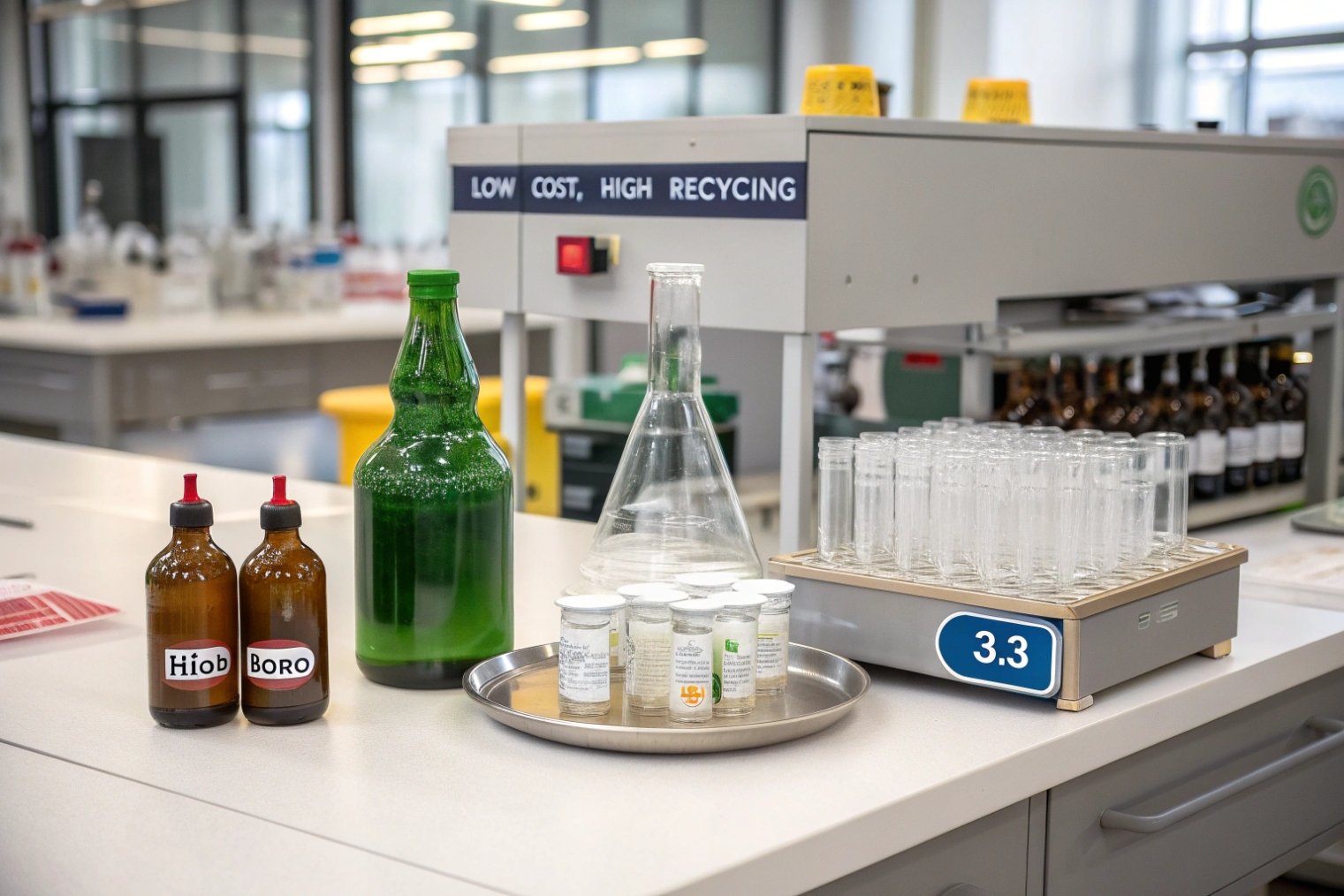
You see “high borosilicate” on a spec sheet and “soda-lime” on bottles and wonder which one is really better for your product, and where the extra cost actually goes.
Soda-lime glass is the low-cost workhorse for bottles and jars, while high borosilicate adds boron for much lower thermal expansion, better heat and chemical resistance, but higher cost and tighter recycling limits.
Both materials are safe, clear, and strong. In most packaging, the default is still soda-lime container glass 1 because it is widely available and optimized for high-speed bottle production. When applications push into repeated high heat or harsh chemistry, many teams move to borosilicate glass 3.3 2 for extra thermal and chemical stability.
Which performs better for hot-fill, microwave, and dishwasher?
Many buyers think “borosilicate = always safer for heat,” but production reality is more subtle, especially when you add caps, labels, and line speeds.
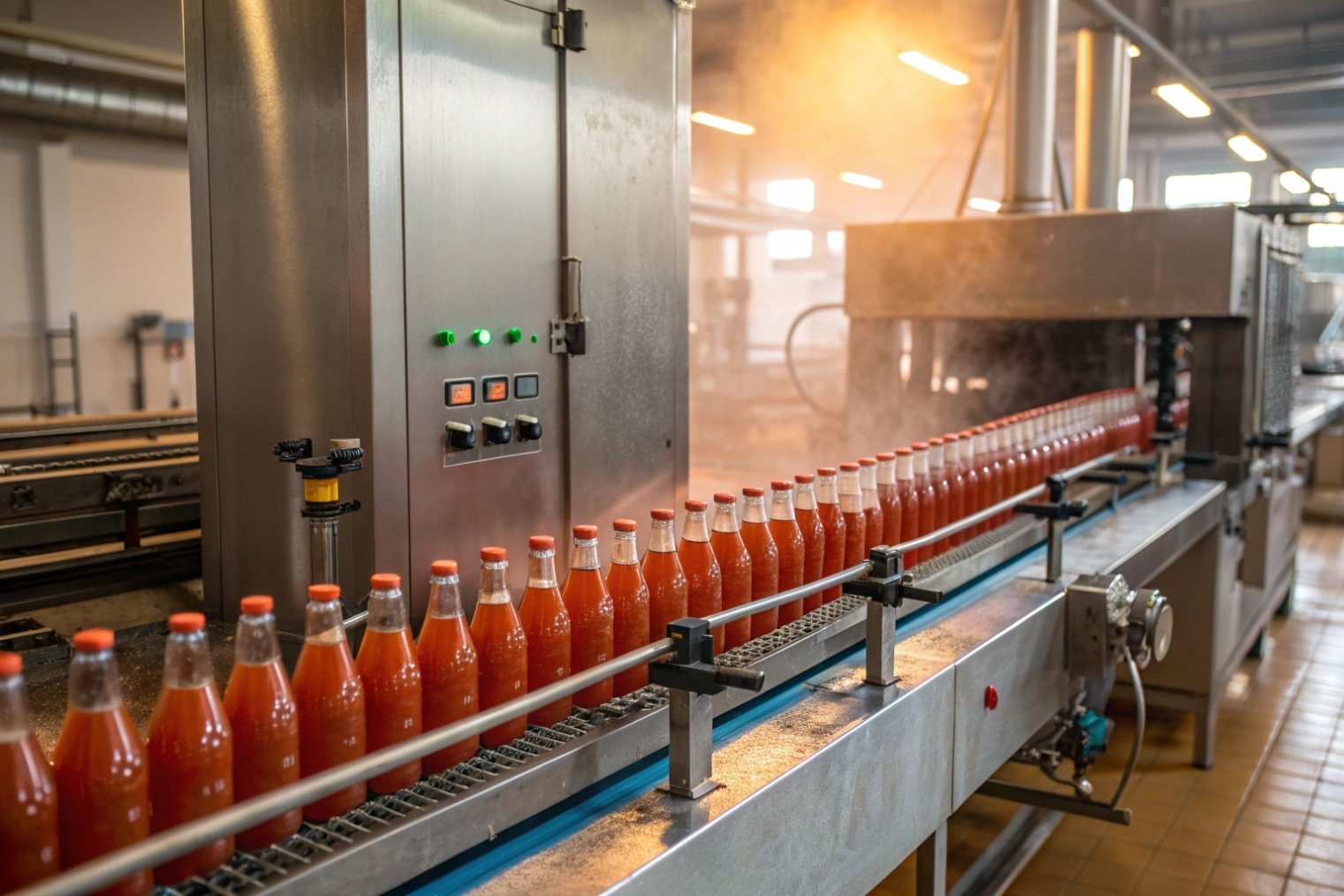
High borosilicate wins for repeated high-temperature and thermal-shock conditions, but well-designed soda-lime handles most hot-fill and dishwasher cycles; microwaving is usually limited more by closures than by glass type.
Hot-fill and thermal shock
For hot-fill food and beverage:
- Soda-lime container glass is designed to handle typical hot-fill and pasteurization profiles if the bottle is properly designed and annealed.
- However, soda-lime has a higher coefficient of thermal expansion (CTE) 3 (≈ 8–9×10⁻⁶/K), so it is more sensitive to very fast hot–cold shocks and uneven heating.
High borosilicate 3.3:
- Has a much lower expansion (≈ 3.3×10⁻⁶/K).
- Tolerates larger temperature jumps (design-dependent).
- Handles repeated cycles with better thermal shock resistance 4.
For classic hot-fill lines (juice, sauces, teas), soda-lime is usually enough, as long as:
- The temperature profile is controlled.
- The bottle thickness is uniform.
- Cold water sprays and cooling tunnels are set correctly.
High-boro becomes interesting when:
- Containers see repeated oven or autoclave cycles.
- Thermal shock is hard to control (lab, industrial, or cookware use).
Microwave use
Most packaging bottles are not truly “microwave products”, regardless of glass type, because:
- Closures, liners, and pourers may not be microwave-safe.
- Labels, inks, and foils can heat or damage.
- Shape and headspace can create hot spots.
For household cookware and labware, high borosilicate is preferred when you expect repeated microwave cycles plus hot–cold changes. For normal consumer bottles, both glass types are usually labeled “not for microwave use” because of the closure, not the glass.
Dishwasher resistance
Both glass families can go through dishwashers, but:
- High borosilicate generally has better long-term resistance to chemical attack and clouding from strong detergents and high temperatures.
- Soda-lime bottles can also survive dishwashing, but repeated cycles with aggressive detergents may cause more surface wear over time.
In commercial reuse systems (for example refillable bottles), the wash chemistry and temperature matter as much as the glass family. Properly formulated soda-lime can work well in these systems.
Quick application guide
| Use scenario | Better choice in practice |
|---|---|
| Standard hot-fill bottles/jars | Soda-lime container glass |
| Pasteurization with controlled cooling | Soda-lime (proper design + process) |
| Repeated oven-to-table use | High borosilicate |
| Frequent microwave heating | High borosilicate (with microwave-safe closures) |
| Autoclave / lab media bottles | High borosilicate |
| Domestic dishwashing (normal use) | Both; high-boro ages more slowly |
How do mechanical strength and impact resistance compare?
It is easy to assume the “high” in high borosilicate means stronger in every way, but impact behavior tells a different story.
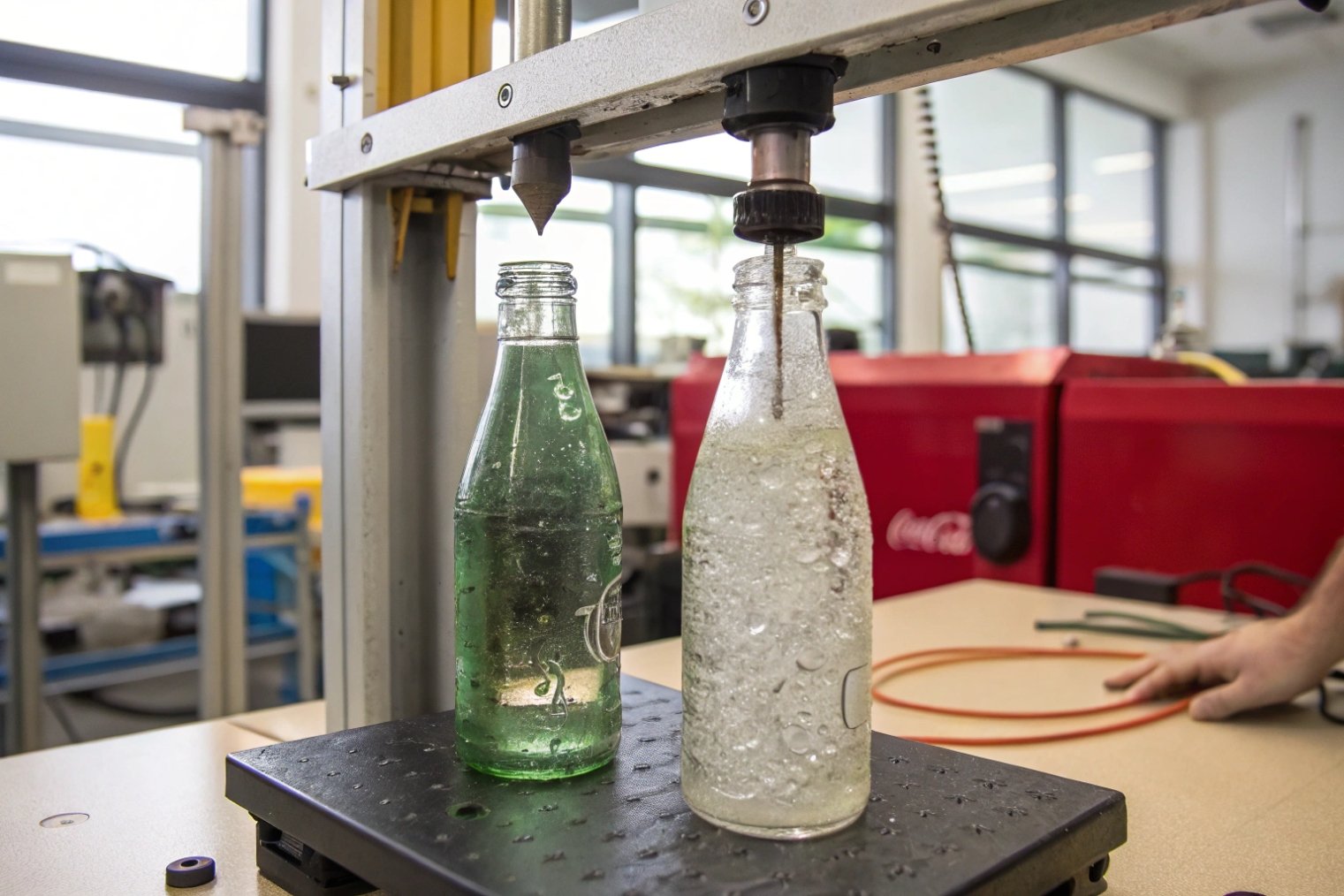
High borosilicate is harder and more stable under heat, but tempered soda-lime usually offers better impact resistance; in real handling, design, thickness, and tempering matter more than the chemistry alone.
Static strength vs real-world impact
On paper:
- High borosilicate has higher hardness and excellent high-temperature strength.
- Soda-lime has slightly higher density and a different balance of elasticity and brittleness.
In practice, impact performance often depends on whether the container is tempered glass 5 (surface compression) versus simply annealed, plus how much surface damage it accumulates during conveying, filling, and shipping.
Brittleness and surface defects
Both materials are brittle. The key weak points are:
- Scratches on the surface.
- Stones, bubbles, or cords in the glass body.
- Sharp contact points on conveyors or in crates.
High borosilicate often runs in cleaner, slower processes for labware and cookware, so defect rates can be low. Soda-lime container glass runs at high speed, but modern lines use controlled forming, automatic inspection, surface treatments, and packaging designed to minimize damage.
Weight and feel
Density differences are small but real:
- High-borosilicate: ~2.2–2.3 g/cm³.
- Soda-lime: ~2.4–2.5 g/cm³.
For the same geometry, high-boro is slightly lighter. But design choices usually dominate:
- Premium spirits bottles in soda-lime are intentionally heavy.
- Lab bottles in high-boro are often more slender and functional.
Mechanical comparison summary
| Property / behavior | High borosilicate 3.3 | Soda-lime container glass |
|---|---|---|
| Hardness (scratch) | Higher | Lower |
| Thermal strength | Very high at elevated temperatures | Good at moderate temperatures |
| Impact resistance (tempered) | Usually lower than tempered soda-lime | Tempered glass has excellent impact |
| Typical processing | Slower, specialty applications | High-speed bottle and jar production |
| Density / weight | Slightly lower | Slightly higher |
For everyday bottles and jars that see more impact than extreme heat, soda-lime (often with tempering or coatings) is usually the more robust, cost-effective choice.
Are there recycling stream or cost differences by region?
Many brand owners want “high-boro” on the box and “high recycled content” on the sustainability report, but those two goals can clash.
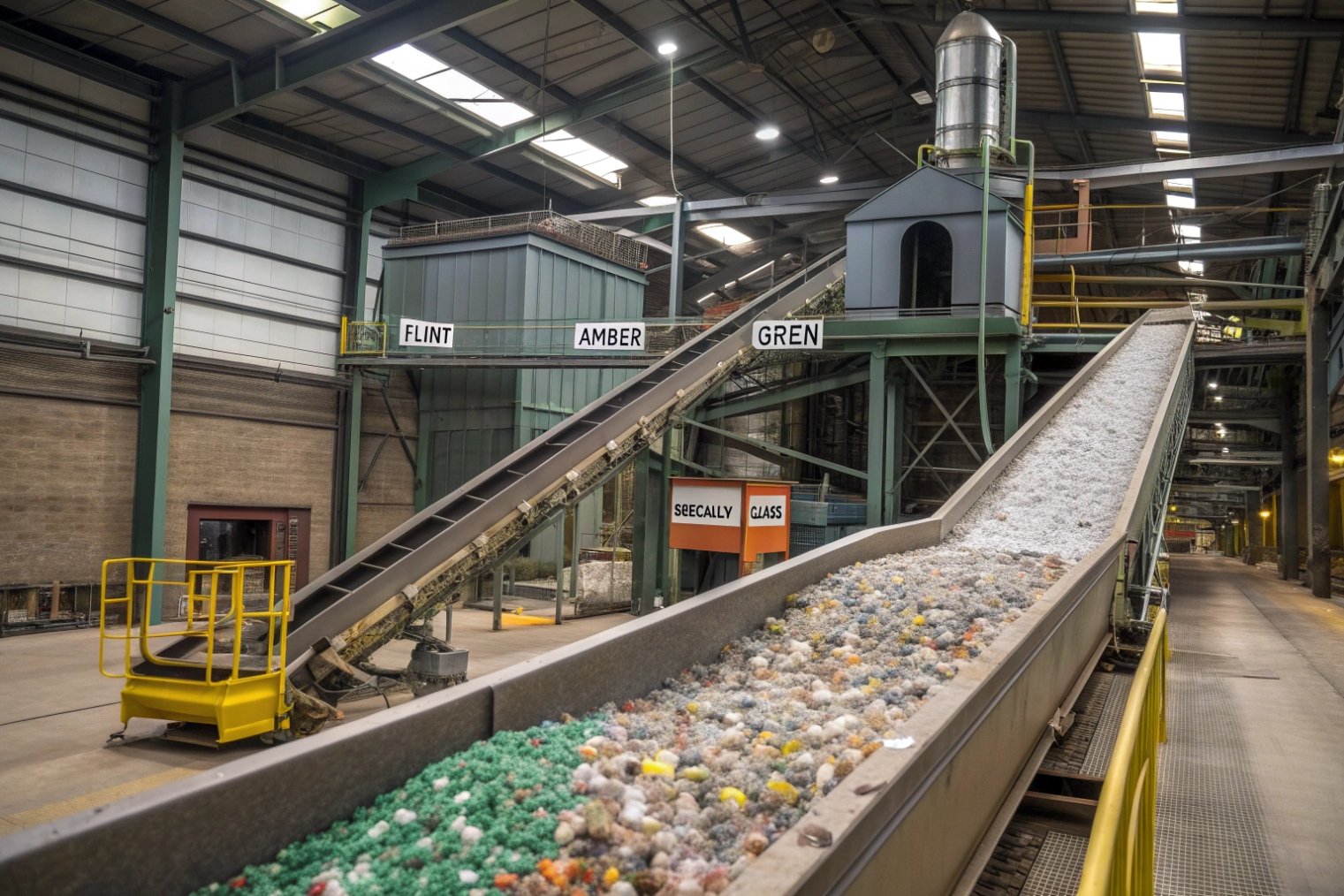
Soda-lime bottle glass fits mainstream recycling streams and is cheaper almost everywhere; high borosilicate is usually treated as a contaminant in container cullet and runs on smaller, more expensive melting capacity.
Recycling streams
Global recycling systems are built around soda-lime container glass. That is why programs often warn that cookware and lab glass can disrupt the container-glass recycling stream 6.
When high-borosilicate enters soda-lime cullet:
- It does not melt or behave the same way.
- It can create stones or hard inclusions in containers.
- It can shorten furnace life if levels grow too high.
By contrast, soda-lime bottles and jars have established collection, color sorting, and cullet markets in many regions, making high recycled content much more practical.
Cost and regional differences
Soda-lime container glass benefits from:
- Massive economies of scale.
- Broad raw-material bases (sand, soda ash, limestone).
- Many plants in every major region.
High-borosilicate:
- Uses more expensive boron sources and higher-purity silica.
- Runs in specialized furnaces with lower throughput.
- Has fewer producers, which means less competition and longer logistics in some regions.
Rough cost picture:
| Aspect | Soda-lime container glass | High borosilicate glass |
|---|---|---|
| Raw material cost | Lower | Higher (boron, purity) |
| Furnace size / volume | Very large, high throughput | Smaller, specialized |
| Recycling compatibility | Excellent in bottle streams | Limited, needs separation |
| Typical price per unit | Baseline for packaging | Noticeable premium |
If your brand targets high recycled content and easy end-of-life recycling, soda-lime packaging is usually the safer path.
Do closure/liner selections change with glass type?
Many people expect a different closure system for high-borosilicate bottles, but the main drivers are actually process and product, not whether the glass has boron.
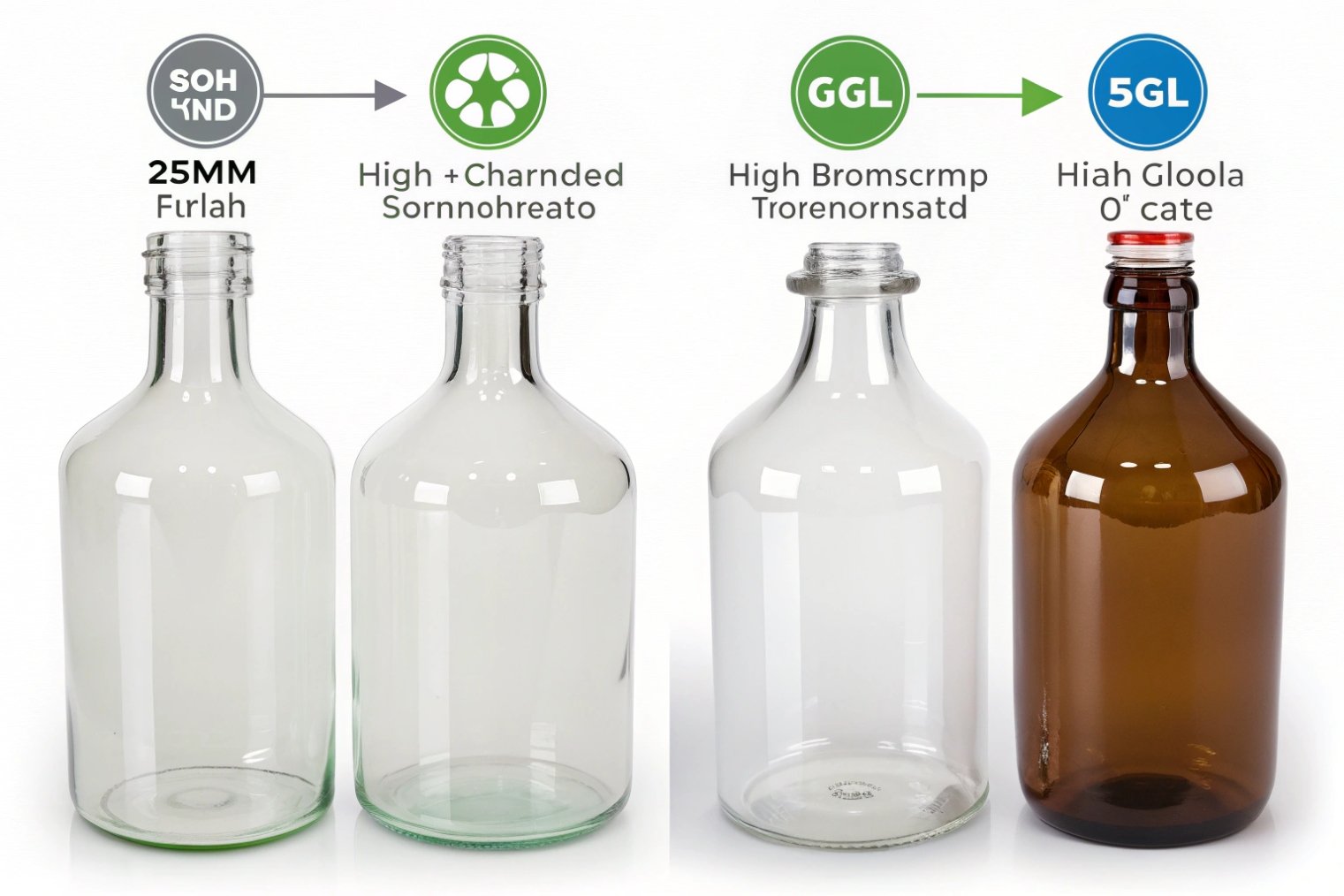
Neck finishes and closure standards are largely the same for soda-lime and high-boro containers; what changes is liner choice and cap design based on heat, pressure, and chemistry, not the glass family itself.
Neck finishes and standards
Most packaging neck standards are defined geometrically, not by chemistry. For labware, a common reference is the GL45 lab bottle thread 7, which can be produced in different glass families depending on the use case.
The glass does not force a different closure type. What matters is:
- How hot the container gets.
- Whether there is vacuum, carbonation, or pressure.
- Which chemicals the closure and liner will contact.
Liner and cap selection
For food and beverage bottles, common choices include metal caps with appropriate liners. For labware and pharma bottles, you often see threaded caps with PTFE, silicone, or rubber liners rated for sterilization and chemical exposure.
So the sourcing logic is:
- Define process and product (heat, pressure, chemistry, shelf life).
- Choose glass family (soda-lime vs high-boro) that can handle those conditions.
- Select closure and liner that match both the glass finish and the use conditions.
Simple mapping
| Application | Typical glass family | Typical closure / liner combo |
|---|---|---|
| Hot-fill tomato sauce | Soda-lime container | Lug cap + plastisol / PVC-free seal |
| Extra-virgin olive oil | Soda-lime, high-flint | ROPP cap + EPE/foam or barrier liner |
| Premium spirits | Soda-lime, extra-flint | ROPP / GPI finish + specialty stopper / insert |
| Lab media bottle | High borosilicate | GL45 cap + PTFE/silicone liner, autoclavable |
| Autoclaved pharma vial (Type I) | High borosilicate / Type I | Rubber stopper + aluminum crimp seal |
Conclusion
Soda-lime glass is the cost-effective, recycling-friendly base for most bottles; high borosilicate is a specialist for heat and chemicals when your process truly pushes beyond normal packaging conditions.
Footnotes
-
Overview of soda-lime glass composition and why it dominates bottles and jars. ↩︎ ↩
-
Reference properties for borosilicate 3.3 used in labware and heat-stress applications. ↩︎ ↩
-
Explains CTE and why expansion drives thermal-stress risk in glass containers. ↩︎ ↩
-
Background on thermal shock mechanisms and why low-CTE glass resists cracking. ↩︎ ↩
-
Shows how tempering adds surface compression to improve impact resistance. ↩︎ ↩
-
Recycling guidance explaining why non-container glass can contaminate bottle cullet streams. ↩︎ ↩
-
Defines GL45 thread basics to align bottle/closure selection for lab packaging. ↩︎ ↩






