
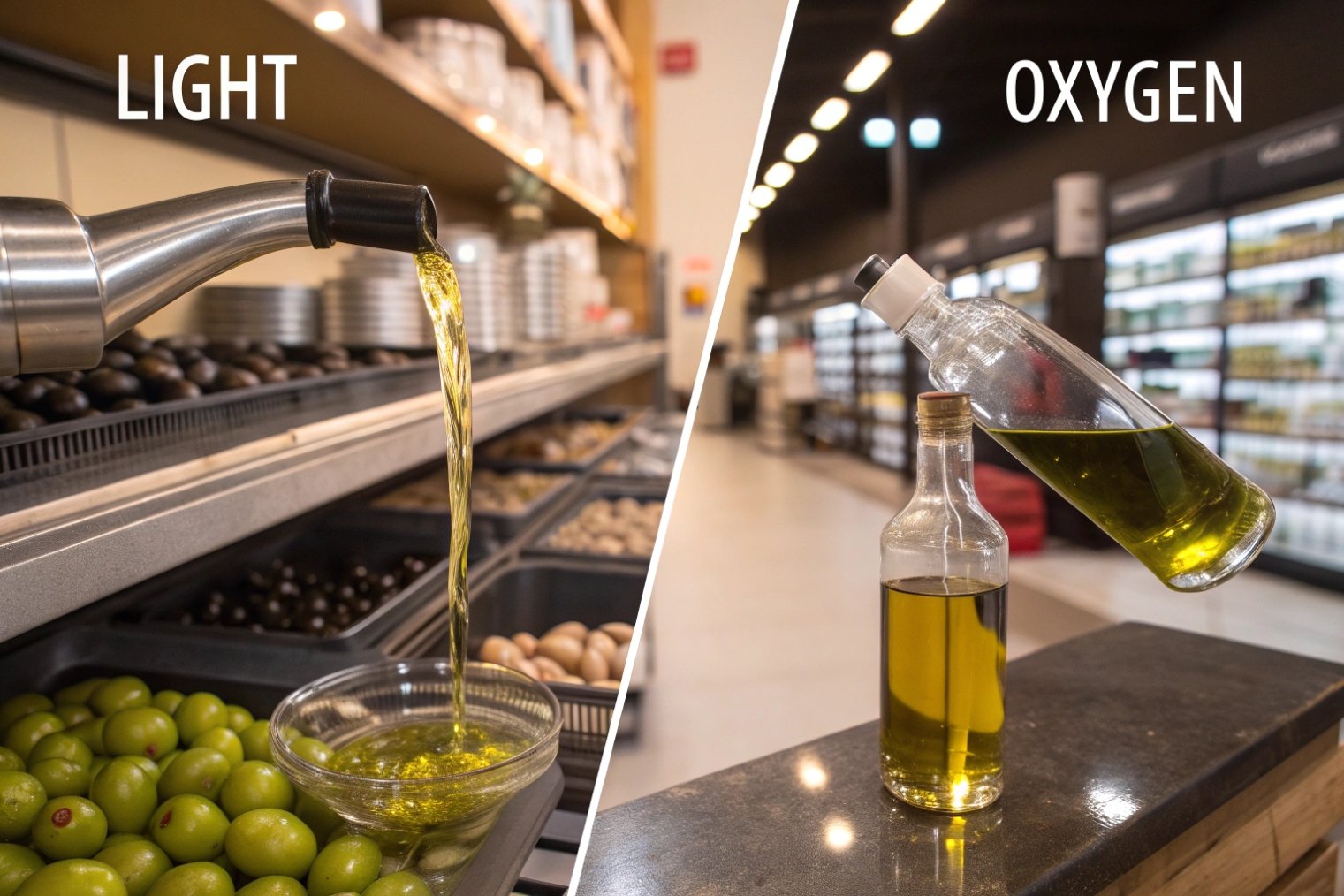
You pay extra for a good olive oil, then one day it tastes flat and greasy. The oil did not “go bad overnight”; light and oxygen have been working slowly in the background.
Most olive oil is packed in dark bottles because amber and green glass filter UV and part of visible light, slowing photo-oxidation and rancidity; closures, labels, and even alternative packages then decide how much oxygen and light still reach the oil.
As a bottle supplier, I see the same pattern again and again: the oil quality is excellent at the mill, but the packaging and storage decide what reaches the consumer. Dark glass is a strong tool, but it is only one part of the full protection system. Many brands also align quality language (EVOO, virgin, etc.) to the International Olive Council trade standard applying to olive oils and olive-pomace oils 1 so “quality” and “protection” match the same definition.
How do amber and green glass block UV and slow rancidity?
You can press the best olives in the world, but if the oil sits in clear glass under shop lights, it loses its edge fast.
Amber and green glass cut UV and high-energy visible light, limiting photo-oxidation driven by chlorophyll and other pigments; amber generally protects better than green, while clear flint is the worst for shelf life.
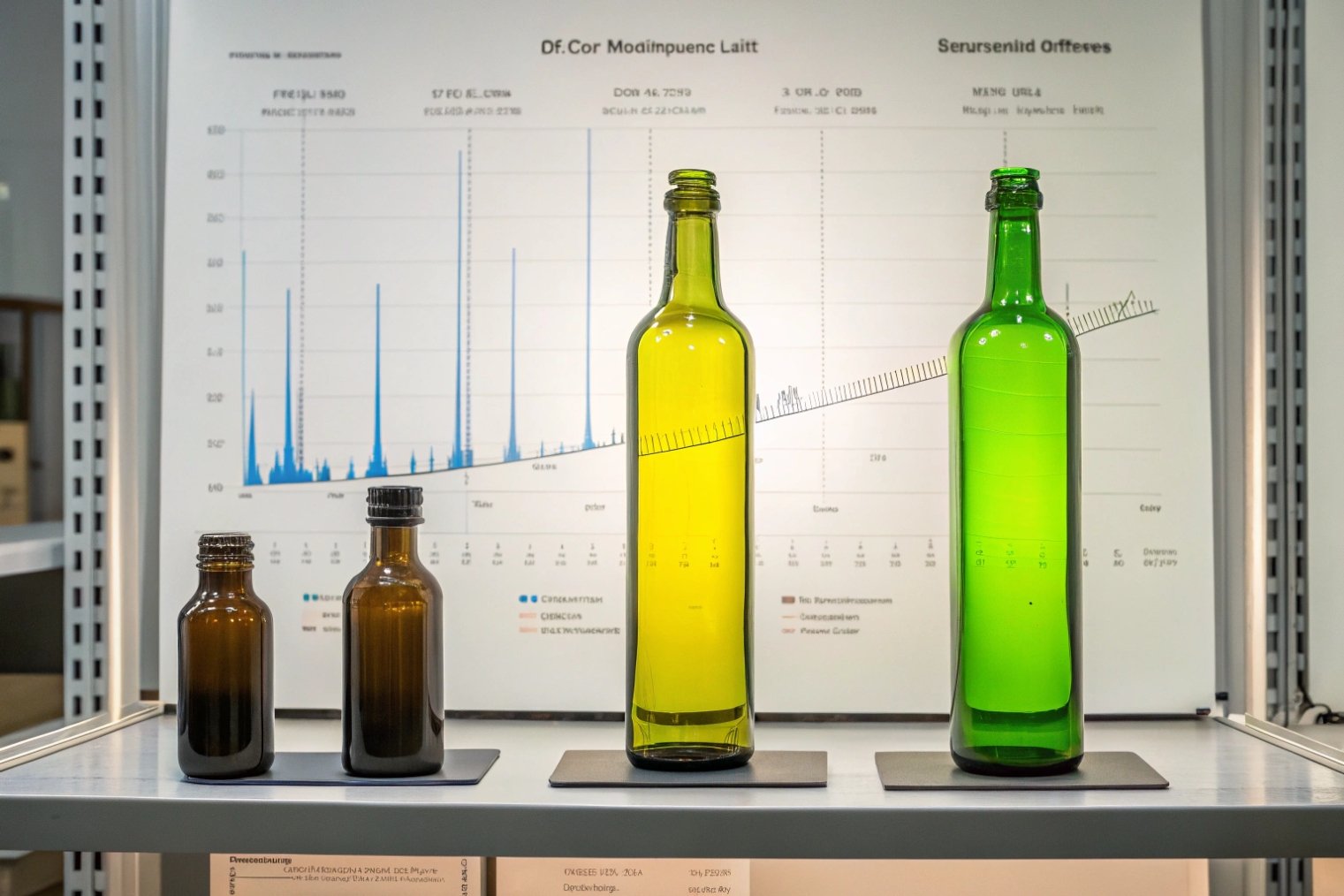
Light, chlorophyll, and why oil “gets old” faster
Olive oil is rich in:
- Chlorophyll and other pigments.
- Polyphenols and vitamin E.
- Unsaturated fatty acids.
Light, especially in the UV and blue range, triggers photo-oxidation:
- Chlorophyll absorbs light and acts as a photosensitizer 2.
- It transfers energy to oxygen.
- This forms reactive oxygen species that attack the fatty acids.
The results show up as:
- “Stale”, “cardboard”, or “paint-like” aromas.
- Loss of the fresh, green, peppery notes.
- Drop in polyphenol and vitamin E levels.
This type of photo-oxidation of olive oil during storage 3 runs even at room temperature, so bottles sitting in bright stores or near windows can lose quality quickly.
How different bottle colors filter the spectrum
Glass color acts like a built-in filter:
- Clear flint glass lets almost everything through. UV is partly absorbed by the glass itself, but visible light passes easily.
- Green glass cuts more UV and some blue light. Protection improves, but not fully.
- Amber / brown glass 4 blocks most UV and a large share of blue and even some green-red light. It gives the strongest protection among common packaging colors.
A simple way to think about it:
| Bottle color | Light protection (overall) | UV protection | Practical effect on oil |
|---|---|---|---|
| Clear flint | Very low | Low–medium | Fastest quality loss |
| Light green | Low–medium | Medium | Better than clear, still risky under strong light |
| Dark green | Medium | Medium–high | Common compromise |
| Amber/brown | High | High | Best among standard glasses |
| Fully opaque (tins, boxes, ceramics) | Very high | Very high | Strongest protection |
In many studies, amber outperforms green, and both are far better than clear glass. This is why serious extra-virgin brands avoid clear bottles unless they use sleeves, boxes, or heavy labels to block light.
Practical choices for olive oil brands
For a packaging project, I usually start with three simple questions:
- How bright is the final environment? Shelf lighting, windows, open markets?
- How long should the oil stay “top quality” in real conditions?
- What design freedom do you have for color, labels, and outer boxes?
If the oil will sit:
- In supermarkets with strong lighting, I push strongly for amber or very dark green plus large labels or boxes.
- In online-only or boxed gift sets, deep green can be acceptable if the bottle stays covered most of the time.
- In open markets or sunny shops, dark glass alone is not enough; we add sleeves, boxes, or even move to tins or bag-in-box.
The more you reduce light, the more you keep the fruity, bitter, peppery profile that your producers worked so hard to create.
Does bottle color interact with oxygen ingress from closures?
Many people mix two problems together: light and oxygen. Color solves light; closures control oxygen.
Bottle color does not change oxygen ingress directly; oxygen comes mainly from headspace and closures, while glass stays an excellent barrier, so dark glass must be combined with low-oxygen closures and small headspace to get full protection.
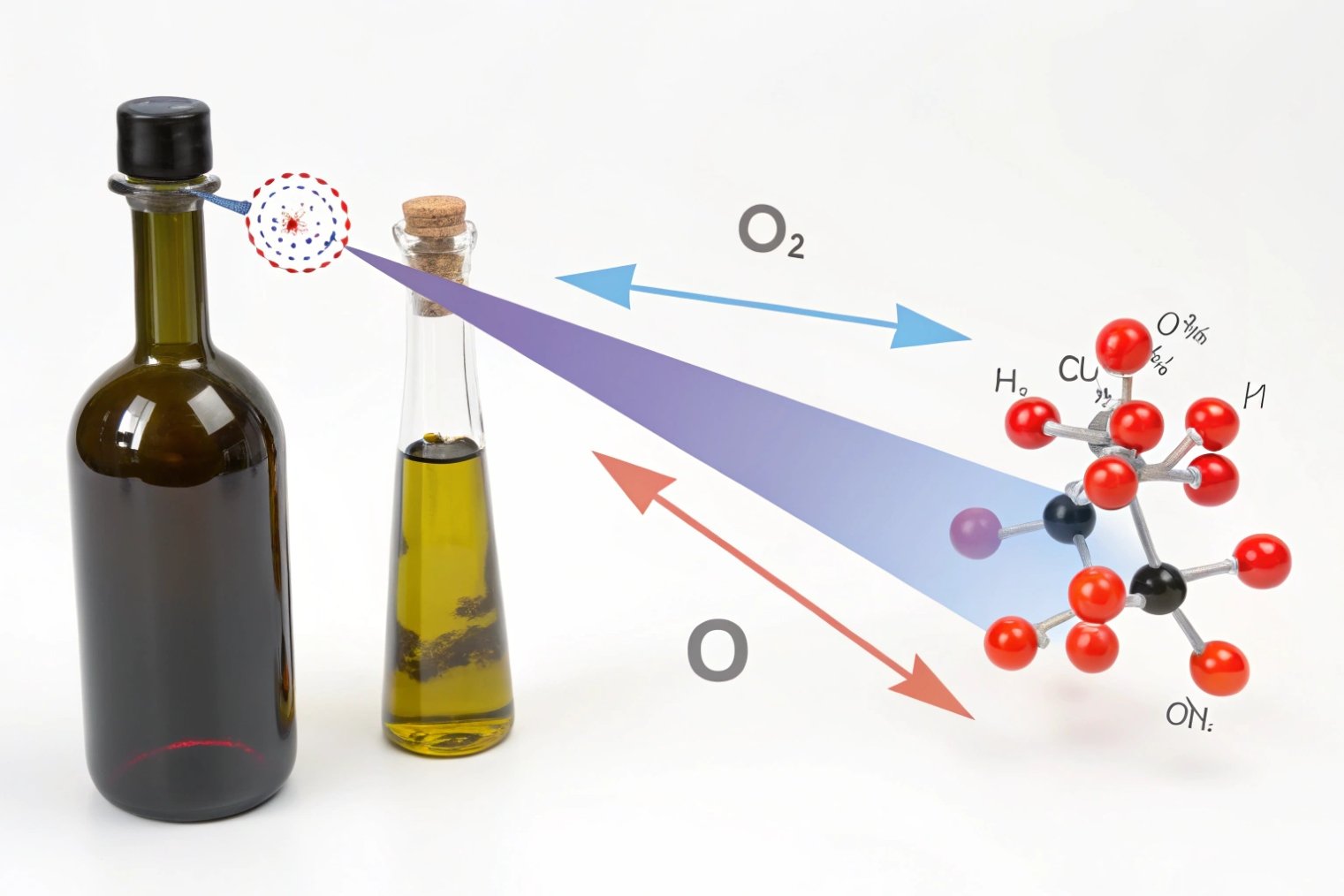
Where oxygen actually enters
In a typical olive oil bottle, oxygen comes from:
- The headspace left above the oil at filling.
- Air dissolved in the oil itself.
- Leakage through the closure system over time.
Glass walls are almost perfect barriers. The weak points are:
- The interface between finish and liner.
- Plastic parts like pourers and capsules (each material has its own oxygen permeability and oxygen transmission rate (OTR) 5).
- Poorly applied caps or damaged threads.
So if a dark bottle uses:
- A cheap, thin liner.
- A cap with poor torque control.
- Large headspace.
Then oxidation will still move fast, even if the oil is well protected from light.
Does dark glass change oxidation rate?
Color makes almost no difference to oxygen by itself. What often happens in the market is correlation, not causation:
- Premium oils usually choose dark bottles + better closures + nitrogen flushing + small formats.
- Cheap oils often sit in clear or light green bottles with basic caps and large formats.
So people see that dark bottles “keep oil fresher” and credit color alone. In reality, the whole system is better:
- Less light.
- Less headspace.
- Fewer oxygen leaks.
If you take the same closure and same filling conditions, then:
- An amber bottle and a flint bottle will have similar oxygen ingress.
- The amber bottle will still win on light-related damage.
Design rules for low-oxygen packaging
When I work with olive oil packers, we set simple rules:
-
Headspace
- Minimize headspace volume.
- Use nitrogen or inert gas flushing 6 where possible.
-
Closures
- Choose proven food-grade liners with low oxygen transmission.
- Control torque carefully on the capping line.
- Avoid damaged or chipped finishes that create micro-leaks.
-
Format
- Prefer smaller sizes if customers use oil slowly. Less time for oxygen to work after first opening.
- For food service, consider bag-in-box or larger tins instead of huge glass bottles.
A quick closure overview:
| Closure type | Oxygen control potential | Notes for olive oil |
|---|---|---|
| Aluminum screw cap + good liner | High | Very common and reliable |
| Tinplate cap with pull-off band | Medium–high | Good if liner and torque are correct |
| Synthetic pourer + cap | Medium | Convenient, but watch O₂ through plastics |
| Natural cork (like wine) | Low–medium | Not ideal for long-term oil storage |
Bottle color and closure have to work together. Dark glass protects against light; the closure must protect against oxygen.
Are tins and bag-in-box better than glass for light protection?
When we talk only about light, even amber glass has a rival: packaging that simply lets in no light at all.
Tins and bag-in-box systems block light completely and, in the case of bag-in-box, also reduce oxygen build-up as the bag collapses; for long shelf life and large formats they usually outperform even dark glass.
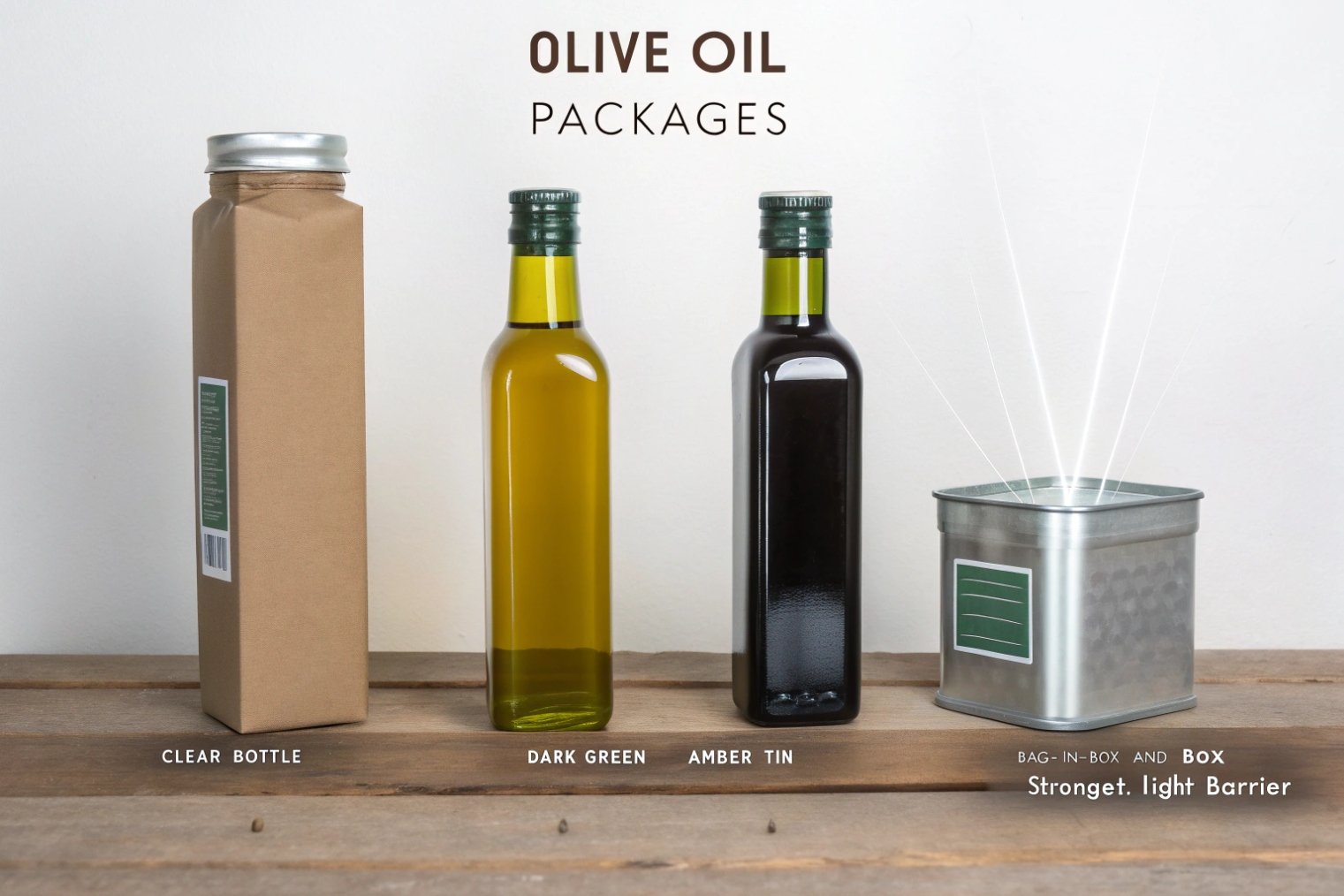
Light protection hierarchy
If we rank olive oil packages only by their light barrier:
- Bag-in-box systems 7 – effectively zero light on the oil.
- Opaque tins – zero light on the oil, except maybe during short pouring periods.
- Dark amber glass – very strong reduction of UV and blue light; some light still passes.
- Dark green glass – good but weaker than amber.
- Clear glass – poorest protection.
So for a producer who sells:
- 3–5 L formats to restaurants, or
- High-value oils that may be stored for many months,
tins or bag-in-box are strong options.
Oxygen and headspace: why bag-in-box is special
Light is only half the story. The other half is oxygen exposure over time, especially after opening.
- In a rigid bottle or tin, as you pour oil out, air flows in to replace the volume. The headspace oxygen slowly reacts with the oil surface.
- In a bag-in-box, the inner bag collapses as oil is dispensed. There is much less headspace, and fresh air contact is minimal.
So bag-in-box gives:
- Excellent light protection (thick outer carton).
- Very low oxygen exposure both before and after opening.
- Better protection for delicate flavors, especially in warm climates or slow-use kitchens.
When to choose each format
Each format has its own pros and cons:
| Format | Light protection | Oxygen control | Consumer perception | Typical use cases |
|---|---|---|---|---|
| Dark glass | High (not total) | Good with right closures | Premium, gift-friendly | Retail bottles 250–1000 ml |
| Clear glass | Low | Same as dark glass | Visual appeal, risky for quality | Short-term, boxed, or entry-level |
| Metal tin | Very high | Good before opening, medium after | Traditional, robust | 1–5 L for home and food service |
| Bag-in-box | Very high | Very good, especially after opening | Less “romantic”, very practical | Large formats, online, HoReCa |
For brand image and gifting, glass wins easily. For maximum shelf life, especially in hot or bright conditions, a tin or bag-in-box will beat dark glass in pure technical terms.
A common hybrid strategy:
- Fill bag-in-box or tins for long storage and food service.
- Offer dark glass in smaller sizes for retail, with the same oil.
This way, you get both performance and presentation.
What label and cap choices best preserve flavor?
Once you choose the main package, small decisions still matter: label area, inks, caps, pourers, and even capsule color can change real-world protection.
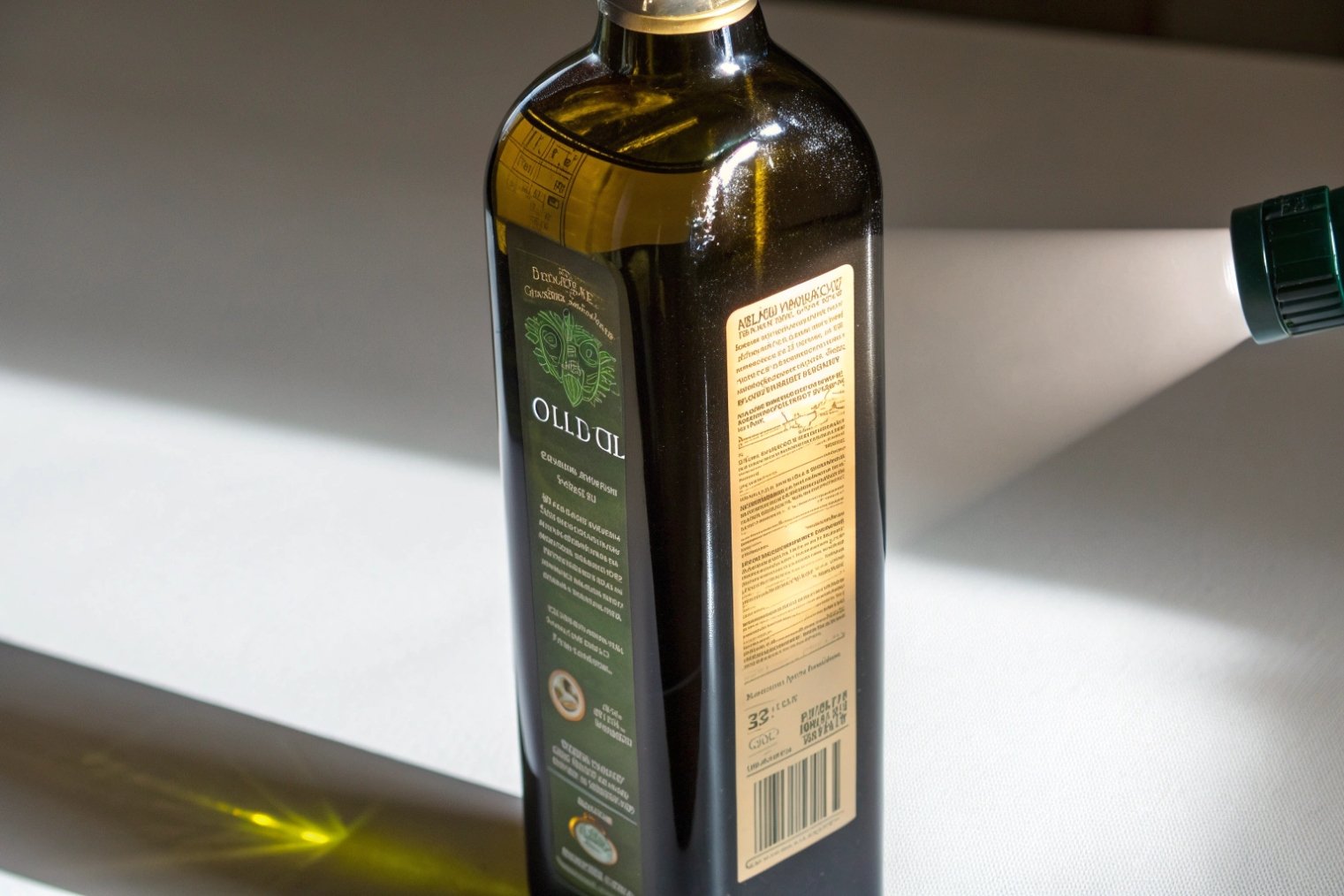
Full-height, opaque labels, dark capsules, and airtight screw caps with good liners all work together with dark glass to shield oil from light and oxygen, while small sizes and fast turnover do the rest.
Labels as extra light barriers
Labels are not only for branding. They also act as cheap, flexible light shields:
- Larger labels cover more of the sidewall and protect the oil from lateral light.
- Opaque or metallic inks and papers block more light than clear or thin films.
- Full or partial sleeves can turn a colored bottle into an almost opaque package.
Some simple rules that work well:
- Wrap at least 50–70% of the bottle height with labels or sleeves, especially on the “front side” facing store lights.
- Use thicker papers or laminated labels for added barrier.
- Avoid large “windows” of bare glass on high-exposure shelves, unless the bottle is mostly stored in boxes.
Caps, liners, and pourers
The cap system is the main door for oxygen. Good choices:
- Aluminum screw caps with quality liners (for example, EPE, Saranex, or other low-O₂ liners) are a strong standard.
- Non-refillable pourers should be tested for oxygen ingress; some use plastics with higher permeability, so design and material selection matters.
- Dark or opaque capsules over the closure area also block light around the neck and headspace.
A simple comparison:
| Component | Best practice for olive oil stability |
|---|---|
| Closure body | Metal screw cap (aluminum or tinplate) with stable dimensions |
| Liner | Proven food-grade liner with low oxygen transmission |
| Pourer | Use only tested designs; check O₂ ingress and sealing |
| Capsule / overcap | Dark or opaque material to block light at the neck |
Torque control during filling is also critical. Under-torque leads to leaks; over-torque can crush liners and reduce seal life.
Storage, consumer behavior, and “real life”
Even the best package loses the battle if the user stores it wrong. On my side, I always remind customers to put clear instructions on the label:
- “Store in a cool, dark place, away from stove and window.”
- “Use within X months after opening.”
- “Close tightly after each use.”
You can also:
- Offer smaller bottles to households that use oil slowly.
- Place the brand’s larger packs in tins or bag-in-box, not huge clear bottles.
Packaging can slow oxidation and light damage a lot, but it cannot stop time. The goal is to keep the oil in its prime state for as much of its life as possible.
Conclusion
Dark glass, smart closures, and thoughtful labels work together; if you combine them with good storage and realistic pack sizes, your olive oil reaches the customer much closer to the mill’s original vision.
Footnotes
-
Official IOC standard defining olive oil categories and key trade quality parameters. ↩︎ ↩
-
Explains photosensitizers and how they trigger light-driven oxidation reactions. ↩︎ ↩
-
Evidence on how packaging and light exposure change olive oil oxidation and shelf life. ↩︎ ↩
-
Background on amber glass and why it blocks UV/blue light in packaging. ↩︎ ↩
-
Defines oxygen permeability/OTR to compare closure and pourer materials. ↩︎ ↩
-
Introduces inert-gas flushing concepts for reducing oxygen in package headspace. ↩︎ ↩
-
Explains bag-in-box structure and why collapsing bags reduce air contact after opening. ↩︎ ↩






