
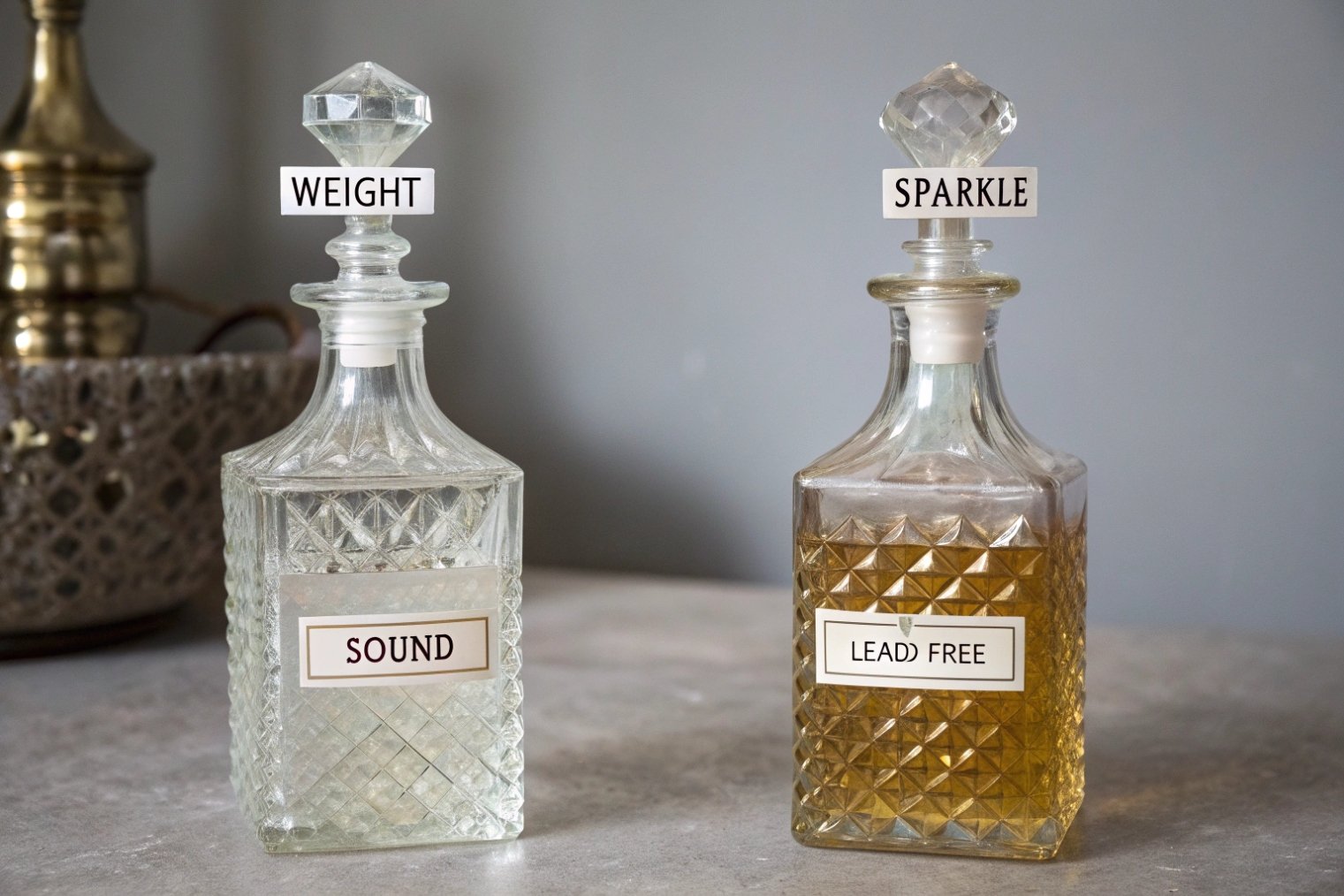
Lead in glass sounds scary, but in real projects the real risk is not guessing — it is assuming every “crystal-look” bottle is safe for food without checking.
You can distinguish leaded from lead-free bottles by weight, sparkle, and sound, then confirm with XRF or lab tests, backed by clear regulatory limits and modern lead-free “crystal-look” alternatives.
Most everyday bottles for food and drinks are soda-lime and lead-free. The trouble starts with decanters, perfume bottles, and “crystal style” packaging where design pushes toward heavy bases and high brilliance. That is where we need a simple method: quick field checks, then proper testing and paperwork.
What quick visual and weight clues indicate lead content?
You cannot carry a lab everywhere, so the first filter must be eyes, hands, and ears.
Leaded glass is denser, brighter, and more “musical”: it feels heavier, shows stronger rainbow sparkle, and rings longer when tapped compared with lead-free soda-lime bottles of the same size.
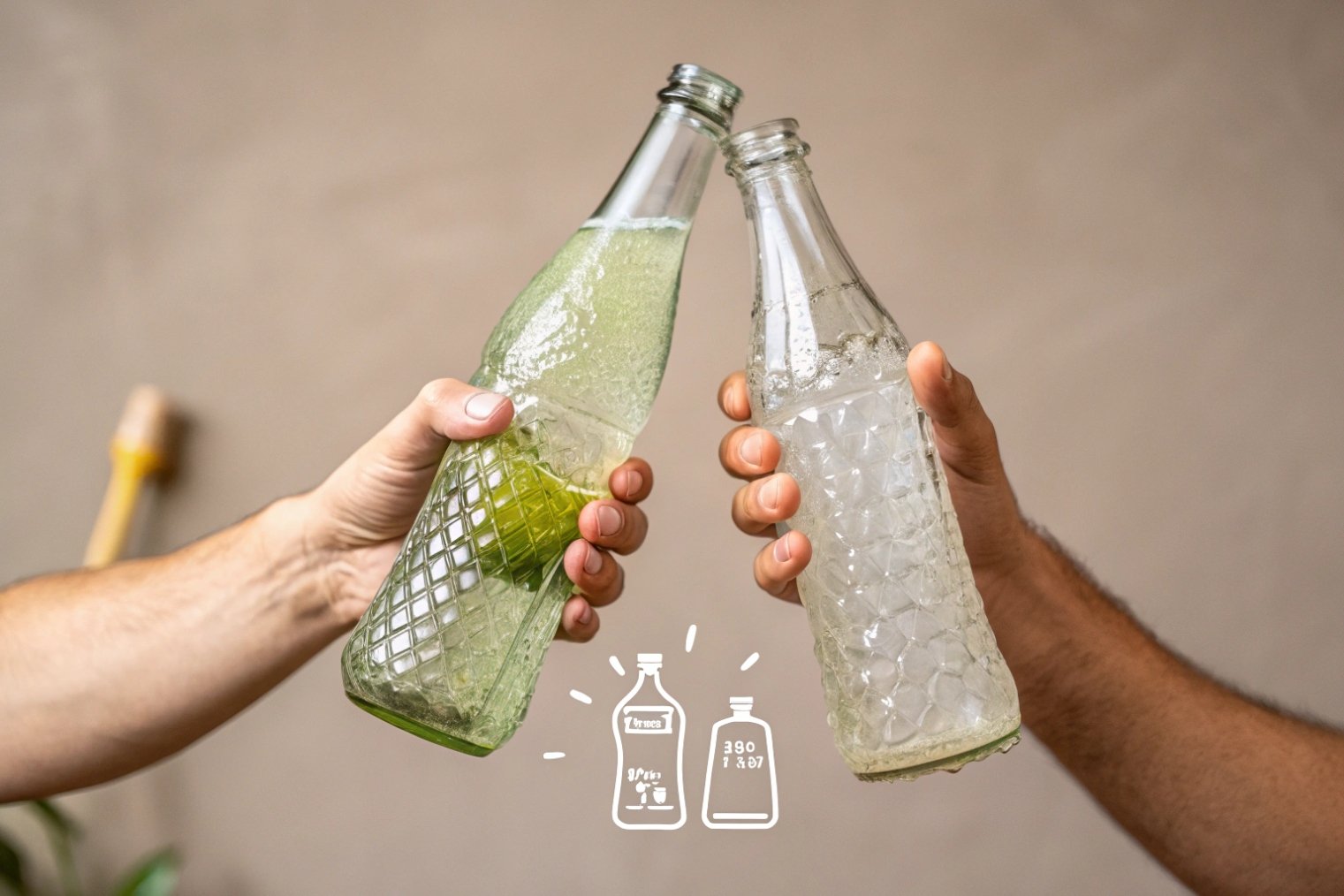
Simple clues you can check in seconds
When I compare two similar bottles side by side, I always start with four basic signals:
-
Weight in hand
For the same shape and wall thickness, leaded glass feels noticeably heavier. Lead oxide increases density, so a small decorative bottle can feel “surprisingly heavy” compared with a normal soda-lime bottle. -
Sparkle and dispersion
Leaded crystal has a higher refractive index and dispersion 1{#fnref1}. Under a point light (phone flashlight, shop spotlight), facets and edges throw strong rainbow flashes. Soda-lime and lead-free “crystal” sparkle less and show weaker color separation. -
Tap test (sound)
A gentle tap with a fingernail or metal ring gives:- Leaded glass: long, bell-like ring that “sings” for a moment.
- Soda-lime: short, sharper clink that dies quickly.
-
Design details
Leaded crystal often appears as:- Thick, heavy base with hand-cut or sharp facets.
- Very fine detail with polished cuts and sometimes a polished pontil.
- Fewer or softer mold seams, depending on how it was made.
By contrast, a typical packaging bottle has clear mold seams and more uniform walls.
Labels help too:
- “Lead crystal” in EU terms usually means ≥24% lead oxide.
- Terms like “crystalline” or “crystal glass” often mark lead-free or low-lead compositions.
None of these clues alone is a legal proof, but together they help decide whether you are probably holding decorative crystal or standard packaging glass.
Quick clue summary
| Clue | Likely leaded glass | Likely lead-free packaging glass |
|---|---|---|
| Weight | Heavy for its size | Normal or light for its size |
| Light behavior | Strong rainbow sparkle, high brilliance | Clear but less “fire” |
| Sound when tapped | Long, ringing tone | Short, duller clink |
| Typical usage | Decanters, perfume, luxury gifts | Water, spirits, sauces, soft drinks |
| Label words | “Lead crystal”, %PbO stated | “Lead-free”, “crystalline”, no Pb claim |
These quick checks are perfect for first screening. But if food safety is on the line, they are only step one.
Can handheld XRF or lab tests verify Pb levels for food contact?
Visual tests tell a story, but regulatory people will always ask, “Do you have data?”
Yes. Handheld XRF can non-destructively detect lead in glass and decorations, while laboratory methods like ICP or AAS with migration tests verify if a bottle meets food-contact limits.

Handheld XRF in practice
On the factory floor or at an incoming inspection, handheld XRF analyzers for lead in glass 2{#fnref2} are the fastest way to check for lead:
- The analyzer sends X-rays into the glass surface.
- Each element emits a characteristic signal.
- The device reports Pb presence and approximate concentration.
Key points:
- XRF is non-destructive and works through coatings or thin inks.
- It is great for screening raw glass, finished bottles, and decorated areas.
- It detects total lead in the surface zone, not what actually migrates into food.
For buyers, XRF gives a simple answer to the first big question: “Is there lead in this glass or its decoration at all?”
Lab methods for regulatory proof
For real food-contact compliance, regulators care about migration, not just composition. Even if glass contains some lead, what matters is how much can leach out under defined conditions.
Typical lab steps:
-
Total composition (optional but useful)
Small samples of glass can be dissolved and analyzed by:- ICP-OES / ICP-MS
- Atomic absorption spectroscopy (AAS)
This gives accurate %Pb in bulk glass, but again, this is not the same as migration.
-
Migration tests
Simulants such as acetic acid solution are used to mimic contact with foods. The bottle or piece is soaked for a defined time and temperature, then:- The liquid is analyzed for lead (and other metals).
- Results are compared with limits from lead migration testing for glassware 3{#fnref3} or other regional rules.
-
Home-level screening
For consumers or small brands, there are lead swab kits or vinegar-soak tests. These can show if lead is leaching at a high level, but they are rough and not enough for official certification.
When testing is worth the money
XRF and lab tests are most valuable when:
- You source decorative decanters, gift bottles, or vintage-style crystal for real beverages.
- You change suppliers or decoration techniques and need to confirm “lead-free” claims.
- You plan to sell in strict markets (EU, US, CA) where authorities can test products independently.
In most standard packaging projects, we specify soda-lime, no intentionally added lead, and stay away from crystal-type formulations. Even then, many buyers still ask for at least one independent XRF or migration report as a safety net.
Which regulations limit lead in packaging glass worldwide?
Markets do not treat “a little lead” as a small issue anymore. Regulations now touch both the glass itself and the whole packaging item.
Global rules restrict lead both as a heavy metal in packaging and as a migrating contaminant into food, with frameworks like EU packaging rules, US toxics-in-packaging laws, food-contact limits, and special labeling for lead crystal.
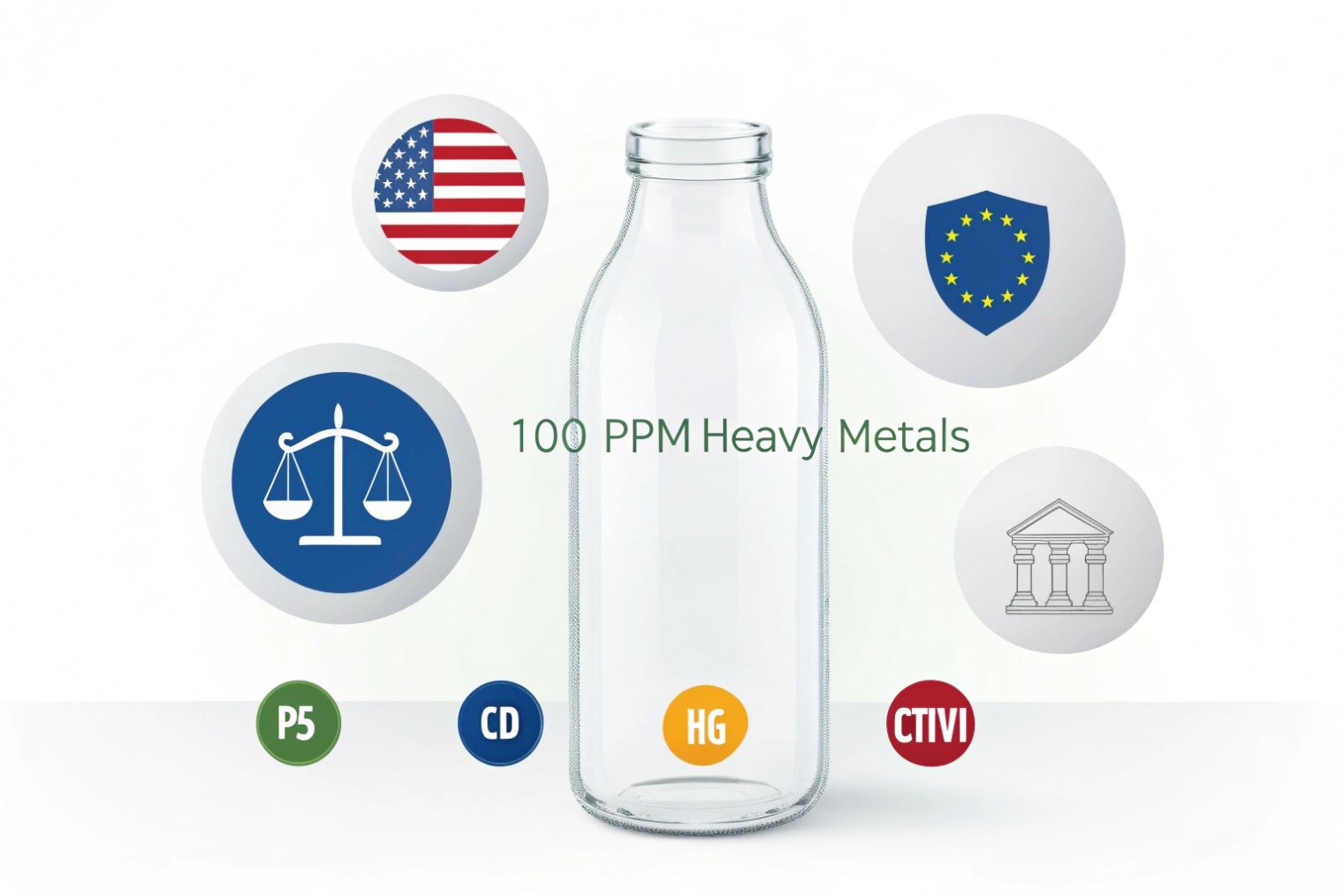
Packaging-level heavy metal limits
Many regions use “toxics in packaging” style rules. One common model limits the sum of lead, cadmium, mercury, and hexavalent chromium in a packaging item to 100 ppm (by weight).
Examples of such approaches include:
- The EU Packaging and Packaging Waste rules 4{#fnref4}, applied through member-state laws.
- US state-level laws following the Toxics in Packaging model legislation 5{#fnref5} (Toxics in Packaging Clearinghouse, TPCH).
These rules treat the whole package as a system: glass, coatings, inks, foils, and closures. Even if the glass body is clean, decorative enamels or labels can break the limit if they use heavy-metal pigments.
Food-contact and migration rules
For bottles in direct contact with food or beverages, we also watch migration limits.
- In the EU, food-contact materials fall under general rules plus specific heavy-metal migration limits. Lead must not migrate into food simulants above defined levels.
- In the US, the FDA evaluates packaging and food-contact substances 6{#fnref6}, focusing again on leachable lead, not total content.
- National rules in countries like China, Japan, and others add their own limits and test conditions.
For lead crystal tableware, the EU has specific standards that define categories by lead content and set stricter migration limits plus recommended usage (for example, not storing acidic beverages long term).
Labeling and warning requirements
Some regions also require labels or warnings where lead is present:
- In the EU, the term “lead crystal” is regulated and tied to a minimum lead oxide content; other terms like “crystalline” signal low or no lead.
- In places with policies similar to California Proposition 65 7{#fnref7}, products that can expose users to more than a small amount of lead may need consumer warnings.
For mainstream packaging, most brands now choose the simpler path:
- Use lead-free soda-lime or modern lead-free crystal formulations.
- Specify “no intentionally added lead” in materials declarations.
- Verify decorations are made with lead-free enamels and inks.
A buyer’s basic paperwork package normally includes:
| Document / test | Why it matters |
|---|---|
| Declaration of composition | Confirms soda-lime glass, no added lead |
| Heavy-metal content test | Checks packaging heavy-metal limits (100 ppm) |
| Migration test report | Shows lead does not leach into food |
| Coating / ink safety data | Verifies decorations are lead-free |
With these in hand, you can answer regulators and retailers with confidence.
Are “crystal-look” effects achievable without using lead?
Design teams love the sparkle and weight of crystal, but buyers and lawyers dislike the word “lead.” The good news is that these goals do not conflict anymore.
Yes. Modern lead-free “crystal” and high-flint soda-lime can deliver heavy bases, strong brilliance, and sharp facets using barium, zinc, or high-clarity formulations instead of lead oxide.
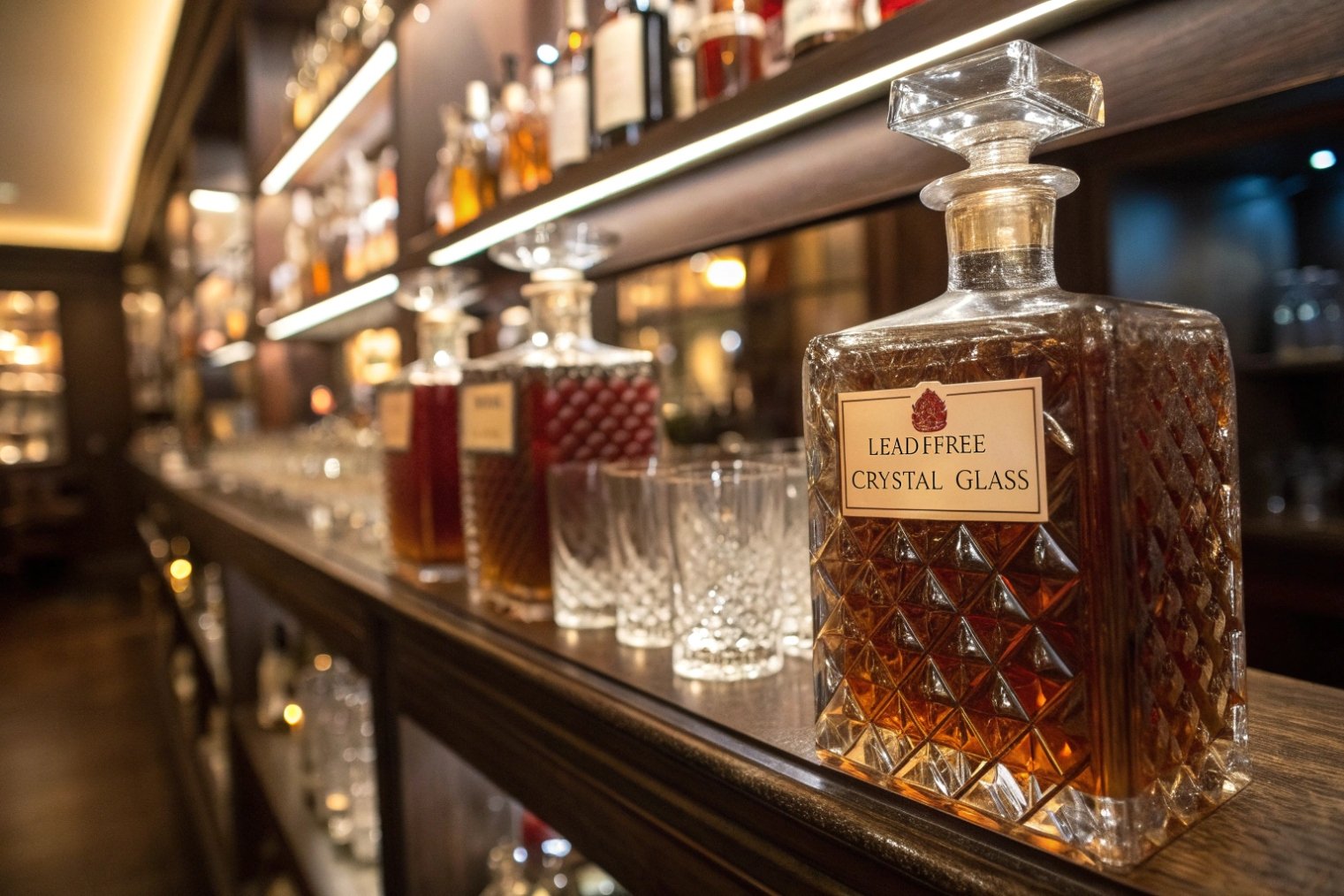
How we get “crystal” performance without PbO
Lead’s role in traditional crystal is to:
- Raise the refractive index and dispersion (more sparkle).
- Increase density (heavier feel).
- Soften the glass slightly, making hand-cutting easier.
To replace that, modern glassmakers use other oxides such as:
- Barium, zinc, or potassium oxides to boost refractive index and density.
- Tweaked soda-lime or aluminosilicate systems to keep chemical durability strong.
These glasses are often marketed as:
- “Lead-free crystal”
- “Crystal glass”
- “High-flint” or “extra-flint” packaging glass.
They can reach impressive sparkle and weight while remaining fully lead-free and food-contact compliant. Many premium brands now choose lead-free crystal glass alternatives 8{#fnref8} for barware and packaging.
Design tricks that enhance the crystal effect
Material is only half of the look. Smart design and forming also matter:
- Thick bases and heavy walls give that “luxury in hand” feeling even with soda-lime.
- Sharp shoulders, deep punts, and bevels create strong light play.
- Polished or fire-polished surfaces increase gloss.
- Embossing and cutting-style motifs mimic classic crystal patterns.
For premium spirits or cosmetics, we often combine:
- A high-flint, lead-free soda-lime or lead-free crystal composition.
- A heavy bottle design with a deep base and wide bearing surface.
- Optional frosting, partial metallization, or color fades to highlight the form.
All of this is possible while keeping:
- Lead content below detection or regulation limits.
- Compatibility with normal soda-lime cullet streams (if the formulation stays within that family).
Balancing image, safety, and cost
From a buyer’s point of view, the key questions are:
- Do we really need a traditional lead crystal composition, or do we mainly want look and feel?
- Will the bottle store product long term, especially high proof or acidic liquids?
- What regulations and retailer requirements apply in target markets?
In most modern projects, a lead-free crystal or high-flint design gives:
- Enough sparkle and weight for marketing.
- A cleaner story for health, compliance, and sustainability.
- Easier recycling and cullet management in the standard soda-lime loop.
So yes, “crystal-look” and “lead-free” can live in the same bottle — it just takes the right glass recipe and careful design.
Conclusion
To manage lead risk in glass bottles, we start with simple visual and weight checks, confirm with XRF or lab tests where needed, align with global regulations, and then use modern lead-free crystal technologies to deliver the desired premium look without compromising safety.
-
Learn how lead oxide raises glass refractive index and sparkle. ↩ ↩
-
Overview of portable XRF tools used to screen glass for lead content. ↩ ↩
-
EU directive example describing limits on lead and cadmium release into food simulants. ↩ ↩
-
Summary of EU rules on packaging waste, recycling, and toxic metals limits. ↩ ↩
-
Reference text for 100 ppm heavy-metal limits in packaging materials. ↩ ↩
-
FDA guidance on evaluating packaging and food-contact substances for safety. ↩ ↩
-
California’s warning and exposure rules for products containing lead. ↩ ↩
-
Example of modern lead-free crystal products achieving traditional crystal aesthetics. ↩ ↩






