
Many people hear “borosilicate” and “borax” and then assume every clear bottle on the shelf must contain boron.
Most mass-market glass bottles use soda-lime glass with no borax, while borax (borates) are mainly used as a boron source in borosilicate and other specialty glasses.
For everyday food and beverage bottles, the classic recipe is still silica sand, soda ash, limestone plus cullet 1{#fnref1}. Boron is not required in that system. When we move into labware and some pharma vials, boron enters as boric oxide from borax or boric acid and changes the glass family completely. That shift has consequences for thermal shock performance, recycling, cost, and compliance.
Is borax required for soda-lime versus borosilicate bottles?
Many procurement teams ask if they “must” add borax to improve bottle quality. The answer depends first on which glass family we choose.
Borax is not required or typical for soda-lime bottle glass, but a boron source such as borax or boric acid is essential for true borosilicate bottles; they are different glass families, not simple variants.
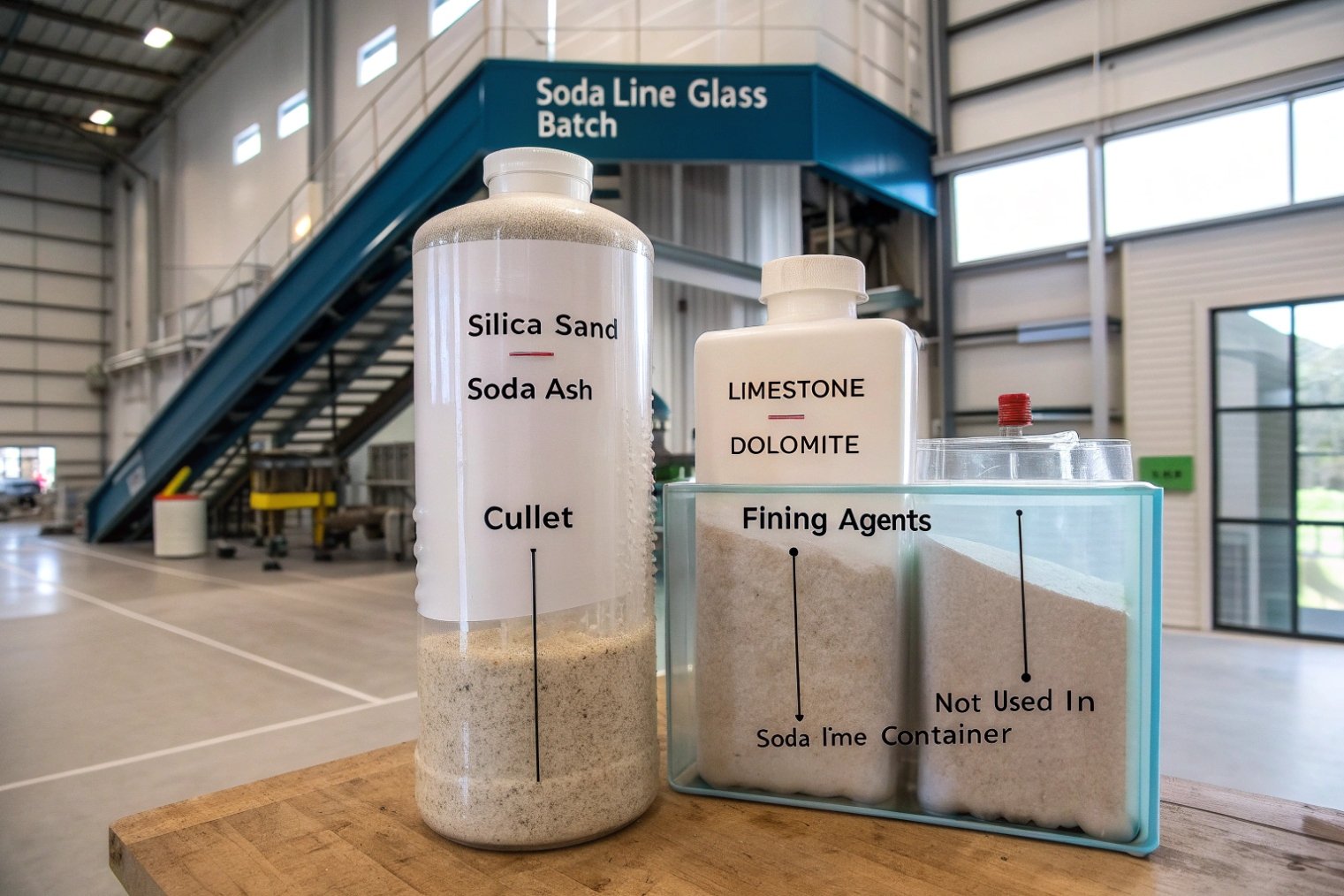
For soda-lime container glass 2{#fnref2}, the standard batch uses:
- Silica sand for the SiO₂ network.
- Soda ash as the sodium source to lower melting temperature.
- Limestone and dolomite for calcium and magnesium to stabilize the glass.
- Fining agents and cullet as needed.
This recipe does not include boron. In fact, by definition, soda-lime glass does not contain boron-based components. It already reaches the balance of clarity, strength, and cost that food and beverage bottles need. Adding borax to a soda-lime furnace would change the composition toward a mixed or “borosilicate-like” region and disturb cullet compatibility, so container plants avoid it.
For borosilicate glass 3{#fnref3}, boron trioxide (B₂O₃) is a key network former. Typical compositions use around 13% B₂O₃ combined with high silica. Factories often introduce this boron through industrial borax, boric acid, or related borates. Without that boron, the glass is no longer borosilicate. This is why lab reagent bottles, flasks, and some high-end cookware are clearly labeled as borosilicate while standard bottles are not.
There is also a third group: boron-free specialty containers. Some advanced pharma vials are designed on purpose without boron, even though they target high performance. This shows that boron is a tool, not a requirement, and that many container applications can meet their targets using carefully engineered soda-lime or alternative compositions.
So when we discuss “borax in bottles,” we must always start with the glass family. For mainstream soda-lime bottles, borax stays out. For true borosilicate containers, a boron source is part of the core design.
How does borax impact thermal shock resistance and durability in bottles?
Once we talk about borosilicate, people usually want to know what borax actually changes in the glass, beyond a line in the batch sheet.
By supplying boron oxide, borax lowers glass thermal expansion, improves thermal shock resistance, and boosts chemical durability, but these benefits are built into borosilicate glass as a separate category, not as a small tweak to soda-lime bottles.
Inside the melt, borax breaks down and delivers B₂O₃. That boron enters the silica network and changes how the glass behaves:
- It helps lower the thermal expansion coefficient, so the glass expands and contracts less with temperature shifts.
- It can reduce viscosity at a given temperature, which helps melting and fining.
- It increases chemical durability, especially against water and many acids.
This is why borosilicate glass survives large temperature jumps better than soda-lime 4{#fnref4}. A borosilicate lab bottle can handle hot media, autoclave cycles, and quick cooling that would crack a standard beverage bottle. The low expansion also reduces stress around local hot spots, such as direct burner heat on lab glassware.
However, in the context of bottle production, we normally do not “dose a little borax” into a soda-lime furnace just to chase these benefits. There are reasons:
- Standard soda-lime bottles already meet the thermal and mechanical needs of filling, pasteurization, and normal consumer use.
- Container cullet streams are optimized for boron-free soda-lime. Once boron enters, cullet becomes incompatible with regular furnaces and must be segregated.
- Changing expansion and viscosity in a running soda-lime furnace would require new forming settings, new mold designs, and new strength tests.
So in practice, borax and borosilicate are used when we need a full step change in performance: for example, lab bottles that rotate daily between hot autoclaves and cold benches. For jam, juice, or beer bottles, the extra performance is not necessary, so the cost and recycling penalties are not justified.
In short, borax and boron give strong benefits for thermal shock and durability, but those benefits live inside a dedicated borosilicate system. They are not a casual additive for everyday soda-lime container lines.
Is borax safe for food contact and global compliance (FDA/REACH)?
The word “borax” sometimes triggers safety concerns, because borates are tightly regulated in detergents and other direct-contact uses.
As a raw material, borax is a regulated industrial chemical, but once melted into borosilicate glass its boron is locked in the glass network; properly formulated borosilicate containers are widely accepted as food- and pharma-contact safe under FDA and EU rules.
We need to separate two things:
-
Borax as a powder or solution
This is an industrial chemical with specific classifications in many regions. Under EU regulations on borates and classification 5{#fnref5}, several borates are listed with reproductive toxicity classifications above certain exposure levels. That means factories must manage worker handling, dust control, and documentation carefully. REACH registration and safety data sheets apply to the substance itself. -
Boron as part of the glass network
During melting, borax loses water, decomposes, and the boron becomes part of the solid glass structure. In borosilicate, it sits in the Si–O–B network. In this state, boron is not free; it does not behave like a soluble salt. Migration from well-annealed glass into food or pharma products is extremely low and sits far below regulatory limits.
This is why borosilicate glass is widely used for:
- Laboratory reagent bottles and flasks.
- Borosilicate glass for pharmaceutical containers 6{#fnref6}.
- Household glassware and bakeware that contact food every day.
Both FDA and EU food-contact frameworks treat fully vitrified glass (including borosilicate) as an inert material when it meets composition and migration criteria. For pharma, pharmacopeias and specific standards define tests for surface hydrolytic resistance. Type I borosilicate passes these by design.
For container buyers, the practical checklist is:
- Ask the supplier for food-contact compliance declarations for all target markets (for example food- and pharma-contact safe under FDA and EU rules 7{#fnref7}).
- For pharma, ask for pharmacopeia compliance and hydrolytic resistance reports.
- Confirm that lids, coatings, and inks are also food-safe; these are often more critical, from a migration point of view, than the glass body itself.
So the short answer is: borax in the batch has handling and regulatory rules as a chemical. Borosilicate in the finished bottle is well established as safe for food and pharma contact when made under the right standards.
What are the cost and sourcing considerations when using borax in bottle production?
Even when the technology looks attractive, production teams still need to ask: “Will borax raise our costs or help control them? And can we source it reliably?”
Using borax to make borosilicate bottles usually raises raw-material and process costs versus standard soda-lime, and it needs a separate cullet and supply chain, so it is reserved for high-value, high-performance applications.
On the cost side, several elements move at once:
-
Raw material cost
Borax and boric acid are specialty chemicals. They cost more per unit than limestone or standard soda ash. Borosilicate also needs higher-purity silica and tighter batch control, which adds cost. -
Energy and furnace operation
Borates can lower melt temperature and change viscosity, which helps energy efficiency on some lines. But borosilicate still tends to be produced on dedicated furnaces with different temperature profiles and refractories than soda-lime. Investment and operating costs per ton are usually higher, especially at smaller scales. -
Forming and productivity
Bottle lines built for borosilicate often run different articles: labware, pharma bottles, technical containers. Volumes are lower than mass beverage bottles. Forming speeds and tooling design follow that reality, so the cost per bottle is higher even before we look at materials. -
Cullet and recycling
Introducing boron into a container line brings a big hidden cost: it breaks compatibility with the standard soda-lime cullet loop. If borosilicate bottles mix into soda-lime cullet, they cause problems in furnaces tuned for boron-free glass. So borosilicate cullet must be collected and recycled separately. This is hard to do at scale for general packaging.
On the sourcing side, borax supply is concentrated:
- Major borate resources sit in a few countries, with large producers controlling most output.
- Price can move with mining costs, currency, and global demand from glass, ceramics, detergents, and agriculture.
- For a soda-lime plant, soda ash and limestone are widely available and mostly domestic in China; borax would add a more exposed, import-sensitive item to the supply chain.
This is why, in the container-glass world 8{#fnref8}, we see a clear pattern:
- For mainstream food and beverage bottles, producers stick to soda-lime. It is cheaper, fully compatible with existing cullet streams, and more than strong enough for the job.
- For high-value niches where thermal shock resistance, chemical durability, or lab standards matter more than lowest cost per unit, producers invest in borosilicate furnaces and accept the higher raw-material and processing cost.
For buyers, the decision is simple once the use case is clear. If the product does not need borosilicate-level performance, adding borax to the design only complicates supply, cost, and recycling without a clear benefit.
Conclusion
Borax is a powerful tool for borosilicate and specialty glasses, but standard soda-lime bottle lines stay boron-free to keep performance, cost, and recycling in a simple, efficient balance.
-
Overview of sand, soda ash, limestone and cullet used in glass packaging batches. ↩ ↩
-
Reference description of soda-lime glass composition and typical properties. ↩ ↩
-
Technical profile of borosilicate glass and its main performance advantages. ↩ ↩
-
Explanation of why borosilicate glass tolerates higher thermal shock than soda-lime. ↩ ↩
-
Official substance information on borates, hazards and regulatory classification in the EU. ↩ ↩
-
Example of borosilicate vials used as primary pharmaceutical packaging. ↩ ↩
-
FDA overview of packaging and food-contact substances used with food. ↩ ↩
-
Industry association explanation of container glass and its role in packaging. ↩ ↩






