
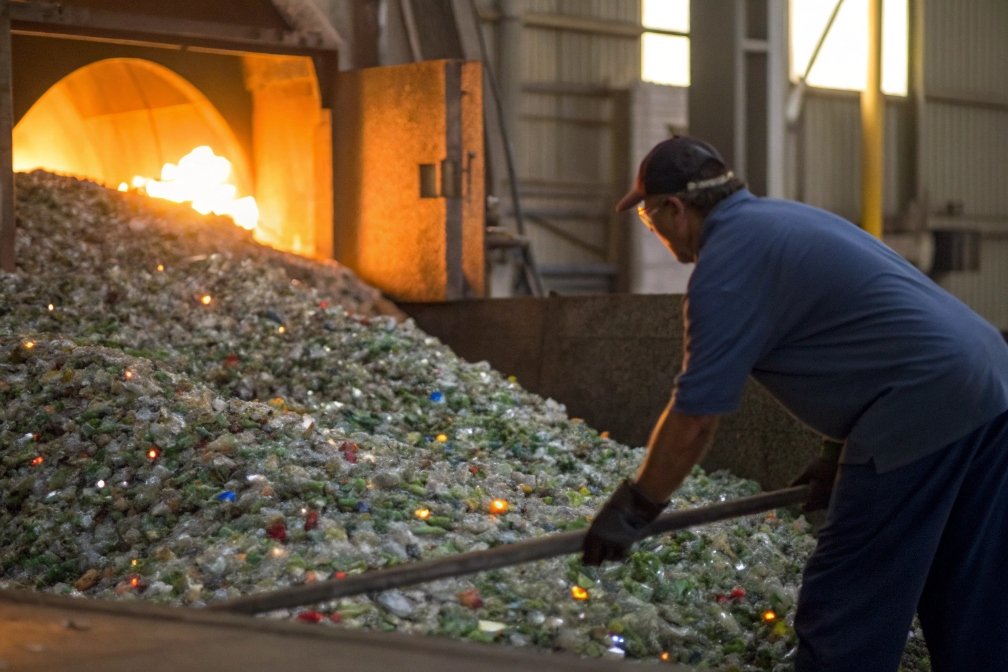
Customers ask for “green glass” more and more, but the answer usually depends on cullet levels, reuse loops, and how that bottle lives after it leaves the furnace.
Different glass bottle materials are eco-friendly when they use high recycled cullet, fit into strong reuse or return systems, and stay in clean recycling streams with honest, verifiable sustainability data.
From a sustainability point of view, material is only half the story. The other half is system design: refill vs one-way, recycling quality, color management, and the way we prove our claims with proper certification.
Does higher cullet content cut energy and CO₂ emissions?
Every time we shovel virgin batch into a furnace instead of cullet, we pay twice: once in energy, once in CO₂.
Yes. Higher cullet content clearly reduces energy use and CO₂ per kilogram of glass; every 10% cullet can save roughly 2–3% furnace energy and about 5% CO₂ emissions.
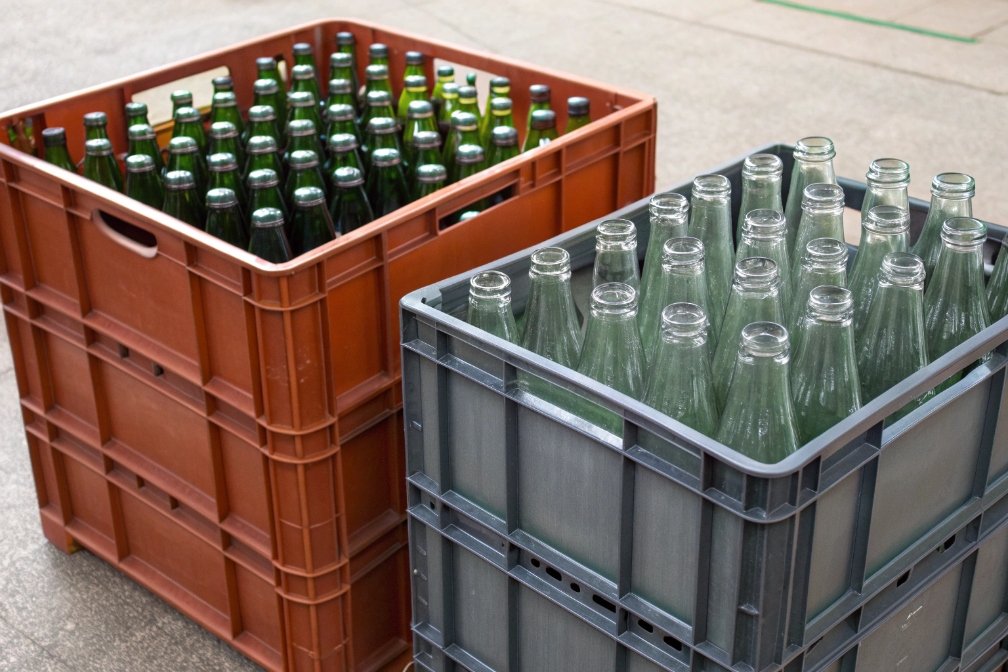
How cullet changes furnace energy and emissions
Cullet is already melted glass. When we re-melt it, we skip the biggest energy cost in glassmaking: breaking down raw quartz sand and carbonates. Virgin batch needs high temperature to decompose limestone and soda ash, and those reactions release process CO₂ on top of furnace fuel.
When we increase cullet share, we:
- Cut fuel consumption because cullet melts at lower energy input 1.
- Cut process CO₂ because we use less carbonate raw material.
- Often reduce NOₓ and other emissions due to lower peak flame temperatures.
Life cycle studies show typical container-glass production at about 1.25 kg CO₂-eq and ~16–17 MJ of primary energy per kilogram of glass if we run with limited cullet. When cullet share rises, this footprint falls in a near-linear way.
Every extra 10% cullet tends to bring:
- 2–3% energy savings at the furnace.
- Around 5% CO₂ reduction, combining fuel and raw material effects.
This looks small at first, but across tens of thousands of tons per year, it is huge. High-cullet plants often target 60–80% recycled content in standard soda-lime colors 2 when collection systems are strong.
Why cullet quality and color matter
Not all cullet is equal. High cullet content only works when the cullet is:
- Clean (low ceramics, metals, paper, organics).
- Sorted by color well enough to hit the right shade.
- Free from borosilicate, leaded glass, and other special glasses that disrupt melting and color.
We also see different behavior by color:
| Color / type | Cullet tolerance and usage |
|---|---|
| Flint (clear) | Needs very clean cullet, low color contamination; high value but low impurity tolerance |
| Amber | Good tolerance to some mixed cullet; can reach high recycled content with stable color |
| Green | Can absorb more mixed colors; often used where mixed cullet is common, but cullet value may be lower |
| Borosilicate pieces | Should stay out of container cullet; higher melting point and boron contamination risk |
So yes, higher cullet content is one of the strongest levers to cut CO₂ in glass. But without good collection and sorting, the theoretical benefit stays on paper.
How do returnable grades compare to one-way bottles?
If we only look at one trip, a light one-way bottle can look efficient. Over many trips, a refillable bottle often wins by a large margin.
Well-designed refillable glass systems can cut per-use emissions by up to 70–85% versus one-way bottles, as long as return rates and trip counts stay high and transport distances are controlled.
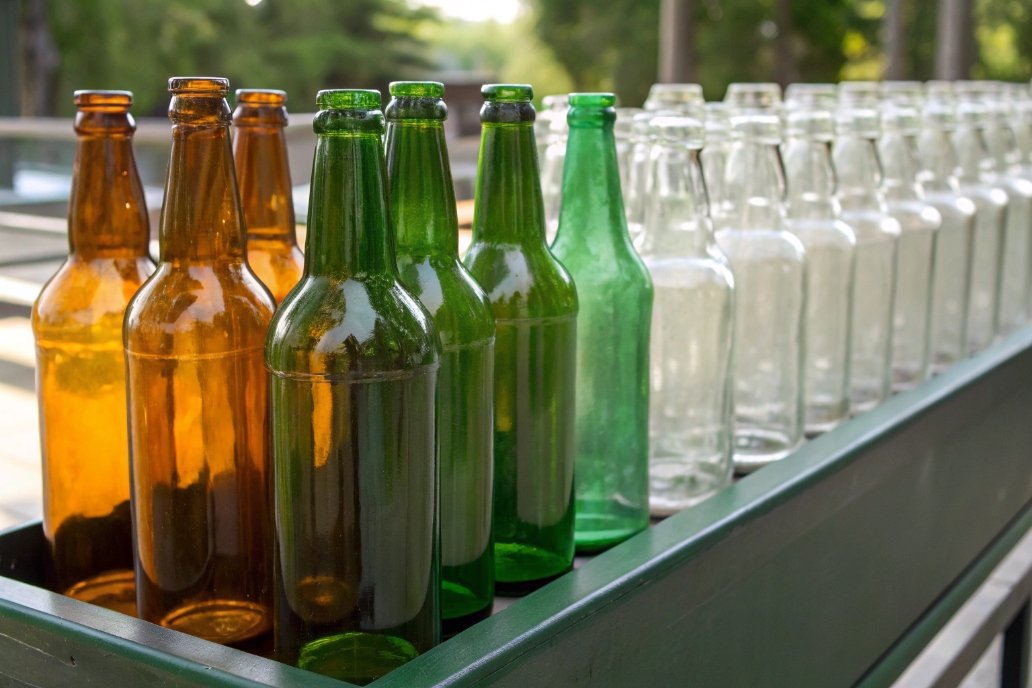
Why refillable bottles change the carbon math
A standard one-way bottle uses its full material and furnace energy for a single fill. The impact per fill is simply the LCA of that bottle plus transport, filling, and end-of-life. Most studies agree that, per use, a single-use glass bottle has a higher footprint than single-use PET or cans because glass is heavy and energy-intensive to melt.
Returnable grades flip this logic. The bottle is heavier and stronger, so its first fill is more “expensive.” But that impact spreads over many reuse cycles.
Imagine a refillable bottle that:
- Survives 20–30 trips on average.
- Uses industrial washing instead of being remelted each time.
- Travels in a local or regional loop, not halfway across a continent.
Studies from Europe and other regions show emissions reductions up to around 85% per use compared with one-way glass 3, when reuse systems are efficient and return rates are high.
Design differences between returnable and one-way
To survive many loops, returnable bottles use:
- Thicker walls and reinforced heels for impact and crate handling.
- Stronger finishes and shoulders to resist repeated capping, decapping, and washing.
- Surface treatments that hold up under caustic wash and abrasion.
One-way bottles focus on lightweighting:
- Thinner walls.
- Optimized shapes for stacking and label area.
- Lower glass mass per container to reduce energy and transport emissions.
This leads to a simple trade-off:
| Aspect | One-way glass bottle | Returnable glass bottle |
|---|---|---|
| Glass weight | Lower | Higher |
| Trips per bottle | 1 | 15–30+ (system dependent) |
| Production CO₂ per use | Higher | Much lower when trip count is high |
| Washing / logistics | None (just recycling) | Needs washing plants and reverse logistics |
| Best for | Long export, irregular demand | Local / regional loops, steady demand |
Returnable grades shine when:
- Return and refill logistics are strong.
- Bottles stay in a closed loop for a brand or pool.
- Markets accept standard shapes that can be shared.
Poorly organized reuse (low returns, long backhaul, heavy breakage) can erase these gains. So “refillable” is not a magic word; the system and the bottle design must work together.
Are amber/green formulations easier to recycle than flint?
Many people assume clear glass is “best” because it looks pure and can become any color later. The furnace story is more complicated.
Technically, amber and some green formulations are more forgiving in recycling because they can absorb more mixed-color cullet, while flint needs very clean, color-pure cullet to stay clear.
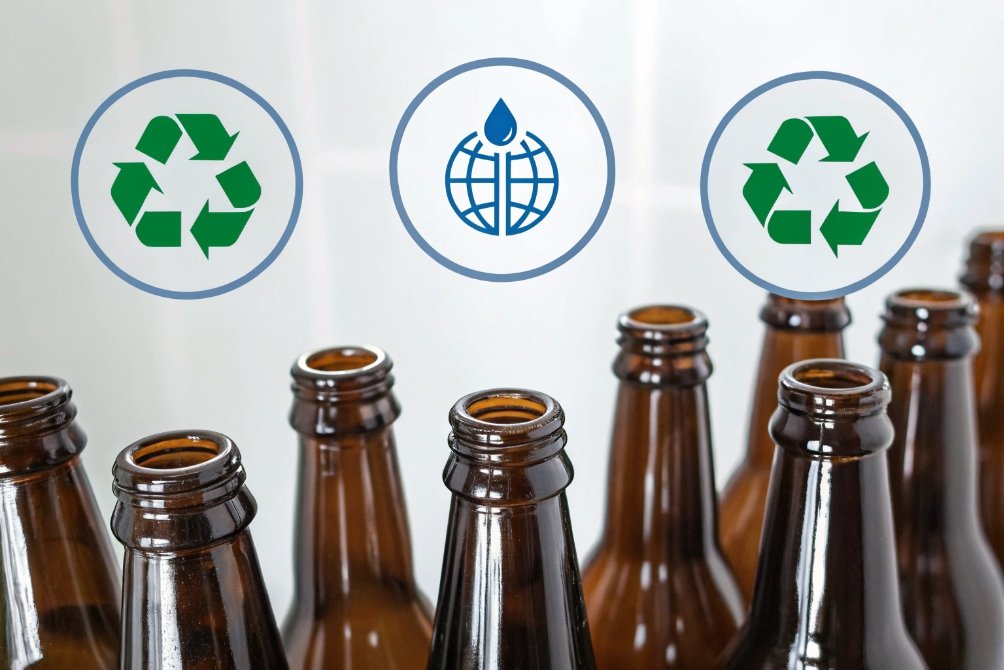
How color affects cullet flexibility
Glass color comes from small amounts of metal oxides and redox conditions in the melt. When we remelt cullet, the color of that cullet sets tight limits for the next batch.
For flint (clear) glass:
- Even small amounts of green or amber cullet will tint the melt.
- To keep a bright, neutral clear color, the cullet stream must be very well sorted and low in contamination.
- This raises cullet sorting costs and sometimes limits recycled content when supply is dirty.
For amber and many green glasses:
- The color is darker and more saturated.
- The melt can accept more mixed cullet (for example, some green mixed into amber) without visible quality loss.
- Plants can often run higher cullet percentages using real-world mixed-color streams.
From a recycling operations view, this means amber and green can act as “sinks” for mixed cullet 4 that cannot meet flint purity standards.
Market demand vs technical recyclability
There is a twist. Eco-friendliness is not only about what is technically easy in the furnace. It also depends on:
- How much demand exists for each color.
- How collection and sorting systems are set up.
- How many times that glass actually gets reborn as a new bottle instead of a low-grade product.
In many markets:
- Consumer and brand demand for clear bottles is strong, especially for premium beverages and cosmetics.
- Green and amber have strong roles in beer, wine, and some food jars, but volumes may vary.
So while amber and green are easier to recycle technically, flint is still widely recycled where systems are strong. Mixed-color cullet can also be blended into special “dead leaf” greens or used in applications where color is less critical, which helps raise overall recycling rates.
A simple way to see it:
| Color type | Cullet purity needed | Max recycled content (typical, not absolute) | Furnace flexibility |
|---|---|---|---|
| Flint (clear) | Very high | High when cullet is very clean | Low tolerance to color contamination |
| Amber | Moderate | Very high with mixed amber/green cullet | Good tolerance to some mixed colors |
| Standard greens | Moderate | High with mixed green/brown cullet | Good sink for mixed-color cullet |
For eco-design, that means:
- If a brand is flexible on color, choosing amber or green can help use more recycled content.
- If the brand insists on flint, then they should support higher-quality collection and sorting to keep that cullet stream clean.
Which certifications substantiate sustainability claims?
Many bottles now carry words like “eco,” “green,” or “low carbon.” Without clear standards, this can easily drift into greenwashing.
Robust sustainability claims for glass bottles usually rely on ISO-based LCAs, product carbon footprints, EPDs, and third-party frameworks like ISO 14001, Cradle to Cradle, or EcoVadis scores.
What to look for behind a “green” bottle claim
When we present an “eco” glass bottle, it helps to show more than a marketing line. Strong signals include:
-
ISO 14040/14044 life cycle assessment (LCA) 5
A full LCA of the bottle or system, done to ISO standards, shows climate, energy, and other impacts across raw materials, production, transport, use, and end-of-life. It should state system boundaries and data sources. -
Product carbon footprint (PCF), often under ISO 14067 6
This gives a clear CO₂-equivalent number per bottle or per 1,000 bottles. It is useful for comparing different weights, cullet contents, or reuse scenarios. -
Environmental Product Declarations (EPDs)
EPDs follow standardized rules (PCRs) and are third-party verified. They present LCA results in a format that brands and regulators can compare across suppliers. -
ISO 14001 environmental management certification
This does not give a CO₂ number itself, but it proves the factory runs a structured environmental management system with continuous improvement.
Certifications focused on circularity and supply chain
Beyond LCAs and management systems, there are labels and rating systems that look at broader sustainability:
- Cradle to Cradle Certified™ 7 for products or materials, including glass types, that meet criteria on material health, circular design, renewable energy, water stewardship, and social fairness.
- Recycled content claims, sometimes backed by standards like EU “recycled content” rules or specific regional schemes, to show actual post-consumer cullet levels.
- EcoVadis or similar CSR ratings that score a producer on environment, labor, ethics, and sustainable procurement.
- For packaging placed on the EU market, compliance with packaging and packaging waste directives and participation in extended producer responsibility (EPR) schemes.
For food and pharma, we already track glass through quality and safety standards like:
- ISO 15378 / GMP for primary pharmaceutical packaging.
- Food-contact compliance (e.g., EU, FDA) that ensures glass does not leach heavy metals or unwanted substances.
These are not “eco labels” by themselves, but they support safe, long-lived packaging, which is also part of sustainability.
How buyers can pressure-test a claim
When a supplier promises a “30% lower carbon glass bottle,” it is fair to ask:
- Is there an ISO-based LCA or PCF behind this claim?
- What cullet percentage is guaranteed, and is it post-consumer?
- Is the plant ISO 14001 certified?
- Are there EPDs, Cradle to Cradle, or similar third-party documents?
| Claim on brochure | Helpful proof to request |
|---|---|
| “High recycled content” | Declared % cullet, method of calculation, third-party check |
| “Low carbon bottle” | PCF or LCA report (ISO 14067/14040/44) |
| “Sustainable factory” | ISO 14001 certificate, energy mix data |
| “Circular design / eco bottle” | EPD, Cradle to Cradle, or detailed LCA |
When certification and data back up the story, glass becomes not just a “nice” material, but a traceable, measurable part of a low-carbon packaging strategy.
Conclusion
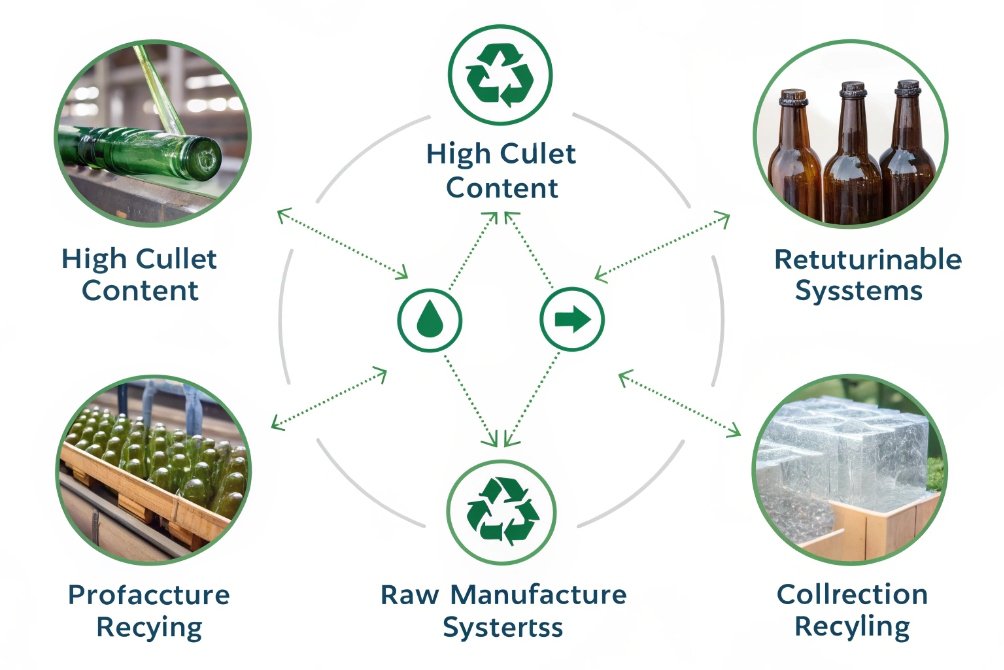
Glass becomes truly eco-friendly when we combine high-cullet soda-lime, smart returnable systems, color choices that support recycling, and transparent certifications instead of vague green claims.
-
Explains how cullet use lowers energy demand and emissions in glass production. ↩ ↩
-
Industry overview of European glass recycling rates and typical recycled-content levels. ↩ ↩
-
Brand case study on the environmental benefits of reusable and refillable glass packaging. ↩ ↩
-
Fact sheet on glass recycling, color streams, and how mixed cullet is used. ↩ ↩
-
Official ISO page describing the 14040/14044 life cycle assessment framework. ↩ ↩
-
ISO reference for product carbon footprint standard 14067 and how PCFs are defined. ↩ ↩
-
Certification program details for Cradle to Cradle Certified™ products and materials. ↩ ↩






